Monday, September 14, 2015


Thursday, September 10, 2015
No Baby Bourke Peeps Yet
 |
| Bourke Parakeet, Peaches, is about to become a mother. She is an opaline fallow hen with red eyes and very sweet. |
I was able to candle two of Peaches' eggs. They are fertile. Since this is her first clutch she's very protective. I candled those two while she was briefly outside the nest box. When she hurriedly returned, I didn't get to inspect the remaining eggs as I didn't want to upset her.
I've had experienced hens that were not hand fed or hand tamed who allowed me to move them aside to see their eggs or babies without incident. They trusted me.
Peaches is hand fed and very tame. However, she will scold and peck at me if I simply place a finger on the edge of the door to her nest box. She's determined to protect her first clutch.
I looked in her box again this evening and don't see any egg shells. That's a definite indication that an egg has hatched. No hatches yet. Although, she did move a bit when she turned to scold me and at least one egg is dark and looks like it's on the verge of hatching. Perhaps tomorrow. Her first egg is 21 days old today. Our weather has been cool some days and that can delay hatching, which is usually 18 to 21 days for Bourkes.
Since she and the male are inexperienced, it's possible that the first couple of eggs won't be fertile and only the later three will be. The first two were laid several days earlier than the others, which leads me to consider that possibility.
 |
| Our male Bourke, Storm, is of Normal coloration, so we may end up with a diverse clutch like this one from another pair a while back. |
May all your birds stay healthy and happy,
Rosie (who also writes as Zara Heritage on Amazon.com.
My novel, Cast Me Not Away, is available as an eBook or in Print).

Peace and Blessings.
Monday, August 31, 2015
Bourke Parakeet, Red-Eyed Opaline Fallow Hen on Eggs
 |
| Peaches on five eggs, first is due to hatch Labor Day. |
Here is the only hen we still have producing. All others had their three clutches for the year. This will be Peaches' first clutch ever. She's two years old, but her mate, Stormy, was only hatched last January. He is feeding her regularly and even going into the box with her already. Most of my male Bourkes wait until the babies are two or more weeks old before they venture into the nest box with their mates and offspring.
Because of Stormy's youth, we will watch closely any babies that hatch. There is also the possibility that the eggs won't be fertile, but we witnessed several matings that looked successful to us. We are optimistic. So far, an opportunity to candle the eggs has not occurred. Since it's her first clutch, I'm leaving her alone more than I might otherwise.
We will let you know the outcome in a week or two.
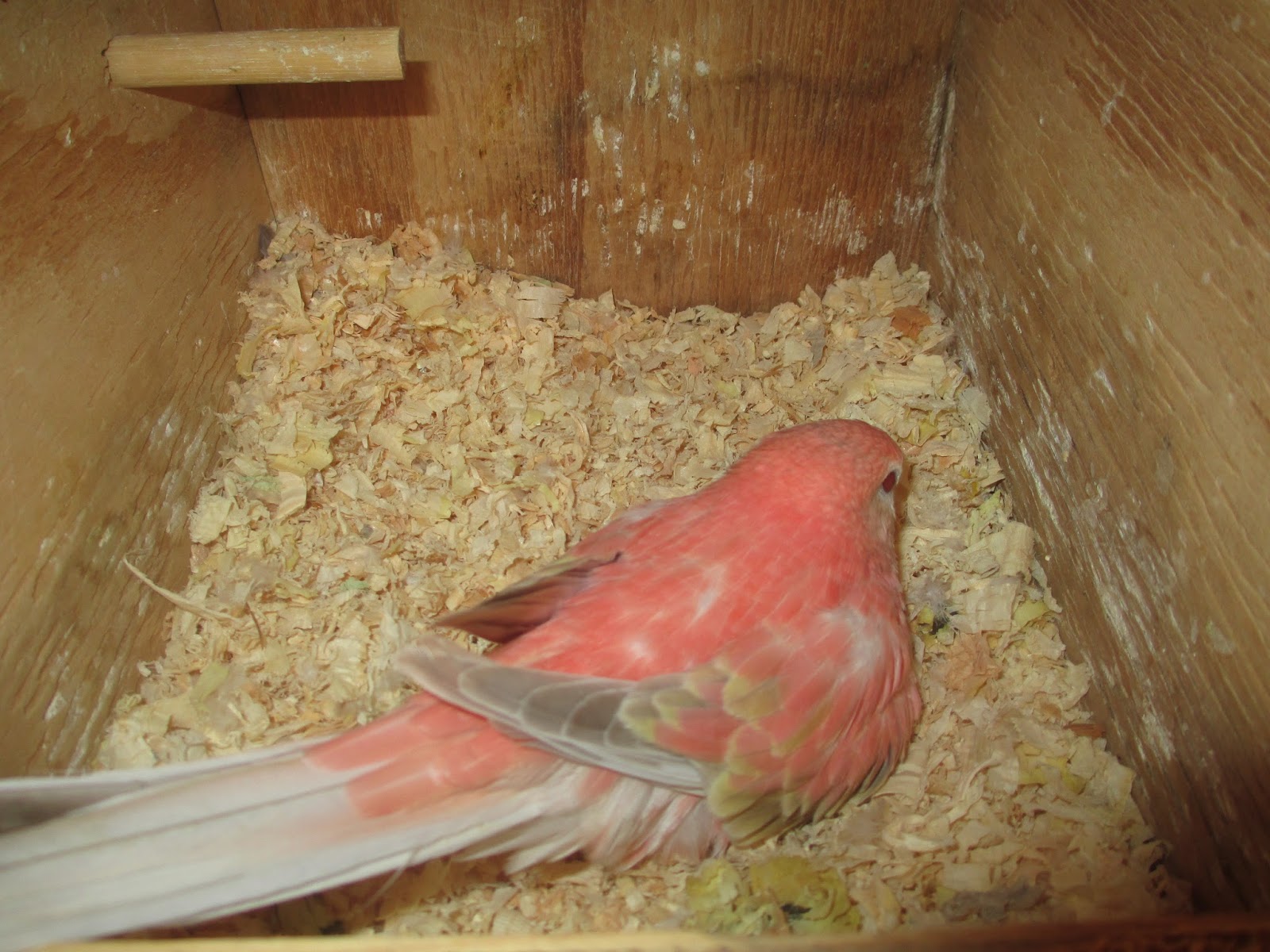 |
| As you can see, she changes position while on eggs. |
 |
| Peaches' mate, a Normal Bourke we named Storm. His father is a Lutino, so we hope to get interesting babies. |
PEACE AND BLESSINGS!
Sunday, August 30, 2015
Bourke Parakeet Baby Update
The last clutches of baby Bourkes from this summer have all gone to their new homes ... all 14 of them. Earlier clutches from these two and others were sold and gone before these babies arrived.
 |
| Rosie and Pretty Boy's 3rd Clutch of 2015 |
 |
| The same clutch from above, now out of the nest and ready to sell to other bird lovers. |
 |
| These four are from Fuchsia and Flame's 3rd Clutch. |
 |
| Here are Fuchsia and Flame's four, all out of the nest and able to go to new homes. Miss them already. |
One little lady, Peaches, is two years old and on her first clutch ever. She is a pretty Pink Opaline Fallow, red-eyed hen. Her mate, Stormy, is a Normal whose father was a Lutino (yellow and pink). If her eggs are fertile and hatch, it will be interesting to see what they look like.
I bought Stormy a few months ago and he only hatched last January. He's very young to be a father. If their mating was successful and the eggs hatch, I will watch very closely to be sure all the babies are adequately fed. Sometimes young fathers aren't very good at it ... yet, he's feeding his mate and that's a good sign. If necessary, I'll help with feeding the new hatchlings.
Will keep you updated on this late-in-the-year clutch.
May all your birds thrive.
Peace and Blessings.
Peace and Blessings.
Wednesday, August 26, 2015
My Novel, CAST ME NOT AWAY, is Now Available

Link to Amazon: CAST ME NOT AWAY
Historic Facts: In 1939 a secret program, Aktion T4, was instigated by the Nazi’s designed to rid Germany of all children deemed unworthy of life. Later, it expanded to include mentally or physically handicapped adults. It is estimated that over 275,000 died under this edict and it set the stage for the extermination of millions of Jews, gypsies, Catholics and other enemies of the state.
Through it, the Nazi’s determined that death by gas chamber was more efficient and less costly than lethal injection. Hitler’s Nazi Party was horrible and cruel to millions ...
but let us not forget that it first began with the children ...
Through it, the Nazi’s determined that death by gas chamber was more efficient and less costly than lethal injection. Hitler’s Nazi Party was horrible and cruel to millions ...
but let us not forget that it first began with the children ...
SYNOPSIS of CAST ME NOT AWAY: Fast forward to a time and place where the future meets the past, and the abortion/euthanasia movement reaches its inevitable conclusion. Family size is strictly regulated everywhere, not just in China. The unborn are routinely aborted and unwanted children are labeled as useless, and sent away to be gassed and their bodies incinerated.
In this time of darkness, Mira Hastings and Grayson Stevens join a cadre of other brave individuals who stand against this mountain of evil by putting their lives on the line to rescue ill-fated children from certain death. In a bold attempt to bring down the beast, they publicly expose the greed and corruption that drives the system. Declared enemies of the state, Mira and Gray are forced underground as they flee the wrath of a vengeful government. On the run they encounter danger at every turn. But, with the aid of a network of supporters, they also encounter hope, joy…and love.
In this time of darkness, Mira Hastings and Grayson Stevens join a cadre of other brave individuals who stand against this mountain of evil by putting their lives on the line to rescue ill-fated children from certain death. In a bold attempt to bring down the beast, they publicly expose the greed and corruption that drives the system. Declared enemies of the state, Mira and Gray are forced underground as they flee the wrath of a vengeful government. On the run they encounter danger at every turn. But, with the aid of a network of supporters, they also encounter hope, joy…and love.
God Bless our Children. There, but for the Grace of God, go we.
Peace & Blessings,
Wednesday, July 8, 2015
Great Egrets and Double-crested Cormorants near Coos Bay, Oregon
Rosie Bird's most recent video. Love the southern Oregon coast.
Peace & Blessings!
Saturday, June 13, 2015
Bourke Parakeet Babies, Parent and Hand Fed For Sale on Oregon's South Coast
HELLO ALL!
 |
| These lovely Rosy Bourke babies are for sale. All are hand fed and banded. |
I've been so busy with my novel, "Cast Me Not Away," that is to be published soon, that I've not been able to do my favorite past time: blogging here.
Another time consumer: I agreed to hand feed baby Bourkes for two people. When I do this, I don't normally ask for a deposit. Feeding baby Bourkes is an act of love, but time consuming and more expensive than with parent fed babies, so I should take a deposit.

I removed two of Fuchsia's offspring and two of Rosie's to hand feed. They are ready, but the buyers are not. As has happened before, one said, "Oh, I thought North Bend was near Bend." Bend is in Eastern Oregon far from the south coast of Oregon where I live, near Coos Bay. No matter how often I emphasize where I am, there are still mistakes. The other buyer had a family emergency. Does happen.
So, I have four pretty babies waiting for new homes. Also have some parent fed Bourkes that I'll let go for $75 each or the very tame, hand fed youngsters are $125 each. Also, have two adult bachelors, both red-eyed opaline fallow Rosies that I'll consider selling. Both were hand fed and very tame. Kept them for a Lutino hen, but she's now paired with a Normal brown fellow.

I cannot ship. It's too far to PDX. I will meet people south of us in Coquille or Bandon, Oregon, or north of us to Reedsport or possibly Florence. We will be making a trip to Eugene in August if I still have birds at that time. More are coming, but they will be parent fed. I band all birds with closed bands giving hatch number, year of hatch and our initials: EGL.
If interested, write to me at: rosie.birds@gmail.com

Peace & Blessings!
Sunday, May 3, 2015
BOURKE PARAKEET DIET AND OTHER ISSUES, A QUESTION
Recent Inquiry. Some emails result from Rosie Bird Videos, and possibly not from this blog.
 |
| Rosy Bourke hen and her chicks. |
QUESTION:
Good morning,
Please can you answer a few questions for me? I have recently acquired a pair of Rosie's and have not been able to get more info on them:
What seed do the eat? They don't seem to eat the parakeet seed but are in the budgie seed.
What supplement, veggies or fruit can they have?
Can they be put together in a cage with show budgies?
Do they have to be separated from other birds to be able to breed?
 |
| Grit, oyster shell, white mineral block, cuttlebone, nestling food and brown rabbit circular salt block . |
ANSWER:
Bourkes primarily eat budgie seed, but can eat finch seed and some things in cockatiel seed. They like vegetables. I give mine cooked corn, peas, green beans and carrots. Fresh broccoli and/or kale are both very good. Mine won't eat fruit ... a few will try apple, but not fond of it. They should always have at least cuttlebone available. Other good things are mineral block, oyster shell and rabbit salt blocks (for the vitamin D in them).
When breeding I give mine egg food (boiled egg, including shell and bread crumbs blended together).
Bourkes can be housed with other birds in an aviary of adequate size. Larger birds may harass them, however. If you have a mated pair, the males will usually chase one another, and hens will also chase the other hen (an exception might be siblings, but more often than not, they will still be aggressive to the competition). Housed in an aviary, always provide more nest boxes than you have pairs. A budgie or cockatiel box is fine. In a smaller cage, it's okay to put young birds together until mature during breeding season. Then there may be problems if both sexes are present. I've had no trouble housing just hens, or just males together. Mix the sexes, however, and there will be problems when there's plenty of daylight (or artificial light) to simulate breeding season.
Please go to my website and enter "breeding" into the Search box. Many early posts will come up on this topic. There's even one on egg food. Here is a link to one of them:
 |
| Lutino Bourke hen. |
Peace and Blessings!
Thursday, April 16, 2015
Bourke Parakeets: Determining Sex
 |
| Nest box being attached in February to begin new season of breeding, egg laying and raising of young Bourkes. |
On Thu, Apr 16, 2015 at 1:35 AM, David wrote:
Hi Rosie,
I’m trying to sex 2 bourkes. One is the wild type the other being a Rosie.
Hope you may be able to help.
Regards,
David
----------------------------
 |
| Baby Bourke at 9 days old, ready for banding with Budgie sized bands. His feet are at maximum length. Any bigger and he couldn't have been banded. |
ANSWER:
On Thu, Apr 16, 2015 at 10:53 AM, Rosie Bird
Hello David,
Wild types are easy once they are mature. Males have a tiny
line of blue feathers over the cere (nostrils). Females don't have that. Males
are also slightly brighter in pink and blue areas, with brighter turquoise in
shoulders. However, this feature varies between birds. So, the blue line above
their cere is the main determining factor.  |
| Normal Bourke Parakeet. This is a male. His colors are slightly brighter than the hen's. Male Bourkes of the wild variety also have a tiny line of blue feathers above the cere (nostrils). Difficult to see in this photo. |
 |
| Normal Bourke hen and chicks. |
As for Rosies, only their behavior will give them away,
short of having them DNA'd. Once mature, males will often display in ways that
hens do not. They also seem to sing more and occasionally wolf whistle.
When I'm going to sell young Rosies and am unsure of their
sex, I've sometimes sent a tiny blood sample in for DNAing. It requires
clipping a toenail slightly short, dabbing a smear of blood on a card, and then
dipping the "injured" toe into corn starch to staunch any further
bleeding. I resisted doing that for years, but once done, I realized how easy
it was and didn't seem to hurt the little birds. I use Health Gene in Canada.
It's only $12 and they send a lovely certificate that follows up after an email
giving the sex of the bird.
http://www.healthgene.com/avian-dna-testing/
Below is a copy from The Splendid Bourke Bird Blog on
BlogSpot. If you go there and enter "Sexing" into the Search Box, you
will get lots of posts on this topic.
http://thesplendidbourkebirdblog.blogspot.com/
"Male Bourkes throw their shoulders back and flair
their wings slightly at the shoulder, standing tall. I call this strutting. You
won't see a hen do this and males do it at a very young age.
Hens take longer to behave like hens. If there is a male
bird present they squat down and raise their tail, cheeping, (preferably for
another Bourke, but I've seen them display for other parakeet varieties when no
male Bourke is around). On rare occasions I've seen a male do this in front of
a hen who doesn't want to mate...I think he's showing her how. :-) Birds have
preferences for their mates too."
Peace and Blessings,
Gail  |
| An Oregon Coast Sunset taken above Larson Slough, about five miles from our home. |
Monday, February 23, 2015
Did Ancient Cultures Keep Pet Birds? Yes! Yes! Yes!
This was too good not to share.
Gaius Valerius Catullus, another Roman poet, mention his
love’s pet sparrow in section 2-3. It can be accessed here: http://en.wikisource.org/wiki/Translation:The_poems_of_Catullus
 |
| My pet Rosy Bourkes. |
Rosie.birds@gmail.com received an inquiry about where to find info on pet birds kept by ancient cultures. My husband, author E.G. Lewis, is a guru on ancient Roman culture and he answered for me. If you're also interested in pet birds kept in first century Rome ... here you go:
"My wife forwarded your request to me since her post on the
Splendid Bourke Bird Blog was derived from one I did for my Sowing the Seeds
Blog, here:
As you read it, you
will notice that some of the conclusions are based on logical assumptions as
much as anything else. The Bible references, Job for instance, assumes that if
someone asks, “Can you make a pet of him like a
bird?” it must have been a common practice. Alexander the Great’s
connection to parrots is well documented. I conduct most of my research via the
internet., but I can offer a few print sources.
The Amores by Roman poet Publius Ovidius Naso…commonly
known as Ovid. In Book II, Elegy VI, he laments the death of his lover’s pet
parrot. A hard copy would probably be available at your local library. If you
simply need the quote, it can be found here: http://www.poetryintranslation.com/PITBR/Latin/AmoresBkII.htm#anchor_Toc520535838
You can also download a copy at the site.
Here is one book I came across: Parrot Culture: Our
2500-Year-Long Fascination with the World's Most Talkative Bird, By Bruce Boehrer, University of Pennsylvania Press. It is
available on Amazon as a used hardback for $2-$4. It is also available on
Google books.
Finally, I’ll suggest another internet resource: www.unrv.com is a site entirely devoted to the
Roman Empire. If you want to take the time to search out a page that deals
with day-to-day Roman life, etc., or you can post a question and hopefully
get several responses. I’ve used them for my novels when I can’t find an answer
anywhere else."
Lastly, this is Gail again, here is a link to my husband's site on Amazon.com. He has nine books in print and as ebooks. Some are also now in audio. Blessings, Gail
 |
| Author, E.G. Lewis. -- My husband, Ed, with our wonderful Chinook. |
Thursday, February 12, 2015
Exotic Bird Expertise ... Visit the Label List of Topics
NOTE: To find a topic that interests you, or to get questions answered, please scroll to the Label List in the Lower Right Column and select a topic to bring up many previous posts. If you have a problem, you can write to me at rosie.birds@gmail.com (Be sure to make birds plural). Peace & Blessings.
Saturday, January 31, 2015
Exotic Bird Update From a Busy Writer Behind on Blogging
I can't believe the entire month has gone by and I've not posted anything. Going to squeak in a post on the last day of January just so the month's count won't be zero.
I'm busy editing two books. Cast Me Not Away should be perfect by the time it reaches print ... can't believe how long this book is taking. Began it in Nov., 2009. It's written, but being chopped and edited like crazy. Zara Heritage is my pseudonym ... my real name belongs to so many others.
 |
| Potential Cover |
 |
| Potential Cover |
My Small Exotic Birds book is on hold until the novel above is finally done! Which cover do you like best?
Meanwhile, all my breeder pairs want nest boxes. It's been sunny and warm as it usually gets every February on the Southern Oregon Coast. It's happening a little early this year. However, I'm making them wait a while longer. All our hens were allowed three clutches through Spring and Summer and need a good long rest. Rosie raised 12 healthy babies last year, more than any of the others in 2014. We shall see what happens this year.
I've added a Lutino Bourke hen and am eager to hopefully see babies from her. Isn't she pretty? So is the mate I hope she will accept. Sweetheart is 3 years old. If 18-month-old Sunny absolutely refuses him, I do have a handsome male hatched early last summer, but he's still young.
 |
| Sunny and Sweetheart. Hopefully to become a mated pair. |
Everyone have a wonderful 2015. May all your birds bring you joy, and if you're raising exotic birds, may all their eggs hatch and their offspring become beautiful, healthy birds.
Peace and Blessings for 2015.
Monday, December 22, 2014
Bourke Parakeet Visits -- Merry Christmas!
Merry Christmas and Happy New Year
Bird Lovers Everywhere!
 |
| Newly weaned Rosy Bourke Parakeet babies. |
 |
| A Rosy and a white-faced opaline fallow Bourke. |
Some of our sweetest Rosy Bourkes have come to say hello. Rosie Bird posts video's on You Tube. This video of our tamest members went up today.
May 2015 give you many blessings with healthy,
happy birds to bring cheer into your life.
Peace & Blessings!
Monday, November 24, 2014
MITES ON BIRDS - A Question & Answer
 |
| Flame and Fuchsia, Rosy Bourke Parakeets |
We get many questions and I try to answer every one. I'm remiss, however, about posting them here. Someday I'll go collect more and post others. Meanwhile, this one arrived today.
 |
| Duchess and her daughters, Lady Gouldian finches. |
QUESTION:
Hi
Gail,
I
have a Bourke's parakeet with scaly face mites, a.k.a. knemidokoptes
infestation. He was diagnosed today at the veterinarian. She put him, and my
two others Bourke's on Stronghold medicine.
I give one dose to each bird today,
then after two weeks I give the second dose. She's concerned he isn't getting
enough vitamin A, so I'm adding a liquid multivitamin on their food. The peas
they like the best so I drop some on top of those. They have more dandruff than
usual and have been molting (or losing) feathers. This is my first experience
with mites! Have you had this problem before? Any suggestions?
Thank
you,
Melissa
ANSWER:
Hello
Melissa,
Years
ago I leaned into a nest box to inspect the babies and later noticed a tickle
at my forehead. I looked in mirror and saw teensy black spots moving there.
Ick! I'd probably let my head touch the edge of the box's lid when I opened it.
I looked at the nest box closely and sure enough, that's where they came
from... there were lots of them on the box lid. I was not happy.
 |
| No mites on these healthy Rosy Bourke Parakeet babies. |
Unfortunately,
the vets in our area don't know anything about birds, only dogs and cats or one
or two treat horses and cows. Our closest avian vet is many, many hours away,
although I made the trip once and she is very nice ... she's the only avian vet
I know of in our whole state. :-(
After
careful investigation, I ordered a concentrated mite spray on the internet. Our
Grange had some kinds, but they didn't have good reviews, whereas this one did.
When it arrived I diluted per directions and put it in a small bottle that had
had eye glass cleaner in it. It gave a fine mist. Used a directed, it was
touted to not hurt baby birds in the nest. I removed all food and water, then
sprayed everyone, even those in the nests. Cleaned the cages and waited a short
while for everything to be very dry before returning food and water.
Fortunately,
it took care of the mites and I've never seen any since. What kind of mites
they were, I've no clue. I still have the concentrate in case it's ever needed
again.
Two
things I'd recommend for your birds if you're not already doing it. Buy fresh
Kale and give it frequently. We chop ours up and put it in empty lids. We store
the extra leaves in the fridge for up to a week, and can chop a little every
day for the birds. It's rich in Vitamin A.
Maybe
even more valuable are the rabbit salt blocks. They have iodine and Vitamin D.
The birds will use them as needed just as they use cuttlebone. A lifetime
breeder, who gave talks to bird specialists all over the world before he
decided he was too old to keep traveling, told me about this. Since I added
them a few years ago, my birds' production of babies has increased ... that's
an indication of good health. The salt blocks will damage wire cages, so keep each in a plastic dish or lay them on newspaper like I do.
The
dander and molting could be expected from a mite infestation. Once they’re
gone, and given a healthy diet, your birds should gradually return to their
former splendor.
Peace
& Blessings,
Gail
MORE INFO:
This
was covered in an earlier blog post last April. Here is the text from that post:
"Mites transfer to other birds easily. I assume that, like cat lice, they can't survive on people or other animals.
I had mites occur once to my flock years ago. I bought a mite spray
at our Grange that didn't work well (it was 8in1). Also, it was
necessary to avoid the head and eyes. It said nothing about what to do for
babies in the nest, and I had many of them at the time.
What DID work was "Avian Insect Liquidator" by VETAFARM. It's a concentrate, and when mixed according to directions, it's approved for spraying into a nest box, even on newly hatched chicks. It costs more for a bottle, but is a concentrate and makes a lot. I mixed the concentrate into a tiny spray bottle because it only takes a small amount. I reused a spray bottle that previously had eyeglass cleaner in it. It is small and emits a fine spray.
What DID work was "Avian Insect Liquidator" by VETAFARM. It's a concentrate, and when mixed according to directions, it's approved for spraying into a nest box, even on newly hatched chicks. It costs more for a bottle, but is a concentrate and makes a lot. I mixed the concentrate into a tiny spray bottle because it only takes a small amount. I reused a spray bottle that previously had eyeglass cleaner in it. It is small and emits a fine spray.
That mixture worked wonders right away. I had to order it online, but it came quickly. It was ordered through All Bird Products, Inc. The 100ml bottle makes two liters and I still have the concentrate these many years later. I've never had a reoccurrence of the problem."
Mites sap a bird's energy and are harmful, especially to baby birds and should be taken care of as quickly as feasible.
Mites sap a bird's energy and are harmful, especially to baby birds and should be taken care of as quickly as feasible.
 |
| A young Opaline Fallow Pink Rosy Bourke Parakeet. |
Peace & Blessings!
Sunday, November 9, 2014
Hand Feeding Baby Rosy Bourke Parakeets, and a Link to Video with Tips & Tricks
Hand feed, or allow parents to feed?
Bourke Parakeets are easier than most birds to hand tame while young. Even those left in a cage all the time will become quite friendly, coming up to the cage bars when you talk to them.
If you can hand feed your baby birds, however, they will become remarkable pets, sweeter and more affectionate than those that are hand tamed. It is labor intensive and requires a great deal of care.
Click below for Video on You Tube of me hand feeding Rosy Bourke babies:
 |
| Four newly hatched Rosy Bourke Parakeets. Best to wait and allow the parents to feed them until the young are about two weeks of age. |
 |
| These two hand fed birds are learning to eat on their own. Offer lots of choices for them, especially spray millet. |
Bourke Parakeets are easier than most birds to hand tame while young. Even those left in a cage all the time will become quite friendly, coming up to the cage bars when you talk to them.
If you can hand feed your baby birds, however, they will become remarkable pets, sweeter and more affectionate than those that are hand tamed. It is labor intensive and requires a great deal of care.
Click below for Video on You Tube of me hand feeding Rosy Bourke babies:
 |
| Two hand fed baby Rosy Bourke Parakeets. |
 |
| Mother Rosy Bourke in nest box with her youngsters. |
 |
| Four Baby Rosy Bourkes being parent fed. |
Sunday, October 26, 2014
Bird Toy Warning
This warning and photo came to us via Face Book. I cannot validate it, but do know that China has poisoned dogs and cats in the USA via pet food with Melamine in it. It tests like protein, but isn't. As my husband said, "If they'd put chicken droppings in the pet food, it would test as protein too and wouldn't poison pets. Dishonest and wouldn't provide any nutrition, but at least it wouldn't have killed them." Not just dishonest and greedy, but cruel.
It would not surprise me if Chinese bird toys are a risk too.

I have two bird ladders that are colored with dyes that run when wet. I'd have been happy to buy them as plain wood without the dyes, which look very much like those in the photo above. I've decided to remove the ladders from my cages. From now on, no painted or dyed wooden toys from China for any of my birds. Better safe than sorry.
Zinc and lead are both dangerous for birds. How can we know if paint from outside the USA is lead free?
It might be that hard plastic bird toys are safest, along with plain wooden dowels for perches. No dyed or painted things.
It would not surprise me if Chinese bird toys are a risk too.
I have two bird ladders that are colored with dyes that run when wet. I'd have been happy to buy them as plain wood without the dyes, which look very much like those in the photo above. I've decided to remove the ladders from my cages. From now on, no painted or dyed wooden toys from China for any of my birds. Better safe than sorry.
 |
| One removed. One more to go. |
 |
| This one was recently cleaned and dyes ran badly. |
Zinc and lead are both dangerous for birds. How can we know if paint from outside the USA is lead free?
 |
| I almost hate to take this away from her. She likes it. |
 |
| Fortunately Bourke Parakeets do very little chewing. However, this ladder is coming out anyway. |
 |
| All my cages have one or more of these hard plastic mirror & bead toys. All the birds use them to play with the beads and even sleep on them. |
Peace & Blessings.
Sunday, October 19, 2014
Lovely Linnie Aviary
Our beautiful, sweet Cremino Lineolated Parakeet came from Lovely Linnie Aviary. Susan Kruger is a bird breeder located in Springfield, Oregon. Her charming aviary and flight are, indeed, very lovely.
.jpeg) |
| The entrance to her delightfully cozy aviary. |
.jpeg) |
| Surrounded by forest. Notice the skylight in the roof. |
 |
| Susan invites you to look inside. |
.jpeg) |
| Aviary at one end with workspace and viewing area at opposite end where we're standing. |
 |
| Birds are through this door. |
.jpeg) |
| Opposite end of room with workspace, some smaller cages and a comfy chair for peacefully enjoying the birds. |
.jpeg) |
| Lineolated Parakeets enjoying millet. |
.jpeg) |
| Sliding windows let in a cool breeze on warm days. |
.jpeg) |
| Tools for maintaining a clean aviary. |
.jpeg) |
| View of the skylight from inside flight. A side window could be a hazard for flying birds, but a skylight requires them to fly upward, so less dangerous. |
.jpeg) |
| Yummy greens grow in hanging pot. |
.jpeg) |
| They can't all be Linnies. She has cute owl finches too, and also a pair of Rosy Bourkes, not pictured. |
 |
| A few of her Lovely Linnies. |
 |
| Lots of things to climb and play on. |
 |
| Friendly Linnies enjoy visits. |
 |
| More come to look at us as we look at them. |
 |
| Looking upward at the flight from inside the work area. |
 |
| A useful work space. |
 |
| This pretty pair live in the house with Susan and her family. |
 |
| Linnie poster provides color descriptions. It is on the wall in the aviary |
 |
| A view of the left side of the flight. |
 |
| Pretty handy, attractive storage. |
If interested in buying a Linnie, contact Susan Krueger at:
*****
Peace & Blessings.
Subscribe to:
Posts (Atom)