Our twelve babies from first clutches of 2022.
Showing posts with label Bourkes. Show all posts
Showing posts with label Bourkes. Show all posts
Thursday, June 16, 2022


Saturday, September 11, 2021
Available Bourke's Parakeets, and "Foot Color to Identify if Split?"
Our 2nd and 3rd clutch babies are weaned and ready for their new homes. Sweet, tame birds.
Sunday, April 19, 2020
Advantages of Co-Feeding Our First Clutches
 |
| Songster entering the nest box of his four youngsters. |
This year we retired Rosy and Pretty Boy. They are elderly and their clutches from 2018 and 2019 weren't very successful. We might let them have one clutch later in the summer, but will wait and see. So, we have three pairs reproducing at present. Two other pairs we hope will do something in the future.
Because of the pandemic that's currently keeping us all at home, we decided to only co-feed these babies. If, for any reason, we had to be away from home, or were ill, hand feeding would be a problem. Co-feeding is allowing the babies to trust us and become tame without a full-time commitment to feeding them.
Watch the video of our 11 first clutch babies of 2020 on the colored link.
You Tube Video Link, click below
PEACE AND BLESSINGS!
Tuesday, December 24, 2019
Mystery Bourke Parakeet, Part 3
Our Mystery Bird is weaned and ready to take off to her new home. She was DNA'd as a hen.
Our Mystery Bird is weaned and ready to take off to her new home. She was DNA'd as a hen.
 |
| Our "Mystery Bird" is a Pastel Cream fallow Bourke Parakeet. |
 |
| A DNA from Health Gene in Canada says she is female. |
 |
| All her colors are soft and muted: Pink, yellow, blue and gray. |
 |
| She won't darken as much as a male would, but her colors will become more pronounced as she matures. |
 |
| Bird in front is Sunset, the father of the Pastel Cream in the back. He is also a fallow Bourke. |
 |
| Because he is male, Sunset's colors are very bright. Pastel Cream fallow Bourke in center with her sister, a Rubino Bourke in back. |
 |
| Pastel Cream Fallow Bourke in front of her sister, a Rubino Bourke from an earlier clutch. Their mother is a Lutino Bourke named Starfire. |
Our Mystery Bird is weaned and ready to take off to her new home. She was DNA'd as a hen.
Saturday, July 28, 2018
Reader Question on Naming Bourke Colors and More
QUESTION:
ANSWER:
Hello Gail, Last
week, I acquired a pair of Bourke's. The
male is a dark-eyed Rosey, and I believe the female is a red-eyed lutino. I've attached a picture of them. What would be the correct terms for their
mutations?
They had two tiny fuzzy little dark-eyed chicks when I got
them on the 26th of this month (picture taken today is attached). I am assuming they hatched on the 24th and
the 26th. With my other parrots, their
eggs tend to hatch two days apart. Is it
the same with Bourke's? There were
several other eggs, but some were not fertile, two were no longer viable, and
I'm not sure about the other one. I
don't know if it's a DIS or not at this point, so I'm just going to leave it
alone.
The father is doing a great job of feeding the mother
millet, a safflower seed blend, pellets, and freshly-chopped veggies. The mom comes out occasionally, but is in the
box probably 90% of the time.
I've raised parrots (green-cheek conures, parakeets, English
budgies, parrotlets, and cockatiels) and even doves for years, handfeeding all
but the doves. However, as I mentioned
above, I'm totally new to Bourke's, and I want to become educated on them.
Though I've raised parrots for years, I'm not at all good
with genetics or being able to keep mutation names straight.
Will you please explain to me the difference between lutino
and rubino? I understand a rubino to be
a cross between a rosey and a lutino.
And I understand that a rosey is another word or opaline. Is that correct? But what are the differences in
appearance?
What exactly makes a fallow a fallow? Can you have a dark-eyed lutino or rubino, or
are the eyes always red? Can a rosey
have red eyes, or will they always have dark eyes? Can any of the offspring between my pair be a
normal Bourke's, or will they definitely be rosey or lutino or maybe even
rubino?
I saw in a video of yours that you band on approximately Day
9 (or when their little eyes open). With
all of my birds, I tend to band on Day 8, but 9 works for me if you think
that's best. I've read elsewhere that
the English budgie/parrotlet/parakeet band is appropriate. Do you agree?
I just so happen to have this size as I've raised may of those
chicks. Thank you in advance for sharing your expertise! - Dana
 |
| Dana's mated pair. |
 |
| Dana's Lutino and clutch. |
ANSWER:
Hello Dana,
Wow so many questions, all good ones though. All Lutinos or Rubinos have red eyes. All fallows have red eyes. To be fallow, a Bourke will have gray edged wings instead of black, and red eyes. Gray can be very dark or very light. Bourkes that are fallow can be any shade of rose (even dark rose), or any shade of pink, but will always have lighter wing edges and red eyes if they are fallow.

Lutino and Rubino are really the same except that to be named Rubino, a Bourke must have rose or pink all the way down its back to the beginning of its tail. Like the bird in your picture, a Lutino can have some pink on its back, but it doesn't reach to the tail. Instead part of the back or rump is yellow. Some Lutinos are all yellow from back of their head to their tail, others like yours have more pink.
A Rosy (my preference for spelling, although maybe I'm being out-numbered by Canada and Europe who write Rosey with an "e") ... A Rosy Bourke always has dark eyes, otherwise it would be a fallow. A Rosy Bourke always has dark-edged wings.
The color of your babies could be normal if the male has a normal parent or grandparent. Odds are better that they will be Rosies. Note that normal babies in the nest develop dark feet, whereas a Rosy will have light colored feet. Occasionally, a Rosy will have feet that are not pink, but slightly between the dark color of a normal and a Rosy. Those, I believe, are Rosies that are split to normal.
Bourkes with dark eyes, cannot be Lutino. However, your hen could produce Lutino males. She can only carry the gene for her own color. She decides the sex off all the offspring, as you may know from raising other birds. Birds are different in this way from mammals. In birds, it is the female that determines the sex, not the male. Your male, however, could possibly be split to another color beside his own. Only male Bourkes can be split for another color. If you know the color of his parents and grandparents, that helps...
With bands, you can use either Budgie or English Budgies sizes. I have only used the smaller Budgie sized bands although the site I get them from (L&M Bird Bands in San Bernardino, CA), says that English Budgie bands work too. My Linnies used Parrotlet or Lovebird sized bands, and those would not have worked for my Bourkes. Although I band at 8 or 9 days, I'd keep checking your babies. That timing works best for clutches of four, five or six. When there is only one or two babies, they grow faster as they get fed more, and might need to be banded earlier. :-)
I highly recommend a copy of my newly published, "Rosie Bird's Guide to Small Exotic Birds." In that book I tried to answer most of the questions I frequently get. It also has a chapter on egg binding and what to do in an emergency. There is also a chapter devoted exclusively to Bourkes, my favorites.
Here is a link to it on Amazon in the USA, but it is also available from Barnes & Noble and other booksellers, as well as Amazon in most other countries. Please do a review ... I will greatly appreciate it. Thanks!
Peace & Blessings,
Gail

Sunday, February 11, 2018
Pale Fallow or blue-edged Cream Bourke Parakeet
Here is a photo of a new coloration for us. We've named him Sunset. He's not hand fed, but is extremely affectionate and tame anyway. It helped that I handled him a lot while still in the nest, simply because of his unusual coloration ... although he has a wonderful personality all his own. He is out of Blossom, a Lutino Bourke, and Songster, an Opaline Fallow Rosy Bourke.
 |
| Pale Fallow or blue-edged Cream Bourke. Very young here, and color is more pale than it will be. |
 |
| Pale wing edges, red eyes and rose on back. |
 |
| Still very young here. |
This bird could also be called a Fallow Normal or a Pale Fallow. All Fallow Bourkes have red eyes, or they are not Fallow. For instance, a Cinnamon Bourke is a lighter shade of Normal, but has dark eyes. They also have darker nails. This bird has very light nails or claws, true for Cream Bourkes. The photos below are of our sweet Sunset several months later after his coloration has darkened. Most Rosy Bourkes also darken in color as they mature, especially the males.
 |
| Back is not brown as with a Normal. It is a dark shade of rose. |
 |
| He doesn't want to leave our side and remains near us even when others are out and about flying everywhere. |
 |
| Scalloped edges along wings are pink, not yellow, like some birds. Shoulders are brighter blue than shown in photos. |
 |
| My favorite Bourke ... at least today. Smile. |
Sunset climbed under my husband's shirt this morning ... just investigating, but so cute! Reminded him of the Budgie he had as a child that would ride around in his pocket. Might damage Sunset's long tail to put him in a pocket. Smile.
 |
| Love this guy, and all Bourke Parakeets. |
Peace & Blessings!
Saturday, February 20, 2016
Bourke Babies for Sale. Many Varieties and Probable "Splits"
 |
| We prefer to only have one pair of Bourkes per cage, however, babies temporarily change that. |
In their first clutch she laid five eggs, and raised four very different babies. The second clutch held six eggs. Five hatched and they raised all five. Rosie Bird on You Tube has several video's of these babies. A link is given at the end of this post for the latest one.
 |
| A Lutino and a Rosy on perch in back. Rubino on floor with Normal on front perch at right. |
Storm is a Normal Bourke, split to Lutino since his father is a Lutino. His mother is a Rosy. Peaches' parents are both Rosy Bourkes with dark eyes, and they seem to throw one or two Opaline Fallow babies with red eyes in every clutch. Peaches is a light pink, Opaline Fallow with red eyes and some yellow feathers on her wings. So far in two clutches they've had four Rosies, two Normals, two Lutino's and one Rubino. These offspring could be split to Lutino as their father is.
 |
| Lutino in front has a bright yellow back. Rubino is behind her. They're siblings. |
 |
| Very young Lutino, Rosy and Rubino, all siblings. |
 |
| Very young Rubino Bourke hen. Rubino's have red eyes and are rose colored with no black edging anywhere. |
 |
| These Lovelies are for sale. |
If you are able to travel to our beautiful coast, we can describe fascinating places to visit, such as world famous Shore Acres State Park, for instance. Many nice places to stay in Coos Bay or North Bend as well. Many hotels or motels, plus our favorite Bed & Breakfast: http://www.coosbaymanor.com/
Write to rosie.birds@gmail.com with questions, or for more information.
Here is the link we promised to our video on You Tube of four baby Bourkes currently for sale as of February 20, 2016. https://www.youtube.com/watch?v=KgQDyNoD0PU Or view below:
Peace & Blessings!
Monday, December 22, 2014
Bourke Parakeet Visits -- Merry Christmas!
Merry Christmas and Happy New Year
Bird Lovers Everywhere!
 |
| Newly weaned Rosy Bourke Parakeet babies. |
 |
| A Rosy and a white-faced opaline fallow Bourke. |
Some of our sweetest Rosy Bourkes have come to say hello. Rosie Bird posts video's on You Tube. This video of our tamest members went up today.
May 2015 give you many blessings with healthy,
happy birds to bring cheer into your life.
Peace & Blessings!
Sunday, October 12, 2014
Rosy Bourke Parakeet Video and Recent Update

Rosie Bird has many videos downloaded on You Tube. The most recent is attached below this post.
We allowed Rosie and Pretty Boy three clutches this year. Rosie laid four eggs each time, hatched and raised all four every time. Twelve baby Rosy Bourkes from my sweetest hen, Rosie. Not all birds are as consistently successful as she is.
This year in her first clutch she had two Opaline Fallow Bourkes, so I decided to hand feed them rather than her third clutch, as typically done in the past. I kept those two very sweet, tame Opaline Fallow Rosy Bourkes as future breeders. There is one of both sexes and their new names are Songster and Peaches. As you may guess, he sings and wolf whistles beautifully.
Rosie's second clutch of four were all lovely Rosy or Opaline Rosy Bourkes, but no Fallows with red eyes. In her third clutch there was one Opaline Fallow.
The video below shows four of Rosie's sweet babies. Two are from her first clutch and the two I'm hand feeding are from her third clutch. All ten of her sweet offspring have been sold and have gone to new homes. The last two, very sweet hand feds shown in the video left today. We met both buyers in Reedsport. One of our babies will live in Florence, Oregon and the other in Forest Grove, Oregon.
Bourkes are among the cleanest and quietest of birds. I highly recommend them. Although I love Linnies, cockatiels and finches of all varieties, Bourkes remain my favorite Small Exotic Bird.
Peace & Blessings!
Friday, August 8, 2014
Today's Bourke Question & Answer on Lone Bourke Hen Laying Eggs
 |
| Today's photo of Rosie on four eggs. |
There are still many questions and answers to post, but little time. This one came today, so all it takes is a quick copy and paste.
Question: LONE BOURKE HEN WON'T QUIT LAYING EGGS
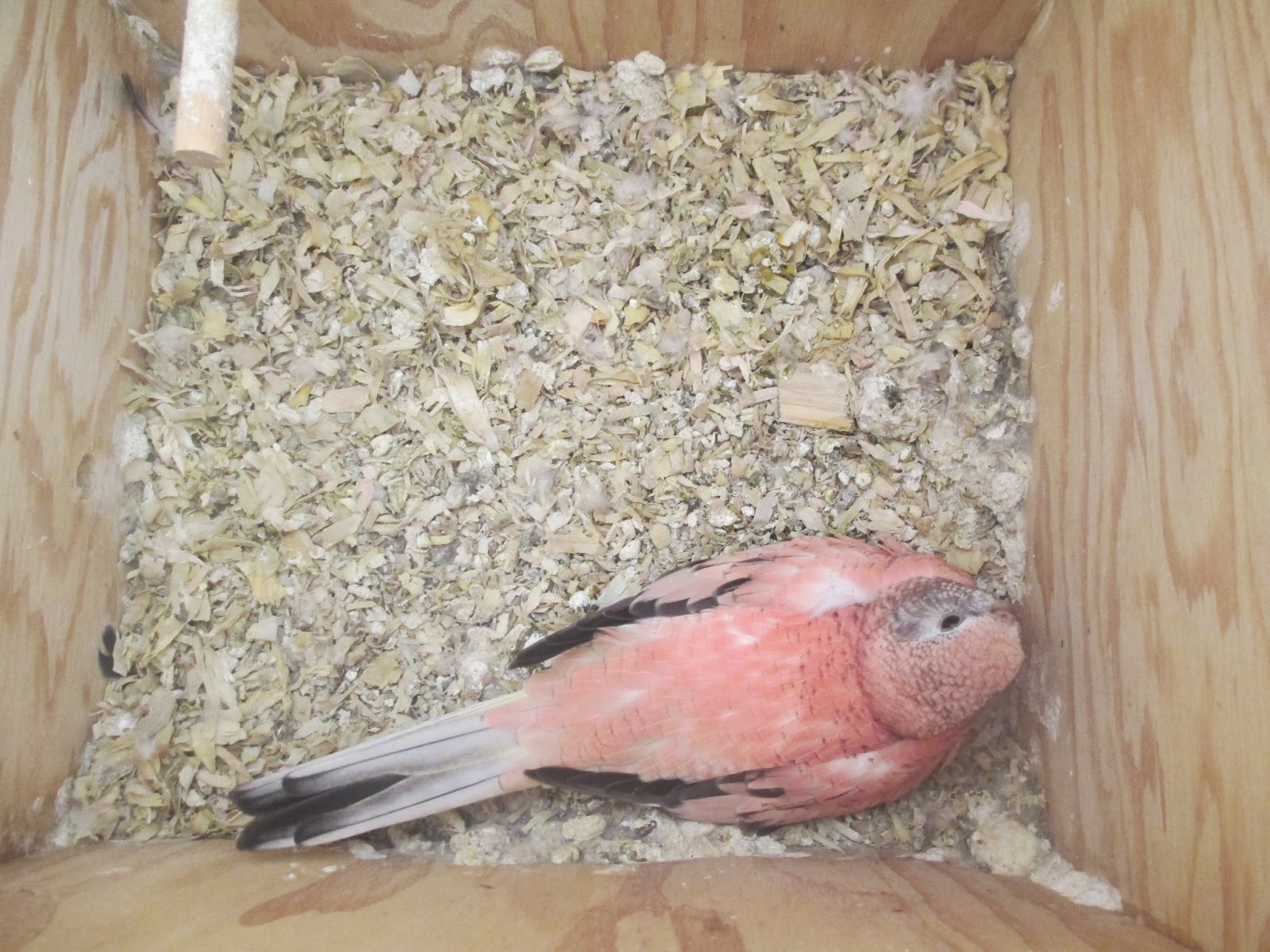 |
| Photo of Fuchsia on eggs. |
Hi Gail,
First, thanks for creating this blog! I love reading your posts :)
I'm hoping you might be able to offer some suggestions on how to discourage my beautiful female normal bourke from constantly laying eggs? My husband and I have had her for a year and a half now and she has never had a mate. We don't intend on getting another bird.
She is such a sweet little character and I honestly don't mind that she lays eggs, but I am concerned for her health. We have taken her to our avian vet and consulted local bird shops, but none of the suggestions seem to deter her. The vet suggested we remove the eggs as soon as possible (but she continues to lay eggs until she reaches about 4 or 5. The bird shops suggested hard boiling them and putting them back, changing the location of her cage often, and misting her environment with water occasionally to simulate the rainy season? Nothing seems to work and she is already on her third round this year.
For the most part she is still behaving normally and will come out to interact a few times a day. She's still eating and drinking normally and does not sit on her eggs at night. We only use newspaper on the bottom of the cage and change it regularly (especially if we've noticed nesting behavior). Unfortunately, she will tear up any new paper we put in and create another nest.
Any suggestions you have would be much appreciated!
Thanks,
C ---
------------------
 |
| My 7 young Rosy Bourkes in a travel cage and about to go to their buyer. |
Answer:
Hello C ---,
I'm curious where she's laying her eggs. I assume she doesn't have a nest box? That would stimulate egg laying, and isn't necessary for birds unless they are intended to lay. Is she using a seed cup or bowl? If so, remove it and feed her in something very shallow. If she's laying on the floor, that's another matter.
Egg laying is stimulated by sunlight ... longer days in the summer and shorter in the winter. She needs to get less light, whether sunlight or artificial light. Do you have a dark room where she can spend the late afternoon, evenings, etc. Allow her only 8 hours of daylight each day and she should quit laying. That might seem mean ... taking her away from the family; however, producing eggs is physically stressful and continuous egg laying puts her at risk. Have plenty of calcium available for her ... cuttlebone, mineral block, oyster shell. She needs to replenish her reserves.
When hens lay eggs and are allowed to sit on them, that's better for them then taking the eggs away. To do so can cause them to quickly lay another clutch. If she sits are her existing eggs for over 20 days and realizes they won't hatch, that might dissuade her from continuing to lay. She needs to know they are not any good. So, by leaving the eggs with her, she will lay fewer eggs and perhaps educate herself that laying is futile.
Even hens with mates sometimes have to abandon eggs that are infertile. They will typically sit for about 24 or 25 days before giving up (this can vary). I always recommend letting hens abandon their eggs themselves, rather than removing eggs before a hen gives up on them. Hens aren't producing more eggs while they're brooding. Also, they won't see you as the "bad" person who stole their eggs.
If she has eggs now, leave them with her. Let her keep brooding. Eventually, she will quit. Then, do the "dark" days treatment before she can start laying again. If she is in a room where you have the lights on late, that could be stimulating her to lay eggs at any time of the year. She's reacting to a longer day length and needs more hours of darkness.
Best of luck. Hope this helps.
-------------
Additional Thoughts:
Two of my Bourke hens are on their third clutch of eggs this year. Typically, I have allowed them to raise two clutches and hatch a third. When the babies in the third clutch are two weeks old, I remove and hand feed them so that I can take the nest boxes down. If I don't do that, the hens will begin laying more eggs before their previous young have all fledged.
Two of my Bourke hens are on their third clutch of eggs this year. Typically, I have allowed them to raise two clutches and hatch a third. When the babies in the third clutch are two weeks old, I remove and hand feed them so that I can take the nest boxes down. If I don't do that, the hens will begin laying more eggs before their previous young have all fledged.
This year, I hand fed the first clutches because there were two babies I wanted to keep and wanted to ensure they were very, very tame. Now, I need to decide if I'm going to hand feed their third clutches too. I probably will need to in order to prevent them from laying more eggs...
 |
| Young, hand fed Opaline Fallow with Red Eyes. He was DNA tested and is a male. |
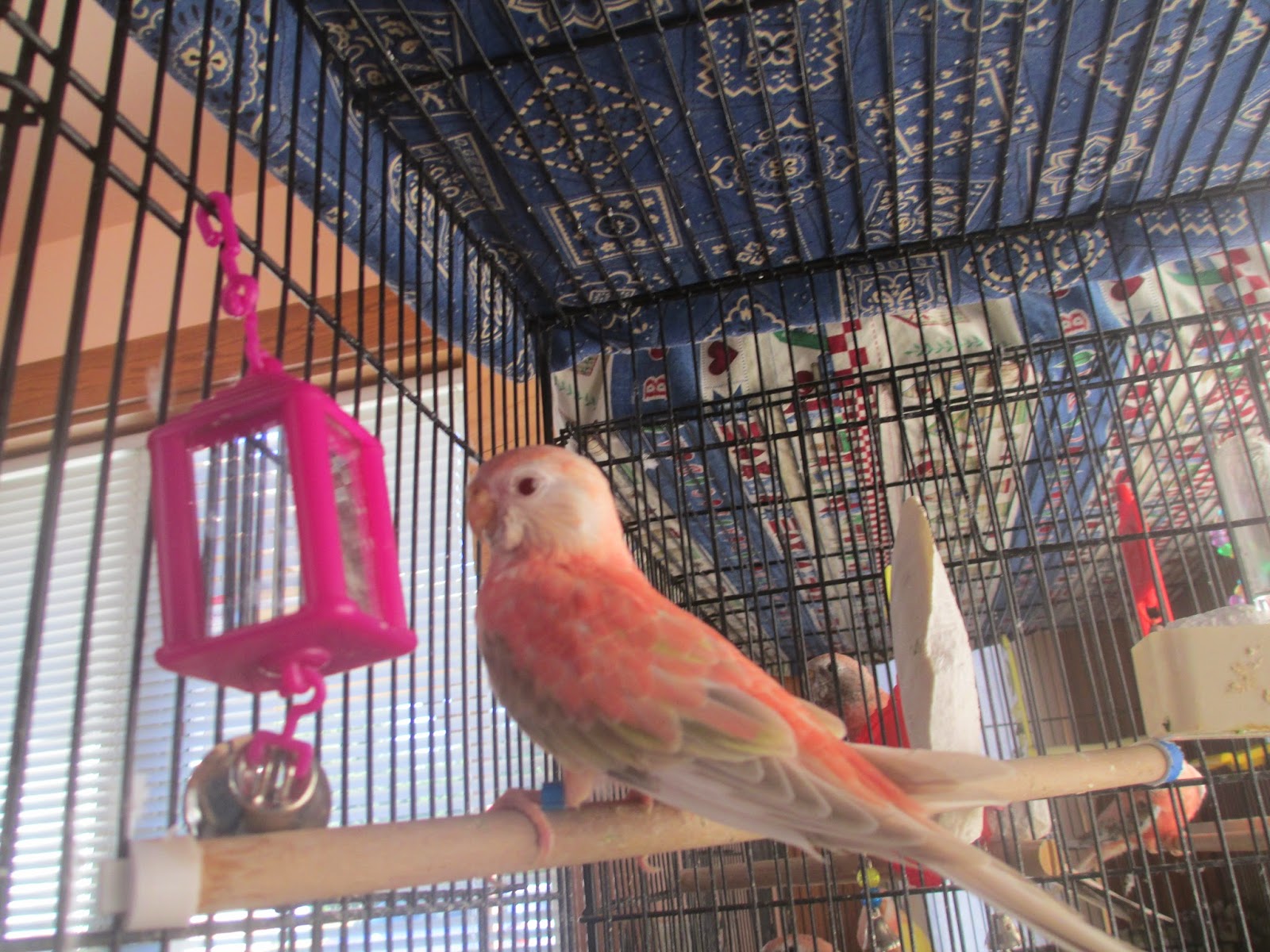 |
| Sister of the bird above. She was also DNA tested. She is an Opaline Fallow Bourke from Rosy parents. |
 |
| Two hand fed birds in front are promised and will leave us next week. The Lutino hen in the background is staying. |
Peace and Blessings
Friday, July 4, 2014
Flame & Fuchsia's Babies on Video
Flame and Fuchsia are parents of three baby Rosy Bourke Parakeets. They're less than two weeks old in this video taken July 3, 2014.
Peace & Blessings to all.
Have a SAFE, Celebratory Fourth of July.
Monday, June 9, 2014
Bourke Parakeets For Sale: Babies, Hand fed, Very Tame; Rosies, Opalines and Opaline Fallows
Life is so busy lately that I've not posted recently. I want to, and have lots of questions sent to rosie.bird@gmail.com that were answered and I hope to share with Readers.
I've been hand feeding five baby Rosy Bourke parakeets. Prices range from $150 to $225, depending on color. All are very, very tame and sweet. Sorry, but I don't ship. Can meet buyers from Coquille to Reedsport. We are in North Bend, near Coos Bay, on the southern Oregon Coast. (Not Bend, which is in Eastern Oregon). Three are $150 each and the Opaline Fallows with red eyes are $225. Contact us at rosie.birds@gmail.com


 |
| These darlings are $150 each. Hand fed and very sweet. |
 |
| Pale pink, Opaline Fallow Rosy Bourke with red eyes. This one is $225. |
 |
| Hiding in a tissue box. These sweethearts are $150 each. |
 |
| Just had a bath. Feathers are wet. |


Contact us via email at: rosie.birds@gmail.com
PEACE & BLESSINGS!
Sunday, April 6, 2014
Bird Breeding Tip for Small Exotics, Especially Bourke Parakeets
I've raised a variety of small exotic birds over the decades of my life. As a child my grandfather gave me budgies from his flock. Later, my father added a variety of finches, doves and quail. Except for a parade of tame budgies, all others lived in outdoor aviaries.
 |
| Flame and Pretty Boy, male Rosy Bourkes in adjacent cages. They spend too much time displaying at each other. |
Today —although I have several other birds— my favorites are the grass parakeets, especially Bourkes. They're gentle, quiet birds, and less messy or destructive than other varieties.
 |
| Putting up a visual barrier between the cages. Any old piece of cardboard works well. |
We recently gave nest boxes back to our Rosy Bourke parakeets. As usual, the two males began displaying at one another and ignoring their hens' attempts to entice them to breed. These photos show what steps we take each breeding season to help our males focus on their mates and not what they consider to be the competition next door.
 |
| Flame at left. Pretty Boy on right. Visual barrier in place. |
 |
| Flame & Fuchsia on left. No longer does Flame stay on the side of the cage next to his neighbor, ignoring his mate. Pretty Boy also now focuses on his mate, Rosie. |
 |
| Fuchsia at the opening to her nest box with Flame nearby. |
 |
| Rosie in the doorway of her nest box. A swing is in foreground. |
 |
| Top of Fuchsia's nest box is open. She's only just begun to set up housekeeping. |
 |
| A composite of two photos ... Rosie is half out of her nest box opening. Pine shavings line the bottom of box. |
If you have a large aviary, you can put Bourkes together when they're ready to breed. But, they do best one pair to a cage when indoors. I've found that mine get along better with other varieties of birds than they do with other Bourkes of the same sex. They can be competitive for mates and/or nest boxes. The same holds true for Splendids (Scarlet-breasted) Parakeets and possibly most grass parakeets.
Peace & Blessings.
Subscribe to:
Posts (Atom)