Showing posts with label Sexing. Show all posts

Tuesday, February 5, 2019

SEXING, MATING AND SHARING CAGES WITH OTHERS...

The year 2018 was full of health issues for my husband and me. Although recovering from surgery, I’ve answered questions sent to rosie.birds@gmail.com. Haven’t shared them on this website and should have. Here is a recent inquiry about Bourke Parakeets and my response.  Blessings all!
------------------------------
QUESTION
 I understand that Bourke's can be difficult to determine gender until they molt (I would assume most especially the Lutinos and rosies).  That being said, will two males or two females get along well?  What if one baby is a male and the other a female...will they copulate later if there is no nest box for them? –Dana


ON MATING:
 Once sexually mature, a male and female of any variety will want to mate when conditions are right for them, even if they’re brother and sister, or there is an age difference. We had a pair that bickered with each other all the time, yet still produced offspring. Once their mates were switched the bickering stopped. They didn’t like each other, but still mated. With new mates they were both happier.

 It’s long days that stimulate egg laying in all hens, and many will lay even when no male is present. The presence of a nest box helps stimulate egg laying, but isn’t always a requirement for an eager hen.  Eggs, of course, will be infertile. Chicken houses use artificial lighting to stimulate egg laying, and we do the same in our homes if lights are left on in a bird’s room into the evening or early in the morning. By extending “daylight” when normally it would be dark, hens react.

With Bourkes the male typically investigates a nesting area to be sure it is safe for the hen. Some Bourke hens ask to mate even when there is no nest box available, but most males won’t mate until there’s a safe place for her to lay her eggs. That is usual behavior in the majority of Bourke pairs, but occasionally may differ in some pairs.

We have one pair that are mating right now, but she’s not laying eggs. In another month or so they will get a nest box. I’ve tried to limit the number of hours of light they are exposed to and I believe that’s why she’s not laying yet. The fact that they are mating anyway is very unusual for birds. They are also a very young pair.

SAME SEXES IN A CAGE TOGETHER:
Putting birds together while young is the best option. Youngsters always accept one another.
That said, usually Bourkes get along well with other Bourkes and other varieties of small birds. However, placing a mature bird in with another mature bird needs to be done slowly by introducing them first.  One might decide to protect his or her home from the stranger. It’s wise to put their cages beside one another, but not put the birds together in the same cage yet. Give them several days or longer to get acquainted.

Chasing occurs most often during mating season when there is competition between birds. Hens will chase other hens away and males will chase other males. If there are only two of the same sex and none of the opposite sex in their cage, chasing isn’t likely to happen. In fact, Bourkes are happier if they are not alone in a cage. A companion, even of the same sex, is appreciated.

We kept a male Bourke and a male Linnie together. Both were tame and they became good friends.


SEXUAL IDENTIFICATION:
This is covered elsewhere on the blog. If you enter Sexing in the Search Box, it will find other posts. Briefly, Normal (wild-colored) brown Bourkes are easiest to identify once mature. Males have a tiny line of blue feathers on their brow above the cere (nostrils). Hens don’t have this, neither do very young birds.

Bourkes of every other color can be DNA’d by a reputable veterinary laboratory that does Avian DNA testing. Often Rosy hens will have darker faces than the males do, but this is open to a wide variation and unreliable. Or, sometimes the sex of the parent birds gives a clue to the likely sex of the offspring. This is not full proof either, but if the parents are two different colors from one another, it helps. Most baby Bourkes become the color of the sex of their opposite parent. In other words, a Rosy male is likely to produce Rosy hens. Likewise, if the mother is a Normal, she is likely to produce Normal sons. Again, this is not 100% accurate. Grandparents and other ancestors play a role too. Experience with past clutches verifies how well this works with a certain pair or birds.

Other than that, we must depend upon the behavior of the Bourkes to tell us their sex. Males will often do a “strut” by standing tall with shoulders back and wings slightly flared open at the shoulders. This is most often done toward other males. Hens will sometimes squat down, chests forward and tails up in the air, cheeping. However, I’ve seen mature, mated males do this in front of their hens as if to tell them what they want them to do. A few people claim you can tell a Bourke's sex by how it stands on the perch and will describe differences in how a male vs. female stands. I believe it's nonsense.

In all feathered animals the sex of the offspring is determined by the hen, unlike in humans where the father determines a baby’s sex. There is more on this in other posts as well.

Don’t fail to get a copy of my book on Small Exotic Birds. Below is a link to it on Amazon in the USA. It is also available from other booksellers in the USA, or from Amazon in the UK, and available from Amazon.com in most other countries.


Peace and Blessings.


Thursday, April 16, 2015

Bourke Parakeets: Determining Sex


Nest box being attached in February to begin new season
of breeding, egg laying and raising of young Bourkes.
QUESTION:
On Thu, Apr 16, 2015 at 1:35 AM, David wrote:
Hi Rosie,
I’m trying to sex 2 bourkes. One is the wild type the other being a Rosie.
Hope you may be able to help.
Regards,
David
----------------------------
 
Baby Bourke at 9 days old, ready for banding with
Budgie sized bands. His feet are at maximum length.
Any bigger and he couldn't have been banded.
 
ANSWER:
On Thu, Apr 16, 2015 at 10:53 AM,
Rosie Bird wrote:

Hello David,
Wild types are easy once they are mature. Males have a tiny line of blue feathers over the cere (nostrils). Females don't have that. Males are also slightly brighter in pink and blue areas, with brighter turquoise in shoulders. However, this feature varies between birds. So, the blue line above their cere is the main determining factor.
 
Normal Bourke Parakeet. This is a male. His colors
are slightly brighter than the hen's. Male Bourkes of
the wild variety also have a tiny line of blue feathers
above the cere (nostrils). Difficult to see in this photo.
Normal Bourke hen and chicks.

 
As for Rosies, only their behavior will give them away, short of having them DNA'd. Once mature, males will often display in ways that hens do not. They also seem to sing more and occasionally wolf whistle.

When I'm going to sell young Rosies and am unsure of their sex, I've sometimes sent a tiny blood sample in for DNAing. It requires clipping a toenail slightly short, dabbing a smear of blood on a card, and then dipping the "injured" toe into corn starch to staunch any further bleeding. I resisted doing that for years, but once done, I realized how easy it was and didn't seem to hurt the little birds. I use Health Gene in Canada. It's only $12 and they send a lovely certificate that follows up after an email giving the sex of the bird.  http://www.healthgene.com/avian-dna-testing/

Below is a copy from The Splendid Bourke Bird Blog on BlogSpot. If you go there and enter "Sexing" into the Search Box, you will get lots of posts on this topic. http://thesplendidbourkebirdblog.blogspot.com/

"Male Bourkes throw their shoulders back and flair their wings slightly at the shoulder, standing tall. I call this strutting. You won't see a hen do this and males do it at a very young age.

Hens take longer to behave like hens. If there is a male bird present they squat down and raise their tail, cheeping, (preferably for another Bourke, but I've seen them display for other parakeet varieties when no male Bourke is around). On rare occasions I've seen a male do this in front of a hen who doesn't want to mate...I think he's showing her how. :-) Birds have preferences for their mates too."

Peace and Blessings,
Gail

An Oregon Coast Sunset taken above Larson Slough,
about five miles from our home.
 
PEACE AND BLESSINGS!


Thursday, March 29, 2012

Sexual Behavior in Bourke Parakeets - Interested Hens, Disinterested Males - Question & Answer


Opaline Bourkes with pink eyes. Cousins from 2011.


Elizabeth writes:

"I was looking over your site a little and found it very interesting. [Thank you!]

I have a question about male bourkes. My male is a lutino and close to a year now, I also have a rosy hen that is about two. The hen squats in position to breed all the time, however she will also do it just seeing me walk into the room. My question is why my male does not seem to show much interest in her? I do not have a box up and am not interested in having babies at this time, but would love to have baby bourkes at some point. Do you have to have a box in order for bourkes to breed? [Usually]

Will a hen demonstrate the breeding posture in front of another hen? [Yes, if no male is present]. My lutino seems rather placid, I have never seen him put his wings back and strut like you were describing for male behavior. The lutino was parent raised and I received him shortly after being weaned and easily trained him. He will sit in my hand while I pet him, and likes his cheeks to be rubbed but only slowly. I did for a short time own another male bourke purchased with the hen but he passed away from a heart attack. He was very old, and my hen also demonstrated to him, but he also did not do anything..." [Perhaps because he was old and/or unwell].


One of my favorite birds. Notice yellow at end of wings.
Rump, where blue is often present, it's yellow.

My answer:

Very young male Bourkes sometimes don't respond to females. Most begin to get interested at slightly over a year of age, but some may take longer. I wouldn't worry until two years old or more. It would be unusual if a male isn't interested by then. However, birds have preferences too and sometimes pairs simply won't bond. When that happens I swap partners and usually that works. Since you don't have that choice at present, a nest box might stimulate the male to act like a male.

Even without nest boxes up, most of my hens are displaying right now. However, the males they've bred with before are ignoring them. I believe this is because Bourke males typically enter a nest box (or hollow tree) first to be certain it is safe for their mate. Without a nest box present, they are less interested in attempting to start a family.

With your pair, if your lutino is actually a male, and since there isn't another male Bourke present, he may not see any reason to display. There is no competition to challenge, and the hen is already willing, so why bother? If you really want to test whether he's a male, I recommend putting up a nest box. If suddenly there are 8 or ten eggs in the nest box you can be reasonably sure you have two hens. Hopefully, however, you will begin to see mating and have fertile eggs. If you don't want to keep the offspring, I'd bet you can find a pet shop that will be happy to buy them from you.

Personally, I am overjoyed watching baby Bourkes hatch, begin to grow and feather out. With a lutino and a rosy, all their offspring should be lovely birds.

If you live anywhere near Southern Oregon, I'd consider doing some trading with you. I am hopeful my young white-faced, pink-eyed birds from last year will produce lutinos next time around. Some have a lot of yellow on them. Smile.

Birds are such a blessing and bring such joy.
Peace & Blessings to You.

Thursday, February 23, 2012

WINGS AND FEATHERS TO IDENTIFY SEX

Each Parakeet variety is different, and so are the methods for sexing them. This post is intended to clear up a mistaken idea about sexing Rosy Bourke Parakeets. It may have occurred because of a discussion over sexing young Splendids. 

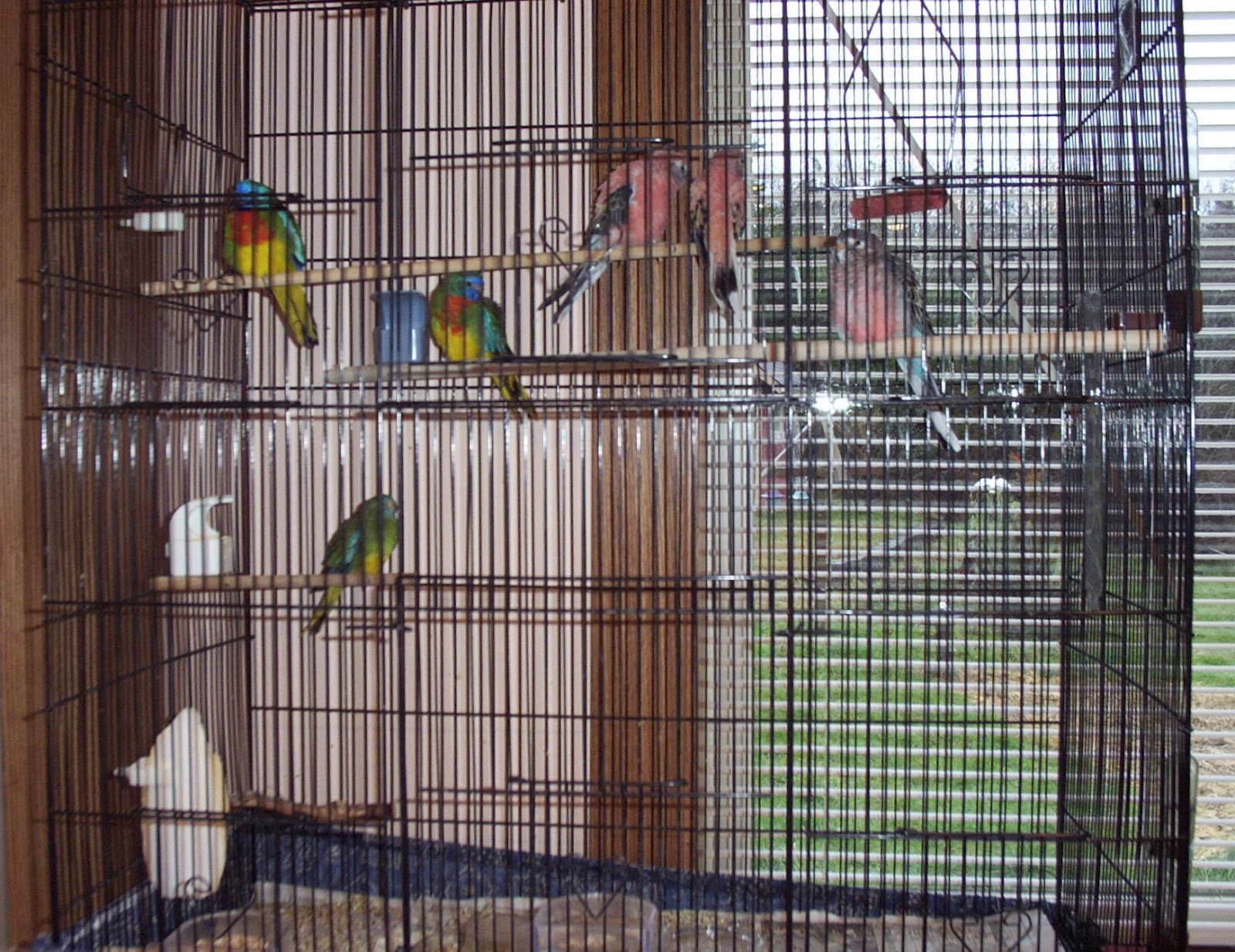
Splendids and Bourkes sharing a cage.
I've posted before that young Splendid (Scarlet-chested) Parakeets can often be sexed before a male's' red chest fills in. Simply look under a young feathered bird's wings. Hens have a white stripe under their wings. If the underside is all black, they are male. Occasionally, you will see broken white bars and their sex is still questionable. In my experience, the birds with broken white bars later lost those bars and were males. However, I don't guarantee that this will always be the case with all young Splendids who exhibit broken white bars.

Splendid wing photos are courtesy of:  www.grassparakeet.co.uk

Underside of Splendid hen's wing.
Underside of Splendid cock's wing.


Broken bar. This one turned
out to be a male Splendid.


A comment was made that Bourkes, too, have white bars under their wings and that this is indicative of sex. Not so! When I first read that, I thought, "Can this be true? After all the years I've raised Bourkes have I overlooked something this simple?" 

Rhett Jr. is definitely a male Rosy Bourke. All my male
Rosies exhibit a white stripe under their wing. This is
not a valid way to identify sex in a Bourke.
To verify or deny that comment, I grasped some of my tame birds and looked under their wings...(this is not a position they particularly like).

Sugar, a Rosy Bourke hen. The underside of her wing
is very much like the male Rosy Bourke's. Her face is
darker, which is often the case with hens vs. cocks.


In all cases, my male Rosies have white bars (or stripes) and so do my female Rosies. There was no significant difference. It was interesting to note, however, that my Normal males don't have a white stripe ... only the Rosies do.
Spicy, who is mated to Sugar above, is a Normal male Bourke.
Notice that under his wing there isn't any white bar.
That's different from the male Rosy Bourkes in my flock.

The lovely color wheel below was made by Washington State Artist Chris Maynard of Featherfolio. All of the small feathers from Bourkes and Splendids below came from our flock. Smile.


A Link to:  Feather Art

Peace & Blessings.

Saturday, April 23, 2011

SEXING LUTINO BOURKES ... Malcolm's Question

Malcolm, your server in the UK won’t accept my email replies to you.

Malcolm wrote with a question about his pair of Lutino Bourkes who don’t appear to be interested in each other and he wonders if there is a way to sex them without putting them through a vet exam.

This Lutino Bourke is not one of my birds. Wish it was.
I've previously written about sexing Bourkes, and particularly about their behavior as a way to sex them. The dates to reference on this blog are May 25, 2010 and June 17, 2010.

If you enter "Sexing Bourkes" in the search feature above, you will get those posts and others that reference sexing. There are also "Labels" at the end of each post. Click on a topic and it will bring up all related posts.

As you may know, adult normal Bourkes are easier to sex because the males have a tiny blue line of feathers over their cere (nostrils).

In Lutino's, like Rosa’s, look for the male to stand up straight, throw his shoulders back and flair his wings slightly. He may only do this when he's mature and interested in breeding because there's a hen present, although I've had youngsters in mixed cages tell me what sex they are this way (and it always proved true). When mature hens flair their wings, it's typically downward as they lean forward, as if to sweep the ground. They also put their tails up and cheep to attract a male.

The odd thing about that female behavior is that I've seen males do that when their own mate is no longer willing to breed. Are they showing her what they want her to do, maybe? Or, is it because of a hormone change in older birds? That's something I've been considering writing about.

Here's a link to one of my posts on sexing. Click here >  More on Sexing Bourkes
Best of luck.
Peace & Blessings.

Friday, November 19, 2010

Birds and Their Feathers: Selecting a Healthy Bird

Healthy Splendid Parakeets, Rainbow & Jewel.
When selecting a bird to add to your flock or as a pet…There is much to be learned by examining a bird’s feathers since feathers are a good indication of a bird’s health and well-being. Molting is a normal process where feathers are periodically lost and replaced with new plumage. I’ll attempt to identify the difference between a molt and when something might be wrong with the bird, such as disease or malnutrition.

One-week Rosie Bourke babies, pink tipped feathers
just starting to show.
Budgerigar parakeets (budgies) appear bald when they hatch. Bourkes and Splendids both have “natal down” covering them. Like any chick, it’s wet at first hatch, but quickly dries to become fluffy. These are actually downy feathers, those that provide added warmth by underlying the larger outside feathers in mature birds. A baby bird’s feathers begin to form in the follicles as the bird grows. These appear as darkened areas under the skin that are easier to see in larger birds than in small parakeets such as Budgies, Bourkes, Splendids and other small members of the avian family.

Feathers gradually protrude through the skin, encased in a sheath. The fuzzy tips of feathers soon begin to show through the end of the sheath. If you are raising Bourkes and have a mixed pair (one Rosie and one Normal), you can begin to recognize their future color at this stage. Rosies will show their pink at the ends of feather sheaths on their backs one to two weeks after hatching. You’ll also know their sex since color is sex-linked in Bourkes. Hens from mixed parents will be the color of their father. Males will be the color of their mother.

Rosie Bourke babies with some down still present.
No stress bars on them. Lines are color and fade as they mature.
Until their first molt, most young birds have the same color plumage as the hens of their species. This is especially true of Splendids. Males develop their scarlet chest after their first molt. However, even the rose color in Bourke males’ deepens and seems to become richer as they mature.

Sexing Baby Splendids: Although young Splendid parakeets look like mom at first, you can lift their wings and look for white bars on the bottom of their wings to help determine males from females. The undersides of the wings of adult Splendid males are all black. Youngsters with white bars (or stripes) under their wings are female. However, some have broken white bars and that makes identification trickier since they could be either sex. In my clutches, however, the hens have had solid white bars and the broken white-barred babies grew up to be males that later filled in with black after their first molt.

Close up of healthy feathers on a Rosie Bourke.
Healthy feather development requires adequate nutrition. If there is a disruption in the absorption of nutrients when the feathers are developing, stress bars may appear on the feathers. In this case, feathers may be a normal length, but with a line across them where areas on each of the shafts are empty of the colorful pieces that poke out and lock together. This can be caused by digestive disturbances, pro-longed periods of chilling, or the bird not being fed enough as the feathers were developing. They can appear as dark lines or white lines, depending on the color of the feathers.

If only one or two feathers have these bare areas, they are probably not stress bars. This can happen when a feather sheath isn’t preened off soon enough. What you need to watch for are continuous lines of stress bars.

Yet, a bird with stress bars may since have recovered and be healthy. If it's healthy, replacement feathers won't have the stress bars. If it is a bird you’re considering purchasing, you might want to wait and watch, skip that bird and look for another, or have the bird evaluated by an avian veterinarian before purchasing it.

Molting is caused when feathers are pushed out by new feathers coming in below them. A bird should never have bald spots because of a molt, and most birds molt the same feathers on both sides. The easiest way to recognize a molting bird is the feather sheaths you will see at the wings, tail or head. Lone birds will have more trouble preening these off than if you have a friendly pair. They will help preen areas for each other that they cannot reach, for instance, the top of their heads.

Damaged feathers also occur if birds fly into things, or from over handling. See my articles on safety.

As always, looks at the bird's eyes. They should be shiny and alert. Not half closed or watery. Also, inspect the bird’s vent. If feces have gathered there, the feathers around the vent are wet and/or soiled, that’s a bird to avoid as it may be ill. You don’t want to introduce that bird to your other birds. New birds, even apparently very healthy birds, should be quarantined for ten or more days before introduction to your others. If at any time, one of your birds appears ill, address the problem promptly and keep it separated from your others to avoid spreading the problem.

Friday, August 20, 2010

Question on Egg Laying & More on Recognizing Sex of Birds

A Rosy & a Normal Bourke. Both are males.
Kim writes that she recently adopted three Bourkes, a Rosy and two Normals. The Rosy was supposed to be male, but has laid four eggs. Kim threw out the first three, but now the hen is sitting on the fourth egg. She’s concerned for its health and isn’t interested in raising more birds. She had several questions, addressed below.

A male Normal Bourke. See blue above cere.
I feel sorry for your little hen if she's trying to sit on an egg on the floor of her cage... She must be desperate to raise something. Is one of the other birds feeding her? Males feed females they consider their mate, even if they don't breed. Typically it’s a nest box that triggers egg laying, but I had one hen that used a seed cup. I quickly gave her a nest box and she moved into it. If one of your other birds isn't feeding her, you may only have three hens. Or, perhaps the other two consider themselves to be mated and she's the 3rd bird out... It should be apparent that you have a pair if one is feeding another. Bachelor males will sometimes try to feed another male, but hens don’t normally feed one another.

Since you've searched and been unable to find Bourkes in the past, you might consider allowing these to breed and offer the youngsters to a local pet shop. There might be others who'd like to have them and it would generate some income for you, which would help cover the expense of the birds. You say you’re concerned that they might be related. Although it's preferable not to allow birds to mate with a parent or sibling, it's not as disagreeable as it is for mammals. It's a risk worth taking if you want to.

Colors are brighter on male Normal Bourkes.
A Splendid is behind him.
Be sure your birds have cuttlebone and mineral block to insure they get enough calcium. If she's laying eggs, she needs it more than ever. Oyster shell and grit are good too. She might continue to lay a number of eggs if you keep removing them. By allowing her to sit on the fourth egg, she will probably not lay more right away. That's better for her (unless you decide to offer a nest box and let her raise a family).

To discourage egg laying, provide less light. As we move into fall and winter, keep them in a room where the lights go off as the sun goes down. Farmers stimulate their laying hens to keep producing eggs by extending their day length with artificial lighting. Leaving the lights on in the evening will similarly affect your Bourkes. You asked about removing a male, and I wouldn't recommend it for preventing egg laying...it's not likely to have that effect and will leave one of your three birds very lonely.

Sexing your Normals should be an easy thing. As I've mentioned in previous posts, Normal males have a tiny row of blue feathers over their cere (nostrils)...females don't. A very young male will develop it around 6 months of age or so. A male’s pink chest and the blue on his shoulders also tend to be brighter than a female's. It’s hard to recognize, however, except when you have them together and compare them.

Good Luck! I hope you have a male ... their songs & wolf whistles are lovely. Enjoy your sweet birds.

Tuesday, July 27, 2010

Added "Question" to Labels

Each of my posts has labels listed below. If you choose one (a topic) and click on it, you will get all the posts related to that topic. I just added "Question" to the labels. To read the questions and answers from other readers, you can click on it and all of them will be brought up. Be sure to read any comments below each post too. Similarly, if you have questions about sexing your birds, you can choose that link, or any other of interest to you. Thanks!

Question on Personalities - Male or Female?

Marie asked: "My female 12-yr-old Rosy Bourke died yesterday. I have 1 one-yr-old female. Now should I get another female or a male?"

You have our sympathy. It's possible to become quite attached to our pets and Bourkes can be very sweet and interactive.

The obvious question would be, "Do you want to raise baby Bourkes?" I assume not, or you wouldn't be asking which sex is best...you'd already know you want a male. 

As a woman, even if sexual relations were not an issue, I'd rather live with my husband than my very best female friend. Your Rosy is probably no different. A female companion is better than none, but a male...well, he's going to mean a lot more to her.

If you don't provide a nest box, your pair will probably not breed. Nest boxes stimulate the urge to raise young. However, I had one experienced mother hen who didn't wait for me to return her nest box during the breeding season and laid an egg in her seed cup. This is unusual, however, and even less likely with a bird that's never raised young before.

Even though a pair without a nest box probably won't breed, the male will likely feed her. This is a bonding activity, similar perhaps to human kissing. It also proves he can be a competent father. Male Bourkes feed the hen while she's brooding and raising chicks. They later take over feeding the offspring when the young leave the nest and he helps them learn to feed themselves.

A happy pair of Bourkes will sit together much of the time and the male will offer to feed the hen occasionally. Male Bourkes are also lovely singers. They naturally wolf whistle (softly) and their songs are longer. They spend more time singing than hens do. They're also more active because of their courtship behaviors.

My recommendation is that a male will offer you (and your hen) more entertainment than will another female. Too bad you don't live in Oregon. I have two young male Rosy Bourkes available who are hand fed and very tame.

Best of luck and God Bless you and all your pets, four-legged or winged.
Smile.

Thursday, June 17, 2010

Question on Sexing Bourkes

Question from Reader in South Australia:  "... I currently have a Rosa Bourke called Icarus. However, I am not 100% sure whether Icky is in fact a boy or a girl? When I bought him I was initially told it was a girl, and then on closer examination the seller told me it was a boy. I'm just wondering if there is a reasonably clear way to sex them? I've heard all different ideas regarding sexing them (colour of faces, the way they respond to your low whistling, etc.) - but the main thing people say is that they are hard to sex..."

If you will click on the label below called "Sexing," it will open previous posts for you on this topic.

Avian veterinarians can look internally and sex birds, but Bourkes are small and I wouldn't want to have that done to mine (besides the expense). The books say that females have flatter heads and sometimes darker faces. I've not found this to be a successful way to sex them. Instead, behavior is the very best identifier.

Males sing a lot and wolf whistle, especially in the spring and more often when they are single. Males with a hen are less likely to "call" for one. However, they may sing more than she does. Also, her song is less lengthy. Males behave differently too. At about three or more months of age the males typically begin a "display" behavior. They "strut" more than a female (who doesn't); they flair their wings at the shoulders at other birds ... flaring at females to entice them and at other males to intimidate them. Males also want to feed other birds. If no hen is present, the dominant male will try to feed the less dominant one. Hens don't feed a male (an exception to this is if their eggs did not hatch and they want to feed something. For a short time they may try to "re-feed" the male after he's fed them, just as they would have fed the babies that should have hatched but didn't ... kind of sad).

Because I've been around these birds, it's easy for me to recognize the difference in behavior at an early age. I realize it will to be harder for anyone who hasn't had several to compare with each other. When I first started breeding Bourkes, I made several mistakes on judging their sex. Now, not so much...the behavior is obvious to me. I hope this helps somewhat... Click on the tag for "Sexing" below for more information.

Tuesday, May 25, 2010

More on Sexing Bourke Parakeets & a little on Splendids

Just noticed one of my young Bourkes doing a bounce and flair on his perch. He's definitely a male. Not only do male Bourke parakeets put their shoulders back and slightly flair their wings at the shoulders, but if they add a bounce too, that's a clear indication of a male Bourke.  In this photo, the male is at the far left, shoulders back, head up.

Females tend to have darker faces than males, but that's not totally reliable. I have a lovely male with a blue-gray face that's actually darker than some of his daughters. But, the girls will darken up as they mature, or so is the case with my hens. Once they are laying eggs, their facial feathers seem to come in darker than when they were youngsters. 

Other sources say the hens have a flatter head than the males do. Possibly the males flair their head feathers slightly when courting. As youngsters though, this isn't obvious to me, and that's when you want to learn their sex. Once they are mature, their actions will project their sex pretty clearly... That is, unless you have two males and one is dominant... then, you may have trouble telling that the subservient one is male and not female. However, in a mixed aviary where at least one hen is present, the males will "strut" their stuff and show off so that you should be able to identify them pretty easily if you pay attention to their behavior.

Females who are harrassed by too many males are likely to "scold" loudly. They also do this if they don't like the mate you gave them. Then it's time to switch them.

By the way, remember I moved my female Splendids to different males because for two years neither has had fertile eggs? Well, my 5-year-old patriarch was attempting to mate with his new lady. Wish them luck! They've been in the nest box together, but that's no guarantee. His attempts with her were better than with the previous hen ... just hope he's successful. All may depend on how stable she stands through the process. But, at least they're trying ... that's more than was done before with their earlier mates. This hen has never produced before, but the male, Rainbow, is the father of her previous, unsuccessful mate. Rainbow's first mate passed away. He's no youngster, but seems healthy.

Currently, have two Bourke hens on eggs and another asking to breed with her new mate. Should have three raising young soon (I hope!). Have several others who have each raised three clutches recently and are "resting" for a few months. Their boxes are closed or removed.

Have six babies almost ready to sell, only one is still being handfed occasionally. The others are eating on their own. They are so sweet. It's always difficult to part with them.

This photo is of the last six I sold. They are in a travel cage. It's not a cage where any babies live. It's too small. However, a divided cage like this works fine for temporary transportation. The links to Amazon below are for books I've discussed in the past.

Peace & Blessings!


Bourke's Parakeets

Sunday, May 16, 2010

Another Bourke Gender Identification

I'm sitting here listening to a young Bourke sing and realized there's one method of identifying sex that I've not mentioned before.

Three Rosies are sitting along a perch and one Rosy is singing away, interspersed with wolf whistles. He is a MALE for sure. Male Bourkes like to sing, especially in the Spring. I'm not sure how early this characteristic begins, but it happens while they are still very young ... too young to breed. He's just chittering away happily while the other two are quiet. They are likely hens, although I'm less sure of their gender than I am of his. Hens will sing too, but they tend to chirp more quietly and less often.

It's early morning and that's when Bourkes are most active ... at dawn and dusk ... early morning and late evening. If sunrise is at 5 a.m., as it is here now, they will start singing slightly before the sun is up no matter how early.

Something else was mentioned in a comment about a pair of birds that turned out to be male, and that triggered a memory. If there are no females available, the more dominant male will try to feed the less dominant one. This is common in both Bourke and Splendid parakeets. The males instinct is to feed a mate, and if no hen is around, they'll try to coerce another male to accept being fed.

In a cage of mixed birds, several times I've seen a male Splendid single out a female Bourke and attempt to feed her. That's only because I have two extra male Splendids that I've been unable to find mates for. The Splendids prefer a female Bourke to another male Splendid if both are present. However, they leave male Bourkes alone! Bourkes are slightly larger and can intimidate Splendids when bothered. By the way, you won't get a hybrid Bourke/Splendid, although Splendids may try... Splendids have, however, successfully bred with Turquoisine grass parakeets.

May all your birds have Good Breeding! Smile.

Friday, May 14, 2010

Bourke Behaviors

Thanks to “Sags” for his comment on the last post. I thought I’d address some of the ideas he raised. He said he’s been told another way to sex Bourkes is by looking at two birds sitting “together; a hen will generally sit flat to the perch, whilst the male will be more upright.” I believe this goes along with my observation that males “strut” their stuff during breeding season. They may sit higher to stay alert and protect their mate. However, at other times during the year, I see no difference in how they sit on a perch.

My bird pairs are mostly in cages of their own, 30 inches long by 18 inches wide and 18 inches high. The length allows Bourkes to fly in circles, something they do well.

Sags also says he thinks “hens will bite with a vengeance, much more than males when held.” I haven’t noticed any difference. However, I’ve learned how to catch or hold them so that I won’t be bitten. When reaching into a cage, I may use a washrag to capture birds I feel are likely to bite with “a vengeance.” Then they can bite the rag all they want to. I also keep a bird net handy in case one escapes, but I seldom need it. Of course, tame birds don’t bite!

When I was a kid my grandfather taught me how to hold wild budgerigar parakeets to avoid nips. You pin their head between the second knuckles of your first and second fingers so that they can't turn their head to bite. This hold works fine on Bourkes and Splendids too. See photo example at left.

Note that in the UK Bourkes are called Rosa Bourkes and in the U.S. we call them Rosy Bourkes – same birds. Sags added, “As you say Rosa is sex-linked, but a rosa hen paired to normal male will only produce normal looking coloured birds, the young males being split for rosa...unless the father is split for rosa (only males can be split) then you get both rosa and normals in the young males and hens.”

I didn’t know that only males could be splits. I have Normal males who produce Rosy hens, and realize they are splits (heterozygous), their father was a Rosy. All my Normal hens have only produced Normal males and Rosy hens. Their mates have all been Rosies. I expected that a Rosy hen with a Normal male would produce Rosy males and Normal hens. That’s what I had interpreted from what I’d read, but have not put it into practice before.

Recently, for the first time, I have a Rosy hen with a Normal male. Their first clutch was fertile, but the eggs didn’t hatch. If Sags is right, then all their young will be Normals. It will be interesting to watch this happen, if they manage to hatch their eggs. That hen is starting a new clutch now.

Sags said, “… I just wish I was as successful in breeding my birds. Things are not going too well so far (only last night I removed a dead chick, a lutino splendid)....I blame the British weather!”

When I have hens on eggs that are about to hatch, I make sure that the room they are in is at least 70 degrees or warmer. I think my success is because my birds live indoors where it’s always warm. They also get lots of light from large windows. Along with seeds, they get fresh greens and veggies too … maybe that helps.

Sags said, “Incidently, it’s my pictures in the link for sexing splendids. The wing bar is not 100% reliable, but helps when used with the differences in colour.”

Thanks again for your comments, Sags! I like your photos at: http://www.grassparakeets.talktalk.net/   It's a great site with wonderful web cam shots of babies in the nest!

P.S. I get my birds’ bands and bought the bird net from: L & M Bird Bands in San Bernardino, California. http://www.lmbirdlegbands.com/
May your birds bring you peace & joy. Here are two of my latest, almost adult babies.


Monday, May 10, 2010

Splendid Sex Identification

Thanks to reader, neversink7, for providing the site address below which has photos of Splendids, including the wing bands mentioned in the previous post.

http://www.grassparakeets.talktalk.net/sexing.htm

Sunday, May 9, 2010

Sexing Splendids

Although there are many hybrid colors of Splendids, I think the normal variety is the prettiest. Why fool around with a good thing? Adult male Splendids in their normal wild color are easy to recognize. The males have a scarlet chest and the females don't.

All young Splendids look like hens. It could be many weeks before bits of red begin to show on their chests, indicating that they're male, gradually filling in to cover most of their chest.

As with Bourkes, I'm not going to go peering inside a bird ... it might injure them and I wouldn't know what to look for anyway. I'm not a vet. Leave this to the professionals!

However, there is another way that may help determine the sex of your young birds. Splendid males tend to have black beneath their wings, whereas, females have white bands within the black. If the white bands are broken, you may have to wait and see whether the white bands fill in or disappear. In my case, I've seen partial white, broken bands fade out to become all black (males). If the underside of the wings are already black, then you know you have a male. If there are strong, unbroken white bands (lines) on the underside of the wings, then you have a female.

I posted this description once before and a reader said he appreciated it. He used this and said it's always proven true for him since. Handling the babies to check the feathers on the underside of their wings should also help tame them.

Good luck sexing your youngsters!

Sexing Bourkes

You may already know how to sex normal Bourkes (those with brown backs). Adult males grow a narrow row of blue feathers above their cere (nose/nostrils). Females don't have that line of blue, and typically neither do Rosies.

Sexing Rosies or young birds is more difficult. I'm not a vet and can't peer inside the birds, or do a DNA sample. But, watching the birds will often give a clue as to their sex. Males tend to strut their stuff by throwing their shoulders back and slightly flairing their wings at the shoulder. This is an obvious clue that they are male. Sometimes youngsters will start to do this almost as soon as they are weaned (eating on their own).

Another clue is if they attempt to "feed" a sibling. When this occurs, the one doing the feeding is likely male. Very young birds can be seen "practicing" this behavior. Don't, however, mistake this for when they are trying to steal food from each other's mouths!

Male Bourkes feed their hen during courtship and when she's on eggs. As soon as young leave the nest, father Bourkes take over most of their feeding. So, male feeding comes naturally to them, even at a young age.

As for identifying very young hens, that's not as easy. All you can do is say, "well, I don't see any male behavior, so this is probably a hen."  You have a 50/50 chance of being right!  

Peace & Bird Blessings.

Monday, November 9, 2009

The Birds & the Bees, if You Please …

Birds do it, Bees do it, Even educated fleas do it, let's do it, let's fall in love… Sorry, this is only about birds.

The photo is of Budgies doing it, not unlike other varieties of parakeet. Bourke and Splendid cocks attract a hen by calling to them. Bourkes have a lovely song that includes a natural wolf whistle. Splendid calls are not as pretty, but seem to get the job done.

Once the lady enters his area, a male attempts to woo her by trying to feed her. If she is attracted to him, she will allow this. The quality of the regurgitated food probably proves what competent fathers they can be. A hen may wait a few days to get to know the gent, or she may decide she’s ready immediately.

Hens signal a willingness to mate by hunching down and raising their tails in the air. They also cheep loudly, issuing their “come on big boy!” call. During the mating process they often continue their encouraging cheeping. But not always…maybe it depends on his expertise.

Males tentatively place a foot on the back of the female. When they think she’s standing steady enough they will step up onto her back. They usually extend their wings for balance. Experienced males don’t have to dance back and forth, but inexperienced ones may wobble before proceeding. Sometimes the hen is knocked off her perch and may scold as she falls. To successfully mate, the male must lean to one side of the female and fold his tail under hers – all while keeping two feet securely on her back…a real balancing act for them both.

The male bird attempts to touch his vent area to hers. He doesn’t have a penis, but both birds seem to enjoy vent to vent contact as his sperm enters her. It’s all over in a matter of seconds and he hops off. It’s referred to as the “cloacal kiss.” If contact was made, she will sit still for a moment or two afterwards.

Some scientists believe that birds are descended from dinosaurs. Try to conjure up an image of two Tyrannosauruses based on the foregoing information. Tee Hee!

It’s assumed that the reason birds lay eggs is so that the babies can develop outside the hen, allowing her to fly without carrying the extra weight. That’s also an argument for why cocks carry their sexual organs inside; although there can be some swelling during mating season, allowing sperm to be farther from the body and kept cooler. If you’re interested in more details, there’s more information on the internet.


Sexing

SPLENDIDS: Young Splendid parakeets all look alike. The scarlet chest develops on the males as they mature, and the timing of this varies. I had a young clutch of three all get scarlet chests before another male who was hatched a few months earlier. So, it can vary. However, sometimes sex can be determined by looking under their wings. Males tend to have a black band beneath their wings, whereas, females have white bands. If the bands are broken, you may have to wait and see whether the white bands fill in or disappear.

BOURKES: Bourke parakeets are harder to sex. Yet, males often display at an early age. They throw their shoulders back and slightly flair their wings. I’ve never seen a female do this. It’s a male display activity. Females tend to have darker faces than the males, and supposedly the top of their head is flatter. However, good luck with either of those methods. Pink and Rosy Bourke colorations vary widely. Normal Bourke males will develop a tiny ridge of blue feathers above their cere (nostrils). If you look closely at a mature bird, this will be present in the males and absent in females.

Rosy Bourke colorations are sex linked. Because of that, if you have a mixed pair (a Rosy and a Normal brown); you will know what sexes you have as soon as pin feathers begin to show on the babies. Their offspring will typically be the color of the parent of the opposite sex. So a Rosy father will have Rosy daughters. The Normal hen will produce Normal sons. The opposite is true too. A Rosy hen will have Rosy sons and a Normal cock with have Normal daughters.

I have one pair of Normals who actually produce 50% Rosies. The male in the pair had a Rosy father, so he is a split Normal. All the Rosies have been daughters and all the Normals have been males. If you want to learn more about this, you can search for Homozygous and Heterozygous traits in birds.

An interesting website, Visual Wings, describes a number of Australian parakeets. It’s at: http://www.grassparakeet.com/index.htm

By the way, Fuchsia is doing fine and eating on her own now. Her mother is back on eggs, so to protect those offspring, I expect to pull them within a week of their hatch and hand feed them. As I mentioned earlier one of the parents (unsure which one) killed Fuchsia’s younger sibling and injured Fuchsia’s wing. The parents are in a cage of their own, so another bird didn’t do this. I suspect it was the father, but he successfully raised three babies with another hen (who scolded him constantly, maybe to protect her babies). All our other pairs have proven themselves to be reliable parents and I believe this is very unusual.

Until next time. Enjoy your birds.