Showing posts with label breeding. Show all posts

Saturday, October 10, 2020

Question: When Will a Bourke Hen Lay Eggs?


I get questions on my YouTube videos nearly every day. Thought this common response is worth sharing on this Blog too, so here it is.

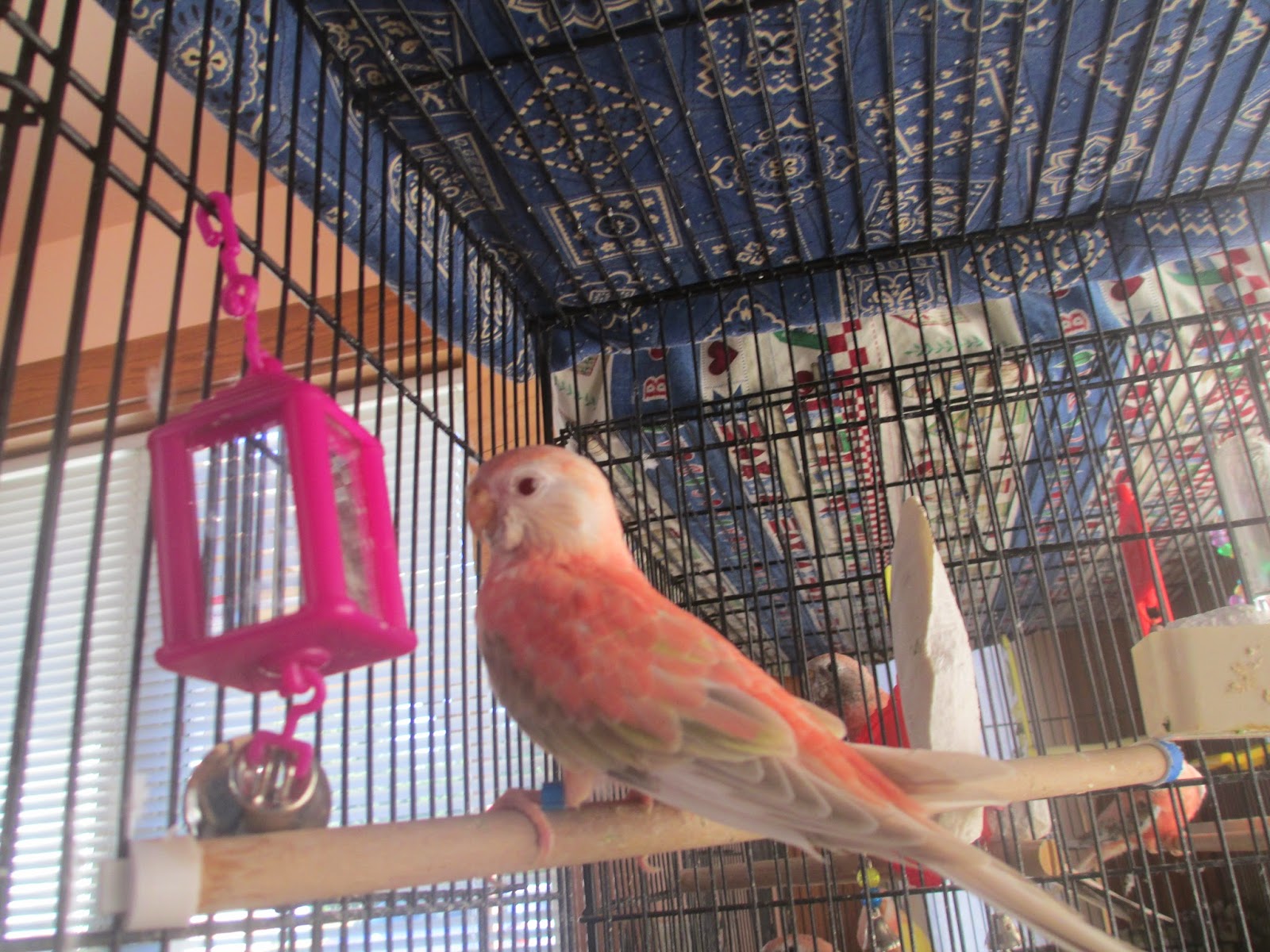
All our birds love these swings.
Bourke's Parakeet hens should be at least a year and a half old before laying eggs (18 months). Some may want to lay as early as one year old, but there is a risk of egg binding in a hen that is too young. Best age for breeding and laying eggs in Bourke's is two years of age. For the first year they are still building their own bones and should not use calcium to lay eggs before they are fully mature.

If your question is about how long after you see them mating will they lay eggs ... I don't know. It can be different for each hen. Even hens without a mate can lay eggs. They won't hatch, of course. It is day length (day light) that triggers egg laying in all birds and fowl. Wild birds lay when it is warmest during spring or summer. As days shorten, they don't raise babies. Our domestic birds are the same way. Even indoor lighting can trigger them to want to lay eggs. It is called circadian rhythm. 

We can control their urge to lay eggs by limiting the amount of light they get to only 8 to 10 hours per day.  Or, to encourage them to lay, provide indoor lighting that lasts at least 14 hours per day.  But, be sure to allow them some night time, at least 8 hours.

It is also important to provide good calcium sources. Cuttlebone is essential. We have two cuttlebones for each pair of our Bourkes. We buy 6 to 8 inch sized cuttlebones, not the tiny ones found in too many pet stores. If you do an online search you will find them. We also provide a white mineral block, but even more important, we add a brown rabbit salt block. These salt blocks have iodine and other trace minerals that are advantageous for birds. Don't worry about the salt. Your birds will only use as much as they need. Keep the salt blocks away from cage wires, however, or they will damage them. We place ours on the floor with newspaper under them, and away from overhead perches. 

As an FYI: Since adding these brown rabbit salt blocks several years ago, we've not had a single egg binding incident. These were recommended to us by a long-time bird breeder who used to travel across the USA and Europe giving speeches about small exotic birds. He knows his stuff, and we're happy to share it with you. They also increased the size and success of our birds' clutches. 


Some recently weaned 2020 Bourke's Parakeets.

PEACE AND BLESSINGS!

Monday, March 6, 2017

March Hello about Bourkes

Hi All,  Sorry I've been away for a month ... so much going on. Too many trips out of town.

Rosy Bourke Parakeet, Fuchsia, on five eggs
We gave in to birdie demands and put nest boxes up a bit earlier than usual. Three hens have fertile eggs: Fuchsia, Rosie and Peaches.

Rosie, on four eggs. She is a Rosy Bourke Parakeet hen.

Peaches on six eggs. She's an Opaline Fallow Rosy Bourke.

Bella is on four infertile eggs, but she's new at this.

Bella on four eggs that can't hatch
because they're infertile.

Blossom and her mate have not ventured into the nest box yet. They're a new couple too, so we are hopeful they will soon take advantage of the nest box.
Songster in front and his hen, Blossom, behind him.
Songster is an Opaline Fallow and Blossom is a Lutino.

We have two lovely Lutino hens that need mates. Sunny is a mature girl from outside our flock, but none of our guys will have anything to do with her. All found mates elsewhere. Can't imagine why. She's very pretty and sweet.

Sunny, a mature Lutino Bourke Parakeet hen.

Starfire is a tame daughter from Peaches and Stormy. She's too young to mate, but doesn't have a fella waiting in the wings yet either. Tee-hee.
Sweet Starfire is a Lutino hen from Peaches & Stormy.
She is young, only hatched last year. 

With this many hens, we should limit how many clutches the gals have this year. Every year I'm fearful we won't be able to sell all the babies, that we will have more offspring than people interested in them. Fortunately, that hasn't happened yet.

Eventually two or three of these pairs will find new homes. We still hope to have only four tame pairs, but it's difficult to part with any of them. Sometime down the road, we need to have a large indoor aviary in a room where the lights can go out early so they won't be stimulated to want to breed, giving them all an early retirement. But, I do love seeing the miracle of new life each Spring. So wonderful.

Even though we should downsize, I still hope to find a mate for Starfire and keep those two! For now, she's my favorite. All the older, original birds, will always remain with us too. Love them all. Smile.

Peace & Blessings!
May all your eggs hatch and your birds stay healthy and happy. 
You stay healthy and happy too!

*****
***
*


Friday, November 27, 2015

BOURKE PARAKEET BABIES AS THEY GROW, a Rosy, Lutino, Rubino & a Normal


Peaches and Storm's first clutch. She laid five eggs and hatched them all, but one red-eyed youngster disappeared within the first few days. The other four thrived. See them completely grown up at the end of this video.

Peaches is an Opaline Fallow Rosy hen out of Rosie and Pretty Boy, both Rosy Bourkes with dark eyes. Storm is a Normal Bourke. His father is a Lutino (yellow) and his mother is a Rosy. They produced a very diverse, beautiful clutch!

Peace & Blessings!


Sunday, August 30, 2015

Bourke Parakeet Baby Update

The last clutches of baby Bourkes from this summer have all gone to their new homes ... all 14 of them. Earlier clutches from these two and others were sold and gone before these babies arrived.
 

Rosie and Pretty Boy's 3rd Clutch of 2015


The same clutch from above, now out of the nest
and ready to sell to other bird lovers.


These four are from Fuchsia and Flame's 3rd Clutch.

Here are Fuchsia and Flame's four, all out of the nest
 and able to go to new homes. Miss them already.
 
One little lady, Peaches, is two years old and on her first clutch ever. She is a pretty Pink Opaline Fallow, red-eyed hen. Her mate, Stormy, is a Normal whose father was a Lutino (yellow and pink). If her eggs are fertile and hatch, it will be interesting to see what they look like.
 
I bought Stormy a few months ago and he only hatched last January. He's very young to be a father. If their mating was successful and the eggs hatch, I will watch very closely to be sure all the babies are adequately fed. Sometimes young fathers aren't very good at it ... yet, he's feeding his mate and that's a good sign. If necessary, I'll help with feeding the new hatchlings.

Will keep you updated on this late-in-the-year clutch.

May all your birds thrive.
Peace and Blessings.


Sunday, May 3, 2015

BOURKE PARAKEET DIET AND OTHER ISSUES, A QUESTION

Recent Inquiry. Some emails result from Rosie Bird Videos, and possibly not from this blog.
Rosy Bourke hen and her chicks.
QUESTION:

Good morning,

Please can you answer a few questions for me? I have recently acquired a pair of Rosie's and have not been able to get more info on them:

What seed do the eat? They don't seem to eat the parakeet seed but are in the budgie seed.
What supplement, veggies or fruit can they have?
Can they be put together in a cage with show budgies?
Do they have to be separated from other birds to be able to breed?

Grit, oyster shell, white mineral block, cuttlebone,
nestling food and brown rabbit circular salt block .


ANSWER:

Bourkes  primarily eat budgie seed, but can eat finch seed and some things in cockatiel seed. They like vegetables. I give mine cooked corn, peas, green beans and carrots. Fresh broccoli and/or kale are both very good. Mine won't eat fruit ... a few will try apple, but not fond of it. They should always have at least cuttlebone available. Other good things are mineral block, oyster shell and rabbit salt blocks (for the vitamin D in them).

When breeding I give mine egg food (boiled egg, including shell and bread crumbs blended together).

Bourkes can be housed with other birds in an aviary of adequate size. Larger birds may harass them, however. If you have a mated pair, the males will usually chase one another, and hens will also chase the other hen (an exception might be siblings, but more often than not, they will still be aggressive to the competition). Housed in an aviary, always provide more nest boxes than you have pairs. A budgie or cockatiel box is fine. In a smaller cage, it's okay to put young birds together until mature during breeding season. Then there may be problems if both sexes are present. I've had no trouble housing just hens, or just males together. Mix the sexes, however, and there will be problems when there's plenty of daylight (or artificial light) to simulate breeding season.

Please go to my website and enter "breeding" into the Search box. Many early posts will come up on this topic. There's even one on egg food.  Here is a link to one of them:
 
 
Lutino Bourke hen.
Peace and Blessings!
 

Friday, August 8, 2014

Today's Bourke Question & Answer on Lone Bourke Hen Laying Eggs

Today's photo of Rosie on four eggs.

There are still many questions and answers to post, but little time. This one came today, so all it takes is a quick copy and paste.

Question: LONE BOURKE HEN WON'T QUIT LAYING EGGS

Photo of Fuchsia on eggs.


Hi Gail,
 
First, thanks for creating this blog! I love reading your posts :)
 
I'm hoping you might be able to offer some suggestions on how to discourage my beautiful female normal bourke from constantly laying eggs?  My husband and I have had her for a year and a half now and she has never had a mate. We don't intend on getting another bird.
 
She is such a sweet little character and I honestly don't mind that she lays eggs, but I am concerned for her health. We have taken her to our avian vet and consulted local bird shops, but none of the suggestions seem to deter her.  The vet suggested we remove the eggs as soon as possible (but she continues to lay eggs until she reaches about 4 or 5. The bird shops suggested hard boiling them and putting them back, changing the location of her cage often, and misting her environment with water occasionally to simulate the rainy season?  Nothing seems to work and she is already on her third round this year. 
 
For the most part she is still behaving normally and will come out to interact a few times a day. She's still eating and drinking normally and does not sit on her eggs at night. We only use newspaper on the bottom of the cage and change it regularly (especially if we've noticed nesting behavior). Unfortunately, she will tear up any new paper we put in and create another nest.
 
Any suggestions you have would be much appreciated!

Thanks,
C ---
------------------

My 7 young Rosy Bourkes in a travel cage and about to go to their buyer.
 
Answer:
 
Hello C ---,

I'm curious where she's laying her eggs. I assume she doesn't have a nest box? That would stimulate egg laying, and isn't necessary for birds unless they are intended to lay. Is she using a seed cup or bowl? If so, remove it and feed her in something very shallow. If she's laying on the floor, that's another matter.

Egg laying is stimulated by sunlight ... longer days in the summer and shorter in the winter. She needs to get less light, whether sunlight or artificial light. Do you have a dark room where she can spend the late afternoon, evenings, etc. Allow her only 8 hours of daylight each day and she should quit laying. That might seem mean ... taking her away from the family; however, producing eggs is physically stressful and continuous egg laying puts her at risk. Have plenty of calcium available for her ... cuttlebone, mineral block, oyster shell. She needs to replenish her reserves.

When hens lay eggs and are allowed to sit on them, that's better for them then taking the eggs away. To do so can cause them to quickly lay another clutch. If she sits are her existing eggs for over 20 days and realizes they won't hatch, that might dissuade her from continuing to lay. She needs to know they are not any good. So, by leaving the eggs with her, she will lay fewer eggs and perhaps educate herself that laying is futile.

Even hens with mates sometimes have to abandon eggs that are infertile. They will typically sit for about 24 or 25 days before giving up (this can vary). I always recommend letting hens abandon their eggs themselves, rather than removing eggs before a hen gives up on them. Hens aren't producing more eggs while they're brooding. Also, they won't see you as the "bad" person who stole their eggs.

If she has eggs now, leave them with her. Let her keep brooding. Eventually, she will quit. Then, do the "dark" days treatment before she can start laying again. If she is in a room where you have the lights on late, that could be stimulating her to lay eggs at any time of the year. She's reacting to a longer day length and needs more hours of darkness.
 
Best of luck. Hope this helps.
-------------
 
Additional Thoughts:

Two of my Bourke hens are on their third clutch of eggs this year. Typically, I have allowed them to raise two clutches and hatch a third. When the babies in the third clutch are two weeks old, I remove and hand feed them so that I can take the nest boxes down. If I don't do that, the hens will begin laying more eggs before their previous young have all fledged.
 
This year, I hand fed the first clutches because there were two babies I wanted to keep and wanted to ensure they were very, very tame. Now, I need to decide if I'm going to hand feed their third clutches too. I probably will need to in order to prevent them from laying more eggs...

Young, hand fed Opaline Fallow with Red Eyes.
He was DNA tested and is a male.

Sister of the bird above. She was also DNA tested.
She is an Opaline Fallow Bourke from Rosy parents.

Two hand fed birds in front are promised and will leave us
next week. The Lutino hen in the background is staying.

 
Peace and Blessings


Friday, July 4, 2014

Flame & Fuchsia's Babies on Video

Flame and Fuchsia are parents of three baby Rosy Bourke Parakeets. They're less than two weeks old in this video taken July 3, 2014.

Peace & Blessings to all.
Have a SAFE, Celebratory Fourth of July.


Friday, April 25, 2014

Splendid and Turquoisine Parakeet Cross - A Question for Readers

A question for Readers: I know that if a canary is crossed with a green singing finch, their offspring will not be able to reproduce. They're essentially mules.
 
Is that also true of a cross between a Splendid Parakeet (or Scarlet-chested) and a Turquoisine Parakeet? Can their offspring reproduce? I'd guess not, but haven't found confirmation anywhere.
 

These photos are of a young bird parented by a male Splendid Parakeet and a female Turquoisine Parakeet. Photos were contributed by Miriana Loricchio, a bird breeder in Canada.
 

Anyone know the answer to our question?
 
Everything I've read confirms that Bourke Parakeets will not reproduce with any other variety of parakeet. It's interesting that Splendids and Turqs will accept one another as mates. I'm confident Bourkes and Splendids will pair off with one another too if another suitable mate isn't present. I've seen them do so, and even attempt to mate. But, fertile eggs do not result.
 
What about other interbreeding bird varieties? Anyone know of others that successfully reproduce? If so, can those younger birds choose mates of their own and reproduce with either of their parents' kind? I'd like to satisfy my curiosity.
 
Did you see my post about the Cockatiel and the Rose Breasted Cockatoo (or Galah) who presumably raised an offspring between them? If not, here is a link to it:
 
 
Peace & Blessings


Sunday, April 6, 2014

Bird Breeding Tip for Small Exotics, Especially Bourke Parakeets

I've raised a variety of small exotic birds over the decades of my life. As a child my grandfather gave me budgies from his flock. Later, my father added a variety of finches, doves and quail. Except for a parade of tame budgies, all others lived in outdoor aviaries.
 
Flame and Pretty Boy, male Rosy Bourkes in adjacent cages.
They spend too much time displaying at each other.
Today although I have several other birdsmy favorites are the grass parakeets, especially Bourkes. They're gentle, quiet birds, and less messy or destructive than other varieties.
 
Putting up a visual barrier between the cages. Any old
piece of cardboard works well.
We recently gave nest boxes back to our Rosy Bourke parakeets. As usual, the two males began displaying at one another and ignoring their hens' attempts to entice them to breed. These photos show what steps we take each breeding season to help our males focus on their mates and not what they consider to be the competition next door.
 
Flame at left. Pretty Boy on right. Visual barrier in place.


Flame & Fuchsia on left. No longer does Flame stay on
the side of the cage next to his neighbor, ignoring his mate.
Pretty Boy also now focuses on his mate, Rosie.
Fuchsia at the opening to her nest box with Flame nearby.


Rosie in the doorway of her nest box. A swing is in foreground.
Top of Fuchsia's nest box is open. She's only
just begun to set up housekeeping.


A composite of two photos ... Rosie is half out of her
nest box opening. Pine shavings line the bottom of box.
 
If you have a large aviary, you can put Bourkes together when they're ready to breed. But, they do best one pair to a cage when indoors. I've found that mine get along better with other varieties of birds than they do with other Bourkes of the same sex. They can be competitive for mates and/or nest boxes. The same holds true for Splendids (Scarlet-breasted) Parakeets and possibly most grass parakeets.
 
Peace & Blessings.


Thursday, December 12, 2013

Are Galatiels For Real? Check This Out.

After reading about a Galatiel at a Cockatiel website, I started searching for one. The photos and video below are borrowed from talkingbirds.com.au, and the article there is written by Lloyd Marshall. He claims it might be the only one in the world.

Marshal says, "It was bred accidentally by Nikki Wann, who lives at Brewarrina in outback Australia. She had five female cockatiels, six male cockatiels and a 12-year-old male galah in an aviary together."


Nikki Wann's Galatiel.


Parents of a Galatiel. Hen is the Cockatiel. The Gallah, or
Rose-Breasted Cockatoo, is the parent father.

Click on the link for a video of the Galatiel.


This photo is certainly striking. It's possibly
a later photo of the same bird after it has matured.
Or, perhaps its merely photo enhanced.
Anyone know?


Peace & Blessings.


Tuesday, September 17, 2013

Bourke Parakeets & Others - End of Season Update

I've tried to keep up with questions to rosie.birds@gmail.com, but lately I haven't been posting as often to this blog because my husband had back surgery. He is recovering nicely, but between him and the new puppy, my time is limited. One day I'll gather the newest questions and post them with their answers. However, for now, I want to update everyone on the current state of affairs with my birds this season.

Rosy Bourke parakeet on eggs. This is our sweetest hen,
 called Rosie. Photo taken 9-17-2013.
We've always recommended no more than three clutches a year per pair of birds. And, only two clutches per year for birds that might be stressed in any other way, such as being older, the weather suddenly turning cold, predators nearby causing a panic that could happen again -- anything that might make raising a third clutch difficult for the mated pair.

In spite of that recommendation, one year a young Flame and Fuchsia raised a fourth clutch because I didn't get their nest box removed in a timely manner. Often, I will hand feed a third clutch just to take some of the stress off the parent birds, and in the case of Flame and Fuchsia that year, I did hand feed their last clutch. Hand feeding the last clutch also allows me to remove the nest box before a pair begin mating again and the hen can go back and start laying more eggs.

Bourkes often begin to mate again right away, and a hen may lay eggs for a new clutch before their last clutch of young ones are all eating on their own. This year, in Fuchsia's case, while the last baby of her third clutch was still in the nest box, she laid another clutch of four eggs.

I couldn't hand feed the third clutches of any of our pairs this time because I knew we'd be traveling to a larger city for my husband's surgery. The birds were left alone with plenty of water and extra food for three days and two nights. They did fine, but hand feeding their young was out of the question.

Our oldest hen, Cherry. Her last clutch didn't hatch, so her
nest box has remained clean for this one. It seems unlikely
 these eggs will hatch either as her mate, Rhett, is quite
elderly too. In 1st clutch this year, they raised two.
My hubby usually attaches and removes nest boxes for me. This year, he's unable to remove them, and the nest boxes are still up. That problem can be dealt with by blocking off the entry opening. But, busy me, did not do so.

I also try to clean boxes between clutches and add new pine shavings. Since my birds are all very tame, if needed I can remove eggs for a short time and return them to a clean box. The hens always accept this from me. I'm not recommending it for everyone, however. I simply know my TAME birds will allow this, and I think they appreciate a clean box. The eggs are never away for more than a few minutes and handled carefully.

This post is to let you know how adaptable Bourkes (and probably all birds) can be. The picture below illustrates how they can accept their circumstances. Fuchsia's third clutch of four left the box pretty dirty and I've not been able to remove and clean it. She is using her "dirty" box for a fourth clutch. Cleaning it now will be a challenge since the dried food around her eggs is so hard. I need to decide when to do it...possibly after the babies hatch and I take them out to hand feed. Meanwhile, the box has a slight odor, but the weather is cool and that helps...

I'd never recommend allowing Bourkes to have fourth clutches in the same year, however, sometimes things happen that are beyond our control. These eggs are already laid and I'm not going to throw them away.

Fuchsia's box after raising four babies and starting
another clutch before the nest box was cleaned.
Instead of pine shavings, bottom has dry droppings.
The Lady Gouldian finches have babies again. All their clutches from late last year sold, and when she started laying eggs on the floor, I decided to give them their nest box back. I hear tiny peeps coming from within, Duchess won't move to let me see what's under her, smile. This photo is of a clutch from last year. They are about a week old here.
 
Lady Gouldian finch babies at about one week of age.


Turquoise Lineolated Parakeet.
The pair of Linnies (new to me), are in the nest box. The hen wasn't coming out, so I finally peeked in. She looked like she was brooding and I assumed she had eggs. However, I finally saw her out of the box and rushed over to have a look. No eggs. Disappointed, but still hopeful.

Cobalt blue Lineolated Parakeet. He loves his toys.


Light pink, white faced and red-eyed, opaline fallow Bourke.
This baby is from Rosie and Pretty Boy's third clutch this year.
She should be eating on her own soon. For now, Pretty Boy is
still feeding this daughter and his mate, Rosie, who is on eggs.
We have no breeding Splendids right now. It's all about the Bourke parakeets...my favorites.

Peace and Blessings,
Gail


Wednesday, April 24, 2013

Preparing EGG FOOD for Breeding Birds or "Egg Food For Young" ... Grin.


Flame and Fuchsia's 3 well-fed youngsters. Photo taken today,
April 24, 2013. Babies growing strong with added egg food.


Egg Food is inexpensive, nutritious and easy to make. My birds love it and I feed it to them throughout the breeding season. The American Egg Board tells us that eggs contain many essential vitamins and minerals along with high quality protein. They are one of the few foods naturally rich in vitamin D, which plays a role in calcium absorption and formation of strong bones. So it’s good for Mama and her babies. In case you’ve never made Egg Food before, we’ve created a detailed step-by-step pictorial for you to follow. Remember, this is a supplemental food and should not be fed exclusively! If given in the morning, remove it in the evening, or sooner if the weather is very hot. Keep it fresh, and always have parakeet seed available, as well.
 
Before We Begin…
The first problem you’ll encounter when feeding hard-boiled eggs to small birds is getting it into a form that they can eat. Most of them don't pick up chunks of food. So your first task, after you’ve boiled your eggs is to convert them into a fine enough form that your birds will eat them.
We’ll accomplish this by mashing the cooked eggs and combining them with dry bread crumbs. When mashed, the yolks tend to become gummy and the dry bread provides texture. The laying and rearing process takes a lot out of the mother bird. Don’t be surprised if they begin to appear noticeably thinner. Bread flours are typically enriched, so the crumbs you mix in provide nutritional benefit as well as calories for energy. Be sure to save the shells when peeling your eggs; they are an important source of calcium.
 
You may be tempted to use a blender or food processor to make your Egg Food. I try to make mine in small batches so that it remains fresh and I’ve found the quantities involved to be too small for the blender to process efficiently. I also use a small coffee grinder to reduce the egg shells to a floury consistency. It’s probably not necessary, but it disperses in the mix easily that way. Be sure to dry the shells in the microwave or oven before grinding them.

With that out of the way, let’s make some Egg Food


1. Gather Everything You'll Need

Egg Food is definitely a Lo-Tech project. All you need is a bowl; some fine, dry bread crumbs; your eggs, a fork, a potato masher, and a way to grind the shell. Instead of using a grinder, you could also put the dry shells in a plastic bag and go over them with a rolling pin.


2. Peel Your Eggs and Save the Shells
3. Coarsely Mash the Eggs

4. Use a Fork for Finer Texture


Keep working the tines of the fork through the mixture to break up the larger pieces of egg white and combine it with the yolk.


5. Oven-Dried Shells Ready for Grinding


6. Add the Shell and Blend


Spoon the powdered egg shells over the top of your pulverized eggs and use the fork to disperse it throughout. It is much easier to do this while the egg mixture is still a little gummy. The addition of dry shells will help give the mix a better texture.


7. Add Dry Bread Crumbs to the Mix 


You'll find recipes for Egg Food that give specific quantities of crumbs to eggs. I prefer to add a little at a time and test always following the cook's motto that it's easy to put it in, but hard to take it out. As a rule of thumb, I add about as much bread crumbs as eggs. You'll notice that I use a commercial product. You can, of course, make them yourself from bread crusts and loaves going stale. However, it's more work and saves very little money.
 
Store your Egg Food in an air-tight bowl in the refrigerator to keep it fresh. As I said earlier, I try not to make too much at a time so my birds always have a fresh supply. 


Close-Up of the Final Texture

The Result -  Happy and Healthy Birds. This is Rhett.

Rosie and Pretty Boy's four offspring. Also benefiting
from added egg food. Photo taken today, 4/24/2013.

Rhett and Cherry's three babies. Photo taken today, 4/24/2013.
Baby on top has pink eyes. Others have dark eyes.
 Peace and Blessings.