PLEASE CLICK "HOME" in lower left below to access the most recent post. This blog began in 2009, so there are countless entries. See Label List for topics of interest. Avoid leaving comments on OLD posts as they might be missed. Questions? write to rosie.birds@gmail.com. Blessings!
Saturday, June 12, 2010
Friday, June 11, 2010
OPERATION eBOOK DROP For U.S. Military Overseas
United States Military deployed overseas who use an electronic reading device, iPhone, iPad, Kindle, Palm Pilot, Nook, etc., can obtain a free eBook from Cape Arago Press. This publisher, along with others, participates in Operation eBook Drop to provide our troops with free eBooks.
Tell a friend or family member overseas to visit http://www.capearagopress.com/ to look at the books being offered there, then email EGLewis@capearagopress.com and he will send them instructions and a coupon to download a free copy.
We support all the men & women fighting to maintain freedom.
God Bless them!
Wednesday, June 9, 2010
Problem bird ... slow to grow up!
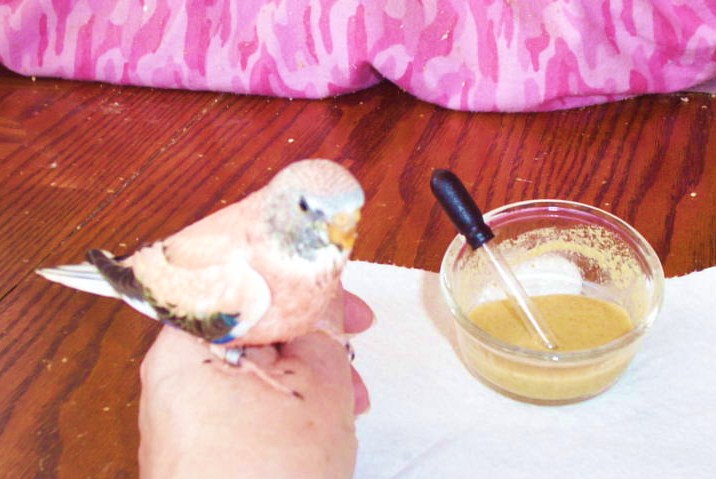
The baby Bourke in my left hand has been slow to learn to eat. In the nest he was much smaller than his healthy sibling, and his lack of growth worried me. Therefore, I pulled him to hand feed. He caught up quickly in size, flies okay, but he's still asking to be handfed when others his age are eating on their own.
I've cut him down to two feedings a day and I notice he "nibbles" in the seed bowl and at the bottom of the cage. He appears to be trying to eat, and maybe even succeeding sometimes. But, he still begs to be fed and eats a lot each time. He likes cut up green Kale and when I gave the tame birds shredded wheat cereal one morning (they wanted to share mine)... he ate some of that. So, there are things he can eat besides Exact handfeeding formula, but parakeet seed or even spray millet seem to be a puzzle to him.
All my birds love corn, but he won't touch it. I even squeezed it open and put it to his mouth. There's no reason he couldn't eat it ... just as easy as the Exact formula ... but he would have nothing to do with it! I've decided to call him Pipsqueek, or Pip for short. He does squeek to be fed and is a pip of a problem. Pun intended, smile.
Anyone else have a slow grower like this?
Friday, June 4, 2010
Better Info on Discounts
Cape Arago Press has put together some unbeatable discounts:
1) Save 10% on single copies of either WITNESS or DISCIPLE.
2) Buy them both and get one at half-price. That’s like a 25% savings on each one.
3) Buy WITNESS, DISCIPLE, or both, at regular price and get the eBook free.
And Cape Arago Press charges NO Shipping or Handling Fees in the U.S.! Do the math and count your savings.
As always, you’re welcome to download FREE Discussion Guides and other informational material from their website.
SPECIAL BOOK DEALS Currently Offered.
Okay, these books aren't about birds. However, they were written by my husband, Ed Lewis - an excellent writer! Smile. If you're a history buff, you'll like these wonderful novels that remain historically accurate. Learn more about First Century Judea while being delightfully entertained.
E.G. Lewis's books are offered from all online booksellers, or through the Publisher, Cape Arago Press. Check out the SPECIAL DEALS on right now at the Publisher's website:
This website has sample chapters, video trailers and, if you move around the site, you'll find other fascinating facts.
Read a synopsis of each of these books at:
CAPE ARAGO PRESS:
Click on the web address above.
May You Have Peace & Blessings
& Good Reading!
More on Parenting
As I watched my male Splendid taking a bath this morning, ...of course he finished before I got the camera... I thought about how caring he's always been to his mates. Yes, mates. He's had three.
Rainbow was hatched to Merlin & Millet almost six years ago. He's now the patriarch of our Splendid Scarlet-chested parakeets (I know, it's either or, but I like the play on words). His first hen, Jewel, produced three lovely male Splendids. With her 2nd clutch a few months later, I noticed that her first two eggs seemed larger than typical. One morning, with no warning, she was dead. A third egg, even larger than the first two was stuck. She died of egg binding. (In another post, I'll try to talk about what can be done to save the hen, although I've posted on it before, it's important).
Maybe this is the best place to mention that Bourke hens go right back to the nest and lay more eggs as soon as their offspring are fledged...sometimes even sooner. In my experience, Splendids allow themselves more time between clutches.
Rainbow's 2nd hen, Jewel-2, seemed to please him and he fed her, but they never mated. Her eggs for the past two years have been infertile. So have the eggs of a Splendid hen in with Rainbow's son from Jewel. For that reason, I swapped hens this year. Rainbow now has Rivkah, and Rainbow Jr. has Jewel-2.
Rainbow and Rivkah have hit it off and appeared to be mating on several occasions, or at least attempting to. I'm hopeful everything came together as it was meant to. Smile.
My experience with Splendids is that the males spend a lot of time with their hens in the nest box, encouraging and feeding them. When the eggs hatch, they help feed the babies and spend almost as much time with the nestlings as does their mother.
With Bourkes it seems to be different. Male Bourke parakeets remain outside the box, apparently guarding it from predators. They will stand on a perch or hang from the opening to feed the hen who comes to the opening. She usually only leaves to defecate, maybe grabbing a drink and possibly a quick bite or two. But, she primarily depends on her mate for sustenance while she's brooding.
What the two varieties of parakeets do have in common is that the males of both species check out the nest box days before she enters it. A male will make several reconnaissance trips before his hen ventures into the box.
An exception to this rule for Bourkes is with my male, Chitter, who enters his hen's box while she's on eggs. He is also the father of the babies I've had to pull and hand feed to protect them from one of their parents harming them. It seems likely that it's him since he is also exhibiting unusual behavior by entering the box while his hen is on eggs. Most male Bourkes won't help feed their young directly until after they leave the box. He feeds the hen and she feeds the babies until they leave the box. Then he takes over the majority of their feedings, although she still helps.
Disclaimer: Every bird has a distinct personality all their own. What I've said here may not always prove true. It is my observation of my own birds; currently, six Splendids and 22 Bourke parakeets.
Peace & Blessing to You and Your Birds!
Keep Smiling!
Monday, May 31, 2010
Breakfast for Babies
Time for breakfast.
These youngsters are eating on their own, but the youngest still begs to be fed. To keep him healthy, he gets two feedings of Exact Handfeeding Formula a day now, but also has nestling food and other seed available.
If I put my finger under their breast, they step up. I move them to my face to talk to them, and they will nibble the tip of my nose. I believe that's a sign of affection...very sweet. I love birds.
Friday, May 28, 2010
Baby Birds with Problem Parents
Neversink7 asked, "...have you ever had problems with splendid or bourke parents pulling the feathers off of their babies?" His Splendid parents are misbehaving and he wonders if a nutritional deficiency could be a possible culprit.
I don't think nutrition of any kind would cause this. There are plenty of feathers available that fall off the birds naturally and I often see my birds "playing" with fallen feathers, as well as routinely preening themselves. They can chew on all the feathers they want to, so why take them from their babies?
I've never had Bourkes pull feathers, except for the incident with one pair savaging a baby. With that pair, I always rescue and handfeed the young almost as soon as they hatch. I believe the male wants to breed again and dispatching the babies will allow that. I recently put the hen on "rest" and moved the male to another hen whose eggs have always been infertile. She's now on fertile eggs and I'm interested to see what happens. I may end up handfeeding her young too, if this male is actually the "bad" parent.
[UPDATE: After the cock was successful with another hen and a good dad, it turned out that the mother of the brood was to blame. Although she could hatch her eggs, she would not raise the babies and would begin savaging them as soon as all the eggs hatched. I still have two of her offspring (a brother and sister) that were hand fed and are wonderful parents with their mates. Both are very sweet natured. Their mother eventually developed an odd "droop" and died a few days later. I've wondered if she had a brain tumor that made her crazy or something. Also, she was sold and came back to me after her first clutch with a different mate also died. I don't know what her history was for the two years she was away from me.]
My experience with Splendids is different. Many years ago I bought my 1st pair and the hen's back was bare. I was unfamiliar with Splendids, but didn't like the fact that the male pulled the feathers from her back. She was sweet and tame, but he was wild...drew blood the first time I caught him.
Their first brood died. They didn't seem to know to feed them. Their second clutch of three did fine and I still have a male from that clutch. He has NEVER pulled feathers from his mate(s) and neither has his son (the grandson of the 1st bird). None of my Splendids have ever pulled feathers from their young. I was happy to let that original bird go as a lone caged bird to someone else who enjoyed watching and listening to him.
To Neversink7: How many clutches have your problem birds had? I'd limit them to two or three, with a few months in between. Maybe they're tired of feeding and caring for their young...? Sounds like you are doing the right thing by pulling and handfeeding them.
Another thought ... if the young birds are fledged and able to eat on their own before the parents begin pulling the feathers, in the wild they would try to chase them off to live elsewhere. In a small cage or aviary, they can't leave. Is only one parent feeding and the other pulling feathers? That seems likely. I remove my own young birds as soon as the father begins to "chase" them from their perches. By then, they're eating okay and he wants them gone.
Past experience with Finches: I once had a beautiful pair of Zebra finches. The hen was all white and the male was pied. They produced gorgeous babies with a "saddle" of color over the backs of white birds. Very pretty. However, about the 3rd year the male began to throw newly-hatched babies out of the nest. I'd put them back, and he'd throw them out again. He continuously did this and wouldn't raise them any longer. They'd produce another clutch and he'd do the same thing. My belief is that he felt he'd produced enough progeny and only wanted to continuously mate, not work to raise young. I gave him away to a bird store.
Past experience with button quail: As a kid, I had a pair of cute button quail that hatched a large clutch. I
was shocked one day to go out to the aviary and find half the clutch bloodied and dead. Apparently, a male button quail will kill his sons after a certain age ... Sad. I don't know if every one of them does this, but enough do, that babies shouldn't be left with their dad for very long. Perhaps removing male button quail as soon as their eggs hatch is wise.
This sounds like it's the males of the species that savage their young. That might be typical, but I did have a female budgerigar parakeet who visited the nestboxes of other hens and killed their young. After she'd done this more than once, I finally caught her in a box that wasn't hers and realized who was doing it. She was "dispatched" and I never had another problem in that aviary.
There must be good birds and bad birds, just as there are good dogs and bad dogs, good people and bad people.
Thursday, May 27, 2010
Fun with House Finches, wild birds
A friend on Oahu, Hawaii sent these pictures.
House finches made a nest in their hanging spider plant. All four eggs hatched. Cute! The adult bird is the dad. Hens don't have the red coloring.
These finches are also called Linnet finches in other parts of the country. Or, Papayabirds ... but probably only in Hawaii!
Tuesday, May 25, 2010
More on Sexing Bourke Parakeets & a little on Splendids
Females tend to have darker faces than males, but that's not totally reliable. I have a lovely male with a blue-gray face that's actually darker than some of his daughters. But, the girls will darken up as they mature, or so is the case with my hens. Once they are laying eggs, their facial feathers seem to come in darker than when they were youngsters.
Other sources say the hens have a flatter head than the males do. Possibly the males flair their head feathers slightly when courting. As youngsters though, this isn't obvious to me, and that's when you want to learn their sex. Once they are mature, their actions will project their sex pretty clearly... That is, unless you have two males and one is dominant... then, you may have trouble telling that the subservient one is male and not female. However, in a mixed aviary where at least one hen is present, the males will "strut" their stuff and show off so that you should be able to identify them pretty easily if you pay attention to their behavior.
Females who are harrassed by too many males are likely to "scold" loudly. They also do this if they don't like the mate you gave them. Then it's time to switch them.
By the way, remember I moved my female Splendids to different males because for two years neither has had fertile eggs? Well, my 5-year-old patriarch was attempting to mate with his new lady. Wish them luck! They've been in the nest box together, but that's no guarantee. His attempts with her were better than with the previous hen ... just hope he's successful. All may depend on how stable she stands through the process. But, at least they're trying ... that's more than was done before with their earlier mates. This hen has never produced before, but the male, Rainbow, is the father of her previous, unsuccessful mate. Rainbow's first mate passed away. He's no youngster, but seems healthy.
Currently, have two Bourke hens on eggs and another asking to breed with her new mate. Should have three raising young soon (I hope!). Have several others who have each raised three clutches recently and are "resting" for a few months. Their boxes are closed or removed.
Have six babies almost ready to sell, only one is still being handfed occasionally. The others are eating on their own. They are so sweet. It's always difficult to part with them.
This photo is of the last six I sold. They are in a travel cage. It's not a cage where any babies live. It's too small. However, a divided cage like this works fine for temporary transportation. The links to Amazon below are for books I've discussed in the past.
Peace & Blessings!
Tuesday, May 18, 2010
Good Morning Young Bourkes!
Actually, only the three in back are youngsters. The one or two in front are tame adults from earlier clutches. They still like to beg a bite or two once in a while. Something about the Exact's taste, or maybe they just like the extra attention they get when being fed.
I missed a good picture this morning, but by the time I got the digital camera on, the scene had ended. One of our young birds landed on a chair arm and Chinook, our big old malamute mix...mala-mutt...sauntered over and put a nose up to him. The baby nibbled his nose a bit, but by the time I had the digital camera on, their introduction was over.
Never leave other pets, or young children, unattended with your birds. Even the most reliable can have an "accident" or forget to be careful. Chinook is more curious than anything, but I watch him around the birds. He knows he's not to hurt them, and I doubt he ever would, but pets can do the unexpected.
As I mentioned in an earlier post, one morning we made a shopping trip to Eugene about a three-hour drive away. We were gone nearly 12 hours and when we arrived home, our oldest cat had been asleep in a window seat and left there all day. He never bothered the birds, but I would not intentionally let a cat stay alone in the same room with them all day.
We live in the country and usually put the cats outside when we leave...where the other two were. Although, one night one of our adult children was visiting and let another cat inside with the birds. About 1 a.m. she meowed outside our bedroom door wanting to come in with us. Who knows how long she was in the same rooms with the birds. She never bothered them either, and she's a stray we took in two years previous to that incident. She isn't a cat we raised ourselves, yet she's probably grateful to be rescued. She quickly accepted our big dog, and responded by looking away any time she glanced at a cage and was told sharply, "No Birds!"
As another aside. We love the wild birds around our place too, and when I'm outside and there are birds at feeders, I tell the cats, "No Birds!" and they seem to leave them alone too. They catch mice, moles and voles and I had to rescue a chipmunk from one of the cats a few months ago. But, I've never seen them go after wild birds ... a benefit of their indoor training, I'm sure.
May God Bless You and our Beloved Pets.
Sunday, May 16, 2010
Another Bourke Gender Identification
I'm sitting here listening to a young Bourke sing and realized there's one method of identifying sex that I've not mentioned before.
Three Rosies are sitting along a perch and one Rosy is singing away, interspersed with wolf whistles. He is a MALE for sure. Male Bourkes like to sing, especially in the Spring. I'm not sure how early this characteristic begins, but it happens while they are still very young ... too young to breed. He's just chittering away happily while the other two are quiet. They are likely hens, although I'm less sure of their gender than I am of his. Hens will sing too, but they tend to chirp more quietly and less often.
It's early morning and that's when Bourkes are most active ... at dawn and dusk ... early morning and late evening. If sunrise is at 5 a.m., as it is here now, they will start singing slightly before the sun is up no matter how early.
Something else was mentioned in a comment about a pair of birds that turned out to be male, and that triggered a memory. If there are no females available, the more dominant male will try to feed the less dominant one. This is common in both Bourke and Splendid parakeets. The males instinct is to feed a mate, and if no hen is around, they'll try to coerce another male to accept being fed.
In a cage of mixed birds, several times I've seen a male Splendid single out a female Bourke and attempt to feed her. That's only because I have two extra male Splendids that I've been unable to find mates for. The Splendids prefer a female Bourke to another male Splendid if both are present. However, they leave male Bourkes alone! Bourkes are slightly larger and can intimidate Splendids when bothered. By the way, you won't get a hybrid Bourke/Splendid, although Splendids may try... Splendids have, however, successfully bred with Turquoisine grass parakeets.
May all your birds have Good Breeding! Smile.
Friday, May 14, 2010
Bourke Behaviors
Thanks to “Sags” for his comment on the last post. I thought I’d address some of the ideas he raised. He said he’s been told another way to sex Bourkes is by looking at two birds sitting “together; a hen will generally sit flat to the perch, whilst the male will be more upright.” I believe this goes along with my observation that males “strut” their stuff during breeding season. They may sit higher to stay alert and protect their mate. However, at other times during the year, I see no difference in how they sit on a perch.
My bird pairs are mostly in cages of their own, 30 inches long by 18 inches wide and 18 inches high. The length allows Bourkes to fly in circles, something they do well.
Sags also says he thinks “hens will bite with a vengeance, much more than males when held.” I haven’t noticed any difference. However, I’ve learned how to catch or hold them so that I won’t be bitten. When reaching into a cage, I may use a washrag to capture birds I feel are likely to bite with “a vengeance.” Then they can bite the rag all they want to. I also keep a bird net handy in case one escapes, but I seldom need it. Of course, tame birds don’t bite!
When I was a kid my grandfather taught me how to hold wild budgerigar parakeets to avoid nips. You pin their head between the second knuckles of your first and second fingers so that they can't turn their head to bite. This hold works fine on Bourkes and Splendids too. See photo example at left.
Note that in the UK Bourkes are called Rosa Bourkes and in the U.S. we call them Rosy Bourkes – same birds. Sags added, “As you say Rosa is sex-linked, but a rosa hen paired to normal male will only produce normal looking coloured birds, the young males being split for rosa...unless the father is split for rosa (only males can be split) then you get both rosa and normals in the young males and hens.”
I didn’t know that only males could be splits. I have Normal males who produce Rosy hens, and realize they are splits (heterozygous), their father was a Rosy. All my Normal hens have only produced Normal males and Rosy hens. Their mates have all been Rosies. I expected that a Rosy hen with a Normal male would produce Rosy males and Normal hens. That’s what I had interpreted from what I’d read, but have not put it into practice before.
Recently, for the first time, I have a Rosy hen with a Normal male. Their first clutch was fertile, but the eggs didn’t hatch. If Sags is right, then all their young will be Normals. It will be interesting to watch this happen, if they manage to hatch their eggs. That hen is starting a new clutch now.
Sags said, “… I just wish I was as successful in breeding my birds. Things are not going too well so far (only last night I removed a dead chick, a lutino splendid)....I blame the British weather!”
When I have hens on eggs that are about to hatch, I make sure that the room they are in is at least 70 degrees or warmer. I think my success is because my birds live indoors where it’s always warm. They also get lots of light from large windows. Along with seeds, they get fresh greens and veggies too … maybe that helps.
Sags said, “Incidently, it’s my pictures in the link for sexing splendids. The wing bar is not 100% reliable, but helps when used with the differences in colour.”
Thanks again for your comments, Sags! I like your photos at: http://www.grassparakeets.talktalk.net/ It's a great site with wonderful web cam shots of babies in the nest!
P.S. I get my birds’ bands and bought the bird net from: L & M Bird Bands in San Bernardino, California. http://www.lmbirdlegbands.com/
May your birds bring you peace & joy. Here are two of my latest, almost adult babies.
Tuesday, May 11, 2010
A Baby Bourke’s Future Color
If you keep mixed couples, i.e., one Normal Bourke and one Rosy Bourke, you may wonder what their newly hatched babies are going to look like.
The Bourke book I own, published in the UK, says that Normals will have gray fuzz and Rosies will have white fuzz, and that’s how you can tell what they are going to be. Balderdash! All my fuzzy little baby Bourkes look the same even though some grow up to be Normals and some grow up to be Rosies. They all appear to have fuzz that’s more white than gray, sort of an off-white.
Maybe early Rosy babies were fuzzy white and Normals with no heterozygous genes were fuzzy gray? Mine always look alike, even when both colors are in the same clutch.
That said, there is another way to guess their future color. From their feet! Most Normals have dark feet and those destined to grow mostly pink feathers will have pink feet. That said, one of my current Rosy babies has feet with both brown and pink skin. It has no other Normal features, so I think you can safely assume that a baby bird with “striped” feet will be Rosy. The striping is unusual though.
Once their feathers begin to bud out, you will soon recognize pink dots of color on the backs of the Rosies.
As a reminder, Bourke color is sex-linked and babies will be the color of the parent of the opposite sex. This means a Rosy dad and a Normal mom will produce males that are Normal Bourkes and all their hens will be Rosy Bourkes and vice versa; a Rosy hen will produce Rosy sons and her Normal mate will produce Normal hens.
I have one pair, however, who produce 50/50 of each color and both are Normals. The male had a Rosy father and a Normal mother, so he is the Normal color. Apparently he’s heterozygous. All his progeny who are pink have been hens. All the Normals have been male. If you want more explanation of homozygous and heterozygous, query the internet. There’s more info. out there than I can provide. Suffice it to say that he carries the gene for Rosies, as apparently did many other Normals, or we wouldn’t have our beautiful Rosies. Smile.
May you have Rose-colored Blessings Galore.
Breeding The Colorful Little Grass Parakeet
$29.99 from Amazon
Splendid Reflections: 40 Years of Grass Parrakeet Husbandry
$29.28 from Amazon
Monday, May 10, 2010
Splendid Sex Identification
Thanks to reader, neversink7, for providing the site address below which has photos of Splendids, including the wing bands mentioned in the previous post.
http://www.grassparakeets.talktalk.net/sexing.htm
Sunday, May 9, 2010
Sexing Splendids
Although there are many hybrid colors of Splendids, I think the normal variety is the prettiest. Why fool around with a good thing? Adult male Splendids in their normal wild color are easy to recognize. The males have a scarlet chest and the females don't.
All young Splendids look like hens. It could be many weeks before bits of red begin to show on their chests, indicating that they're male, gradually filling in to cover most of their chest.
As with Bourkes, I'm not going to go peering inside a bird ... it might injure them and I wouldn't know what to look for anyway. I'm not a vet. Leave this to the professionals!
However, there is another way that may help determine the sex of your young birds. Splendid males tend to have black beneath their wings, whereas, females have white bands within the black. If the white bands are broken, you may have to wait and see whether the white bands fill in or disappear. In my case, I've seen partial white, broken bands fade out to become all black (males). If the underside of the wings are already black, then you know you have a male. If there are strong, unbroken white bands (lines) on the underside of the wings, then you have a female.
I posted this description once before and a reader said he appreciated it. He used this and said it's always proven true for him since. Handling the babies to check the feathers on the underside of their wings should also help tame them.
Good luck sexing your youngsters!
Sexing Bourkes
You may already know how to sex normal Bourkes (those with brown backs). Adult males grow a narrow row of blue feathers above their cere (nose/nostrils). Females don't have that line of blue, and typically neither do Rosies.
Sexing Rosies or young birds is more difficult. I'm not a vet and can't peer inside the birds, or do a DNA sample. But, watching the birds will often give a clue as to their sex. Males tend to strut their stuff by throwing their shoulders back and slightly flairing their wings at the shoulder. This is an obvious clue that they are male. Sometimes youngsters will start to do this almost as soon as they are weaned (eating on their own).
Another clue is if they attempt to "feed" a sibling. When this occurs, the one doing the feeding is likely male. Very young birds can be seen "practicing" this behavior. Don't, however, mistake this for when they are trying to steal food from each other's mouths!
Male Bourkes feed their hen during courtship and when she's on eggs. As soon as young leave the nest, father Bourkes take over most of their feeding. So, male feeding comes naturally to them, even at a young age.
As for identifying very young hens, that's not as easy. All you can do is say, "well, I don't see any male behavior, so this is probably a hen." You have a 50/50 chance of being right!
Peace & Bird Blessings.
Thursday, May 6, 2010
Feed me, Feed me ... & More on Breeding
In this first photo, all the birds want out to be fed at once. Sometimes I let them all out together, but it's easier to feed them one at a time (and less messy).
The three babies I'm feeding right now are almost weaned. They're scratching around and appear to be trying to eat seed. Hopefully, they are. Spray millet is the easiest, and I've given them nestling formula, as well as typical adult parakeet seed mix.
Once they are eating on their own, they will still want to be fed occasionally. Maybe it's only comfort food, or maybe it's needed to augment what they are eating on their own. No matter. I don't want them to go without, so I'll feed them until I'm certain they no longer need it or want it.
The three photos above are of three different babies. Although similar, I can easily tell them apart.
The picture in the lower right is of Rosie crowding into the box with the babies. See her long tail sticking out? The babies' tails are shorter. Rosie has been asking her brother, Flame, to breed so maybe she thinks she's ready for a nest box. She's not! Only three months old, she won't be ready until a minimum of 10-12 months of age ... best at two years old. In a week or less, the tissue box will be history and the babies will be ready to sell.
Although distantly related, one of these babies may stay instead. However, at this point it's a guess which one is male. I hope to choose correctly. One looks just like Rhett, his father, and I think that might be the one to keep. He flies to my finger like Rosie does ... a good quality. The fact that I can call Rosie, hold up my finger and have her fly to it from anywhere in the room, is the main reason she's my favorite. Smile.
More on Breeding:
Three of my hens have had their three clutches in the last few months and deserve a rest to maintain good health. In the past, I've only allowed my hens to breed once a year. I put up nest boxes in Feb. or March and took them down after two or three clutches per hen. All came down in the Fall irregardless. Last year, however - because of noisy disruptions - we didn't have successful clutches in Spring or Summer. When things quieted down, the hens decided to go back to their nests in the Fall before the boxes came off, so I let them. Indoors with lights on in the evening, the day length didn't affect them much. Now, they want to continue to breed since the weather's sunny & warm.
In discussing this with bird expert, Bob Nelson, he said that a two or three month rest period should be adequate. His recommendation? Close off the boxes until the Fourth of July and reopen them then. Sounds like a plan!
For us, this year has already proven to be a bountiful one for baby Bourkes, and may get better. Two other young hens have laid fertile eggs that didn't hatch. Maybe they will succeed next time, so their boxes will stay up. We have seven pairs of Bourkes altogether (not counting babies or Rosie or Flame).
Splendids, as mentioned in another post, haven't done well for the past two years. All eggs have been infertile. I moved males around recently, and am hopeful a change will create success ... even if only with one of the pairs! I have two extra males and it would be nice to have hens for them.
Peace & Blessings.
Sunday, May 2, 2010
Getting Iodine into their Diet
So far, the birds haven't investigated it like they would fresh vegies. Next step will be to try mixing it in with Petamine, a treat they like. He also pointed out that ladygouldian.com carries liquid iodine that can be added to their water. If our birds continue to ignore the granulated kelp, we might order some. We'll see.
Although most of my hens are successful, this year two have had fertile eggs that didn't hatch. Adding iodine may or may not solve the problem. It can't hurt to try.
This came from Canada. I won't buy anything that I know comes from China.
Friday, April 30, 2010
New Temporary Home
The answer? You see it here. A Puffs tissue box turned on its side. Paper towels in the bottom are changed each time the babies are fed. They can go in and out as they please, so they are free to roam and practice their flying as they please. They can also try to eat on their own as there are several easy-to-eat choices available.
I put tame Rosie and Flame in with them to see how they'd do. Rosie has already taught the smallest one to eat spray millet, or at least try to. When I reached into the cage this afternoon, the oldest flew onto my arm next to Rosie who always gets there first. Granted it was time to feed the babies so he was motivated, but it was a first for him and pleased me.
The two tame older birds are setting examples for the babies. Interactions between the young adults and the youngsters are cute to watch.
Be careful if you decide to do this, however. Adult breeding Bourkes might try to chase the babies away and could harm them. These two tame birds are very gentle and still very young themselves. Still, I watched them closely until I was certain they wouldn't "bully" the younger birds.
Subscribe to:
Posts (Atom)