Friday, August 6, 2010

Friday Update, Visiting Horses and Grandchildren

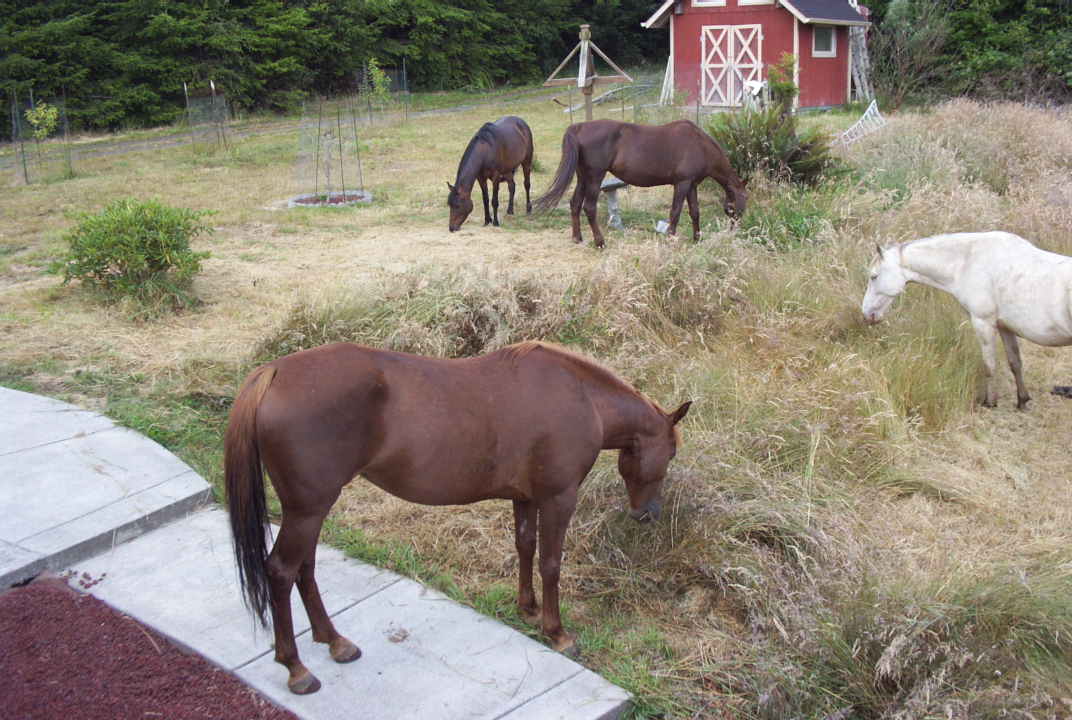
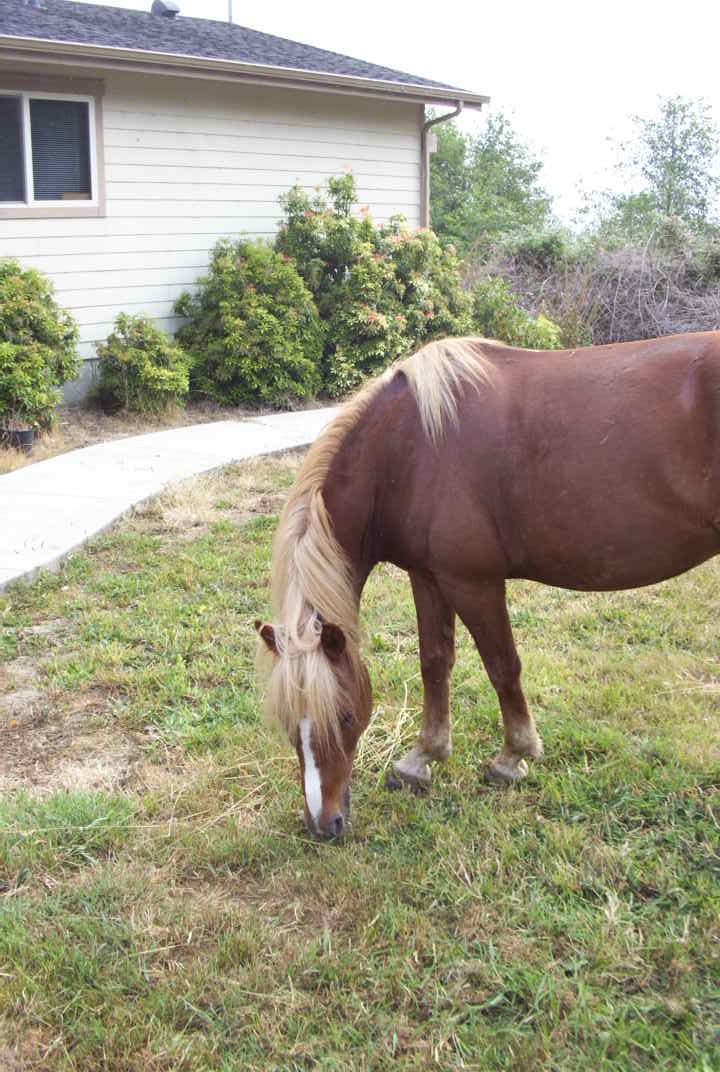
It's been a busy week. Woke up one morning to seven horses grazing around our house. I called the owner who showed up about an hour later, after he'd repaired the damaged fence that let them escape.

They were very friendly horses, but did leave too many droppings, munched or trampled decorative plants, tromped on sprinkler heads that my husband will have to repair (I haven't pointed them out to him yet). All in all, I'd rather they'd stayed home.

Our grandson is with us. He's fifteen. Unfortunately, the horses visited before he did. Maybe he'd have had more interest in them than in my tame Bourkes? I expected that he'd enjoy the birds...should never have expectations (especially of other people) and you won't be disappointed. Smile. So, no photos of him with the birds...at least not yet. He finds most things boring.

After the middle of the month we will have two granddaughters visiting. One of them is a bird lover like her grandmother...me. I look forward to her fresh, young attitude. She's still only seven and interested in everything her grandparents have to offer. Give her a few years and that may change.

As soon as the swallows outside my laundry room window were fledged, the whole bunch of them disappeared. Rather abruptly. I wonder if it's because we've had one of the coldest summers I've ever experienced in Oregon. Must be that global warming they've spent so much time talking about.

In the 1970's we were being warned about an imminent ice age. Never take any of it seriously, especially since many scientists in the know have debunked the global warming claims. But, our mainstream media refuses to hear them. The liberal mainstream media has its own agenda.

Our 12-year-old granddaughter tells me that in school they are being taught to say, "global change," and not global warming any longer. Guess they don't like having egg on their faces. Anyway, I believe the swallows flew south early this year because it's cold here. Most days it doesn't make it to 70 degrees, although we've had maybe two or three very warm days on the coast all summer. Europe had a year without a summer in it's history. This feels like ours. Not that I'm complaining...I like cloudy, cool days. Easier to put on a jacket than cool down when it's really warm.

Our grandson came from Texas and said it was 106 degrees there when he left. I'm glad we're in Oregon. I wonder if it's the weather that makes him want to visit us rather than that Grandma & Grandpa are interesting and fun...? Need to get him out of the house and busy doing something, but can't today. I'm attending a retirement luncheon for a friend. Tomorrow is committed too. He seems happiest playing video games. Is every young person today addicted to video games? Sure seems like it.

Until next time...I hope I'll have news about the birds. No eggs or babies at the moment.

Peace & Blessings.

Sunday, August 1, 2010

Splendid Results Not So Splendid...

Jewel, a Splendid hen, does a good job covering her five eggs.
Checked the nest boxes of the two Splendid hens. It appears that one has infertile eggs. I didn't disturb the other hen, and there should be signs of hatching, but nothing...no broken shells, so probably no babies for her either.  These two Splendid hens are very flighty, so I tend to leave them mostly alone. The males are friendlier.

I've had much better success with the Bourkes, and many of the Bourke hens are so used to me that I can lift them off their eggs and settle them back down without any fuss from them. Can't do that with these two Splendid hens.

Dad is Rainbow Junior, son of Rainbow Sr.
Wish I had a happier update about the Splendids. They've been given special diet aides and everything possible, even switched mates. Each pair accepted the other spouse. Males have been feeding hens and they've appeared to try to mate. But in the end, their mating attempts appear to have been a non-contact sport.  

Splendid Reflections: 40 Years of Grass Parrakeet Husbandry  Amazon.com link for a book by Alec Mizen

Friday, July 30, 2010

Added Tab on Ancient Aviculture Above

The article on Ancient Aviculture is so interesting that I added a tab above where new viewers have a better chance of finding and seeing it. The photos of ancient dovecotes are amazing.

Wednesday, July 28, 2010

BOURKES, COCKATIELS & EGG LAYING

Chloe asked, "I have a female pet cockatiel. She's going on 6 years old, and has not yet demonstrated any wish to lay eggs (although she has not had a mate). I do not wish her to start laying eggs - even though they'd be infertile - as I am worried about egg-binding, and other health issues.

This weekend, I will be bringing home a young male Rosey Bourke's. I've read from your posts that they will feed any female Bourke's or Splendid - sometimes even a less dominant male, and I was wondering if they would try that with a different species, as well (ie. my cockatiel)?

Should I be worried about him triggering her motherly instincts? Also, will he become protective of her, and become aggressive to me?"

Chloe, My experience is it's unlikely that a Bourke or Cockatiel hen will lay eggs if they don't have a nest box or similar "safe" place to hide in. Even when a male is present, they need that nest box. My first tame pair of cockatiels were in a large 3-sided cage that fit against a corner wall. When they started chewing a hole into the wall, I was annoyed and didn't realize at the time that they were attempting to carve out a nesting area. The hole got quite big, but before they could use it, they were removed and the whole wall covered with mahogany siding. (If the room's siding is ever removed, someone will wonder how that big hole got there).
 
As long as my pair didn't have a nest box (over a decade), the hen never laid an egg and no mating occurred.
 
With that same pair, I also had a tame blue budgie who was allowed out of his cage when the cockatiels were. He did all sorts of mating display behaviors in front of the cockatiel hen, but she ignored him. He was smitten with her, but she cared only for the male cockatiel... Who, by the way, never seemed to be bothered by the budgie's wooing behaviors. None of the three birds ever became aggressive to each other or to people. When a budgie hen was eventually provided, all four birds got along splendidly.
 
Although Budgies will attempt to breed with another species, Bourke's have never been known to do so. For this, and other reasons, they've recently been classified in a genus all their own, no longer with other Neophema's. It is unlikely that your male Bourke will attempt to feed your cockatiel. Hopefully, however, they will form a friendship of some kind.
 
There is no need to worry about him "triggering her motherly instincts," as it's her eggs that would do that. Also, having a hen around has never made any of my male Bourke's aggressive to me or anyone else. Their only aggression might be toward another male trying to steal their mate, but even then I've never seen them hurt each other (although for Splendid breeders, I have seen male Splendids draw blood on another male, and need to be separated). Bourkes tend to be very mellow, sweet birds.
 
Hope this helps. Good luck introducing your new friend to your older one. I wouldn't expect any problems.

Tuesday, July 27, 2010

Added "Question" to Labels

Each of my posts has labels listed below. If you choose one (a topic) and click on it, you will get all the posts related to that topic. I just added "Question" to the labels. To read the questions and answers from other readers, you can click on it and all of them will be brought up. Be sure to read any comments below each post too. Similarly, if you have questions about sexing your birds, you can choose that link, or any other of interest to you. Thanks!

Question on Personalities - Male or Female?

Marie asked: "My female 12-yr-old Rosy Bourke died yesterday. I have 1 one-yr-old female. Now should I get another female or a male?"

You have our sympathy. It's possible to become quite attached to our pets and Bourkes can be very sweet and interactive.

The obvious question would be, "Do you want to raise baby Bourkes?" I assume not, or you wouldn't be asking which sex is best...you'd already know you want a male. 

As a woman, even if sexual relations were not an issue, I'd rather live with my husband than my very best female friend. Your Rosy is probably no different. A female companion is better than none, but a male...well, he's going to mean a lot more to her.

If you don't provide a nest box, your pair will probably not breed. Nest boxes stimulate the urge to raise young. However, I had one experienced mother hen who didn't wait for me to return her nest box during the breeding season and laid an egg in her seed cup. This is unusual, however, and even less likely with a bird that's never raised young before.

Even though a pair without a nest box probably won't breed, the male will likely feed her. This is a bonding activity, similar perhaps to human kissing. It also proves he can be a competent father. Male Bourkes feed the hen while she's brooding and raising chicks. They later take over feeding the offspring when the young leave the nest and he helps them learn to feed themselves.

A happy pair of Bourkes will sit together much of the time and the male will offer to feed the hen occasionally. Male Bourkes are also lovely singers. They naturally wolf whistle (softly) and their songs are longer. They spend more time singing than hens do. They're also more active because of their courtship behaviors.

My recommendation is that a male will offer you (and your hen) more entertainment than will another female. Too bad you don't live in Oregon. I have two young male Rosy Bourkes available who are hand fed and very tame.

Best of luck and God Bless you and all your pets, four-legged or winged.
Smile.

Saturday, July 24, 2010

Personality Differences in Bourkes, Splendids and Budgies

As I played with my tame young Bourkes this morning, it struck me how different they are from other varieties of parakeet. I held a baby Bourke out for my husband to see and he instinctively reached over to pet it on the head.

“They don’t like that,” I said.

“Yes, I’ve noticed. They’re very different from the budgies, aren’t they?” he replied.

It’s true, Bourkes and Splendids are approximately the size of the common Budgerigar parakeet, but their personalities differ widely. Budgies and cockatiels like to have their heads scratched. Bourkes do not.
BOURKES: Although they sing, Bourkes are typically quieter than a budgie and less active during the day. They are happiest, most active and sing more often at dawn and dusk, napping a lot throughout the day, especially in the afternoon.

As pets, some Bourkes will nibble at you, offering kisses. They like to ride around on an owner and can be trained to prefer a shoulder to the top of your head. Some will even come to you when called, and bathe in a stream of water running into your hand. But, they are less likely to do either than a budgie. As a rule, they are more reserved and careful. A positive in their favor is that they don’t chew on everything in sight like a budgie will. If you line their cages with paper, some will chew on it and others won’t. However, those who chew it do so a lot less enthusiastically than other varieties of parakeet (so they’re less messy). I’ve read, but can’t confirm, that in a planted aviary, Bourkes leave the plants alone. Mine love greens such as lettuce and kale, so I keep house plants away from their cages to be safe.

SPLENDIDS: I’ve called these little birds clowns in the past and I still think of them that way. Not only are they brightly colored like clowns, they act the part. Splendids love toys and bright objects, especially mirrors. In the wild they feed on the ground and will spend a lot of time on the bottom of a cage or aviary floor. As for lining their cages with paper … expect it to be shredded regularly. They like to chew. And bathing is a must for them. They like taking baths and, unlike Bourkes, tame birds will easily bathe in your hand if you encourage it. Water is their element and water cups will quickly be filled with anything they can find to put in it. Hence, their water needs to be changed more often than any other bird species I’ve ever owned. They make soup of their water, placing veggies, paper, seed shells, whatever they can into it.

Splendids are more active than other parakeets. They do a lot of pacing when in their cage and probably are happiest in an aviary or, when tame, being allowed to fly about the room. Individual birds can be very interactive with their owners. However, if not tame, they tend toward being easily frightened. I keep a night light on in the room with Splendids after dark to protect them from crashing into the sides of their cages if something suddenly scares them.

BUDGERIGARS: Active and intelligent, the only drawback to a tame budgie is that they chew and can be noisy. Otherwise, they’re confident little guys who make great pets and are very interactive. They learn to repeat human words that owners can understand when no one else does. Clearly, they do not repeat as well as a parrot, but they try. They come in almost every color of the rainbow, except red or pink. Those colors are reserved for Splendids and Bourkes. Another plus in their favor is that their droppings are typically drier and more concise than other birds’. That might offset their tendency to shred paper and anything else within their grasp.

NEOPHEMA’S: There are many varieties of Neophema Parakeets and I’ve not experienced others, although I’d like to get to know Turquoisines better. Their colors are gorgeous and I hear they are a fun bird to keep. Perhaps someday I’ll find a breeder willing to accept a pair of Bourkes in trade for a pair of “Turqs.” Other Neophema varieties include: Neophema chrysogater, chrysostoma, elegans, elegans carteri, elegans petrophila and pulchella.

Parrakeets of the World  - The photo above was taken from this book. Here is a link for it at Amazon.com

Wednesday, July 21, 2010

Trouble with Blog Layouts

After wasting time fussing with broken links in this blog, it turns out that our broken links were caused by the previous layout. Switching layouts to the tan shade with the birds in the upper right corner that I liked was not a good idea. All links to other sites didn't work in Explorer. Oddly, they worked through the Firefox browser, so I blamed the Explorer browser, but when I changed to another layout, they work in both.

This is the third layout (I wasn't able to retrieve the very first one), the links work again! Ta dah! Hope you like this choice. It's still bird-ish ... Smile.

Now that the links are working again, I hope you'll take a look at my husband's novels through Cape Arago Press, or visit his blog: "Sowing the Seeds of Christianity" about its historical past. The books are fascinating, historically accurate novels about First Century Judea. The blog has amazing information. Check them out! Their links are in the left column.

Meanwhile ...


We have four birds on eggs, two Splendid hens and two Bourkes! Here are photos of each of the four. Other Bourke hens are poking around in their nestboxes, so hopefully we'll have more babies before the summer is over. So far, no Splendid eggs have been fertile ... maybe the third time will be the charm for these two. Smile.

God bless you and your love for birds!

Monday, July 19, 2010

Cats, Baby Swallows & Wild Mama Birds

We have three indoor/outdoor cats. As I've posted before, they know to leave our birds alone and also realize that they are expected to never threaten birds outside either. 

As baby swallows were growing up in the bird house outside our back door, their parents flitted back and forth ignoring the cats. Not so today! 

Fortunately, I saw them dive down to target our calico. As one swept down at her for the 3rd time she raised a paw in its direction and I shouted, "No!"
She crouched down and looked at me. As I walked over to her, I told her it was okay, that I understood. I lifted her and took her into the house. Much to their dismay, the other two cats were also relegated to be house-bound for the day. 

The young swallows are about to fly the coop, so to speak, and their parents are suddenly aware of the danger cats present. It's one thing to have cats around when your nestlings are snuggled safely in a secure box, but something else entirely when they are about to take their first flight.

Mei-Ling, our sleek black cat, isn't happy about spending all day indoors.

Something to watch for:  I'm starting another blog and currently setting it up. As soon as it looks the way it should (I'm close to having it ready), I'll post the link here. I'm an avid reader and writer, so a book review site seemed a logical step. I'm the moderator plus three reviewers at present, with more reviewers and more books to come. Smile. Actually, I started this bird blog as practice for a blog about writing, but this has become a joy to do! 

Aren't birds wonderful!?

Sunday, July 18, 2010

Swallows

Our baby swallows are still in the boxes outside my back porch. I love hearing them chirp. There are several in each box. This morning as I watched, I noticed that the parents not only carry food into their young, they also carry out droppings. They do all they can to keep the nest clean. Isn't that wonderful? 

These babies are fully feathered and nearly ready to vacate the nest. So, at full-size it has to be more work to keep the nest clean. Bigger birds, bigger droppings. It's no wonder parent birds begin to lose weight as their youngsters continue to grow.

The bird at right is a baby sticking his head outside the nest box. I tried to get a photo of his parents feeding him, but my camera isn't as fast as a flying swallow. 
We have bird seed feeders for other birds, but offer nothing but bird houses for the swallows. I'm thinking it might be nice to raise meal worms again and offer them to the swallows when they return next year. I used to grow meal worms in a large enclosed canister full of corn meal. The worms pupated and became beetles that reproduced and I always had a ready supply of live food for the finches I was raising. Haven't raised meal worms for many, many years, but it is tempting to do so. Then again, swallows do such a good job of ridding us of mosquitoes, do I want to feed them something else?

If you want to raise meal worms too, below are a couple of sites that give directions. Keep in mind, that I did well with one big container for everything. Just reached in to scoop around for the worms when I wanted them to feed the birds. They were always plentiful. I left the beetle and pupaes alone. The eggs were virtually invisible in the corn meal.

http://mealwormstore.com/raising_mealworms.php

http://www.efinch.com/mealworms/mealworm.htm

Tuesday, July 13, 2010

Hand Carved Egg Shells ... Lovely!

As promised, here are photos of Dixie Doris Bowman's beautiful hand carved egg shells. The Emu eggs were done by her daughter, Jennifer Sperling. 

There are shells from:  Ostriches; Emu's; Bob white quail; Pheasants; Tinamou's from both Argentina and Chile; Guinea fowl; Geese; Pigeons; Turkeys; Chickens, both Aracauna and Rhode Island Reds; and even diminutive Cockatiel eggs. 

I've given her Bourke & Splendid parakeet eggs, but have yet to see one carved. She tells me that the emptied shells have to dry out for a very long while before they're ready. Also, the shells have to be substantial enough to hold up to carving. My hens get plenty of calcium, so hopefully their eggs are strong enough. In case you're worried, I only provided infertile eggs.  


These beautiful works of art are for sale. If you're interested, you can contact Dixie Doris Bowman at 541-756-4998. She is located in Southern Oregon, USA.


As you can tell by this sign, a robbery occurred and many items were stolen. If you see any of these one-of-a-kind items, please let Mrs. Bowman know.  Thanks! 


Busy selling & shipping on ebay.

Haven't posted because we've been listing, selling & shipping items sold on ebay; time consuming! Not sure it's worth the trouble, but did it anyway. We sold a bunch last week and have more items for auction this week. My husband and I are seller:  45egl  (the last is the letter l, not the number).

Here are photos of our most recent baby. He is his mother's first offspring, is alone, and ready to leave the nest box.
We also have swallows in bird houses outside and I love hearing their babies cheeping. Two pairs have nests right outside our back porch window. I tried to get a photo of her coming or going, but they are so fast! The best I could get was her tail as she dove into the box.

We have several varieties of hummingbirds that migrate up from Mexico and nest near us. The Anna's hummingbirds stay all year round in Oregon (they don't migrate), so they can become quite tame.

Friday, July 9, 2010

Recognizing a Baby Budgie (Budgerigar Parakeet)

A friend asked me what inexpensive bird would make a good pet for her nine- year-old son. What could be less expensive, or more fun than a Budgerigar parakeet?

They are very domesticated and make wonderful pets, especially for children. They are hearty birds whose average lifespan is 6 to 8 years, although many live much longer. I had one white female who lived to be 12 and I’ve known some to live as long as 14 years, although that’s unusual.

Female Budgie
At pet shops in the USA Bourkes and Splendids can be $150 or more, whereas, a young budgie may be $15 to $25, making them a good first bird for children. A child should be able to handle the budgie and not be bitten, so you want a tame, friendly bird.

How can you ensure that will happen? Look for a very young Budgie. When very young, they tame down easily and will like being held. This post is to help you identify that baby. Let color influence you to some degree, but personality is more important.

Male Budgie
The photo to the left shows an adult female budgie. Her cere (nose or nostril) is brown. The budgie on the right with the blue cere is a male.

The budgie with an almost colorless, pinkish or white cere is the youngster. A black smudge across the beak like the one below has is also a good indication that it’s a baby. Not all babies have that black smudge, but if black is present on the beak, it’s a very young baby – a good sign! The black smudge will quickly subside. Notice, too, that the eyes on this baby are very dark and don’t show a ring around the iris. That’s another helpful clue. However, most important is the color of the cere…it should not be brown or blue. If it is, then the bird is an adult, or very close to it.

If there are other birds present, observe them. Babies will looks “soft” … Their feathers will appear fluffy … difficult to describe, but there is a slight difference in the appearance of a baby’s new feathers and that of an older bird.

Very young Budgie. Cere hasn't changed color yet.
Be sure the baby’s vent (under the tail) is dry. Budgerigars have nicely formed droppings that aren’t as “wet” as other birds. If the feathers under the vent are soiled, avoid the bird as it might be ill. Unless they’re sleeping, healthy birds are active and curious. A curious budgie is likely to make a better pet that will be highly interactive with humans.

Good luck! Budgies are sweet birds, easy to raise and maintain. There’s a reason they’ve been so popular for many centuries.


Upcoming Post: Intricately carved egg shells by Doris Bowman, from Cockatiel to Ostrich.

Wednesday, July 7, 2010

Bourke & Splendid Update on Switching Mates

BOURKES:
This post is mostly about disappointments, however, keep in mind that we did just band baby Bourke #25…so there is also much good news for 2010.

Currently, Brandy is on three eggs with Rory. He never produced fertile eggs with Bella and we hope he does better with Brandy. She is the hen who had a baby savaged and others injured. I had to rescue all her babies with Chitter and hand feed them. Now, Chitter is with Bella (Rory’s former mate). Chitter and Bella are successfully raising one baby, the only fertile egg that Bella has ever laid. This baby is still in the nest, but fully feathered and has never had any injury. So, Chitter and Bella may prove to be a happy, successful pair with Chitter exonerated.

If Rory is also unable to fertilize Brandy’s eggs, then perhaps she is the best hen for him to have, since it is beginning to look like she is the guilty party who injured her young. Brandy is currently on two eggs with more expected. She came from one of our best breeding pairs. They were wonderful parents. One of Brandy’s hand fed daughters is my favorite bird…very affectionate, very intelligent and so sweet. Genetics isn’t reliable at predicting what a bird’s (or a person’s) personality is going to be like.

Sugar is back on three eggs. She and Spice have had two previous clutches that were fertile, but did not hatch. She seems devoted to incubating her eggs, so I don’t believe the problem is that they got cold. Must be something else. Spice is a hand fed Normal Bourke. Rosie, my favorite hand fed Bourke hen, is very interested in him. If none of Sugar’s eggs hatch this time around, I may replace Sugar with Rosie. Sugar isn’t tame, and for that matter, isn’t as pretty as Rosie. I could put Sugar with Spicy’s father, Bing Jr., as his hen, Willow, is older than Bing Jr. and she’s no longer interested in brooding.

Decisions, decisions, decisions.

SPLENDIDS:
If you’ve been following this blog, you know that our two pairs of Splendids haven’t produced any youngsters for the past two years.

And so, this year I swapped Splendid mates. Although Rainbow and Rivka were observed attempting to mate, her eggs were not fertile with him either. It’s so disappointing! The other new pair took longer to become friendly with each other. The hen, Jewel, has entered the nest box and Rainbow Jr. has been feeding her. However, no attempts at mating have been observed. It seems unlikely that she will hatch her eggs either.

There is one other recourse available, short of finding new Splendids, which I haven’t been able to do. We have two extra Splendid males. Unfortunately, Flip is unable to fly due to a “window accident” as a very young bird … hence his name … after his accident, when he tried to fly with his injured wing, he’d flip over. The other male, Rudy, is one I traded for. He came from the same breeder who provided the hens and the breeder can’t tell me whether the three birds are, or are not, related to each other. I had hoped to acquire another hen for Rudy, but it has never happened. I’m considering putting him with one of these hens and see what happens. They just might accomplish something.

Decisions, decisions.

Looking ahead to future posts:

• Budgies make great kids’ pets. How to be sure the Budgerigar parakeet you buy is a young one.

• Photos of intricately carved egg shells.

Thursday, July 1, 2010

Splendid red chests

In an earlier post Ron in Delaware asked about whether his Scarlet-chested parakeet might eventually acquire a redder chest. In thumbing through my copy of "Parrakeets of The World," by Dr. Matthew M. Vriends, I came across this photo representing a typical pair of Splendid parakeets. 

Although my own Splendid males have very splendid red chests (pun intended), obviously not all do. As I mentioned earlier, people are trying to produce other colors in the Splendids. However, even if one has red all the way down his front, or is all blue, I like the contrast of the bright yellow next to the red. This pair doesn't look typical to me. All the Splendids I've ever owned have had brighter colors all over ... red, yellow turquoise and blue.

This photo isn't taken as close, but you can see the brighter colors even at a distance. What I notice most about photos of male Splendid parakeets is that a camera cannot capture the iridescent quality of their cobalt blue faces. In fact, in all the photos I've taken, the males appear to have lighter blue faces than they actually do. In real life they are so much more beautiful than in pictures.

My copy of "Parrakeets of The World" was published in 1979. However, Amazon.com appears to have more recent, inexpensive copies. Here are scans of the front and back cover of my hard copy  book.

I glean valuable bits of information from many bird books, but ignore  any material that I disagree with.  "Take what you like and leave the rest."

To my USA Friends: Have a fun, safe Fourth of July Holiday.

Click to Link to Amazon for this book:  Parrakeets of the World

Tuesday, June 29, 2010

Bird Shows – Also Buying Birds

In my previous Blog I promised Noah to talk a bit about my experience at bird shows. They are exciting and lots of fun. However, it’s a good idea to know how to reach the breeders/sellers after the show. Most have business cards, pamphlets, or something. If not, ask for a contact number and hope it’s real. You should recognize healthy birds and avoid those that seem lethargic. Expect healthy birds to be active, or at least responsive to you when you approach or talk to them, they should have dry vents and clear, alert eyes ...

The best price I’ve ever found on cages was at a bird show. I’ve since ordered more online, but shipping costs made them more expensive than from the bird show, and they were exactly the same. Boxes of California millet at the show were also more reasonable than from our local Grange. And, the quality was better.

When I decided to raise birds again, I investigated varieties that I’d not previously owned. Bourkes were said to be quiet, peaceful parakeets in addition to being beautiful. That won me over. I started looking for breeders, but none were close. However, there was an annual bird show in Hillsboro, Oregon and they listed Bourkes as a variety being offered. It was a 4-hour drive for us, but it turned out to be well worth the trip.

Our first bird show wasn’t as huge as others I saw in Ohio, but there were a lot of bird dealers present with all kinds of birds. The number of finches was particularly impressive. There were also lots of parakeets, and at least three people had Bourkes for sale. The one thing I never saw at any of the Hillsboro shows was a Scarlet-chested, or Splendid, parakeet.

The best-priced Bourkes were offered by an elderly woman from northern Washington near the Canadian border. A friendly male Bourke came right up to the side of the cage when I talked to him, so he was my first pick.

The friendly hen I selected at the show apparently had the same color band as the male indicating she was a close relative. So, she stayed and the woman pointed out another hen she was certain was unrelated. I took her and named the pair Rhett & Scarlett.

Scarlett turned out to be a wonderfully sweet bird, but not very robust. In her too short lifetime, she produced only one baby, Bonnie. However, she fostered another bird’s egg and when a hen rejected a newly hatched chick, I gave it to Scarlett whose infertile eggs were close to a hatch date. She fostered the baby … something that’s not supposed to happen. As I said, she was a very sweet bird. Yet, fostering that baby wore her down and she died before the baby was fully weaned. Rhett finished feeding it. Although elderly, Rhett is still with us and still producing!

A year after buying Rhett & Scarlett, I chanced to see an ad in our local shopper for Exotic birds and called to see if they might have Bourkes. Turned out that she had individual pairs of many kinds of birds, and Bourkes were one of them. I bought the Rosy pair and her only pair of Splendids. Later, I had an opportunity to buy two Normal hens from a bird store that was going out of business.

The Rosy male was quite a singer, so I called him Bing (as in Crosby). His mate became Cherry. They did not reproduce, so he acquired a Normal hen, dubbed Stella (a variety of cherry tree). Bing and Stella became champion producers and very tame, wonderful birds! As we’ve discussed before, all their Normal offspring were males and all their Rosies were hens. The males were the brown wild shade like their mother and the Rosy hens were dark pink like their father.

After Scarlett died, Rhett acquired Willow, the other Normal hen. He fed her and wooed her, but they never reproduced. Eventually, Willow found a mate with Bing, Jr. and they’ve done remarkably well at producing beautiful babies. Although Bing, Jr. is a Normal Bourke, as is Willow, their daughters have all been Rosies, and all the Normals have been males. He has to be heterozygous.

As Willow transitioned to Bing Jr., lonely Cherry went into Rhett’s cage. It was love at first sight, even if Cherry is a bit bossy. They have produced quite a few beautiful Rosies and Rhett’s sweet nature over-shadows Cherry’s pushy personality.

Wanting to add new blood to my lines, a few years later I made another trip to Hillsboro for the annual bird show there. I bought a beautiful Rosy Bourke male to put with Bonnie (actually not the first Bonnie who died young like her mother. This one is out of Rhett & Cherry). He became Clyde, and they’ve done well together.

That same trip, I also bought a white faced pair with pink eyes. They were a mistake. I bought them from the same woman I bought my first young pair from. She said she simply wanted to downsize her flock, but I suspect these were not two-year-old birds like she said. They had not interest in breeding and within the first year, the hen was dead on the floor. The male moved to an aviary elsewhere in trade for a Splendid hen. He did reproduce for that person, however, and I actually have a male Bourke out of that union … another trade.

So, maybe the buy wasn’t too terrible, as I ultimately got a Splendid hen from it. She mated with a son of Merlin & Millet, my first Splendids. That union produced three more sons, however, the hen died of egg binding with her second clutch. So sad. Merlin & Millet’s son, Rainbow, has had two other hens since then, but all eggs have been infertile.

In the past two years, poor economy has caused the Hillsboro bird show to be cancelled. With the price of gasoline so high, fewer people attended and many out-of-area sellers weren’t willing to make the trip to Portland, Oregon any longer.

***

The single baby photos are of our most recent addition, Band #25 for 2010, out of Chitter and Bella. As an aside, Chitter is the father of three clutches (8 babies) with Brandy, and an earlier clutch of three with Candy. All of Brandy’s babies had to be removed and handfed because of one death and injuries to other babies. He was my first suspect. However, no harm has come to this little one. Is Bella more protective? Or, was it Brandy who was guilty all along? If she has a clutch with her new mate, Rory, we shall see. I’m monitoring Chitter’s offspring, and later will monitor Brandy’s offspring very closely. Don't want to lose any.

Shared the photo of Australian parrots just because they're pretty and added a lot of color. Smile.

Peace & Blessings!