Thursday, September 30, 2010

Red Mutations: First Red Factor African Grey Parrot

Hello All!

Lovely scalloped pattern. Red under wings too.
I stumbled upon these photos of a completely red African Grey Parrot and was thoroughly intrigued. So much so, in fact, that I wanted to share them with you. This bird was bred by Hennie Diedericks from South Africa.

Rosy Bourkes were also domestically bred from Normal Bourkes. Maybe someday Red Factor African Grey's will also be available as pets to people all over the world. They're certainly beautiful and desirable! I hope they retain their high level of intelligence and exceptional ability to talk just like their natural wild-colored grey cousins.

First Red Factor African Grey Parrot, 2007.
These photos also led me to search out other beautiful pink or red birds. In upcoming blogs, I'll post photos of pink birds in addition to my Rosy Bourkes and Scarlet-chested parakeets. I'm especially fond of Rose-breasted cockatoos, for instance! However, I've found many unusual varieties, all very interesting to me, and I hope they will be to you too.

Click below to view a film of this amazing red African Grey.


Eyes are dark like other African Greys.


(Update on 8/31/2017:  Apparently You Tube has removed the video link that was originally available. So, I removed it from here too. Enjoy the photos that might not be available elsewhere any longer ... ?)

Peace & Blessings!  

Sunday, September 26, 2010

Baby Bourke Parakeet Banding

Example of supplies to have ready.
Supplies Needed: Mineral oil, a plastic lid or other small container to hold a few drops, a toothpick, a paper towel and the band(s).

Cherry with her baby before banding.


This baby is about the right size for banding. Any smaller and the band will come off. Mother birds sometimes try to remove them. At nine days old, his feet are just the right size.


Bands should be slid over the three longest toes first. You will probably have to grab them on the other side of the band and push it back toward the "knee" joint. Mineral oil on the band helps this process. Some people use petroleum jelly, but I like mineral oil.  Still holding the band back on the leg, the last toe to go on is the smallest, inside toe. It's necessary to use a toothpick to pull it outside the band.

If you don't need a toothpick to get the small inside toe out of the band, the bird will probably lose the band in a day or two and you'll have to repeat the process when his foot is a little larger.


Baby is now safely home with his mom.

Happy Banding!

Friday, September 24, 2010

Newest Baby Bourke Parakeet

Our most recent baby Bourke. Two other hens are on eggs, and another is in the nest box getting ready to lay.

Healthy chick, almost ready to band.

Checked on baby when his mom exited the nestbox.

Five eggs, but only one hatched. Remaining eggs help keep a baby chick warm.
If you're new to my site, you might also enjoy seeing photos of
The link takes you to my post from last June that compares baby Bourkes, Splendids and Budgerigars.

Books below are some I'm considering. If you've read any of them, or decide to buy one, let me know what you think of it. Thanks!  Have a wonderful weekend!  

Monday, September 20, 2010

Warning - energy efficient light bulbs, especially dangerous to birds

I accidentally dropped an incandescent light bulb this morning. Thank goodness it wasn't an energy efficient bulb! The mercury in the energy efficient bulbs is dangerous to us & our pets. When broken, the mercury that's released can be especially lethal to pet birds. Disastrous!

I have 28 birds in the house right now, not counting eggs & babies in nest boxes. I'm so glad this bulb wasn't one of the energy efficient bulbs. I plan to stock up on incandescent bulbs before our gov't makes sure only the so-called energy efficient bulbs - that are not really energy efficient at all - are the only ones we can find to buy...

Dirty Electricity: It might be poisoning us. This video explains it.

Sunday, September 19, 2010

Bourke & Splendid Updates - Successful Hatches and Not

 SPLENDIDS: 
Scarlet-chested parakeets, male on right

As you know, my two pairs of Splendids haven't raised young for the last couple of years. Their eggs have been infertile. In fact, neither of our two hens have ever raised a chick. So, with four male Splendids available, we decided to move Rudy in with Rivka and put Rainbow (the patriarch) in with our other bachelor male, his son Flip.  Rainbow Jr. is still with Jewel. 


Rivka & Rudy ... not very used to each other yet.
 I moved Rivka to another cage and nest box, in addition to giving her a new mate, hoping one or the other might stimulate her to mate. Rivka and Rudy are investigating the nest box, so we shall see. She hasn't allowed him to feed her yet, although he's tried to. I am only "cautiously" optimistic.


Cherry, a Rosy Bourke hen. One egg has hatched, see broken shell at right.
 BOURKES:

As for the Bourkes, my elderly Cherry hatched an egg this morning. Four were hers and one is a fostered egg. Since her eggs were older and I'd given up on them, I think the one that hatched is the fostered egg. She hasn't left the nest box for me to investigate, however. How do I know an egg hatched? She's covering everything, but there is a broken egg shell present ... a sure sign! It's above her head near the wall of the box. The other is an unhatched egg.

The egg Cherry fostered is actually one that a daughter of hers laid on the floor of the cage and I rescued. Later, that daughter went into the nest box and laid more eggs, so I could probably have put it in her nest box, but I trust Cherry more than I trust the younger hen. I am hopeful that the young hen will soon hatch hers.

Candy is fluffed up to cover her eggs. She's not upset.
Candy and Dolph also have eggs. They are a proven pair, so I expect their eggs to hatch in the near future. Happily, we will have more Bourke babies this year! We had many early in the year and then I closed the nest boxes for three months to let the hens rest. Subsequent clutches in the summer didn't produce anything and I thought maybe that was it for the year. Now, it looks like we may get some more baby Bourkes. Hurray!

Until last year, I always removed nest boxes in the Fall, cleaned them and put them away until Spring. However, after an unproductive summer last year, I discovered that my birds did well breeding in the Fall. Perhaps they will do the same this year. 

May all your eggs hatch and your birds never stop singing. Peace & Love. 

Busy with Book Blast - Need to publish a Bourke Book

Books make great gifts!
Cape Arago Press  has suggested I gather my experience together in a book on Bourkes & Splendids. I'm very tempted to do so. What do you think? Any chance there would be a few buyers out there?

Here are photos of the "Book Blast" at Pony Village Mall in North Bend, Oregon last Saturday. This project has kept my husband and me very busy for several weeks. It was his brain child and required a lot of time and effort.

Twenty-five authors were present to meet & greet...sign & sell.  E.G. Lewis has three wonderful novels and we managed to sell several. Amazingly, most of our sales were to people who had either already read WITNESS and DISCIPLE from his tradmarked "Seeds of Christianity" series, so they bought PROMISES; or were recommending the books to friends who came with them. Everyone who has read them, raves about them...

The books are available at Amazon.com, Barnes & Noble or any bookseller site, including my husband's publisher, Cape Arago Press.  Ed writes as E. G. Lewis.

Love, Peace and Blessings to all of you.

Thursday, September 16, 2010

Flame - An Alert, Playful Bourke Parakeet

I took this photo by holding the camera out in front of me.

As I write this, Flame has discovered that I have new glasses. His favorite thing is to fly to my shoulder and when I turn my head to speak to him, he pecks at my glasses.

Now, he's throwing his head back and staring at me, unsure what to do. He's flown away several times and returned for another look. He knows it's me, but he's not happy with the new look.

Where's his familiar toy?  Smiles...

Currently sitting at my computer making signs for a Book Blast at Pony Village Mall in North Bend, Oregon on Saturday, Sept. 18, from 10 a.m. to 3 p.m.  Approximately 25 authors will be there, including my husband and me. We'll be selling novels WITNESS, DISCIPLE and PROMISES both as hard copies and as eBooks on CD.   For Novel Information click here.

Friday, September 10, 2010

Bourke Parakeets as Pets – Taming Parakeets

Young Bourkes tame down as easily as young Budgerigars. I’ve read accounts that even if they’ve been living in an aviary for a year, they will still tame down if handled properly. This is less likely with budgies. No matter what bird you get, the younger they are, the easier they will be to tame.

Each individual bird has a personality all its own, however, and variances in ability to tame them exists.

If your young Bourke was parent fed and weaned, it won’t be as immediately friendly as a bird that was hand fed by a person. Don’t let that stop you from attempting to tame the bird. When it first comes into your home, give it a few days to calm down and adapt. Speak softly to it through the cage. Allow it to get used to you and your voice. Spend only about 15 minutes working with it the first time you take it out. The timeframe can get gradually longer as the bird seems less frightened of you.

When you first attempt to tame the bird, you need to be in a safe, enclosed area. No window glass or mirrors should be present that the bird will assuredly fly into, possibly injuring itself. Read my earlier post on safety and preventing injuries. If the room can be darkened, that may help you, but what works best for budgies isn’t as effective with Bourkes that are used to being active in the evening when the light is dim.

The bird will be stressed and need rest after your attempts to tame it. Remember to keep the first sessions short. When the bird flies from you, retrieve it, but don’t grab it and get bitten. The best way is to put the back of your flat hand in front of the bird’s chest and slowly push upward forcing the bird to step up. Always talk softly in a friendly voice to the bird. Keep attempting this until the bird is tired and stops flying away from you. It is best not to let it rest between your attempts. It is necessary to follow it all around the room, retrieving it from curtain rods, chair backs, etc. It won’t step up at first, but eventually it will. When it does, continue talking softly to it, telling it what a good bird it is for standing on your hand. Over time you can use a single finger in this same way, but a flat hand at first is probably less frightening to the bird. When it’s on your hand, lift it up a few inches from your face, look it in the eyes, and speak with a smile in your voice. Birds are visual creatures and looking the bird in the eyes is something they relate to and expect when being communicated with.

Some people prefer to clip a bird’s wings so that it cannot fly away. You can do this and it won’t hurt the bird. The feathers eventually grow back. However, I don’t find it necessary to cut wing feathers. Even with their wings clipped, birds are still able to do some flying and often flop onto the floor…hopefully on a carpet and not tile. Also, it seems to me that birds whose wings are clipped will resent that treatment and not soon forget it. I want a tame bird that will honestly feel affection for me, so I avoid clipping wings.

Once your young Bourke is sitting on your finger, continue talking “sweetly” to it. Slowly walk it back to its cage and put your hand and the bird inside. It helps if you are fortunate to have a large cage door. Gently, press the bird’s perch against its chest until it steps off your hand and onto the perch.

With enough daily attention, you may one day have a Bourke who will fly to you when called and possibly even bathe on your hand as you hold it next to a small stream of water from your faucet. Be sure to frequently repeat its name so that it learns to recognize it.

Be certain there is always fresh, cool water available, especially after your Bourke has been flying around outside its cage. After your first few training sessions, your bird will be hot, tired and stressed.

Tuesday, August 31, 2010

A Design for Building Parakeet Nest Boxes

Here are several photos of nest boxes we built for our Bourkes and Splendids.

Splendid nest box above, Bourke below.
     Nest boxes can be easy and inexpensive to build. If they're being used for budgerigar parakeets, you will need to carve a round dent in the bottom so that their eggs remain in that area. Budgies don't require any nesting material, but do need a circular indentation approximately two inches in diameter (across), gently sloping inward toward the center until about 1/4 inch to 1/2 inch deep at the center. It should not be any deeper than this. The indentation is put in the center of the box floor.
     Bourke and/or Splendid parakeets lay their eggs in nesting material, and most seem to choose a corner of the box. The best nesting material seems to be pine shavings which can be purchased by the bag. Pine shavings are also used  in pet cages for hamsters and other rodents. Do not use cedar shavings...the smell offends the birds and they are unlikely to use the box.


Rosy Bourkes happily using a cockatiel-sized nest box.
Many variations are possible.
     Instructions to build a standard-sized parakeet nest box have been written up by Ed Lewis who made those in the photos. He placed the directions in a pdf version. Simply click the link below and you will be taken to a site where you can download and print the instructions. If you have any problem understanding them, don't hesitate to contact us. They were easy for me to follow, but I watched the nest boxes being built ... Smile.

<><>
Peeking inside.
This is how we attach them to cages: with 8 inch "cable ties." Drill small holes in the side you've cut longer.
This link will take you to directions for Building a Nest Box.
They can be downloaded for free and saved to your computer. 
P.S. Ed is also E. G. Lewis, author of WITNESS and DISCIPLE, novels you can learn more about by clicking on the Cape Arago Press link in the sidebar at the left.
Peace & Blessings.

Wednesday, August 25, 2010

Visiting granddaughters with Bourkes ... Hard to keep all five in one place at the same time. ;-)

Saturday, August 21, 2010

Granddaughter with my best Bourke, named Rosie!

     Enjoying my granddaughters for two weeks. Seven-year-old is a bird-lover too and can't get enough of the birds. Twelve-year-old doesn't seem to care ... smile.

     Birds in the upper cage are tame youngsters who come out to fly around and visit with us. All other cages only house one pair each. We avoid over-crowding ... honest. 

     Rosie & Flame are two hand fed, tame Bourkes hatched last January. They're my favorites and will remain here as pets. 

     Birds in the upper cage are expected to move on to other homes.  Currently, we have five Bourke hens either investigating a nest box, or already sitting on eggs. All had clutches earlier in the year, then took a three-month rest (nest boxes were removed to stop them from laying). Boxes are now reattached for another attempt at raising additional babies this year.

     I love our sweet Bourkes!

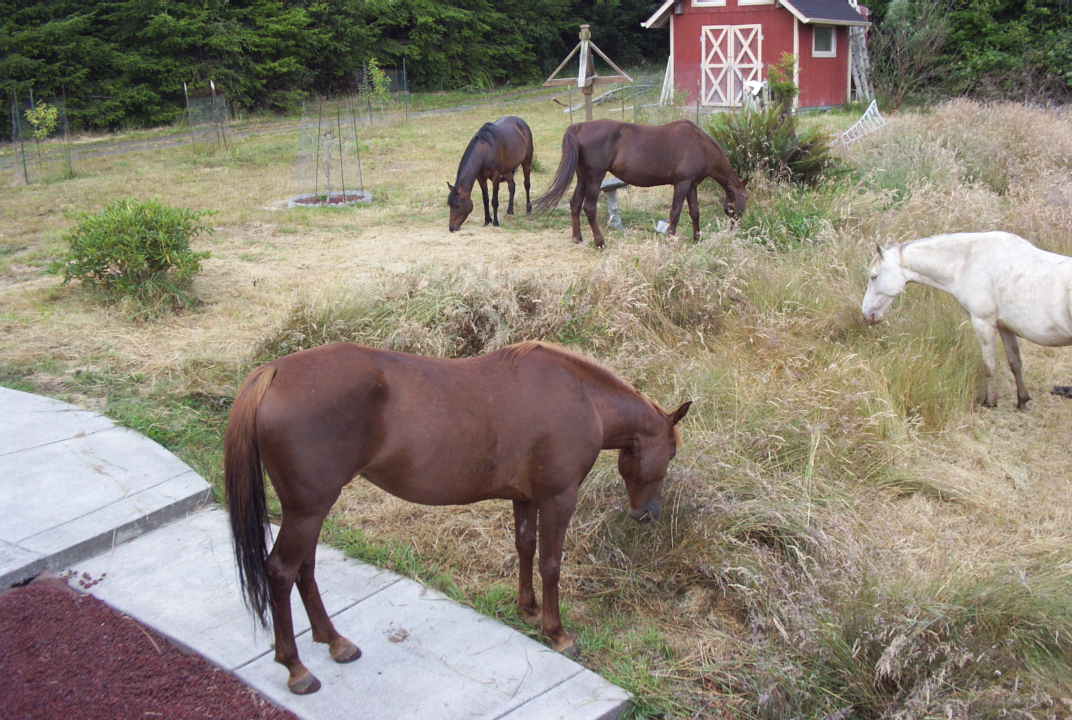
A neighbor's horses compete for attention with the birds.

Friday, August 20, 2010

Question on Egg Laying & More on Recognizing Sex of Birds

A Rosy & a Normal Bourke. Both are males.
Kim writes that she recently adopted three Bourkes, a Rosy and two Normals. The Rosy was supposed to be male, but has laid four eggs. Kim threw out the first three, but now the hen is sitting on the fourth egg. She’s concerned for its health and isn’t interested in raising more birds. She had several questions, addressed below.

A male Normal Bourke. See blue above cere.
I feel sorry for your little hen if she's trying to sit on an egg on the floor of her cage... She must be desperate to raise something. Is one of the other birds feeding her? Males feed females they consider their mate, even if they don't breed. Typically it’s a nest box that triggers egg laying, but I had one hen that used a seed cup. I quickly gave her a nest box and she moved into it. If one of your other birds isn't feeding her, you may only have three hens. Or, perhaps the other two consider themselves to be mated and she's the 3rd bird out... It should be apparent that you have a pair if one is feeding another. Bachelor males will sometimes try to feed another male, but hens don’t normally feed one another.

Since you've searched and been unable to find Bourkes in the past, you might consider allowing these to breed and offer the youngsters to a local pet shop. There might be others who'd like to have them and it would generate some income for you, which would help cover the expense of the birds. You say you’re concerned that they might be related. Although it's preferable not to allow birds to mate with a parent or sibling, it's not as disagreeable as it is for mammals. It's a risk worth taking if you want to.

Colors are brighter on male Normal Bourkes.
A Splendid is behind him.
Be sure your birds have cuttlebone and mineral block to insure they get enough calcium. If she's laying eggs, she needs it more than ever. Oyster shell and grit are good too. She might continue to lay a number of eggs if you keep removing them. By allowing her to sit on the fourth egg, she will probably not lay more right away. That's better for her (unless you decide to offer a nest box and let her raise a family).

To discourage egg laying, provide less light. As we move into fall and winter, keep them in a room where the lights go off as the sun goes down. Farmers stimulate their laying hens to keep producing eggs by extending their day length with artificial lighting. Leaving the lights on in the evening will similarly affect your Bourkes. You asked about removing a male, and I wouldn't recommend it for preventing egg laying...it's not likely to have that effect and will leave one of your three birds very lonely.

Sexing your Normals should be an easy thing. As I've mentioned in previous posts, Normal males have a tiny row of blue feathers over their cere (nostrils)...females don't. A very young male will develop it around 6 months of age or so. A male’s pink chest and the blue on his shoulders also tend to be brighter than a female's. It’s hard to recognize, however, except when you have them together and compare them.

Good Luck! I hope you have a male ... their songs & wolf whistles are lovely. Enjoy your sweet birds.

Tuesday, August 10, 2010

Breakfast for Bourke's

The month of August is very full for us as three of our six grandchildren will be visiting all month.

This photo was taken by my 15-year-old grandson, Matthew, who was willing to take the picture for me. Although, perhaps in typical teen-age male behavior, he refuses to have his own photo taken. Smile.

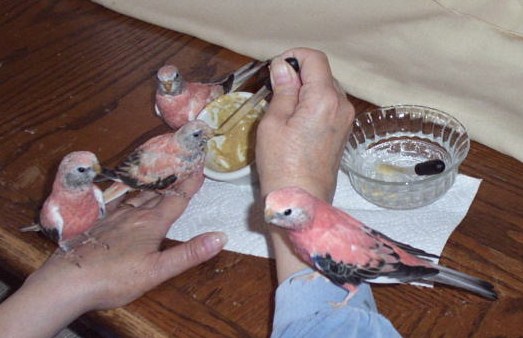
I'm feeding a baby Bourke and our young adult, tame Bourkes are helping themselves to some Exact Hand Feeding formula too. It's a bit of a treat for them. They don't eat much of it, but they always want a taste or two. It seems to help keep them engaged with me vs. flying around and pestering our other birds...those who aren't allowed out for free flying. I'd have to get a net to catch the others, and frankly, there are too many and nets upset all of them.

Currently, I have five who enjoy free flying with me each morning. The cats and dog go outside and then the birds fly freely for a little while. Fortunately, they are usually willing to return to their cages when I want them to.

Bourkes are very sweet-natured birds and typically quieter than most.

Kaytee Exact Hand Feeding Program for Birds  I haven't seen this video, but found it offered at Amazon.com for anyone who is interested. 
May the rest of your summer be blessed and your birds remain healthy and happy!

Original Background is Back!

Took a bit of fussing, but finally found and returned to my original background in Blogger. The hummingbird background was nice, but it kept getting darker and brighter as you moved down the blog. I found that distracting. This one is softer and I like it better. Hope you do too.

Sunday, August 8, 2010

Tame Bourke Parakeets and their Differences

Flame in back, Rosie in front. My favorite birds.

This is a photo of my two favorite Bourke parakeets. At present, I have 22 Bourkes and six Splendids.

Actually, these two are brother and sister, although they came from different clutches. Rosie's parents put their youngsters at risk (discussed earlier), so her clutch of four was pulled and handfed very early on. Rosie, in front, grew up with three wonderful siblings and it was difficult to decide which one to keep and which of them to sell. I wanted to keep them all. She was selected because even at a very early age, she always flew to me directly from the cage, or from anywhere else when I called her. That helped me decide to keep her.

Baby Bourkes ready to sell.
I expected to hand feed an unrelated baby and try to match "him" up with her. However, in a later clutch from her parents, one began to feather in a deep rose color. Darker than any of my other birds, I decided to keep him and named him Flame. Now, I have the dilemma of choosing mates for each of them! Instead of decreasing my flock as I wanted to, I'll be adding to it.

Rosie and Flame help tame other babies as they fledge. The wonderful thing about Rosie and Flame is that whenever they come out to fly ... just about every morning ... when it's time to go back in their cage, they go without any trouble. Not so, with many of the babies who often resist going home to a cage and would rather keep flying about the room. Hence, I'm very fond of Rosie and Flame because they are so willing to do whatever I ask of them.  

No matter how many tame youngsters I have out at a time, Rosie is the one who always chooses to stay with me. She gives kisses, let's me kiss her back and stays with me most of the time. She's very affectionate. On the other hand, Flame will sit on my shoulder, but doesn't interact as much. She's curious and investigates anything I'm doing.

We visited North Bend, Oregon's new Boardwalk yesterday. The photos below are taken there. Happy Sunday everyone and God bless you.


Taken from North Bend, Oregon Boardwalk.

Friday, August 6, 2010

Viewer-ship Passes 2,000! And a shameless promotion for my new Blog.

UPDATE on Sept. 10, 2011 ... Had 40,000 more views over the past year. We are now at 42,000 views. Amazing. Click "HOME" button above to view recent posts.

As of today, this site has been viewed over 2,000 times. Two Thousand and Eleven views since Dec. 11, 2009. It's great to know there are so many people interested in Exotic Birds.

To see where the views came from, click on "Visitors to this Site," to the right. You'll have to use the back button to return to us.

This blog is NOT going away. I love sharing information about my little feathered friends. However, I am wandering afield with this post. Here's why ...

Since my husband is a novelist, I recently started "Summit Book Reviews" to promote books (not only his). As an avid reader, I look forward to that.  I know there are many readers out there who love good entertaining books, and I look forward to seeing Summit Book Reviews quickly increase in popularity.

If you like to read, Summit Book Reviews is well worth a look. Please help raise the readership! Smile. See if you can spot your red dot on "Visitors to this site." It's only updated once every 24 hours, so you'll need to return to check it out.  There aren't many dots there yet (hey, it's brand new!), so it should be easy to recognize yours. Not as easy on this blog, however, but go ahead and try...just remember to use the back button to return. 

THANK YOU! Here is a link to Summit Book Reviews:

Friday Update, Visiting Horses and Grandchildren

It's been a busy week. Woke up one morning to seven horses grazing around our house. I called the owner who showed up about an hour later, after he'd repaired the damaged fence that let them escape.

They were very friendly horses, but did leave too many droppings, munched or trampled decorative plants, tromped on sprinkler heads that my husband will have to repair (I haven't pointed them out to him yet). All in all, I'd rather they'd stayed home.

Our grandson is with us. He's fifteen. Unfortunately, the horses visited before he did. Maybe he'd have had more interest in them than in my tame Bourkes? I expected that he'd enjoy the birds...should never have expectations (especially of other people) and you won't be disappointed. Smile. So, no photos of him with the birds...at least not yet. He finds most things boring.

After the middle of the month we will have two granddaughters visiting. One of them is a bird lover like her grandmother...me. I look forward to her fresh, young attitude. She's still only seven and interested in everything her grandparents have to offer. Give her a few years and that may change.

As soon as the swallows outside my laundry room window were fledged, the whole bunch of them disappeared. Rather abruptly. I wonder if it's because we've had one of the coldest summers I've ever experienced in Oregon. Must be that global warming they've spent so much time talking about.

In the 1970's we were being warned about an imminent ice age. Never take any of it seriously, especially since many scientists in the know have debunked the global warming claims. But, our mainstream media refuses to hear them. The liberal mainstream media has its own agenda.

Our 12-year-old granddaughter tells me that in school they are being taught to say, "global change," and not global warming any longer. Guess they don't like having egg on their faces. Anyway, I believe the swallows flew south early this year because it's cold here. Most days it doesn't make it to 70 degrees, although we've had maybe two or three very warm days on the coast all summer. Europe had a year without a summer in it's history. This feels like ours. Not that I'm complaining...I like cloudy, cool days. Easier to put on a jacket than cool down when it's really warm.

Our grandson came from Texas and said it was 106 degrees there when he left. I'm glad we're in Oregon. I wonder if it's the weather that makes him want to visit us rather than that Grandma & Grandpa are interesting and fun...? Need to get him out of the house and busy doing something, but can't today. I'm attending a retirement luncheon for a friend. Tomorrow is committed too. He seems happiest playing video games. Is every young person today addicted to video games? Sure seems like it.

Until next time...I hope I'll have news about the birds. No eggs or babies at the moment.

Peace & Blessings.

Sunday, August 1, 2010

Splendid Results Not So Splendid...

Jewel, a Splendid hen, does a good job covering her five eggs.
Checked the nest boxes of the two Splendid hens. It appears that one has infertile eggs. I didn't disturb the other hen, and there should be signs of hatching, but nothing...no broken shells, so probably no babies for her either.  These two Splendid hens are very flighty, so I tend to leave them mostly alone. The males are friendlier.

I've had much better success with the Bourkes, and many of the Bourke hens are so used to me that I can lift them off their eggs and settle them back down without any fuss from them. Can't do that with these two Splendid hens.

Dad is Rainbow Junior, son of Rainbow Sr.
Wish I had a happier update about the Splendids. They've been given special diet aides and everything possible, even switched mates. Each pair accepted the other spouse. Males have been feeding hens and they've appeared to try to mate. But in the end, their mating attempts appear to have been a non-contact sport.  

Splendid Reflections: 40 Years of Grass Parrakeet Husbandry  Amazon.com link for a book by Alec Mizen