Sunday, December 12, 2010

Splendid Bourke Parakeets, or those Moody Bourkes & Splendids

Hello All,

Why are you so cranky today?
Seems like I've been posting a lot about wild birds lately. I could go on some more about the rowdy Steller's Jays outside ... those pretty dark blue birds, but it's about time I returned to the designated topic!

Splendid male keeping company with a Rosy Bourke hen.
This is about moody, or occasionally temperamental parakeets. I admit to naming one of my tame Bourke hens "Trouble." Probably haven't told you that before since it's not a positive name. Smile.

Trouble is a hand fed hen hatched early last year. Her brother is "Pastel" because in addition to pink, he has light yellow on his wings and blue on his rump ... three pastel shades. Trouble received her name after frequently refusing to go back into her cage. Of all my tame birds, she's always the last to go home. Catching her can be a lot of trouble.

Yet, she loves to fly onto me, take baths and eat from my hands. She's very tame. The trouble with Trouble is that she's probably TOO smart. They're all smart, but she's too smart for her own good. I had decided to sell my little trouble maker, but now changed my mind ... again. Very unusual for me...yea, right.

Most Bourke faces are darker than these two who have pink eyes.
This morning Trouble decided to stay with me almost the entire time she was out of her cage with the other tame birds ... six all together. She nibbled my hair and talked to me, being very loving. How can you sell one that does that? Silly, huh? Then when I decided they'd all been out long enough, I walked to Trouble's cage with her, Pastel and Flame on my shoulders. When I opened the door and leaned toward it ... all three went in! That was a first for Trouble. She was very mellow and sweet today.

Hand feeding makes any bird very tame. One baby being fed.
The others are older and occasionally like a taste of baby food.
Sometimes before I open the door and let everyone fly out, I will put my hand into the cage and invite them to ride out on my hand. Yesterday, for some reason Pastel refused to get on my hand. Now, this is unlike him. He's usually the first to jump aboard, but not yesterday. In fact, after everyone else was out, he still wouldn't get on my hand. After chasing him around the cage a couple of times, I told him he was welcome to stay home, that I wasn't going to open the door and let him fly out. He had to do it my way or stay put. So, he didn't get out yesterday. Today, however, he was very friendly and first to jump on my hand ... go figure.

What I'm leading up to with these stories is that birds have mood swings too ... just like we do.

Pink-eyed Rosy Bourke couple.
Some refer to the lighter shades as Pink Bourkes.

Snowbird, an albino budgie we had for 12 years was quite a character. She was very tame when out of her cage, but if you put your hand in her cage, watch out! She would attack the intruding hand and actually bite it, sometimes hard enough to break the skin. But, open the door and invite her out and she was gentle as could be. Pick her up and she wouldn't bite. There was something about her cage being her castle and she didn't want intruders. Cleaning her cage took place when she was out of it! Snowbird was purchased as a companion to Skybird, a tame, blue five-year-old budgie. A year after we bought Snowbird, our much sweeter Skybird, was dead on the floor at age six. He loved her too much, perhaps?

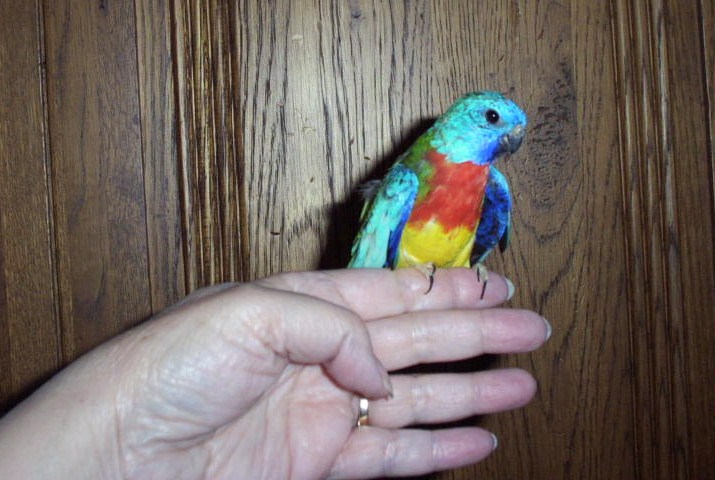
Splendid or Scarlet-chested Parakeet Pair. Hen is below.
As for Splendids ... well, every one of them is different too. Aging Rainbow isn't as tame as he was as a youngster. He doesn't bite, but he also prefers not to come out of his cage. His companions are my tame Bourkes and he gets along fine with them, but since his mate passed away over a year ago, he's lost his vim and vigor. Wish I could find him another mate.

Friendly Pair of Splendid or Scarlet-chested Parakeets.
His mother, Millet, was the sweetest Splendid I've ever owned ... well, maybe her daughter, Jewel, was just as sweet. I made no effort to tame Millet as she was purchased as a breeder. Yet, I could put my hand in her cage and she'd nibble my fingers or take treats from them. She was a wonderful little bird married to a terror ... her mate, Merlin, pulled her feathers and was abusive. Yet, he fathered and cared for his young. Fortunately, his sons and daughters all seemed to have their mother's personality.

Pair of Normal Bourkes in their wild color. Hen in front, male in back.
They say that Bourkes will never mate with any other species of parakeet. Yet, when Millet died and Merlin was alone, I put this male Splendid in a cage of single female Bourkes. One Normal hen (native color) decided she wanted to mate with him and gave him her "come-hither" behavior. Eventually, he paid attention.

Splendids have interbred with Turquisines and other small parakeet varieties, but never Bourkes. He decided to give it a try. Unfortunately, his normal behavior was to pull out a feather from his mate's back before lifting his second leg up. The first time he did it to Willow, the normal Bourke hen, she looked startled and moved away. The second time he pulled out one of her feathers during an attempted coitus, she attacked him! From then on he was terrified of her and kept his distance. That was fine with her! There's a lesson in that. Ladies don't accept abuse, or you may die young like poor, sweet Millet. Be a Willow! Willow eventually got a mate, younger than she, and they raised many, many baby Bourkes, both Normals and Rosies. She's now retired and he's still her loving companion.
Willow!

Saturday, December 11, 2010

Hummingbirds Being Stalked by a Cat or a Hawk?

You know how the sky is before the sun comes up, but there's already light outside? I wanted to allow whatever natural morning light there would be into the house for the birds this morning. So, very early I drew open the window blinds to cloudy wet skies and dim light. Sitting on the railing of our west deck was a rain-soaked hawk.

My digital camera isn't fast enough to snap a
photo of our local hawk, so I borrowed this one.
Our hummers are prey!
I've seen him only twice before and wrote about how he panicked the Bourkes through the window. This sighting was auspicious since I'd mentioned him to my husband as we lay in bed last night. About two weeks ago I started to step out onto the back porch at the south side of the house, and looked down before stepping out. I always check before I step. By doing that I've been fortunate to miss stepping on a tiny green tree frog and another time a small preying mantis. Our back porch is open, but has a roof over it, so little critters sometimes find refuge there ... especially when the weather turns cold.

This time, two weeks ago, there was something strange laying on the door mat. I feared it was a large spider and stepped over it, but it didn't move. I leaned in for a closer look. Sadly, it was the head of a hummingbird! My first thought was to blame one of the cats ... how dare they! We have three hummingbird feeders and, as I've mentioned before, our cats have been trained with a loud "NO BIRDS!"  By learning to first avoid the birds in the house, and with the same command repeated many times outdoors, I thought they'd come to avoid outside birds too. It was perhaps only ten feet away from one of our feeders, and I was shocked to see it.  But, which cat did it? How do you scold the perpetrator if you can't be sure who it was?

As we discussed this last night, my husband noted that he has never seen a cat decapitate a bird. Eat its breast meat maybe, or kill it to fling it and play with it, but decapitate? However, an animal that wanted to eat a hummingbird wouldn't eat the long sharp bill. We tossed around the possibility of the small hawk we'd seen, but I dismissed that. He'd been hunting little rabbits and mice, but surely not swift hummingbirds! Today's discovery of him sitting on the railing of the deck about 20 feet away from one of our feeders waiting for a hummer to land changed my mind. He is the culprit! The cats are vindicated.

My husband asked, "Shall I chase him off?" That was a tough question. He's very pretty and he needs to eat too. However, we decided that stalking our hummingbird feeders is not fair game. So, we did chase him away to go back after rodents. Leave our lovely little hummers alone!

Thursday, December 9, 2010

Cats with Tame Birds, a Tale of Five Bourkes and one Splendid Parakeet

Sweet Patches asleep on a pillow.
This is a cat story. I've talked about my cats with the birds before, but our cats never cease to amaze me!

I have six very tame birds within my menagerie of over a dozen parakeets. Five are Bourkes and one is a Splendid. These favorites of mine get to come out of their cages for free flight and lots of attention fairly frequently.

When they come out to fly around I generally keep them confined to two rooms of the house where it's safe. They can fly back and forth between the two rooms (living room and kitchen), visiting the other birds and my husband or me by landing on our shoulders, arms or hands.

Baby birds being handfed are in box inside cage.
Patches likes being near their electric heater too.
When the birds are allowed free flight, the cats are either outdoors, or shut in a bedroom. It's not that they aren't always trustworthy when the birds are in their cages, but why tempt fate with birds who are flying everywhere.

Yesterday, after the birds had been out of their cages for about an hour, it was time to put them away. I'd been puttering in the kitchen over dirty dishes, watering plants, and assorted odd jobs while the birds flew on and off me, tickling my ears, flying onto my hands and generally having fun. Of course, they'd made lots of wild flights into the living room, circling around many times. They like to exercise and chase each other.

What makes this time different is that when I walked into the living room to gather them back to their cages, our elderly calico cat stood up on my desk chair, leisurely stretching. On the wood floor about five feet in front of her was my Splendid, Rainbow, walking around on the ground as he likes to do. She could easily have leaped on him! The birds had flown over and around her for an hour or so and she had made no attempt to harm them! She could easily have swiped or pounced on several of them while I was in the kitchen and I might not have known.

Patches likes keeping me company as I
pursue another past time, knitting.
Now, this is a cat we have not had since she was a kitten. I think it's easiest to train cats you've raised. However, she was a sickly stray who survived in the woods near our home for at least four or five months before I was able to catch her and get her well. We've rescued other cats that we didn't keep, but in very short order she walked up to our big Malamute/Lab mix and rubbed up against him. I figured if she was going to make friends with him that easily, she deserved to stay with us. Besides, she's very pretty. 

Over time we've come to trust our cats enough that we don't worry about leaving them alone with caged birds while we're outside in the garden, or off to another room to work on a project or something. However, if we expect to drive away to go shopping, to church, or wherever...then we confine the cats to a bedroom or let them outdoors if that's where they prefer to be when the weather is nice. I don't leave them alone with our birds for hours at time. Yet, we have accidentally left a cat asleep in a chair and gone off for a full day, only to find it was in the house all that time with access to the birds, but nothing happened.

But, leaving them alone while the birds fly free is a different story. A bird's flight should excite a cat, right? One swipe and a cat can bring a bird down. I've seen Mockingbird's with a nest in a lime tree chase a cat who ignored them until one day she reached up and killed one. Fortunately, the bird's mate continued to feed and raise their young, but it never again dived at that cat.

One of my favorite cats of all-time, Mei-Ling. Introducing her
to a baby Bourke while also getting him used to her. Notice she
has no claws out. She's curious, but not overly so.
She quickly lost interest.
Sleek black Mei-Ling has been with us since 7 weeks of age and is now 4 1/2 years old. I'd be less surprised if she ignored free flying birds.

Yet, as a stray Patches survived many months alone by hunting birds, mice and anything else she could catch! With yesterday's peaceful acceptance of birds flying all around her, she has gone up in my estimation by over 100%. My husband says she knows which side her bread is buttered on and isn't going to risk being tossed out. Not, that I'd do that. Nor will I deliberately release the birds in her presence again. Why tempt fate.

Oh, by the way, our big old "Malamutt" is safe around the birds too. He's even had them land on him. He doesn't particularly like it, but he doesn't hurt them. They think he's just one more member of the family, which he is. Smile.

May all your pets bring you boundless love, comfort and blessings.

Tuesday, December 7, 2010

Bjarne's Birds: Photos of Bourkes, Splendids & Turquoisines in Color Morph's

I had six tame Rosy Bourkes and one male Splendid out for free flying today. About an hour later, all the Bourkes went back to their cages on my finger without any problem. Got no arguement from them.

The handfed Splendid, however, refused to go home. Eventually, I got out a net and caught him with it. He didn't seem to mind... He knew he was supposed to go home, and must have figured he deserved to be caught in a net. I rarely use a net, but he just would not go back in his cage.

Found this site full of fascinating color changes in both Bourkes and Splendids.

I don't think you can breed a prettier bird than a male Splendid parakeet in his natural state. However, Bjarne's photos of birds he's bred for different colors are all very interesting.  I once thought I might like to try and breed a solid black budgerigar, however, if it takes 22 aviaries like Bjarne has for his parakeets, I'm not up to it. Smile.

Hope you enjoy his photos. 

Bjarne's Birds ... Interesting Bourke & Splendid color changes

Wednesday, December 1, 2010

The Splendid Bourke Bird Blog versus Sowing the Seeds of Christianity Blog

(Don't miss the hummingbird video at the end).

This blog is about six months older than my husband's blog and for a long time I had more readership than he did. Now, he's passed me by. For the month of November this blog had 1,735 views and his had 2,644! That's only 909 more than me... :-)  Sowing the Seeds

Yet, I suppose there are a lot more people in the world interested in Christian history than there are those of us who love birds. Me, I'm interested in both! Smile.

My husband is diligent about blogging three times a week on Monday, Wednesday and Friday. Diligent is not a word I'd use in relation to my blogging...

I've reposted two of my husband's bird related blogs here, one on Ancient Aviculture and one on the History of Pet Birds. I suggested them to him!

Currently he's chosen a theme for December, "All Things Christmas." You might want to have a look. He's an excellent 1st century scholar, writer and novelist. A link in the left column via the cover of  "Witness" (for Witness & Disciple videos click here) will direct you to more information about his fictional, but accurate portrayal of first century life in Judea. The characters should touch your heart. I think his second novel, "Disciple" in "The Seeds of Christianity(TM) Series" is even better. The third, "Apostle" is expected in February, 2011. Can you guess the title of the fourth book? Perhaps I shouldn't tell, but will...it's "Martyr," however, which characters and how will be a surprise.

Along with my blogging, and my own attempts at having a novel published, I get to enjoy doing the first edits of his novels. They're also available as e-books.

On another note, if you read my earlier post about our snow, it melted within a couple of days. It's actually warm here on the South Coast of Oregon today...in the high 50's (Fahrenheit, not Celsius). Still lots of hummingbirds visiting our feeders, but haven't seen our local hawk for several days.

The video below, although of Alaska, is a wonderful film of hummers like those we see every Spring and Summer. The little Rufus hummingbirds really are as aggressive as in this video. We've been able to have them eat from our hands too. It's a wonderful experience. I use a red lid, but NO food color. Boil four parts water to one part sugar and allow to cool. I make four cups of water and one cup of sugar to fill three feeders one or more times a week. In hot weather, it needs to be replaced often or it can ferment. In winter, it lasts longer.

Peace & Blessings!

Friday, November 26, 2010

Casual Friday with Bourkes and Hummingbirds ...

Snow on the South Coast of Oregon is unusual.  It snows in Eastern Oregon a lot, and in Eugene or Portland a few days every year, but seldom down here. The coastal climate is moderate in winter and summer.  That said, we got three inches of snow on our hilltop this week! Rare, amazing and beautiful. Must be the so-called global warming. Right. In the 1970's they were warning that another ice age was coming. Truth is, no one has a clue.

Anna's Hummingbirds don't migrate like the others we see in Spring and Summer. So, they are grateful for the several feeders we put out around the house. They're agressive, however, and one usually claims a feeder as his own and tries to chase everyone else away. Hence, a good reason for multiple feeders. These are some of ours. 

They always have a bird on or near them, guarding his treasure. But, if he flies after a trespasser, another bird will slip in for a sip before he gets back. They're fun to watch.


----------------------------------------------------------------
Can I ride along?
On a different note, Rosie is my favorite Bourke. She's a handfed hen hatched late last year. When she and the other tame birds are out of their cages, the others come and go on and off my shoulder. However, she typically stays with me wherever I go. Probably why she's my favorite...


What's this? I like the clicking it makes.


My hands don't look like they did when I was 20 to 40 years old and proud of them, but time marches on for all of us...  I'm grateful to still be here and able to enjoy being a wife, a mother, and a grandmother with a dog, two cats and over a dozen beautiful, sweet birds.
Let me make it turn!

Whooo...what's under there?

I haven't blogged as often lately because I'm trying to make time to finish a novel. Here she is trying to help! She likes the quiet clicking of the mouse wheel when it's rolled and can't figure out why she can't make it do it herself. 

Birds are all curious, playful creatures.

Hope everyone in the U.S.A. had a wonderful Thanksgiving Holiday.
Worldwide: God Bless all of you, your loved ones and all of your wonderful pets.
***

Friday, November 19, 2010

Birds and Their Feathers: Selecting a Healthy Bird

Healthy Splendid Parakeets, Rainbow & Jewel.
When selecting a bird to add to your flock or as a pet…There is much to be learned by examining a bird’s feathers since feathers are a good indication of a bird’s health and well-being. Molting is a normal process where feathers are periodically lost and replaced with new plumage. I’ll attempt to identify the difference between a molt and when something might be wrong with the bird, such as disease or malnutrition.

One-week Rosie Bourke babies, pink tipped feathers
just starting to show.
Budgerigar parakeets (budgies) appear bald when they hatch. Bourkes and Splendids both have “natal down” covering them. Like any chick, it’s wet at first hatch, but quickly dries to become fluffy. These are actually downy feathers, those that provide added warmth by underlying the larger outside feathers in mature birds. A baby bird’s feathers begin to form in the follicles as the bird grows. These appear as darkened areas under the skin that are easier to see in larger birds than in small parakeets such as Budgies, Bourkes, Splendids and other small members of the avian family.

Feathers gradually protrude through the skin, encased in a sheath. The fuzzy tips of feathers soon begin to show through the end of the sheath. If you are raising Bourkes and have a mixed pair (one Rosie and one Normal), you can begin to recognize their future color at this stage. Rosies will show their pink at the ends of feather sheaths on their backs one to two weeks after hatching. You’ll also know their sex since color is sex-linked in Bourkes. Hens from mixed parents will be the color of their father. Males will be the color of their mother.

Rosie Bourke babies with some down still present.
No stress bars on them. Lines are color and fade as they mature.
Until their first molt, most young birds have the same color plumage as the hens of their species. This is especially true of Splendids. Males develop their scarlet chest after their first molt. However, even the rose color in Bourke males’ deepens and seems to become richer as they mature.

Sexing Baby Splendids: Although young Splendid parakeets look like mom at first, you can lift their wings and look for white bars on the bottom of their wings to help determine males from females. The undersides of the wings of adult Splendid males are all black. Youngsters with white bars (or stripes) under their wings are female. However, some have broken white bars and that makes identification trickier since they could be either sex. In my clutches, however, the hens have had solid white bars and the broken white-barred babies grew up to be males that later filled in with black after their first molt.

Close up of healthy feathers on a Rosie Bourke.
Healthy feather development requires adequate nutrition. If there is a disruption in the absorption of nutrients when the feathers are developing, stress bars may appear on the feathers. In this case, feathers may be a normal length, but with a line across them where areas on each of the shafts are empty of the colorful pieces that poke out and lock together. This can be caused by digestive disturbances, pro-longed periods of chilling, or the bird not being fed enough as the feathers were developing. They can appear as dark lines or white lines, depending on the color of the feathers.

If only one or two feathers have these bare areas, they are probably not stress bars. This can happen when a feather sheath isn’t preened off soon enough. What you need to watch for are continuous lines of stress bars.

Yet, a bird with stress bars may since have recovered and be healthy. If it's healthy, replacement feathers won't have the stress bars. If it is a bird you’re considering purchasing, you might want to wait and watch, skip that bird and look for another, or have the bird evaluated by an avian veterinarian before purchasing it.

Molting is caused when feathers are pushed out by new feathers coming in below them. A bird should never have bald spots because of a molt, and most birds molt the same feathers on both sides. The easiest way to recognize a molting bird is the feather sheaths you will see at the wings, tail or head. Lone birds will have more trouble preening these off than if you have a friendly pair. They will help preen areas for each other that they cannot reach, for instance, the top of their heads.

Damaged feathers also occur if birds fly into things, or from over handling. See my articles on safety.

As always, looks at the bird's eyes. They should be shiny and alert. Not half closed or watery. Also, inspect the bird’s vent. If feces have gathered there, the feathers around the vent are wet and/or soiled, that’s a bird to avoid as it may be ill. You don’t want to introduce that bird to your other birds. New birds, even apparently very healthy birds, should be quarantined for ten or more days before introduction to your others. If at any time, one of your birds appears ill, address the problem promptly and keep it separated from your others to avoid spreading the problem.

Friday, November 12, 2010

Splendid Parakeet Portraits, Scarlet-chested Neophema's

Rainbow, son of Merlin & Millet. Now our old Patriarch.

The flash reflects off their faces making them look turquoise
like their shoulders, however, their faces are actually a dark cobalt blue.
I love my birds and tend to cover much more about Bourkes than my Splendids. That’s probably because I have 22 Bourkes right now, 19 Rosies and 3 normal’s. No doubt that’s why I successfully raise more Rosies than Splendids, hmmm?

Yet, my clownish, very fun Splendids deserve attention too! I only have two hens, but have four male Splendids, all in their normal wild color.

Rainbow is the father of two of our other males, Flip and Rainbow Junior. Handsome Rudy came to us in a trade for one of Rainbow’s other sons in order to introduce genetic diversity.

Although Splendids don’t sing as lyrically as a Bourke parakeet, they do call back and forth to each other, especially the two bachelors who want mates of their own. Not an easy feat to find them though.

If you keep birds, you’ll find the colorful Splendids lots of fun. They love to tear up paper, play with toys and are crazy about swings! They like taking baths, and water cups are just another plaything for them.


You can see some of the shiny, dark cobalt blue of his
face under his beak. The wing color is correct, but their
faces are actually very dark blue, almost black.

Photos at right and below are of Rudy. Hole in nest box doesn't have to be so big. They adapt to various sizes.

They do like to put things in their water! Change their water dish at least once a day or more, and provide them with another source too. A tube of water on the side of a cage works well. It isn’t as likely to be splashed out. Keep an eye on it too, however, because it is likely they’ll make soup in the basin of it as well.
Here is a better depiction of a Splendid's true face color.
As an afterthought, here are other relevant photos, even though they've been posted in earlier articles.
These are young Splendids. Hen is below.
Males above do not have all their scarlet color yet.

Young Male Splendid with a young male Normal Bourke (in wild color).

Very young Splendids. Actually there are four males and
one hen in this cage, but their color hasn't come in yet.
At the time the photo was taken, I didn't know their sexes.
As they matured, the hen had to be removed as she was so outnumbered.


Young Splendid hen with her first egg.

May your Birds Bring You
Peace & Blessings
and Keep You Smiling!

Tuesday, November 9, 2010

PET BIRDS IN THE FIRST CENTURY: African Greys, Alexandrine Parrots & Lovebirds

I admit that I didn't write this post. Because it's about birds, I borrowed it from my husband's first century historical site:  http://seedsofchristianity.com/wordpress/

PET BIRDS IN HISTORY
An African Grey Parrot in the wild.
Birds have been popular pets from earliest times. Hieroglyphic records indicate the Egyptians kept them 4,000 or more years ago. The Romans also kept many varieties of birds as pets. Parrots were most popular because of their color, but they also kept crows, magpies and starlings because they, too, could learn to repeat words. Pet birds were so highly prized, that in wealthy Roman households sometimes a slave’s only assignment was to care for the birds and teach them to talk. The common man, without the connections and affluence required to obtain the more exotic specimens, would have made do with native species such as finches, doves, etc.

The ancient Jews clearly kept pet birds. Duet 22:6 warns, “If you come across a bird’s nest beside the road…and the mother is sitting on the young…do not take the mother with the young.” Robbing a nest would have been a common way to acquire birds for pets or resale. Job 41:15 asks, “Can you make a pet of him like a bird?” And Jeremiah 5:27 says, “Like cages full of birds…”

WHERE THE BIRDS CAME FROM
A large portion of Europe was under Roman control, but the northern latitudes don’t have the colorful birds most favored as pets. And two modern sources of exotic birds, Australia and South America were both unknown. However, Rome’s influence extended into Africa which is home to a variety of colorful parrot species.

Currently, one of the most popular parrots is the African Grey. They are generally acknowledged to be among the smartest of all birds and are known to have vocabularies of up to 500 words. They surely would have been popular in Roman times as well.

An Abysinnian Parrot
Africa is also home to nine species of Poicephalus, or short tailed, parrots. Widely dispersed, several of these species exist in slightly different forms so that they represent a total of 24 varieties when the subspecies are included. One example in this group is the Abyssinian Parrot. It lives wild in northwest Somalia, across northern Ethiopia and into the Sudan. They generally live in areas that are lightly forested and, though this species generally travels in small groups, they sometimes gather in flocks of over a thousand birds. Abyssinian parrots belong to the ring- necked subspecies and are commonly kept as pets.

A wild Lovebird looking out from
hole in tree with nest.
Lovebirds, Psittaccidae Agapornis, are also native to Africa. There are nine subspecies of lovebirds, meaning that these beautiful and popular birds can be found in a wide variety of colors and colorations. They are intelligent, affectionate, and playful little birds who form strong bonds with their owners. 

THE PARTHIAN CONNECTION
The eastern boundary of the Roman Empire butted up against the realm of the Parthians. This area was once part of Alexander the Great’s Empire. Following the death of Alexander, Parthia became a Seleucid governorate under Nicanor. Their sphere of influence extended from the boundaries of Roman Syria to the Indus River.

The Alexandrine Parakeet or Alexandrian Parrot is named after Alexander the Great, who is credited with exporting the birds from Punjab into various European & Mediterranean countries. Given their relationship with Alexander, they became prized possessions of nobles and royalty. The species name eupatria translates to noble ancestry.


The Ultimate Gift an Alexandrine Parrot

The Alexandrine Parrot is a larger version of both the Indian and African Ringneck. They look so much like their smaller cousins that they are sometimes accidentally classified as one of their more popular cousins. All Alexandrine Parrots exhibit the classic ringneck look: dark green bodies, long tails, red beaks, and yellow eyes. The only difference between them and their smaller relatives are their maroon patched wings and larger bills.

One of the Alexandrine’s smaller cousins, the Indian Ringneck Parakeet, can speak so clearly that once monks considered them sacred after hearing one repeat their daily prayers. This big talking, medium-sized bird is capable of reciting long and complicated excerpts from books, poetry, and scripture.

Indian Ringnecks Can Recite
Long Passages of Scripture
By the First Century, Rome had several hundred merchants ships traveling across the Red Sea to India to import pepper. It’s not hard to imagine a bird trader wandering the docks with a cage of birds that he’d trapped and tamed. Who better to sell them to than foreign merchants docked at the harbor?

The merchants would transport the birds back to the Egyptian port of Bernike and resell them to someone heading for Rome or any of the other capitols of the Empire. After all, if Herod the Great were in Rome and happened to see the talking bird Caesar had, wouldn’t he want one too? And if it were the current fashion, wouldn’t Pontius Pilate’s wife, Claudia Procula, want some lovebirds dangling from her ceiling in a gilded cage? Just because they were living out in the sticks didn’t mean she had to live like a peasant. Besides, who did she have to talk to all day? Pontius was always tied up with paperwork, centurions and that high priest, Caiphas…

So were the early Christians familiar with exotic pet birds? The answer is clearly, Yes they were. Did they own them? Maybe, maybe not. Some Christians came from elite families and could have easily afforded to purchase such a pet. Others were poor and would have had to make do with sparrows, wrens, finches, and doves.

Traditional tells us Saint John kept homing pigeons as a hobby. What about the boy Jesus? Did Joseph perhaps construct a cage out of willow branches and wood scraps to house the little desert finch Jesus brought home? It’s certainly not beyond the realm of possibility.

Tuesday, November 2, 2010

Parakeets Are Desirable Prey For Hawks and Falcons

If the Internet sources can be trusted, there are 16 varieties of hawk and 37 different species of falcon. This could make it difficult to identify the small raptor that tried to get into my kitchen this morning.

If only the flash hadn't automatically
discharged! Reflection hides hawk.
Our bump-out with birds inside.
We have a bump-out nook off the kitchen with a plant shelf. Instead of plants, I have four large cages sitting on the shelf with a pair of Bourkes in each, plus one baby recently out of the nest. There are windows on three sides of the shelf. Early this morning, all nine birds went crazy.

A small hawk was flying very close to each of the windows and peering inside at the birds. A nice snack for him! When he couldn’t reach them, he lit on a deck post right outside their window and continued to watch the birds. They did not like it!

Juvenile Sharp-shinned Hawk.
Photo by Kevin T. Karlson

I grabbed a camera, and headed for a window, fixed the bird in the center of the viewfinder and clicked. The flash went off automatically. Drat! He flew away, and the flash’s reflection in the window destroyed any hope of getting a picture of him.

Several hours later, he flew past again, but didn’t land or stay long enough for me to retrieve the camera. However, it was another opportunity to study him and that’s when I decided he most resembled a Cooper’s Hawk or a Sharp-shinned Hawk. Wish I had a picture specifically of him, but he looked just like many of their photos on the internet, some provided here. Since he was small, I believe he was a juvenile Sharp-shinned Hawk. He was very mottled brown, not grey.

There are about 50 species of falcons and hawks in the genus Accipiter. Females are naturally larger and weigh more than males. The smallest falcon is only 9-11 inches long and weighs about 4 ounces. The largest weighs about 2 or 3 lbs. and is 19-24 inches long. A falcon’s lifespan can be as long as 17 years. Large hawks live longer as size is relative to lifespan. Red-tailed hawks have lived 29 years in captivity, although in the wild their average lifespan is only 12 years.

 provided the following information:

Juvenile Birds of Prey
Cooper's Hawk


Sharp-shinned Hawk
Juvenile Sharp-shinned and Cooper's hawks have yellow eyes, dark vertical stripes on their breasts, and variable brown backs and heads with some white spots.

Heavy, bold, reddish streaks on chest and belly.

Usually has a pale stripe above the eye. Finer streaks mostly on upper breast; lower belly mostly white. Often reddish color on side of head and nape.
Photos by David Smith, Grand Junction, Colorado