Friday, May 20, 2011

Bird Leg Deformities

If you missed the comment question at the end of the previous post, here it is with my answer:

“Hi Gail! I am about to get a baby Bourke's - I've had tiels and doves and others (some handicapped) for the last 30+ years, but have never had a Bourke. This baby is special, having a leg apparently splayed to the rear. If I could post a photo, I would... apart from offering flat perches, etc. do you have any advice to offer? Have you ever seen a defect/deformity of this type? The baby does attempt to use the leg/foot."

Answer: I once had a Budgie who lost a leg to a cat. She managed to live out a long life by standing on one leg and did okay. She could fly and land on a perch one-legged. Animals are amazingly adaptable. If your bird seems to fall off perches, then a low perch is wise, or possibly a flat shelf. Bourkes are sweet little birds and yours should make a nice pet in spite of the deformity.


That said, here is another possibility. See the photos sent to me early last year by Debbie in San Diego. This baby Splendid parakeet had a problem that was possibly worse than your Bourke’s. Look at the solution Debbie in San Diego devised. It seemed to work for this baby.

Debbie wrote:
“Scarlet is still doing great. She is now in a big cage and has most of her feathers. She has even made a few attempts at fluttering around. The splint is off. The first two days I wasn’t sure if it had worked. Her legs seemed weak and she sat down often, but after two days she gained strength and now all is good. The various perches in her cage are low and she climbs all over them. I am still feeding her, but she also plays around in the food bowls.”

Perhaps your bird might benefit from something similar, or perhaps it will use the muscles in its leg and over time recover on its own. It sounds as though it may have laid incorrectly in the nest in such a way that it caused the leg to splay outward. Pine shavings help to avoid this. Or, maybe it's something else entirely.

Best of luck with your young Bourke.

Friday, May 13, 2011

REPLACING NEST BOXES FOR BREEDING SEASON

Hello All,
Eight home made parakeet nest boxes after a good cleaning.

Dry and ready to bring inside. Installation was the next day.
I retrieved all our nest boxes from the basement where they’d been stored since last year, shook out a few mouse turds (frown) then brought them up to the laundry room and thoroughly cleaned them with warm sudsy liquid dish detergent. 

After a good rinse, they spent the afternoon on the deck drying in the sun, as the photo illustrates. The sun is beginning to drop on the horizon and the nest boxes, now dry, are about to come indoors. The next day we installed them on cages. An inch or two of pine shavings covers the bottom of our boxes. Bourkes and Splendids like pine shavings (don't use cedar).

Budgies need an indented circle in the bottom of an empty box for their eggs. We're not currently raising Budgies, so all these nest boxes are for Bourkes or Scarlet-chested parakeets.

It’s important to keep an eye on your hens when they’re laying. We’d planned a trip to Chicago during the month of May and I didn’t want our hens laying eggs when I wasn’t at home. This resulted in putting the nest boxes up late this year.

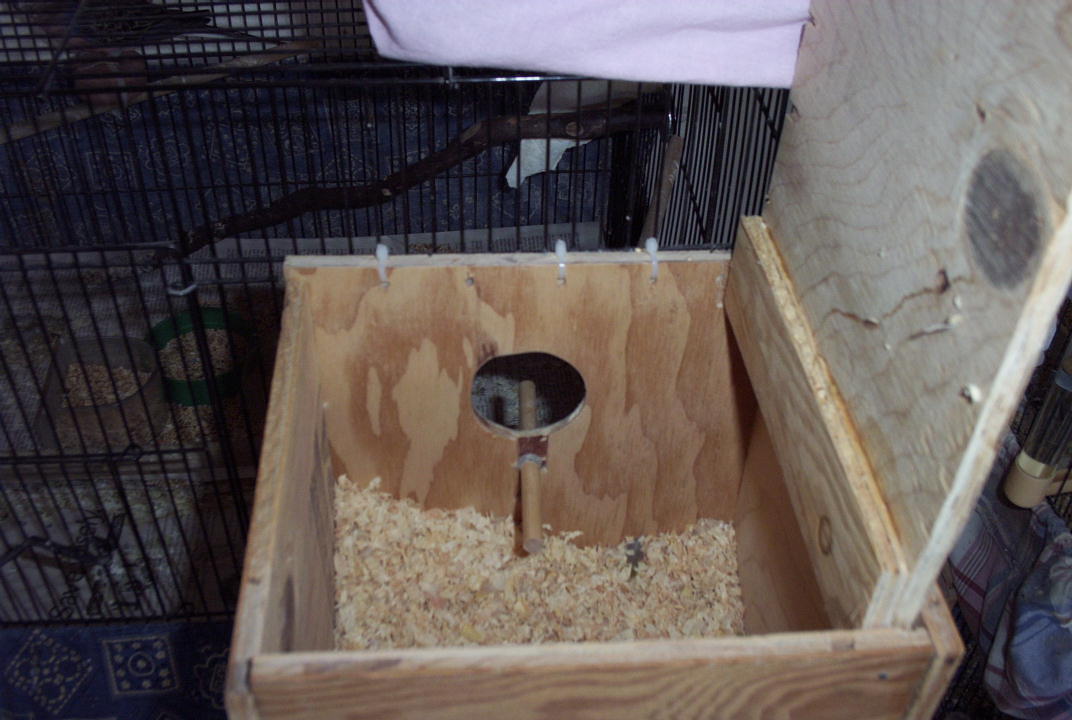
Jewel's new box. It sometimes takes a few days
for birds to investigate a recently installed nest box.
Usually the male checks it out first to be sure it's safe.
 Even though I had someone who would come in each day to provide them with fresh water and food, I wanted to be present during breeding season. If anything unusual were to happen, such as egg-binding, I could recognize and respond to the problem and, hopefully, save a hen’s life. It’s also a good idea to check your nestlings daily. If for some reason a chick isn’t being fed, you can pull the chick and save it with hand feeding.

As you know, having a nest box stimulates the bird’s desire to breed and rear young. Without a nest box, they usually won’t attempt to reproduce. However, like every rule, there are exceptions. One year, I had one female lay her eggs in a food cup in early February.  She has since learned to wait for me to put up a box. I think she realizes that if she waits, one will eventually materialize.
This box slides open on the side, rather than from the top.

Last year Cherry, an older Rosy hen who didn’t lay eggs in 2009, surprised us by raising a total of six youngsters in 2010.  And here I thought she was finished. Apparently not. There was no change of cage or mate  … everything was the same as always. I’m curious to see what she does this year.

Another of my older hens — a Normal named Willow — also appeared to have gone into retirement. Although she raised numerous clutches over the years, in 2009 and 2010 she never glanced at the nest box and turned away her younger mate when he tried to feed her. My husband asked why it was necessary to put a box on their cage.

“You never know,” I said. “Look at Cherry who raised young last year after skipping a year. We’ve nothing to lose. We have the box and it only takes minutes to install it.” Of course, those “lost” minutes were his sacrifice, not mine … Smile.
Clyde outside Bonnie's nest box. 

Peeking inside a newly installed box.
This morning, I looked up from my desk, and Willow was in her nest box!  Will she lay eggs? That is yet to be seen. She was an adult bird when I purchased her a number of years ago, and she isn’t banded. So her age is unknown. If hens live a healthy long life, they eventually quit laying.

Some breeders sell off their older, non-productive birds. I don’t do that. If they’ve done well for me, they deserve a pleasant retirement in the home where they’ve become familiar and comfortable.


Peace & Blessings.
May your birds bring you joy. 

Sunday, May 8, 2011

YOUNG PARAKEET ISN'T THRIVING ... A Question From Erik

Erik writes:

I am a regular reader of your bourke blog and have a couple of questions for you about my new bourke that I got yesterday. She is 8 weeks old and has spent most of this day sleeping. Is this a concern? Also her droppings were normal yesterday, but today it has seeds in it - is this  normal? I know this can be a problem in birds, but thought maybe she is  just a bit stressed and it will clear up in a day or two. She is eating and drinking regularly. I am very concerned at this point. I apologize in advance for asking you these questions, but you are very knowledgable and very experienced. Thank you for your time. Hope to hear from you soon.

----------------------------
Hello Erik,

Thank you for the compliments. I am always happy to share whatever I've learned about raising parakeets and to answer questions.


Young Pipsqueek should be eating
on her own by now, but isn't.
Eight weeks sounds young for a Bourke parakeet to be away from her parents. When birds leave the nest, they are fed for two or more weeks by their parents who help teach them to eat on their own. (Although handfed babies learn on their own with no help as soon as they're old enough).

Did the breeder tell you her hatch date and that's how you determined she's 8 weeks old? Or, has she been out of the nest 8 weeks? Have you witnessed her eating seeds, or attempting to? If she's alone, are there hulls in the seed to prove she's able to hull it on her own? Or, maybe she is reacting to a change in what she's being fed. Is the parakeet seed you are feeding her fresh? Hartz Mountain seed from a grocery store isn't the best place to buy parakeet seed as it may have been on the shelf too long. Also, hopefully, your parakeet seed is more than just white millet and oats.

For now, try offering her other soft foods, pieces of soft wheat bread, soft peas, corn, spinach, kale ... anything that she might like to eat. Nestling food is good if you have it, or can get it in a hurry. It's available online. Also, spray millet is easy for young birds to begin eating.

Don't want one to squirm away while the other is eating.
I suspect she may not be getting enough to eat because she was removed from her parents too soon. That, or the food may not agree with her. Taking birds away from their parents early requires handfeeding with an eye dropper. Exact Handfeeding Formula is what I use. Normally, if you're going to do that, they should be very young, not fully feathered. If she's fluffed up and looks sick, be sure she really is eating and not just pecking around and appearing to eat. Does her crop feel full? If she won't eat any of the soft foods we've suggested, and her crop seems empty, attempting to hand feed can't hurt and might save her ... if, in fact, she was taken away too soon.

But you said she appears to be eating and drinking. If eating is not her problem, and your concern is how much she's sleeping ... remember Bourkes are most active at dawn and dusk. They are early morning birds and sleep a lot during the day. So, maybe she's just exhibiting normal behavior. In the evening when the lights dim, she might become active. Check and see. Also, baby birds sleep more than adult birds, just like we humans.

Rarely a bird will hatch that--for whatever reason--isn't able to adequately feed itself. It is unlikely that this is the case with your bird. When it happens, however, parents will sometimes ruin their own health continuing to feed that youngster long past when it should be eating on its own. After decades of raising countless parakeet varieties, and more Bourkes than I can count, I've had three Bourkes handicapped in that way...so it is rare.  

We're full and sleepy now.
The first one was given away to someone willing to feed it, but it later died. The second, when I realized the father was becoming extremely thin due to feeding his offspring over-long, I removed it and sadly ended up dispatching the bird in a humane fashion rather than let it starve to death (it was not tame). The third bird, I noticed wasn't thriving in the nest and removed it to handfeed. I am still handfeeding this very tame, sweet little "Pipsqueek," a year later. I'm unable to kill her. She does manage to eat some nestling food and picks up the hulls of other birds and runs them through her beak. She only gets an Exact feeding in the morning and usually in the evening now. God willing, maybe she will eat enough on her own someday. I'm not eager to hand feed her for a dozen or more years, smile.

That said, the fact that Pipsqueek has to come out every day for a feeding means that I also let all my other tame birds out at the same time. They get to spend more time with me, and I'm forced to put aside any jobs and allow the birds to bring me joy. So, this bird is really a blessing in disguise.

"Pip" can eat cooked mixed vegetables. Maybe yours will too. A change in diet might be your problem and your solution. Let's hope so.

Young, full-grown Bourke likes snitching samples of the baby's food.
It's fattening though, so not too much!  
Best of Luck! I hope your little one will start to thrive soon.

Peace & Blessings

Tuesday, May 3, 2011

TRIMMING PARAKEET NAILS OR CLAWS

In the next few days I will be replacing nest boxes on my cages. The birds have been fed healthy breeding formulas and they are ready, except for one final detail.
Tame Rainbow won't bite, but he also doesn't hold still.

I took a good look at some of our future fathers and, sure enough, two of them had very long nails, or claws if you prefer that terminology. I prefer calling them nails because it sounds friendlier, less sinister for my feathered companions than claws. Although these two guys had what looked like curved daggers.

Bonnie's mate, Clyde, gets a trim. He bites, hence the washrag.
Domestic caged birds are unable to wear down their nails like wild birds that have to scratch for their food.
A male bird with overly long nails may have difficulty convincing his hen to stand still during the mating process. And, although she must stand still if things are going to connect properly, how can she if his nails are painfully digging into her back? She’s going to squawk and throw him off, ruining any chance of fertilizing her eggs.

Hence, trimming nails when they’re much too long can be a valuable thing when breeding your birds. If you have a very tame, docile bird, it might sit on a perch and let you clip its nails. However, most birds won’t want you handling their feet and you’ll have to restrain them to trim their nails. You definitely don’t want to clip a toe instead of a nail. The bird should recover, but how sad to cause them pain and injury!

Make sure you have the foot held firmly and the toes spread so that you only clip what you want to clip. Some birds squirm more than others. Like us, they exhibit a wide variety of personalities and attitudes. I like using a bathroom washcloth to hold them. They can bite it all they want to and avoid biting me.


Rosy Bourkes have light nails with visible blood vessels
Budgies and Rosy Bourkes have light colored nails that expose the blood vessel within them. You DO NOT want to cut their nails so short that you run into a blood vessel. Better to leave a little nail beyond the dark line running through the nail.


Notice the black nails on a Splendid parakeet.
Lowest nail is already clipped, so no point on it.
With the Scarlet-chested parakeet shown here, his nails are black, so the vessel can’t be seen. I tend to err on the side of caution and am more likely to leave the nail longer than it absolutely needs to be, rather than chance cutting it too close. Doing that will make the nail bleed, and no doubt cause the bird distress you don’t want it to undergo. Sprinkle any wound with cornstarch; it will stop the bleeding and has antiseptic properties.

Remember to reassure your birds with a gentle, sweet voice telling them that you only want to help them. Tone of voice is very important when reassuring your birds. Losing your temper or yelling only upsets them. If you want their cooperation, be gentle, kind and friendly.

Peace & Blessings!

Saturday, April 23, 2011

SEXING LUTINO BOURKES ... Malcolm's Question

Malcolm, your server in the UK won’t accept my email replies to you.

Malcolm wrote with a question about his pair of Lutino Bourkes who don’t appear to be interested in each other and he wonders if there is a way to sex them without putting them through a vet exam.

This Lutino Bourke is not one of my birds. Wish it was.
I've previously written about sexing Bourkes, and particularly about their behavior as a way to sex them. The dates to reference on this blog are May 25, 2010 and June 17, 2010.

If you enter "Sexing Bourkes" in the search feature above, you will get those posts and others that reference sexing. There are also "Labels" at the end of each post. Click on a topic and it will bring up all related posts.

As you may know, adult normal Bourkes are easier to sex because the males have a tiny blue line of feathers over their cere (nostrils).

In Lutino's, like Rosa’s, look for the male to stand up straight, throw his shoulders back and flair his wings slightly. He may only do this when he's mature and interested in breeding because there's a hen present, although I've had youngsters in mixed cages tell me what sex they are this way (and it always proved true). When mature hens flair their wings, it's typically downward as they lean forward, as if to sweep the ground. They also put their tails up and cheep to attract a male.

The odd thing about that female behavior is that I've seen males do that when their own mate is no longer willing to breed. Are they showing her what they want her to do, maybe? Or, is it because of a hormone change in older birds? That's something I've been considering writing about.

Here's a link to one of my posts on sexing. Click here >  More on Sexing Bourkes
Best of luck.
Peace & Blessings.

Wednesday, April 20, 2011

Where Are the Hummingbirds?

An Anna's hummer at feeder even in snow.
In twelve years of living on Oregon's south coast we've always had dozens of hummingbirds ... especially in the Spring when they migrate back. But, even in the winter the Anna's hummingbirds remain all year and don't migrate. So, our feeders have always had frequent daily visits. During breeding season they can become a bee hive of activity and the birds will even land on our hands.

So, what's happened to them all of a sudden? For the past three weeks, there have been NO hummers ... absolutely NO hummingbirds at any of our feeders on three sides of the house, north...west...or south.  We keep them clean, and I've taken them down several times, washed them thoroughly and put new syrup in them, (same formula: boil four parts water to one part sugar one minute and let cool). Probably even replaced the syrup before necessary to be sure it's fresh, but still not birds.

Rain or shine, they were always here!
I called our local Fish & Wildlife office to inquire, and he said he'd look into it and call me back. He hasn't. Is it just us, or are others in the area missing birds too? So far, I've met only one other person with feeders who says she's wondering what's happened. I don't know any others to ask, but would like to.

Saturday, April 16, 2011

Ask Questions...

As I read the key search words that bring visitors to this site, there are a lot of questions. Many I've answered in previous posts, but sometimes the search questions are unique. Even if they are not, it can be daunting to find answers buried in multiple posts. That's why label topics at the end of each post are helpful. They will sort through related articles for you.  

Rosy Bourke hen briefly left nest. The first of four eggs has hatched.
Don't hesitate to contact me with a question. For instance, someone searched on Google: "How long for Bourke parakeet eggs to hatch?"  They found this site, and I hope they located the answer in several of my earlier posts.

For the record, the answer is: typically 18 to 21 days and they usually hatch every other day. Ambient temperature has an effect too. Warm weather tends to encourage eggs to hatch sooner. Cold weather may delay hatching. Also, as noted in an earlier article, hens don't have to start brooding their eggs immediately. Count 18 to 21 days from the day they actually begin sitting on their eggs. Remember to keep a cup or bowl of water available for her to splash in, as eggs may need moisture, especially in dry climates.

If you have a specific question, you can reach me via: rosie.birds@gmail.com

Happy birding!

Thursday, April 14, 2011

Portrait of Rosebud, female Rosy Bourke Parakeet

Rosebud, Rosy Bourke hen hatched Spring of 2010.
We've decided to let one of our very tame young hens fly the coop...so to speak.

Rosebud hatched last year and was handfed with her sister, Fuchsia. Our handsome Flame, also hatched last year, has singled out Fuchsia for his mate, and Rosebud doesn't really have a bird assigned to become her mate--although she is trying to steal Pretty Boy away from gentle Rosie.

In preparation for sweet Rosebud's departure sometime in the near future, here are recent photos taken of her.

We are waiting a few more weeks to replace our nest boxes and let our flock begin raising young again. They are eager, however, and so are we ... absolutely love the excitement of new baby birds.


Sunday, April 10, 2011

Handfeeding Question & Answer

Janice writes:  "I am raising some rosys also. My hen is on her 2nd clutch of the year. The 1st egg hatched April 1, the second on April 3rd, and the 3rd egg on April 8th. All were fine this morning. The parents were in and out eating and I assumed feeding all babies. Well I checked in the box around 8:30p and 1 baby was dead, and the smallest one is near death. The largest is fat and happy. I hand fed the smallest by 8:45p, and it ate well. It is so tiny, it must be the chick that hatched yesterday. I only put small drops of formula on its beak and watched as it drank it down, the drop was low, I added another until I saw the the crop was full, or nearly full. The chick stopped so I did also. I returned it back to its mother. I will check it again in 2 hours."

The first bird I ever hand fed. Spicy is a male Normal
Bourke whose mother hatched four babies, but would
only feed two. I lost one before realizing the problem,
and rescued him. He's several years old now.  When older,
his parents raised clutches of four without any problem.
Janice, it sounds like you are doing the best you can with the baby. Be sure to feed him all that you can stuff into him, and every two hours for a newly hatched baby. Follow directions on the box as it will be a warm, thin formula at first, and later need to be thickened up.

I wonder how your birds did with their first clutch...? They sound like they could be young birds and will do a better job of raising more of their young next year. Or, the babies could have a genetic problem and aren't meant to survive. The fact that they hatched though, means that they were strong to begin with.

I've rescued many babies by hand feeding them when their parents weren't able, or willing, to do so. That said, I have one bird that's a year old and still cannot entirely feed itself. He's like a concentration camp survivor who is alive, but not thriving. I feed him one or two times a day with a handfeeding formula and give him nestling food, which he seems to be able to eat some of. However, for whatever reason, he cannot hull seeds like other birds. When he wasn't thriving in the nest, I took him out and started hand feeding. If I had not done that, he would have died. Yet, perhaps he should have... He is a sweet, very tame little bird, but having to hand feed him for years to come does not appeal to me.

I don't want to frighten you though...most of the babies I've hand fed have grown into perfectly normal, healthy adults and they were all well worth the trouble.

Watch your babies to be sure the parents are keeping them warm. If they've rejected feeding them, they might (or might not) refuse to keep them warm too. Baby birds can expire from being cold even quicker than not being fed. When I've removed babies from the nest, I keep them in a box with pine shavings and a paper towel that I can throw away when soiled. I have a small electric oil heater that I place near the box to keep the temperature very warm. It's helpful to have more than one baby in the box to keep each other warm. You might want to hand feed BOTH babies so that they are very tame once grown, and to keep each other healthy and warm as they grow. That's my suggestion...if you hand feed one, do the whole clutch.

Best of luck. May your baby Rosy Bourkes thrive.

Thursday, April 7, 2011

Budgerigar Personalities vs. Splendids or Bourkes

A safe way to hold baby Budgies and not have them fall off
 a child's lap. These four pale blue babies haven't fledged yet.
I love Budgies and have owned many of them in my lifetime. My grandfather raised and sold them before Bourkes or Splendids were even heard of in the USA. As everyone who loves birds knows, each individual bird has its very own personality, just like every other animal and person.

That said, there are some similarities among related species. Budgies tend to be active, fun and intelligent little birds. They come in almost every color of the rainbow, excluding red, pink or solid black ... although I'd expect to see a solid black Budgerigar parakeet someday if anyone sets out to give it a shot (something I once considered, but never attempted).

Budgies like to chew on anything interesting, and will sample crumbs off your table, or nibble the page edges off a book, newspaper or magazine. Houseplants need to be a safe variety that won't hurt them, and you may want to keep an eye on your Budgie if he or she lands on a curtain rod holding expensive curtains. There's no guarantee they won't chew holes in them too, or the molding around windows, or picture frames. That said, they won't all do that.
Male Rosy Bourke.

Bourkes usually aren't chewers, but they also aren't the playful little clowns that Budgies are. They are less active, but develop an attachment to their owners too. Most tame Bourkes will kiss, sing and climb all over you, just as a Budgie does. Like Budgies, they are curious birds, but typically they take fewer risks than a Budgie will. They tend to be more cautious. Bourkes sleep a lot during the day and become very active at daybreak and dusk. Budgies are happy to be active any time the sun is shining.
Male Splendid or Scarlet-chested
Parakeet.

Splendids chew almost as much as a Budgie. They have active personalities like Budgies, and spend more time awake during the day. They aren't a morning and evening bird like a Bourke. They love water and will put anything and everything into their drinking water, requiring that it be cleaned frequently. Like Budgies, Splendids love swings and other toys. They are clever birds and I've seen them learn to open cage doors.

Albino Budgerigar Parakeet.

Budgies are good mimics and will try to copy what you say to them. Bourkes and Splendids won't. However, Bourkes do wolf whistle naturally and have a pretty song. Budgies chatter and talk more than the other parakeets, and some of them can become noisy... particularly during breeding season.

Male Splendid on left and Normal-colored Bourke male on right.
The uncommon coloration in Splendids and Bourkes makes them a uniquely beautiful pet.  Budgies are inexpensive birds with great personalities and, when tame, they make wonderful, affectionate pets ... especially for kids! Every parakeet variety has its advantages, and it's fun to learn as much as you can about each of them before selecting the right one for you.

Wednesday, April 6, 2011

Budgerigar Parakeets, Adult or Baby Budgie Identification


Adult Male Budgie

Very Young Budgie
Compare these two photos for an easy way to recognize a young Budgerigar Parakeet.

Notice the ring around the adult bird's eye. See the black spots on either side of his chin. In this case, there are two on each side of the bird's head, below his beak.  

His nostrils (cere) are dark blue, indicating he's a male. As she matures, a Female's cere will turn brown. The baby Budgie at the right has a light colored cere that will change to either color as it matures. Although dots aren't always present, they are one more sign to check for in identifying a mature bird.

Baby Budgies also usually appear to have very "soft" feathers. It's difficult to explain the difference, but by comparing an adult and a baby together, the differences are noticeable... In the same way that a puppy or a kitten seems to have softer fur than they will when they are grown, there is a subtle difference too in the feathers of young birds. I suppose you could say they are "fresh and new."

Notice, too, that the baby Budgie's eyes are very dark throughout. This will eventually change, but offers a clue along with the light cere color that you are observing a very young Budgie.

Sunday, March 27, 2011

Question and Answer on Handfeeding Young Bourkes


Back & forth feeding is efficient.
They share a mother's beak, so why not?

Shawn asked a question today about feeding baby Bourkes who have fledged, but were still being parent fed when their father unexpectedly died. Their mother hasn't been doing enough, and the question is "how do you take over feeding when the youngsters aren't used to hand feeding?"

Here's my answer:

Shawn, I'm sorry to hear of your loss.

When baby Bourkes are used to being hand fed you can get away with three or four times a day for fully feathered birds (more often for younger ones). However, since yours aren't used to it, I'd offer them food more often for the first few days. Feed them as long as they'll let you. When they shake their heads and scatter Exact Handfeeding Formula on you, that usually means they're full. 

A clutch of three healthy baby Bourke Parakeets.
Meanwhile, offer them easy things to eat. If you can, buy nestling food. I get mine online from PetSolutions, however, it probably won't reach you fast enough. Millet spray is also easy for babies to start eating. My birds love cooked corn and perhaps your youngsters will try to eat it. Petite peas, cooked carrots, fresh greens that are cut up, like spinach, kale, etc. Anything to entice them to eat something on their own.

Be sure to talk softly too them when you try to hand feed them and be sure the Exact food is warm, but not too hot. Test it on your wrist. If they are hungry they should accept it. You might have to put it into their mouths at first...just a drop at a time to begin with, but they should want it when they taste it. Feed them as much as they're willing to eat. Parent birds stuff their youngsters so full they look like they could burst.

The key to taming them, since they are already feathered, is to handle them a lot and "sweet" talk to them. See my other blogs on taming birds. You may be starting late for hand feeding, but it should work okay. You have a good chance for exceptionally tame, sweet birds. Best of luck!

Here is a link to the post Shawn commented on:   Hand Feeding Answers


Nearly weaned, and eating some on their own.
I kept my favorite bird, Rosie, from this clutch of four and
it was painful to sell the others. They were all very loving.
By the way, although all my adult birds want nest boxes up, I've yet to do so. I limit my birds to two, possibly three, clutches per year and I want to be home during the entire process in case anything goes wrong. Since we may take a trip in a few weeks, and someone else will care for the birds while we're away, I'm going to wait until our return to give the birds their nest boxes. They can still raise two or three clutches this year prior to cool weather.
 
Peace & Blessings.

Sunday, March 20, 2011

BEAK TOO LONG - TRIMMING BIRD BEAKS

Rhett's overgrown beak.

Another view of his overgrown beak, like a fish hook.


He didn't struggle or complain at being handled.

Rhett, my very first Bourke, is getting old and his beak too long. Birds with overgrown beaks are generally elderly, like Rhett. I’m currently caring for 22 adult birds, and Rhett hasn’t received enough of my attention lately. I failed to notice how “long in the tooth” he’d become. His mate’s beak has been trimmed in the past, but his was hidden within his feathers and went unnoticed until today.

Typically the overgrown portion of a bird’s beak will be a different color than the rest of the beak. If a bird’s beak is not too dark, you can hold them up to the light and see a blood vessel running through it. That’s the living portion of the beak.


Maybe because he's old and wise, he held perfectly still.
Although notice that his head is held securely between two fingers.

Overgrown portions are much like fingernails and can be clipped away. Occasionally, they will pop off by themselves. Obviously Rhett’s didn’t do that and, since it had become very long, I needed to step in. By the way, if you accidentally trim a beak too closely…Heaven forbid…you can stop the bleeding with a little cornstarch.
The trimmed portion of the beak.

It's a half inch long!
If you have larger birds, or birds who struggle, one person can hold the bird while the other one trims. However, Rhett didn’t struggle and my husband held the camera instead. Clipping Rhett’s beak was simple and easy.

As you can see, he is no worse for wear and when I opened my hand, he surprised me by remaining there. He even let me switch him to another finger. He’s a smart bird and realized he was being helped.
My sweet patriarch after job is accomplished! His mate in back.

So friendly and accepting, and he is not one of my
finger tamed Bourkes.
What is interesting about these photos of Rhett on my finger and hand is that I’ve never made any attempt to tame him. I purchased him over a decade ago, at 9 months of age, along with his first mate, Scarlett. Neither of them were babies. They were intended to be breeders. Yet, he has always come to the cage bars and talked to me. He never seems afraid, even when his cage is cleaned.

This was the first time he has gotten this much handling, and he gave me no trouble. I think he was showing his gratitude by acknowledging that he isn’t afraid of me. Sweet baby … I love him. We have several sons and daughters of his who are also breeders, and our six very tame Bourkes are his grandchildren…cousins of one another. 
He was willing to stay with me as long as I was willing to hold him. He even let me transfer him from one hand to the other. Cherry, in back, has a beak longer than it should be too...not as long as his was though.

Rhett is a wonderful patriarch. He and sweet Scarlett are responsible for my love affair with Rosy Bourkes.

Thursday, March 3, 2011

PARAKEET EGG BINDING ... What to do to Rescue Hens.

Spicy, a Normal Bourke with his mate,
Sugar, a Rosy whose feathers came in
darker after recovering from egg binding.
An offspring whose mother suffered
egg binding and his egg was fostered.
I’ve mentioned egg binding in other posts, but thought I’d do one specifically targeting the subject. Until a more experienced bird breeder gave me excellent advice, I lost a few hens to this.

Symptoms: Most hens already with one to three eggs will leave the nest and look lethargic and ill. Interest in their eggs will be gone. They will fluff up and appear inactive and obviously sick. If they are sitting on the floor and puffed up, that’s an obvious sign something’s seriously wrong. Death can occur within 24 hours, so it’s important to act fast.

Pick her up in a warm towel. You will be able to see a bulge near the vent, but do not press there or you will kill her instantly if the egg breaks.

Common Advice:
I followed directions given in my bird books, but it was not enough. They say to wrap the hen in a towel to restrain and protect her while holding her vent over steam. This is called “steaming the egg.” They also recommend carefully adding Vaseline to the vent area being careful NOT to massage the area. I followed this advice at different times with three hens, but none of them subsequently laid the egg and sadly all three didn’t survive.

Bonnie and Clyde, Rosy Bourkes.
Bonnie survived egg binding and has
had several successful clutches since.
What Worked:
Instead of Vaseline, lukewarm mineral oil was carefully put into the vent with a small eye dropper. It was also given to the hen orally. Surprisingly, my hens seemed to want to ingest the mineral oil and I had no trouble feeding it to them via the eye dropper. Next, I also held them over steam for a minute or so…being careful not to let them get too hot as my bare fingers were there too. Once they seemed moist and warm, I put them into a small carrying cage with water and seed present. I completely covered the cage with a towel to give them privacy and warmth. Next, I boiled a large mug of water and put it inside the towel so that the steam could reach the hen. Don’t put it in the cage with her…she might injure herself on the hot liquid.

An area heater nearby is a good idea too. You want her to stay very warm, about 98 degrees or so, if possible. Don’t forget the steaming cup of hot water inside her “tent.” Moisture helps, and for this reason a very small cage is an advantage.

Sugar's dark feather pattern after suffering egg binding
and losing feathers. I expect her to be pink again after a molt.
Check on Her Every Hour:
If the egg isn’t laid within an hour, repeat the whole process again. Then check after another hour and keep checking and repeating the process until the egg is laid. I’ve never had to do it more than twice before it successfully helped my hens lay their oversized egg.

Right after being subjected to this unpleasant treatment, my hens have not wanted to return to their current nest and I successfully fostered their previous eggs under other hens. However, the egg that is covered in mineral oil doesn’t hatch…probably because air cannot penetrate the shell in spite of attempting to rinse the oil off of it.

Admittedly, I always wonder if I’ve given a hen enough mineral oil, or too much. You don’t want to injure her with too much. However, too little may not do the trick. So, if the first application doesn’t work, I use a little more the second time. So far, I’ve used this method with three hens at different times and all three hens laid their egg and have recovered. Two of the three have gone on to raise several more clutches without further problems. The third has laid infertile eggs without a problem.

The first time I attempted to feed mineral oil to a hen, I used a tiny syringe instead of an eye dropper, managing to get mineral oil all over her head. As a result, all the feathers around her head eventually fell out and she looked awful for several weeks. When they came back in, they were much darker than before. See the photo. I expect her to be pink again after another molt.

Sugar and Spice successfully mating
while she was still pink.
My bird books say to wait 60 days before allowing a hen to breed again. I’ve chosen to wait an entire season, typically nine months. I see no reason to stress a hen further. Besides the mineral oil tends to leave them unable to achieve fertility until it is completely out of their system.

It’s always important to have enough calcium present for your birds. A bird that is too young or who doesn’t have enough calcium can produce soft eggs, causing egg-binding. My birds always have cuttlebones and mineral blocks available, as well as oyster shell and grit. The problems I’ve had with egg binding didn’t appear to be soft egg shells, but rather eggs that were too large for them to easily pass.
Spicy is a handfed bird, rejected by his parents.
He's a male Normal Bourke. Notice a tiny bit
of blue above his cere (nostrils). This is
only present on mature Normal males,
not on Normal hens.
If your birds don’t appear to be using their cuttlebone or mineral block, there are calcium supplements available to add to their water. If you decide to do this, however, follow the directions carefully…you don’t want to over medicate them.

In other posts I covered advice given to me for hens who had fertile eggs that didn’t hatch. Two readers and a friend recommended adding small salt blocks intended for rabbits. These contain iodine. For a long time the birds ignored them. However, I notice recently that the birds are beginning to chew on them, so I’m hopeful that those hens in the past that had fertile eggs that didn’t hatch will now be successful.

May God bless you and your feathered friends
with good health and productivity.