Sunday, October 23, 2011

Banding The Youngest Bourke

Flame and Fuchsia's current three baby Bourkes.
As mentioned previously, we decided to give the birds nest boxes late this year. Hence, they started laying later and we still have baby birds.

Both Rosie and Fuchsia are still feeding their last three babies each from their second clutches. I've not let any other birds have a third clutch this year, and only allowed Bonnie and Clyde one clutch. Rhett and Cherry, our oldest pair, were the first to reproduce and I removed their nest box after two clutches. They were willing to have a third.
About to band this year's youngest so far, Baby #24.
Silver band for us is EGL. Year is 11, OR for Oregon.
Colored bands indicate parentage.

Rosie and her mate, Pretty Boy, have recently been mating repeatedly. They began as soon as their three had left the nest box. In fact, I think Rosie chased the youngest out. All three still require parent feeding. Yet, that hasn't stopped their parents from wanting to start another clutch. Pretty Boy is taking over most of the feeding. However, soon the babies will adequately feed themselves.

It's interesting what Rosie has done to their nest box. Normally, I clean the boxes before the birds go back for another clutch, and replace the pine shavings with fresh.

I didn't plan to allow Rosie a third clutch. I noticed her in the box before it was removed, and looked inside. She's completely turned over all the pine shavings that were stuck together from baby bird droppings. Although not fresh and clean like it would be after I worked on it, she's done a pretty fair job of cleaning things up and tossing the shavings so that they are soft again. It must have taken a lot of work.

This is as large as a foot can be for "budgie" bands. Bigger
and it wouldn't slip on. I waited a day or two longer than
necessary. Too soon, however, and they slip off in the nest.
Do I want to make Rosie lay eggs on the floor, or in a feed cup, because there is no nest box? I don't think so. I'll clean the box for her, give her fresh pine shavings and allow her that third clutch. She's young and healthy, as well as eager.

Then, there is Fuchsia. She and Flame are the parents of one of the sweetest birds I've ever owned, the one I lost last Monday. Would they produce another pink-eyed baby in a third clutch? One could hope they might. Currently, their three have dark eyes. They're younger than Rosie's. I am very tempted to allow them a third clutch and hope for another like the one that's gone.

In the past, there have been a couple of times when I didn't get a box cleaned out fast enough and there was already an egg in the used box. I temporarily removed the egg, quickly cleaned the box, added new pine shavings forming a "bowl" in the area I knew the hen preferred, and put the egg in it. Both hens accepted this and continued to lay other eggs, even hatching the one that was temporarily moved and replaced.

Although not finger tamed, Rhett's first hen, Scarlett, even accepted two babies and raised them after their own mothers rejected them. I think the other hens were restricting the size of their brood, whereas Scarlett's eggs (with the exception of one) were always infertile. Yet, she wanted to be a mother.

She and Rhett fostered several offspring from adopted eggs. That's not unusual. But what is uncommon is that Scarlett accepted two newly hatched baby birds at different times and raised them. She was a remarkable little Bourke hen and very sweet. She was never extremely hearty though and has since passed away. Rhett, on the other hand, is still with us. Rhett and Scarlett were my very first pair of Bourkes.  

My second pair of Bourkes were Bing (a beautiful singer) and Cherry. They weren't ideally matched and eventually I was able to give Bing another mate. He and a Normal, Stella, produced many beautiful offspring before they passed on. I've no idea how old they were when purchased, nor how old Cherry is either. When Scarlett died, Cherry went to Rhett and the rest is history. Over the years, they've produced and produced ... although she's not the sweetheart that Scarlett was and bosses Rhett terribly. Fortunately, their offspring all seem to inherit his exceptional disposition.

Year 2011 Baby #24 is banded. Blue & Red band will
always indicate his/her parents are Flame and Fuchsia.

Peace & Blessings

Friday, October 21, 2011

A Sad Post... On Loss & Sorrow

Sweet Primrose
A Heavenly Flyer.
I’ve written and rewritten this post in my mind over and over. It must be cathartic to do so. This was written Tuesday, Oct. 18, although not posted immediately. I considered it first, but decided to share it as we all face disappointments in life.

***
 If I could wipe yesterday from my life, I would. Don’t we all have days we wish had never happened? It began with a phone call while I was still in the shower. My husband answered only to hear that a relative in another time zone had died. We grieved for that family, though we didn’t know her. She was only 32.

We’d also learned a day ago that our son-in-law lost his job after 15 years with the company. Perhaps it is another sign of our times.

Later, we opened the mail to find a bill we'd disputed had been turned over to a collection agency. We’ve already wasted so much time trying to rectify this and now have to start all over again. It’s not a large bill, but it's one we don’t owe. The time and trouble over it have exceeded its worth.

Friend of Primrose.
He misses her.

So, when the accident happened yesterday, perhaps my mind wasn’t where it should have been. But that’s an excuse…a  justification.

In previous posts I’ve talked about potential hazards to birds and many things to avoid. I believed I was the epitome of safety and care for my birds. I’ve lost more than a few feathered friends, sure. But, the losses weren’t unusual and I was able to deal with them as timely, unpredictable or unavoidable. Each occurrence was sad, but nature can sometimes be brutal.

This one was different. I spent most of yesterday weeping and had difficulty sleeping last night.

I hesitate to admit to this error. I’m ashamed, hurt, guilty and upset with myself. Only time will help erase the sense of loss. My husband tells me to quit beating up on myself, but what else can I do?

 Others have faced far worse loss, but that thought isn’t consoling. Four decades ago I lost an infant daughter to SIDS. A bird isn’t a child, but this hurts in a similar way. Both seem so senseless. There have been other losses, too. Cats, dogs, birds, relatives…somehow we cope. And, I will cope with this, but it is still fresh. Perhaps I’m supposed to learn sympathy and understanding for those who have also accidentally killed a pet with a car, a recliner, a garage door… It happens, and I’m certainly not one to judge. Especially not now.

I let all my tame young birds out to fly around yesterday morning, as usual. They bring such joy and I wish I could focus on that joy at this moment. My favorite, a young pink-eyed hen I’d hand fed and decided to keep, is the one I lost.


She had also formed a special bond with her look-alike. The two were always together, side-by-side at night, flying together when outside their cage, and often crowded together on my left shoulder, nibbling at my cheek.  

She spent a lot of time on the floor, and I knew that was something to be careful of. I usually followed her with my eyes, reminding the dog to lay still when she approached him and climbed up on his leg. To her, all the pets were just another family member. She was usually followed around by her friend, so I decided to keep him too, and allow them to become a pair as they seemed to want to be. They looked just alike, although he was slightly larger and they each had a different colored band identifying their parents.   

It was just me and the birds in the kitchen and living room. The cats and dog were outside. The doors to the other rooms were closed. No dangerous hot lights, no potential hazards. Window blinds down, so an inexperienced bird wouldn’t fly into a window. All seemed safe.

 I named her Primrose, but have yet to name her best friend. As I leaned over the kitchen counter feeding Pipsqueek, who can’t totally feed herself, there was a ruckus in the cages behind me. I thought a bird had fallen behind the cages and upset the young birds in those cages. I turned quickly to go retrieve that bird who, it turns out, somehow found its own way to freedom.

In turning so quickly, I felt something under my foot. In a flash so many things go through your mind. In that instant, I knew. I hoped beyond hope that what I’d stepped on was the dog’s toy, or something else. But I knew that it couldn’t be, and small birds are so fragile.

I picked up her bleeding body and cried, “No, no, no! Please God, no!” But the answer was not what I wanted. She never made a sound, but gently died in my hands.

My husband came rushing from another room, and held me as I wept hysterically. I’d done it. Me. How could I have been so careless? How? How? How?  

He took my bloody shirt and cleaned it for me, while I stroked the lifeless body of a bird who’d been so beautiful and sweet. The little bird who’d nibbled at my cheek, and was always so eager and loving.  

Why was she on the floor at my feet when the room is wide and big with so many other places for her to have been? She was at my feet because she wanted me to pick her up and put her on my shoulder as I'd done countless times before. This time I didn’t realize she was there and reacted to the noise behind me without thinking.  

Unlike all the other birds, she found it difficult to fly higher than my waist. She was getting stronger and better at flying and I’m sure she’d have caught up with the others in time. But, she never feared anything, and I was always ready to scoop her up.  

Why wasn't I watching out for her? I have no answers, only sorrow. We buried her yesterday afternoon near others we’ve lost, although not in such a horrific way. 
  
This morning her friend flew around the house appearing to look for her. I gave him lots of attention. He, too, nibbled on me and is very sweet. I’ve told him over and over how sorry I am.  

Primrose was the daughter of Flame and Fuchsia. They currently have three babies in their second clutch, but none have pink eyes and a white face like Primrose.  

Rosie and Pretty Boy also have three babies in their second clutch. Theirs are cousins of Primrose and one does have a white head and pink eyes. That baby isn’t hand fed, but I took it out of the nest and held it today.  
Rosie and Pretty Boy's baby from 2nd clutch.
The bird who loved Primrose showed some interest in this baby. It’s fully feathered and almost ready to leave the nest. The oldest sibling has been out of the nest box for a week and the second left their nest box today. 

What is it that makes birds who look alike be drawn to one another? They don’t have a mirror to tell them what they, themselves, look like. But, Primrose and my other pink-eyed baby, were drawn to each other even though other young birds in the cage were not related to them either.

Part of my pain, is knowing her future mate is robbed of the one he chose to love.


Same baby from Rosie and Pretty Boy.
Hasn't left the nest box yet, will soon.
I ask myself over and over why I spent weeks successfully rehabbing a wild hummingbird, only to lose my favorite Bourke? Why have I inconvenienced myself twice a day for more than a year by hand feeding Pipsqueek who is unable to adequately feed herself? Why do I continue to  maintain and provide for another bird that is wild, unattractive and will never have any value? Why not lose any one of them instead?  

I’ve prided myself on being soft-hearted and caring. Then this happens, and I feel like a horrible person. Unable to forgive myself.  

"It was just an accident," my husband tells me over and over. But, I feel careless and stupid.  

Raising birds can be fraught with disappointments … it goes with the territory. There are always losses in life. But, for whatever reasons some are harder to deal with than others.  Hopefully the long-term joys outweigh the disappointments, and we will focus on the joys and release what causes us sorrow.   
April Heather, sleeping.
She went to Heaven when 64 days old.

Normally, I'm an optimistic person, but it’s difficult right now. I loved that little bird. I pray that God makes space in Heaven for little birds who look like angels and love like them too. I hope she’s sitting on my baby daughter’s shoulder, tickling her cheek and making her laugh. 

Monday, October 10, 2011

Food For New Bourke Parents, A Question & Answer

This Spray Millet has been worked over by the birds.
Not all the seeds are there any longer.
Question: My Rosie Bourke just had a baby hatch, this is our first. Do I need to give her special food? Is there anything I can do or should do? She has 2 more eggs in there with her!

Answer: Your Bourkes can exist on seed alone, however, there are healthy things you can add. I provide Petamine Breeding Formula because it has healthy vitamins. They don't need a lot of it, just some each day. It's not a requirement, however. They also like fresh vegetables ... spinach, broccoli, kale, lettuce. Also cooked mixed vegetables, cooked peas, cooked corn, cooked carrots (or fresh shredded carrots). Mine enjoy an occasional piece of bread, especially with added seeds in or on it (like sunflower or sesame, etc.).  Birds also enjoy rice.

A young Bourke eating Spray Millet. Parent birds below.

Spray millet is high in fat content and very good when birds are feeding their young. Parents typically lose weight during the weeks they're feeding babies, so spray millet is healthy then. The rest of the year, you want to only give it sparingly so they don't become obese ... that's not likely to happen when they're raising their families, however.

Again, you don't have to give them all (or any) of this ... but, a varied diet is healthy. Greens are especially good for Bourkes all year round.

Best of luck. If you can, send photos of your mother and babies. I'd love to see them.

Young Rosy Bourke Parakeets. Two with pink eyes.
For young birds Spray Millet is a good introduction to eating on their own.

Peace & Blessings.

Friday, October 7, 2011

HAND FED YOUNG BOURKE PARAKEETS

 
Seven young Rosy Bourke Parakeets.
These youngsters are old enough now to eat on their own, but they still appreciate a treat now and then. It's also a way to encourage all of them to roost on me for a photo opportunity. Typically, when allowed out of their cage, they come and go on and off my shoulders.

One-year-old Pipsqueak being fed, with friends nearby.
I've mentioned Pipsqueak before. She's a one-year-old hen I took out of the nest last year to hand feed because she wasn't thriving. I later learned there was a reason for that. She is unable to eat properly, and Nature would have let her starve. I'm too much of a softy to let her die, so I feed her twice a day with Exact Hand Feeding formula and she does well with it.

These 2011 hand fed young birds are a real joy.
The other six youngsters I chose to hand feed this year are all eating very well on their own now. As mentioned earlier, I chose to feed two of Flame and Fuchsia's five babies because that's a lot for such a young pair to manage, especially since it was their very first clutch. I feared they might not cope with all of them, although now I think they probably would have.

The other four are the second clutch from my elderly pair, Rhett and Cherry. He was looking a little thin ... it's a lot of work raising baby birds. I didn't want to lose either of them from overwork, so I pulled their four too. I thought as long as I was feeding two, why not more. Actually, more is a lot more work. 

Six young Rosy Bourkes with Pip.
All my hand fed birds consider the Exact Hand Feeding Formula to be quite a treat, even when it's no longer required. I enjoy sharing it with them when I feed Pip. Even the adult parents like it.

Those in the photo above are all 2011 youngsters, recently weaned. They are all so sweet. Wish I could keep them all, but that's not reasonable. If you live near Southern Oregon, or want to visit the beautiful south coast with all it's scenic wonders, send me an email. I will have young Bourkes for sale.  rosie.birds@gmail.com

A close-up of one of my pale pink babies with pink eyes.

Peace & Blessings.

Tuesday, October 4, 2011

Young Rosy Bourkes, 2011

Two 2011 youngsters.
Baby in front is from Flame & Fuchsia's first clutch. Pale, pink-eyed bird in back is from Rosie & Pretty Boy's first clutch.
Another view of Rosie's pale baby
from her first clutch.

Currently, Rosie is raising three more in her second clutch. One has pink eyes.

Fuchsia laid five eggs and two have hatched so far. The first has dark eyes. Haven't seen the second one yet, but an egg shell tells me the second in the clutch has hatched. Last time, in her very first clutch, all five survived and are thriving. Only one has pink eyes.

Bird on right is from Bonnie and Clyde. I've dubbed him,
"Sir Grayhead." Notice how the gray feathers go down into
his chest. They circle his head and back too. I've never had
one that looked like this. His father is a very deep rose and
some of his sons have also been (Pretty Boy, for one).
I think this bird is rather unusual and unique.
Aging Rhett and Cherry raised two clutches this year. They wanted a third, but I removed their nestbox. Also removed Bonnie and Clyde's nest box after one clutch. Both pairs would like to continue. However, we now have over 20 baby birds and will need to find buyers for most of them. So much for down-sizing. Smile.

All six who are hand fed are adorable. The two white-faced, pink-eyed babies have paired off and stay together all the time. They are not from the same clutch. One is out of Rhett and Cherry, the other from Flame and Fuchsia. I'm very tempted to allow them to be a pair, since they seem to want to be. However, they are closely related. One is an aunt (or uncle?) of the other.


My favorite hand fed babies from this year, 2011, above. These are a darker pink than Rosie's offspring. I'm tempted to keep these two who seem so fond of each other. Any name suggestions? I'm thinking about Primrose. We sold Rosebud, so we could use that pretty name again for one of these. Any thoughts?

Peace & Blessings!

Tuesday, September 27, 2011

Rosie Rosy Bourke and Her Baby Bourkes

Rosie is eager to escape from her brood of three and take a bath.

Rosie, happy to grab a bath.


Rosie's mate, on my husband, wants to
participate but is hesitant.
Rosie never hesitates.
A Spa moment without the kids.
"Take me away."
Cool and refreshing.


She also appreciates help with feeding her babies since her mate, Pretty Boy, isn't keeping up with the feeding ritual. He's younger than she is. A little help from us is appreciated.

Rosie steps out of her nest box. She's eating the extra
Exact Handfeeding Formula I give to hand fed baby birds.
She was hand fed and is used to it. It's easier than getting "milk"
from her mate and feeding the kids. It's ready immediately
and she stuffs her little ones with it.
Pretty Boy hasn't been totally dependable.
When I hand feed the current six, I give some to Rosie too. She, in turn, feeds it to her three who are fat little rascals.

Rosie's three babies are growing. The oldest is much
bigger than the other two. The unhatched egg was
probably between them, meaning these two are 2 and 4
days younger than their older sibling.

Happy Bird Raising with Peace & Blessings.

Friday, September 23, 2011

Mites and an Update on Catherine's Splendid Question

Catherine's Comment on the Previous Post: 
"Since writing I'm pleased to say all three Splendids survived, even the smallest one we feared we would lose. They are all eating very well, guzzling food down like there is no tomorrow.

I have one other question. When looking the little ones over tonight I noticed these tiny insects falling off them, and when I squished them, they were bright red with blood. Are these mites or something else? And how would I get rid of them? My concern is using a spray on a chick so young.


Following the directions on "VITAFARM Avian Insect Liquidator"
rid us of mites in 2007 and we've never had them since.


The mother is also in a smaller cage, inside the house and nice and warm. She too us eating a lot better, although she still doesn't seem interested in her chicks. The vet has told us to watch her and if her wing doesn't improve, they've given us the details of an expert who lives an hour away.

You're website has been vastly helpful. I actually live in south Wales in the United Kingdom, but there's very little resources on Splendids, which is why you've been a God send. Thank you once again for everything."

My Response:
Thank you, I'm always grateful to know that my blog is helpful.

Your "bugs" sound like mites all right. They will sap a baby's strength. I discovered mites on my birds in 2007 and used the product shown here. I've never had them since. Birds in outdoor aviaries are more susceptible than those kept indoors, but it's possible to carry them inside on our clothing ... especially since many of us also maintain bird feeders outside for our wild feathered friends. It's a wise idea to always wash our hands when we come back indoors, particularly if we've been handling outdoor bird feeders and such.

The "Avian Insect Liquidator" shown here can be used on baby birds without harm, and I've done so. It is a concentrate and needs to be diluted. The best way to apply it is in a gentle mist. I made use of an eyeglass cleaner spray bottle that was empty and washed out. It gives a very fine mist and was very effective. Note that we marked the bottle "Mite Spray" so that it would never be confused with its original product. We also store it with our other bird products, away from "people" items.

We purchased this insecticide online from www.allbirdproducts.com 
Their catalog has good advice, and I called them once and found them very helpful. They have a toll free number in the USA. Doubt it will work in another country, but it is (888) 588-3892. They are in Hemet, California and their number there is (951) 927-5349.

The address on my bottle for the product supplier is:
VITAFARM, 3 Bye Street, Wagga Wagga, NSW 2650 AUSTRALIA. Phone (02) 6925 6222; Fax (02) 6925 6333. This information is from my bottle purchased in 2007, so I hope it is still valid. 

If the babies have mites, all the birds are likely to have them too.You definitely should get rid of these critters. Mist each and every one of your birds and as much of their cage or aviary as possible (but only after removing their food and water first).  Also spray perches and inside and outside nest boxes. My catalog from "All Bird Products" gives detailed instructions and is reassuring about using it on baby birds. It's a lot less harmful than the mites or lice.

Best of luck.

Thursday, September 22, 2011

Splendid Hand Feeding Question and Answer

A female Scarlet-chested parakeet.

Question
Catherine writes:  "I'm wondering if you can help me. Our female red chested parakeet (splendid) had her first clutch. Out of 6 eggs only 4 hatched. Sadly, the very smallest chick completely vanished. I could find no sign of her, not in the nest or on the floor. Now the hen has damaged her wing. We checked the chicks and yesterday their crops were still full, however this morning they were empty. So we put the nest box on the floor so the hen could get access to them easier. The hen took no notice.

When we went back late afternoon 2 chicks had clambered out of the nest and stood under their mother, but she did not feed them, just ignored them. The smallest chick was still in the nest, and when I pulled it out, I thought it was dead, but it was still breathing and after heating it up in my hands it started chirping. Since then I've taken them into the house to hand rear them. Reluctantly they are eating from a syringe. The vet has ordered us chick feed. We estimate the chicks to be 2 and a half weeks old. Can you give me advice on how often to feed, how I'd wean them in the future etc? We've never had Splendids before and I don't want to lose these chicks. Thank you!

A male Scarlet-chested
Splendid Parakeet.
Answer
Not sure where you live, but most communities in the United States have Granges or Pet Stores that carry Exact Handfeeding Formula for birds. I hope the chick feed your vet is getting isn't for chickens. Buying Exact at a pet store might be more expensive than ordering online, but you need it NOW. I recommend calling pet stores and/or anywhere else that sells pet food or caters to birds. Try to find it immediately.

If you enter "handfeeding" into the search window on this site, you will get other posts about feeding baby birds.

Since your babies haven't been fed enough recently, I'd offer them warm food every two hours during the day for the next few days. I'd even be tempted to get up in the middle of the night for the first day or two, just to get them healthy again. Try to feed them until they look like their crops are swollen and large. If they shake their heads, and refuse food, they're full. If they want to keep eating, let them.
You need to keep them warm as well as fed. A space heater near the box they are in will help. I've even put a piece of flannel over tiny ones with no feathers. If all three survive they will help keep one another warm. Since they've missed feedings, they will be more susceptible to cold, so warmth is even more important.
First thing, try to find some local business that carries the hand feeding formula and go get it. Once your babies are eating well, and seem healthy, you can cut back to feeding them four times a day ... about every four to five hours.

After my babies no longer huddle together inside a box (especially at night), I make sure there is other food available. Even when they start pecking at it, you will need to continue feedings for a while. They may get some food from seed, but not enough. Continue to offer feedings at least two weeks after they appear to be eating some food on their own. I give them spray millet and a nestling formula, as well as parakeet seed. They also get Petamine Breeding Formula. All of this isn't necessary, but I have it, so I offer it. They also like the usual vegetables, kale, spinach, corn, lettuce, broccoli, carrots, peas, etc.

It's not surprising that an injured bird gives up on her young. She is focused on recovery, poor thing. I recommend bringing her indoors too. Confining her in a small cage will give her wing a better chance to heal and protect her from harm. If she's staying on the ground, she's at risk from night time predators. Better to keep her warm and safe during her recovery.


If your birds are outside, even in an enclosed building, it's possible that your hen threw the dead baby chick out of the nest and a rodent found and carried the body off overnight. They can get into spaces you'd never believe possible, and are attracted by bird seed.
 
 
A pair of Scarlet-chested, or Splendid Parakeets.

 Best of Luck. If you're not too late, you will have wonderfully tame, beautiful birds.

Tuesday, September 20, 2011

RAISING BOURKE PARAKEETS, Handfeeding and Helping Parents

Six young Rosy Bourke's. These are hand fed, very tame and sweet.
The six youngsters I'm hand feeding are doing great. All are fully feathered, and some will fly to me and sit on my shoulder. The four oldest are eating on their own, but still like getting Exact Handfeeding Formula when the younger birds do.

Another view of my babies being hand fed.

In her second clutch this year, Rosie has hatched three of her four eggs. Although the fourth is fertile, it is unlikely to hatch. It's been too long. It will remain in the nest, however.

As you may recall from an earlier post, Rosie's first clutch of three produced two pink-eyed baby Bourkes, but one died. I believe this was because she didn't feed it and I failed to notice in time. The problem, it seems, is that her mate, Pretty Boy, is very young ... younger than she is. I've watched and he quits feeding her before she wants him to. She continues to loudly chirp, begging for more, and he quits sooner than he should. This appears to be typical behavior for one-year-old males.

Rosie with three babies under her. I'm helping her along by offering
Exact Handfeeding Formula in an eye dropper. Her mate isn't feeding her
enough, so she's getting a little help from a friend. Don't want her to abandon
any of these sweet little ones because she thinks she can't handle them alone.
I've had other hens who behaved in the same way, refusing to feed all their clutch because the male is not supportive enough. In Rosie's case, with this second clutch I've decided the help. She is a hand fed bird and very tame. She was accustomed to eating from an eye dropper and these photos are my first attempt at offering her Exact Handfeeding formula while she's in the nest box.

With Flame and Fuchsia's five babies, I did the same thing, although I started giving it to them when their babies were much older than Rosie's are now. Also, I didn't offer it to Fuchsia when she was in the nest box, but only when she came out of their cage. They'd both eat it and then take it back to their huge brood. It was their very first clutch and all five are doing well. Flame, however, is a two-year-old bird, as are both Fuchsia and Rosie.

Rosie's three babies on Sept. 19, 2011.

Some people recommend waiting for birds to reach the two-year mark before allowing them to breed. However, Rosie was soooo ready and Pretty Boy was the only available male. In spite of their losing one youngster, two more are healthy and beautiful. I expect the three in this clutch to survive if I watch them closely. One even has pink eyes.

 
Fuchsia is also on eggs again, recently laid. She and Flame are remarkable birds. This is their second clutch and once their babies are fledged, I will remove the nest box.

Rhett and Cherry raised seven babies this year and I removed their nest box. Cherry would like to raise a third clutch, but we have enough youngsters for one year. We are overwhelmed with lovely pink baby Bourkes!

May all your Bird Adventures be happy and enriching.
Peace & Blessings.

Friday, September 16, 2011

WING CLIPPING: Question on Clipping Wings

QUESTION: "Someone has mentioned to me to clip their wings ... how do do feel about that?"

This question came in attached to my "Taming Parakeets" post. Thought I'd share the answer with everyone.

This isn't one of my birds. I've never
clipped their wings. This photo comes
from "Bourke's Parakeets" by
Doreen Haggard.
ANSWER: This depends more on a person's circumstances than on the bird's.

If there are cats or dogs in the house, I wouldn't clip them. If not, and you can't always retrieve the bird to put it back in its cage, then clipping might be appropriate. It doesn't hurt them if done correctly. Personally, I like to let my tame birds out to fly free, but they always go back into their cage for me. They consider it their home.

Most of my breeder pairs aren't finger tamed, but they're tame enough to come to the side of the cage and talk to me, nor do they go crazy when their cage is being cleaned. They like to fly in circles inside their long cage. It's healthy exercise that they shouldn't be deprived of. There would be no reason to clip their wings, plus the males use their wings for balance during breeding. So, if you plan to breed then don't clip their wings.

If you have a bird who isn't tame, and you want to work with them, then clipping can be an advantage. Their feathers eventually grow back, hopefully after the bird is now used to you and will sit on your finger or shoulder.

Birds that aren't tame are likely to still bite when caught, even if their wings are clipped.

I would never criticize anyone who feels a need to do this. It's done to larger parrots, cockatoos and macaws routinely to avoid losing them. I suppose parakeets can also fly outdoors given the chance, so there is a risk of losing them too if their wings aren't clipped. If someone in your house, possibly a young child, is likely to open the front door at an inopportune time, then clipping might be wise.

It's important not to cut the flight feathers too close, there are blood vessels in the lower part of the feathers. The photo above gives an idea of how far to cut. Better to not cut enough then too much. You can always go back again, if necessary. If you do cut too close, cornstarch will stop the bleeding. But, I hope you NEVER have to use it.

Again, each situation is different and needs your evaluation and decision.

Sending Splendid & Bourke Blessings Your Way.


Saturday, September 3, 2011

HAND REARING PARAKEETS, Question and Answer


These are the two youngest of five babies in Fuchsia's clutch.
She may look like she's willing to feed her baby, but she's
really stealing a bite of the Exact formula for herself.
Mandy Asked: "Hello, just another question for you if you don't mind answering. I took a 3 week old baby bourke out of her nest on saturday (today is thursday). She is one of three but her mother stopped feeding her, she is quite fluffy with her feathers coming in slowly, however, checked on her siblings today and they are fully feathered,looking like bourke's. Is there something I am doing wrong as to why she is not growing as quickly being hand fed as apposed to parent fed?"

My Answer:  If there's no physical problem, I'd guess the baby may not be getting enough to eat, is not consistently warm enough, or both.

Perhaps your baby is the youngest in the clutch and therefore slower? Hopefully, the reason the mother quit feeding it is not because it had a physical problem. I have one that I'm still feeding twice a day after more than a year because it can’t adequately eat on its own. It has remained slightly smaller than most Bourkes, but it's too sweet to consider putting down. It also eats slowly compared to healthy babies. It doesn't "guzzle" its food. Does yours? Guzzling is a healthy sign.

When you started hand feeding this youngster, did you try returning it to its mother to keep it warm? Some hens will accept the baby and keep it warm even though they don't feed it. Others, push them aside. It's easier for you if Mama keeps the baby warm, but risky at first if you don't watch them closely and retrieve them if necessary. Sounds like you're past that place, however.

Just fed with a very full crop.

View from above shows full crop extending over the shoulders.

Rotund crop from below. Wait until almost empty
before feeding again. At this age, feed again in
about four hours.
Parents literally stuff their babies so full they look like they will burst. We need to do the same thing with hand fed babies. They are rarely full when we think they are. If the baby stops eating before its crop looks like it could burst ... protruding in all directions like an over inflated basketball ... then perhaps the food has cooled too much, too fast.

They like it warm. Not hot, but very warm. Exact Hand Feeding Formula has directions that give the degree range. It's a good idea to start this way until you're familiar with what temp feels right. They say about 105 degrees Farenheit or (102 to 110). For one bird I mix one teaspoon of Exact into two teaspoons of boiling water, stirring until it's cool enough to feed. I test it on the underside of my wrist like you’d test human baby formula.

Try to use a very small container for the food, one that holds heat. (Goodwill and Thrift Stores have an assortment). You can also sit the small container in a bowl of very hot (nearly boiling) water to keep the bowl of food warm. Be careful not to slop more water into your food mix.

Healthy babies "guzzle" down the food from an eye dropper very quickly, so feeding only one baby should make it easy to finish feeding before the food cools too much. I assume you're using an eye dropper. If not, you should.

How often are you feeding the baby? I'm feeding my current clutch four to five times a day, about every four hours. Newly hatched chicks need to be checked every two hours and fed if the their crop is empty. For the first week of life, I get up twice a night, then drop it to once a night at age two weeks. After that, I sleep through the night and feed them only during the day (but I don’t sleep in).

Are you keeping your baby warm enough? Dry enough? Accumulated droppings are wet and cold, so clean the box every time you feed them. Mine have pine shavings under paper towels. The paper towels absorb droppings and get tossed each time the babies are fed.
Box on table above a heat source. Notice they can move
closer or farther from the heat as they need to. Box is
closed when they are not being fed.

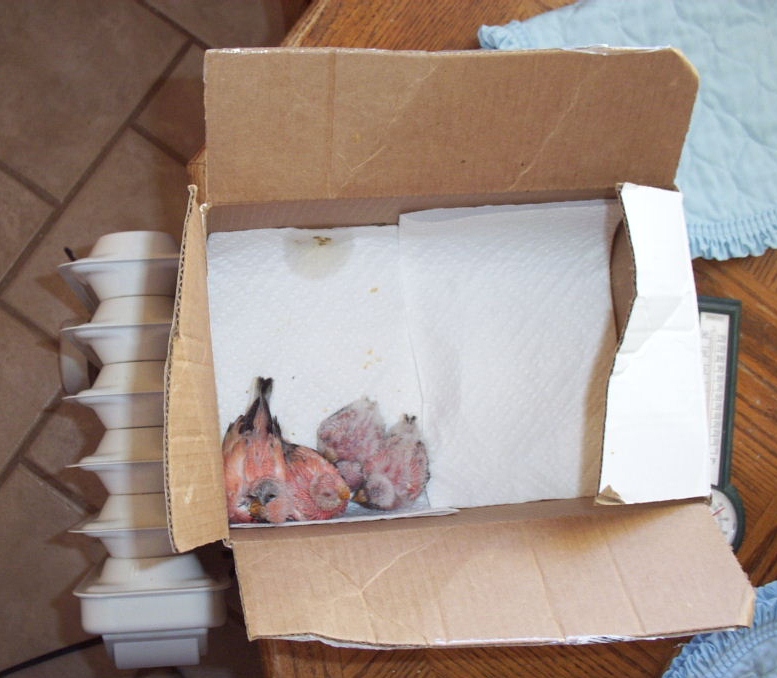
I put an electric oil heater near (not under) my box of babies to be sure they stay warm. The box is long enough that they can move toward or away from the heat source. Also, I've learned to feed more than one at a time. That way they help keep each other warm. Even though our home is 70 to 74 degrees inside this time of year, at night I use the heater. I don't use it except for hand fed babies. Otherwise, their mother keeps them warm enough.

Good luck. I hope your little one grows up to bond with you as a healthy, loving and affectionate pet.
Fuchsia at bowl and Flame on my hand. These two babies
aren't theirs, but they treat all four alike - with disinterest.
They're still feeding the three left in their nestbox, but seem
satisfied to let me take over on the two youngest and the
two shown here from another pair's clutch.  Their main
interest is in the "delicious" Exact Hand Feeding Formula.
These two parents were hand fed babies themselves a little
over a year ago.

Peace & Blessings

Wednesday, August 31, 2011

Rosy Bourke Babies Today

Presently feeding four young Rosy Bourkes. 

Two of Flame and Fuchsia's five babies. These are
the youngest two and are being hand fed.
Nice photo to compare eye colors, one dark, one pink.

With five babies in the nest, I worried about Flame and Fuchsia being over worked. So, taking two of their youngsters seems kind.

Also, Rhett and Cherry are older birds with four in their second clutch. I removed two of theirs to also feed. Once they're a little older, I will probably take their other two as well.

All of these birds will be very tame.

Bird's eye view of the four currently being hand fed.
Notice how pretty the pink-eyed baby from Flame and Fuchsia is becoming. His/her feathers are very deep rose-colored like Flame's, yet has striking pink eyes.


Rhett & Cherry's two oldest of four babies.
These are being hand fed. Others will be later.
The pink-eyed youngster from Rhett and Cherry is still too small to tell what his/her feathers will be like. Picture of two in nestbox are siblings of the two above.
Rhett & Cherry's two youngest.

The pink-eyed young one from Rosie and Pretty Boy is a delicate pale pink with a white face. Lovely.
Rosie and Pretty Boy's pink-eyed baby on left.
She (or he?) is such a delicate, lovely pink with a white face.
Rosie currently is on her second clutch of three eggs. We hope for another delicate pink baby.

Bonnie & Clyde's baby, "Sir Gray Head," is in photo below. Smile.
Little "Gray" out of Clyde, center, and Bonnie at right.
 

Monday, August 29, 2011

Rosy Bourke Father with Food on His Face


Food from when he's fed his mate.
This spread out on his cheek feathers
 and hardened.

Bonnie and Clyde only had one fertile egg out of four. Perhaps that contributed to why Clyde looks like this. He only has his mate and one offspring to feed, and he's regurgitating too much.

This photo shows the "milk" he feeds his mate having hardened around his beak.

I expected to have to catch him and wash his face in warm water. That's something I've done many times on hand fed baby birds when Exact hand feeding formula isn't cleaned off and hardens. Best to find it and get it off before it dries.

However, I procrastinated with Clyde and this bit of hardened "milk" eventually dropped off all by itself a few days later. If this happens to one of your birds, don't let it worry you.

In photo below, Clyde's face is clean. He's the one in the center.
In all honesty, Clyde is the only parent bird I've ever seen this happen to. But, each and every one is an individual. Bless their tiny hearts. 


Baby named "Gray" because of unusual light gray head, back and chest.
Parents, Clyde in center and Bonnie on right.
Baby still has some down on head and rump.
This pair typically produce two or three offspring per clutch,
but this time there was only one.
However, he's unique.
Peace & Blessings!