Tuesday, April 17, 2012

Birds Going Bald, Possible Causes

Blogger identifies search criteria that lead people to this site. Someone searched out why their Splendid parakeet was going bald, so I thought I'd address that problem.

Young Splendid hen with her two brothers.

None of my Bourkes or Splendids have exhibited this, but I did have a female Budgerigar once who did, and I've read about parrots plucking out all their feathers. In the case of the larger birds, there might be a vitamin deficiency, or just plain boredom. I think it's often depression.
Handfed male named Rainbow.

In the case of Beauty, my budgie, she had been a house pet and very happy that way. However, an ugly green male parakeet arrived on our front lawn and I caught him. They quickly bonded and life in the house with the two of them became very noisy.

They were transferred to our outside aviary with the finches. She quickly made use of a finch nest box and hatched an egg. The baby was green and his wings were deformed. He couldn't fly. Because of this, my parents insisted we remove any and all eggs she laid from then on. This upset her immensely, and she started pulling out her feathers, leaving her front entirely bald. That winter she died.

We don't know any of the circumstances of the searcher's Splendid, but would guess it might be lonely and depressed. Another bird, and/or more attention could help. My own bachelor Splendids were provided with lots of stimulating toys and a bigger cage than the other birds. I think this helped keep them satisfied. Splendids are very active birds and enjoy swings and toys.


This bird really used the rings,
climbing in and out of them.
All the birds love their swings.
Another recommendation would be to be sure they have adequate nutrition. They love fresh vegetables, and you should always have cuddle bone and/or other calcium sources available. My birds have all benefited greatly from bird breeder extraordinaire Bob Nelson's advice. He recommended I add small salt blocks intended for rabbits. In doing that, all my birds' health and productivity has increased immensely. Not only did the Bourkes have bigger clutches and hatch ALL their eggs last year (I'd had losses before this), but the size of the new Lady Gouldian finches' first clutch amazes me. I noticed the hen pecking at the salt block just this morning. Is that the reason for their success? I believe so.

To avoid feather plucking, be sure every possible nutritional requirement is met. Give them lots of stimulation with toys and/or other birds. Also, if another bird is present, watch to be sure it isn't plucking the feathers of its companion. If so, you may need to separate them.

Peace & Blessings!

Sunday, April 15, 2012

Lady Gouldian Finch Babies

Snapped a hurried photo of the new Lady Gouldian babies. There are five baby birds showing here. It's possible one or two might be under dad, as there were seven eggs. I'm reluctant to disturb them, so only took one quick picture.

If you double click this photo, it should enlarge. When the picture is
bigger you can see the spots around the baby birds' mouths.
The parent birds shouldn't be able to miss them!
Smile.

A Gouldian breeder suggested that perhaps the move from a breeder to our house stopped their molt and that their colors may come in with the "next" molt. I hope so. Neither parent has the typical cheek patches normally seen on adult Gouldian finches. They do have black spots which indicates they will be black, not red as on some Gouldians.

Notice the bright red at the end of the male's beak. I've read that "his" beak turns red when ready to breed. A hen's turns black and hers is.

It's fun to be raising something new and different than I've ever had before. Exciting really.

The Bourkes are eager to begin breeding too, but they raised so many youngsters last year that I'm making them wait a while.

Peace & Blessings!

Friday, April 13, 2012

Candling Eggs To Verify Fertility - A Better Way

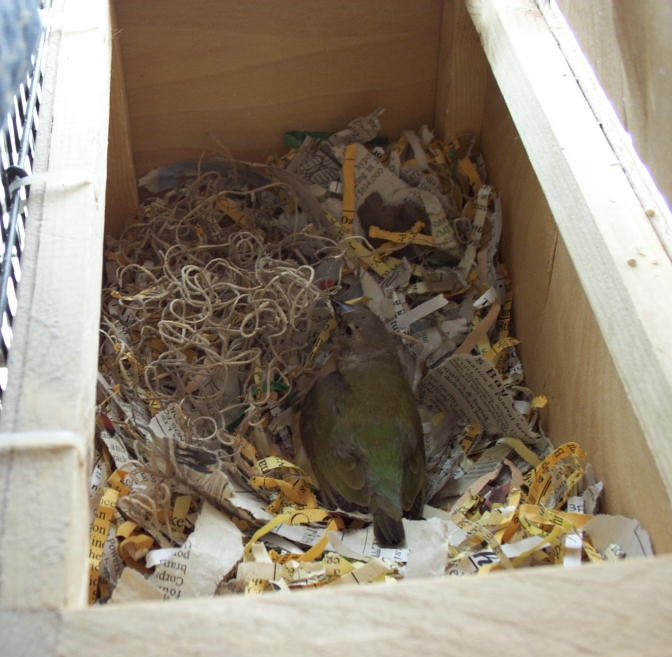
Lady Gouldian hen on seven eggs due to hatch.

I have found a better way to candle eggs.

It's rare that my pair of Lady Gouldian finches are ever both out of the nest at the same time. However, when the sound of the vacuum cleaner made the hen leave her nest for a few moments, it was long enough for me to snatch a peek at her eggs. I used my new method of candling for the first time and found it worked wonderfully and I didn't even have to touch an egg.

In the past, I've shown eggs being candled using the center of a toilet paper roll, duct tape and a flashlight. This works, but you have to pick up the egg, place it over the hole in the duct tape, view it with the light shining through the tube, then put the egg back in the nest. The procedure is repeated for multiple eggs, and there is a certain degree of risk to each egg.

The light attached to my Kindle above is
bright and works perfectly for egg candling.
The flexible  neck can snake around to any
side of a clutch without moving the eggs.
As a new Kindle owner, I bought a light for my Kindle in case our electricity goes out. It's something to do in the dark. When the "Mighty Bright" light arrived, with its flexible neck, it occurred to me that it should work well for candling eggs. I used it in the finch nest and it was wonderful. I didn't have to touch or disturb the eggs and could immediately see that, YES, they are fertile!  Hurray!

I bought this light from Amazon.com and it was relatively inexpensive. I'm very pleased with it.

The photos below are actually of infertile Bourke eggs from last year that I kept in the refrigerator. I like to share them with children who visit. Since my Bourkes are not being allowed to reproduce yet this year, I did a mock-up to show the "Mighty Bright" light to you and how well it works. I'd like to have a photo of it candling the finch eggs, but who knows when an opportunity will arise without having to chase the finch parents off their nest. I'm being more careful with them than I need to be with the other birds. My parakeets are used to me being nosy. Smile. 


Peace & Blessings!


Thursday, April 12, 2012

There's still time for a free eBook novel.

Amazon.com has my husband's book PROMISES by E.G. Lewis available for FREE download until midnight tonight, PST, April 12, 2012. If you don't have a Kindle, they have apps for PC, The Nook, iPad and iPhone also available for free that you can use. All his novels are exceptional. Smile.

Tuesday, April 10, 2012

A Compliment For The Splendid Bourke Bird Blog, Smile.

We love compliments and wanted to share one. Susan wrote:

"I am writing to thank you for your Splendid Bourke Bird Blog. I found it very enjoyable and helpful. I purchased a pair of Rosy Bourkes last week. They are my first birds. …

I came across your blog while searching for information on the care of these birds. Your site answered all of my questions (at least the ones I have so far). The many photos are wonderful! I also enjoyed reading about your husband's books and just purchased "The Witness" for my Kindle.


Thank you very much and keep up the good work."

--------------------------------------------------------------------------------------------


We're thrilled that Susan purchased "Witness" by E.G. Lewis. It's available in hard copy and as an eBook on Amazon.com.


NOTE:
As a promotion, on
Wednesday, April 11, 2012 and Thursday, April 12, 2012 

PROMISES by E.G. Lewis is offered
FREE to Kindle Readers.


PROMISES is a commercial novel. Although the main character is moral, her "ex" is not. Expect suspense, humor and sex in this novel. Get it tomorrow for free at Amazon.com for two days only!


You, too, may contact us through email at: 

Peace & Blessings

Monday, April 2, 2012

Historic 1960's Bird Photos - A younger me with birds.

I wish I had pictures of the aviaries I kept as a child and later as a teenager. My dad, it seems, liked taking photos at the San Diego Zoo in California, where most of these were taken.

Ring necked Turtle Doves at San Diego Zoo.
I'm probably age 16, about 1962.
S.D. Zoo, summer, 1964.
Right after H.S. graduation at 18.

Such joy. I dreamed of having an
aviary like those at the San Diego Zoo.

Feeding meal worms to the finches at San Diego Zoo in 1964.
If you recognize their varieties, please let us know. Thanks!
Blue & Gold Macaw and a Scarlet Macaw.

As you can see, I always loved birds. In my youth, if visitors to the San Diego Zoo in Southern California wanted to feed the birds, they were encouraged to do so, and most in the aviaries seemed to trust me. 
San Diego Zoo walk-thru aviary. Me with
a Mynah bird on my arm.

I'm feeding a Guianan Cock-of-the-Rock

Male Cordon Bleu and male Strawberry finch. From my
aviary when I was a teenager.


A budgie with Zebra finches and what we called a
Coral beak, although I've seen them named something else.
This photo is from my aviary in the 60's when I was a teenager.

Me, my sister, Nancy and Mom, Ellen. San Diego Zoo.
Feeding Ring neck turtle doves.


Perhaps my first bird, Beauty, a blue budgie.
I'm 12 or 13 in this photo.
San Diego Zoo walk-thru aviary. Me as a teen with a Mynah bird.

1967, my beautiful "Captain" budgerigar parakeet.

My high school senior sweater, so 1964. Feeding a male
Cock-of-the-Rock.

My sister and I feeding the wild variety of Banty chickens
at the San Diego Zoo. They were everywhere and often
ended up feeding some of the wild animals in captivity.

My Lhasa Apso puppy, Eechee, in 1969. Bird in cage is
a male singing canary. He sang so loudly that he woke
us every morning and getting a hen for him didn't help.
I traded them both for a young budgie parakeet.

Some of my Zebra finches in a California outdoor aviary.
I raised many varieties of finches when a teenager.

If I were going to go back and live my life over, I'd choose to be an Avian Veterinarian and try to find employment in a zoo. Smile.

Peace & Blessings to you and your birds, domestic or wild.

Friday, March 30, 2012

Lady Gouldian Finch Update

As of today, our single pair of Lady Gouldian finches have seven eggs. She is spending more time on the nest now. Both continue to add more and more torn paper to the box.
Took a quick snapshot of Duchess on her nest.
She's only been with us a few months and this is her
first clutch. I'm more careful with her than with the Bourkes
who are very familiar with my nosy peeks into their nests.
Duke is sitting on a perch outside the opening to the nest box. 

I bought Spanish Moss from a florist and dried it thoroughly in the microwave. They seem to like it, but haven't quit tearing up the newspaper on the floor of their cage...even after I gave them handfuls of paper from our paper shredder. Along with all the Spanish moss, all the shredded paper found its way into their nest box too. It's getting crowded in there, but the eggs seem to be sitting nicely in their round "bowl shaped" area.

It's interesting to me that she chose to brood right in front of the nest box opening and not farther back into the box. The top of the box is hinged and lifts up.

Hope you are having a wonderful day.

Thursday, March 29, 2012

Sexual Behavior in Bourke Parakeets - Interested Hens, Disinterested Males - Question & Answer


Opaline Bourkes with pink eyes. Cousins from 2011.


Elizabeth writes:

"I was looking over your site a little and found it very interesting. [Thank you!]

I have a question about male bourkes. My male is a lutino and close to a year now, I also have a rosy hen that is about two. The hen squats in position to breed all the time, however she will also do it just seeing me walk into the room. My question is why my male does not seem to show much interest in her? I do not have a box up and am not interested in having babies at this time, but would love to have baby bourkes at some point. Do you have to have a box in order for bourkes to breed? [Usually]

Will a hen demonstrate the breeding posture in front of another hen? [Yes, if no male is present]. My lutino seems rather placid, I have never seen him put his wings back and strut like you were describing for male behavior. The lutino was parent raised and I received him shortly after being weaned and easily trained him. He will sit in my hand while I pet him, and likes his cheeks to be rubbed but only slowly. I did for a short time own another male bourke purchased with the hen but he passed away from a heart attack. He was very old, and my hen also demonstrated to him, but he also did not do anything..." [Perhaps because he was old and/or unwell].


One of my favorite birds. Notice yellow at end of wings.
Rump, where blue is often present, it's yellow.

My answer:

Very young male Bourkes sometimes don't respond to females. Most begin to get interested at slightly over a year of age, but some may take longer. I wouldn't worry until two years old or more. It would be unusual if a male isn't interested by then. However, birds have preferences too and sometimes pairs simply won't bond. When that happens I swap partners and usually that works. Since you don't have that choice at present, a nest box might stimulate the male to act like a male.

Even without nest boxes up, most of my hens are displaying right now. However, the males they've bred with before are ignoring them. I believe this is because Bourke males typically enter a nest box (or hollow tree) first to be certain it is safe for their mate. Without a nest box present, they are less interested in attempting to start a family.

With your pair, if your lutino is actually a male, and since there isn't another male Bourke present, he may not see any reason to display. There is no competition to challenge, and the hen is already willing, so why bother? If you really want to test whether he's a male, I recommend putting up a nest box. If suddenly there are 8 or ten eggs in the nest box you can be reasonably sure you have two hens. Hopefully, however, you will begin to see mating and have fertile eggs. If you don't want to keep the offspring, I'd bet you can find a pet shop that will be happy to buy them from you.

Personally, I am overjoyed watching baby Bourkes hatch, begin to grow and feather out. With a lutino and a rosy, all their offspring should be lovely birds.

If you live anywhere near Southern Oregon, I'd consider doing some trading with you. I am hopeful my young white-faced, pink-eyed birds from last year will produce lutinos next time around. Some have a lot of yellow on them. Smile.

Birds are such a blessing and bring such joy.
Peace & Blessings to You.

Tuesday, March 27, 2012

A Swimming Bald Eagle? Yes!

The bald eagle in the video link below actually "swims" on purpose. It's no accident. In the Youtube video he is trying to snatch a nutria out of the water that apparently was shot by someone. It's too heavy to lift, so watch how he acquires it. Click on either link below. Amazing.

Use your BACK button to return to this site.


This is not the bird in the video.

Monday, March 26, 2012

Raising Lady Gouldian Finches

Mr. & Mrs. Lady Gouldian Finch

I take for granted how much I've learned about parakeets, especially Bourkes, Splendids and Budgies. Even some of the smaller finches have lived in our home. Gouldians, however, are a new treat and I realize how little I know about them. Thankfully, it's readers like you who fill in the gaps for me.

Three eggs so far.
This pair of Lady Gouldian finches obviously wanted a nest box, but I resisted since they aren't fully colored yet. However, the hen laid an egg on the floor of their cage last Thursday. So, a nest box went up right away. We didn't have nesting material for finches, but the little male diligently kept tearing newspaper up from the floor of their cage. I removed shredded paper from the paper shredder and gave it to them until I can get to town and pick up something better. It's been fun watching him transfer the slips of paper to their nest box.

Su Yin kindly shared the following information on Gouldians. Thank you Su!  
Male entering nest. Hen in front.
"Sometimes when these guys are ready, they are ready. I would just make sure the hen gets plenty of calcium and vitamin D supplements and give them a bit more protein with eggfood since she's laying. No need to increase too much until chicks are hatched, but if they are still actively molting, then I usually give them plenty of protein supplement. If they haven't been molting, it's possible they are stuck in molt - sometimes stress such as moving to a new home when they are still juveniles can lead to stuck in molt, but they should molt out next year.

[For nesting material] "I usually use dried soft hay/grass - orchard grass is fine, burmuda grass if good, coconut fiber is fine. I suppose shredded newspaper will work. Basically you just want to make sure the nest is cup shaped with a nice bottom so the eggs don't roll around too much and don't get broken on a hard bottom.

"You usually won't catch gouldians mating outside the nest box, so your eggs may very well be fertile - the hens usually sit overnight with the male taking turns during the day. Most pairs won't really sit tight until at least the 3rd egg has been laid though some start earlier and some later. I usually monitor to make sure if the male starts sitting during the day that the hen stays in the nestbox at night. sometimes the male gets over eager and starts sitting during the day while the hen hasn't started yet - this will kill the embryos. If this happens, you can take the real eggs out and put in fake eggs and then replace after both birds sit tightly. About 1 week after both birds start to sit tight, I would candle the eggs to see if they are fertile. Otherwise I tend to leave them alone until hatching time to make sure the babies are fed. Young gouldian couples sometimes can take a couple tries to get things right, but some are good parents to start."

Good luck with them,
Su

They've both been going in and out of this nest box.
Sometimes together, and sometimes one at a time.
Thank you! I will keep all of you posted on their progress.  Peace & Blessings.

Thursday, March 15, 2012

When To Put Up Nest Boxes and Playing With Tame Bourkes

My tame Rosies would rather be with
me than anywhere else. Love it!
None of our birds have nest boxes available to them yet. Having a nestbox present usually stimulates them to mate. However, my lovelies are eager now. Apparently, a few sunny days triggered breeding behavior that I'd prefer they put off for at least another couple of months.

My Bourkes always seem interested when February rolls aroung, but I try to discourage them until spring by not giving them a nest box until the weather is nice. Indoors as they are, however, it's always warm and they see no reason to wait. Too many clutches a year is a physical drain, so I want them to wait and remain healthy. Also, it's a good idea to have a market for their offspring. Smile.
Bathing in the sink is always fun.

My young handfed Rosy Bourke hen, Sugar, (who only hatched last summer) is already breeding with our mature handfed Normal cock, Spicy. I confess that last year I sold Spicy's first hen, along with another male. The purpose was to keep a handfed hen. Spicy is tame and I wanted a tame hen for him. Also, he and his first hen never hatched any of their fertile eggs, although they did successfully foster two from another bird. I'm eager to find out if he will be a successful father with this new hen.

In most instances, you can swap Bourke mates. Most will accept another companion, especially if they've been scolding/fussing at one another. I've only had one exception to this. One male refused a new mate and chased any other hen all over their cage.

Everybody wants a chance at the running water.
Tapping one another on the back means,
"Move over!" Males will step aside for their
mates, but hens don't usually move for anyone.
Eventually, I returned his original mate to him and then sold the pair. They were both good breeders and produced healthy offspring. But, as I've written before, my goal is to have mostly tame birds. The exception to this will be my earliest, and oldest Bourkes, although they are very friendly, but not finger tame. I love all the birds, but since I can't keep them all, my preference is for those eager to spend time on my shoulders or hands.

My tame Flame and Fuchsia have been mating too. They had four clutches last year...that's one too many. They'd have had a fifth if allowed. They shouldn't be in such a hurry. I want them fully rested and recovered before they start over again. They produced 45 offspring last year! They hold the record.


Young Lady Gouldian Finches. My first and only pair.
My new young pair of Lady Gouldians also seem to want a nest box. He is tearing up paper and carrying it to a corner. I haven't seen any breeding, but he's doing his "song and dance" in front of the hen. They seem to like each other. Neither is fully colored yet, so I'm resisting putting up a nest box. Wondering how soon I should... 
We are waiting for them to become fully colored before
adding a nest box, but they seem to want one now. 


Any input on when you allow your birds to reproduce and/or give them nest boxes, gourds or baskets, is welcomed. Please don't hesitate to comment. 

Peace & Blessings.

Friday, March 9, 2012

An Eagle to Be Proud of -- Pride in America.

The only bird in this video is an eagle, and it's one to be proud of. A stirring song. We need to defeat the advance of Socialism in this country and get back to our Forefathers blessed intentions. God Bless America!

http://www.youtube.com/v/6TPgJSZf5Vw?version=3&autohide=1&autoplay=1

Thursday, March 8, 2012

Rainbow, A Splendid Scarlet-chested Parakeet


Rainbow, a male Splendid Parakeet.

With no babies in the nest and all youngsters from 2011 sold, I've had little to blog about. Also, I'm spending most of my time editing my novel, Cast Me Not Away. It is going to come out one of these months...will let you know when it does.

All photos in this post were taken by Charisse Tooze of Tooze Films.


Charisse bought our sweet Rainbow, and is also a first reader for Cast Me Not Away. She has been kind in sending us periodic photos of Rainbow, who enjoys the company of a Rosy Bourke hen. We appreciate the updates and thought we'd share them with you.


I love this one.

Peace & Blessings!