Sunday, July 22, 2012

Parakeet Leg Defect


Foot appears to work normally, but one leg
extends outward at an odd angle.


Our elderly Bourkes Rhett and Cherry's first clutch wasn't highly successful this year. She hatched four of five eggs, but two babies died early on...both with pink eyes. The baby below has something wrong with its leg. I don't believe there was any sort of injury. I suspect it happened in the shell. The leg extends outward instead of in a normal position. Yet, it can be manipulated into a normal position with no apparent distress or pain to the bird.

My husband feels we should remove Rhett and Cherry's nest box and call them retired. Typically, elderly birds quit breeding on their own and these two have gone on longer than expected.

Over the course of several days we made three attempts to pull his leg into a normal position. Every time the contraption came apart or came off. I suspect his mother may have helped remove it.

First attempt to keep leg in a normal position.
We used a strip of bandaid to avoid irritating the skin.

Second attempt with a rigid match stick between and
stronger tape in middle with bandaid tape over ankles.

Third and final attempt. Notice, he's a little older in this
photo than in previous ones. Duct tape over a match stick
with Duct tape over the bandaid tape underneath.
The baby bird never seemed to mind the attention he was being given. I've spent time holding him in my hand with his leg held in a normal position. I think he likes it. Given enough time, simply carrying him around and holding his leg next to his body might begin to allow him to keep it there. Sort of like a person's frozen shoulder, where you have to gradually force it back over time until it's back to normal.

I've never experienced this type of problem before, but Debbie wrote to us about a similar one in 2010. Here is a link to her message with photos of her bird:  Bird Leg Deformity 

Debbie, if you're still out there, please let us know how Scarlet grew up. Did her legs become normal over time?

He can grasp with both feet and if I hold his leg next to
his body, it will stay there. He seems happy and
content in this position.

I didn't expect this bird to leave the nest box on his/her own. I expected to take him out when his younger sibling left the box. However, today he left the nest box on his own and his younger sibling is still in it. The photos below were taken today.

Sitting on a perch one-legged. Flies pretty well too, considering.

Found him sitting in this seed cup. He seemed
comfortable there. Leg is not stretched out quite as far.

This little bird will either be a keeper or one to give away. He/she isn't one to sell, but neither will I put him/her down. Animals are amazing at coping with physical problems.

Peace & Blessings.

Wednesday, July 11, 2012

Baby Bourke Parakeets Today

These clutches began hatching June 18, 19 and 20. By three weeks of age, parent Bourkes spend more time out of the nest than in it. The optimum age to begin hand feeding is also about three weeks, although I've hand fed a few birds from day one, when necessary, and they did fine.

Parents, Flame and Fuchsia were both hand fed and are very tame.
Their first baby hatched on June 19, then every other day thereafter.
Four babies here.

These two are from Rhett and Cherry, my oldest birds.
(His 1st mate was Scarlett and hers was Bing).Their first
egg hatched June 18, 2012. Four of the five eggs hatched,
however, two babies had dark stomachs, indicating
some internal physical defect. Neither survived long.

Rosie and Pretty Boy are the proud parents of these two.
She laid four eggs. Only these two were fertile. Rosie was hand fed
and is very tame. Her mate will get on my finger if I insist,
but he was not hand fed and isn't as tame as the others.

Looks like he will explode! So full he can barely move.
This is an early photo of one of Cherry's babies (also
shown in the 2nd photo above when older). I was worried
about how absolutely stuffed she'd made her two, but
apparently it didn't do any harm. He's healthy and happy.
On Friday I'll begin hand feeding some, or maybe all of these. I may leave one in each nest for the parents to finish...haven't decided yet. I don't want the parents to be upset over having all their children stolen at once, but two of the pairs are tame and will want to "share" in the hand feeding process with me. They like to eat the hand feeding formula whenever they get a chance. I'll be hand feeding at least five of the eight. Flame, Fuchsia and Rosie all join in when I'm hand feeding. The babies will all share the same cardboard box and later the same cage. Colored bands help me remember who their parents are.


Six Baby Lady Gouldian finches have their own cage away
from Mom and Dad now. They need new homes.
Flame and Fuchsia are bathing in their water dish.
So is their bachelor neighbor, Sweetheart, next door.
Sometimes they start splashing me before I can even
finish giving everyone fresh water. They're so cute!

May all your eggs hatch and
all your babies grow to be beautiful adults.
Peace & Blessings.

Tuesday, July 3, 2012

Prolific Lady Gouldian Finches


Duke and Duchess have successfully fledged their second clutch. All six hatchlings are healthy and eating on their own. Meanwhile, even before the babies left the nest, Duchess had laid two more eggs! Currently, she has five, but her first and second clutches were seven. Probably more eggs to come.

Duke has a mouthful of paper shreds. Baby at left.
Cup holding paper shreds.
I like to have newspaper on the bottom of our cages.
It is changed regularly and keeps everything clean.
Since Duke was tearing it into big shreds, I gave him a
cup full of paper from the paper shredder. He loves it.
Duke is happily revamping the nest box. No chance for me to clean it out, but he makes sure it's nice and tidy for another clutch. He has covered up all evidence of the last clutch and made it look spic and span. One problem, however. He covered up Duchess's first two eggs. Then she laid two more. He covered those up too!

So, today I went into the box and dug around to find those eggs. Found five buried eggs and moved them back to the surface. I candled them first, but since she hasn't been sitting on them I'm not certain if any, or all, are fertile. Two appear to possibly have veins in them, indicating fertility. They were probably warmed by the previous youngsters who are still returning to the nest box at night. The first clutch of five babies didn't do that, but this second clutch of six does return nightly.

Held the camera inside the cage for this photo.
Duke with shreds in his mouth.

Eight birds require a lot of food. Several dishes on the
bottom of the cage with a variety of food for the
babies to learn to eat on their own.

Duchess is still feeding her brood, even though they are eating on their own as well. Duke isn't interested in the young birds and has even knocked one or two off the perch when they've been in his way. Soon they will be moved to a cage of their own.

Peace & Blessings.

Monday, July 2, 2012

Bourke Parakeet Banding

I have many other photos and information about banding. Enter "banding" in the Search window if you want more specifics on banding baby birds.

Mineral oil helps slide the bands on, and a sharp toothpick helps pull the last toe through.

Fuchsia's youngest baby is banded. Silver aluminum band
identifies breeder as EGL, with the state OR,
also hatch year and sequential number.
Colored band identifies parentage.


Look at how fat this baby's crop is! Looks like
it could pop apart. Fuchsia makes sure her
youngsters never go hungry.
Today's Bourke Update:

1) Fuchsia hatched all five eggs, however, her pink-eyed baby died after a few days. She now has four healthy Rosy babies, all with dark eyes.

2) Cherry hatched four of five eggs and two babies had pink eyes. One died a day later, the other lived ten days before dying. She has two healthy Rosy babies left, both with dark eyes.

3) Rosie hatched two of four eggs. Both babies have dark eyes and are doing well.
Currently, we have eight (8) healthy baby Rosy Bourke parakeets. All are banded.

Observation:
As a reader previously noted, when a bird's intestinal area is dark it seems to indicate a physical defect. All these pink-eyed babies had dark stomach areas and none of the three survived. Last year, although we lost a few with pink eyes, we also had several who survived and are beautiful and healthy. Their stomachs were not dark...a genetic problem more likely to affect the babies with pink eyes, but thankfully not every time.

Peace & Blessings.

Sunday, June 24, 2012

Parakeet Observation with Egg Food

He'd eaten a lot of this before I took the picture.
He's not even a father, he just likes egg food.
When I added Lady Gouldian finches to my flock, a breeder recommended giving them egg food. Since we make a lot at once, this year for the first time we're giving it to all parakeet varieties as well as the finches.


I've observed that many of the egg shells left after their babies hatch are still there. In the past, I assume they ate them for the extra calcium since egg shells were seldom present except after an immediate hatch.


This year, all the hens are leaving shells in the nest. They just push them aside. The egg food is probably providing them with all the calcium they need. It should also be noted that the father birds are gobbling up the egg food as soon as it goes into their cage. The first day it was given to them they viewed it warily, but now look forward to it fresh every morning.


My favorite male Bourke, Sweetheart.

Bourke and Splendid males feed their mates, who in turn feed the young. After the young leave the nest, fathers take over much of the feeding for about two or three weeks. Splendid males may feed babies while in the nest, however, it's unusual for a Bourke male to do so. With Gouldian finches, both parents feed the young in the nest. Typically, both attend to them during the day, but only mothers at night.


Egg food:
Boiled chicken eggs, including shell, cooled
Dry bread crumbs
Blend together in a blender until shells are ground up
If too wet, it can be dried on a cookie sheet in a low oven
Excess can be stored in the refrigerator for approximately a week.

Last time we blended in mixed vegetables, which kept it moist. The birds seem to love it, moist or dry. Inverted jar lids make excellent serving bowls for small portions that need to be replaced often. Don't leave egg food to go bad. If you leave it in the cage, remove anything that remains by the end of the day, or sooner. Some sites recommend not leaving it longer than an hour. If you live in a hot climate, that is good advice.

Six baby Lady Gouldian finches, 3 wks old tomorrow
 and full of egg food.

Peace and Blessings!

Friday, June 22, 2012

Rosy Bourke Babies Still Hatching

Our three mature hens are all hatching their eggs. Hens from 2011 aren't doing anything yet. Not sure if we have any pink-eyed offspring in any of the three clutches. Will need to have a closer look in a few days after all 14 eggs have hopefully hatched.

Elderly Cherry on three babies with two eggs still to hatch.
Although it looks like an egg at left, it's the top of a shell.
Babies are little fuzzies sticking out from under her.
Photo taken today, June 22, 2012.


Newly hatched chick at top.
This photo taken two days ago of
Cherry's 2nd baby in brief moment
when she left the nest.

Moving Rosie aside to see what she
has hidden under her. Got tired of waiting.
 Two of four eggs have hatched.
Photo taken today.


Fuchsia with three babies and two eggs. Her box
doesn't stay as clean as the other hens'.

Rosie covering two babies and two eggs. She went right
back to this position after I had moved her aside to see under her.
She's a hand fed hen, and very tame.

  
By the way, the extra perches apparent in these nest boxes are not necessary. We made the boxes years ago before we were really familiar with Bourkes and Splendids. Male Bourkes don't typically perch inside a nest box with a hen at night like some other varieties of birds do.

Peace & Blessings

Tuesday, June 19, 2012

Fuchsia's first egg has hatched.

There is an egg shell in Fuchsia's nest box today, although the baby is hidden under her. She's hatched her first egg of the season. It surprises me that Rosie hasn't hatched an egg yet. She was the first to begin sitting on her eggs. Just goes to show the 18-21 day range is subject to wide variation, especially from one Bourke hen to the next.

Monday, June 18, 2012

ROSY BOURKE BABIES 2012

Cherry and Rhett have the first baby Rosy Bourke Parakeet for 2012. All these photos were taken at noon today, June 18, 2012. Cherry and Rhett are seniors, over ten years old. Very experienced, good parents who came together after their first mates died. (Rhett's first mate was Scarlett and Cherry's was Bing, who sang all the time).

Cherry with baby snuggled under her head.
Egg shell in lower left. Baby is already dry with
white fluff. Probably hatched early this morning.

Wider view of Cherry in her box with egg shell and baby.
Old food stains on box walls. She is meticulous about not
pooping in her nest box, and keeps it very clean.

Close-up of Cherry with her first hatchling of the year.
She's not hand tamed, but used to being peeked in at.

This is our hand fed Fuchsia whose eggs should begin hatching
within the next couple of days. She isn't as meticulous as
 Cherry or Rosie about keeping her nest box clean.
It will need a bit of cleaning after all eggs hatch.

My favorite hen, Rosie. Hand fed and sweet as can be,
she keeps a meticulously clean nest box even though she
seldom leaves it. She's a dedicated and loving mother and pet bird.

Peace & Blessings! May all your eggs (and dreams) be fertile and hatch perfectly.

Thursday, June 14, 2012

Lady Gouldian Finches at Eleven Days Old


Duke, shown above, is the father of these six Lady Gouldian babies. They're eleven days old today. Duchess laid seven eggs and six hatched. Remaining egg is in the center. All babies are doing well and I see no reason to remove the egg.

This is the same nest box where this pair raised five babies not long ago. She was back laying eggs before I was able to clean the box. They moved their second clutch to the other side of the box and covered up the old area with more paper. It's actually very clean.

They seem to be used to me lifting the box lid to look in. I worried at first that they might fly out, but they've never tried to. To give them maximum space inside the cage, the nest box is mounted outside the cage with an opening cut through the bars, giving access to the nest box hole. The lid above is hinged.

Rosy Bourke parakeet eggs are due to hatch next week. Getting excited to see if we get more opaline fallows.

Peace & Blessings.

Tuesday, June 12, 2012

Bourke Parakeet Question and Answer


This is our smallest nest box. The others are larger.
Rosie is sitting on four eggs. She's very tame and
a very good mother. Possibly my favorite bird.
Carolyn writes:

"We have been gone on vacation for two weeks. Before we left, I candled the eggs. They all looked the same to my very untrained eye, and I was not sure if that meant they were all fertile, or all duds. So I broke one open and it was infertile. But I left the other four anyway, to give the mama bird something to do.

… we got home yesterday and found this little cutie! I am guessing he is a little less than 2 weeks old. He is mostly brown with pink on his chest, and then his blue britches. Pretty darned adorable!

 I threw the other eggs away. [Eggs help keep babies warm, so best not to remove them. However, if he's already feathered, removing them wouldn't do any harm].

...I am wondering how to make sure he doesn't hurt himself when he is ready to leave the nest box. The box is currently about 6 feet off the ground. When he is ready to leave, should I put it at ground level? The door is about 6 inches above the floor of the box, and has a perch on the inside and outside. Any idea about how long before they are normally ready to fly? Also, should I take the top off the box so he starts getting some light?  …this is our first baby bird."

Answer:

Congratulations Carolyn. Don't move the box or take the top off. Baby birds are used to being in the dark. Also drafts are not good for them. He's snug in his box. Better to leave well enough alone. You don't want to change something that will upset the parents. In nature, nothing is changed while they're raising young.

As for flying, he's not going to hurt himself when he leaves the box. Six feet isn't far even if he fell, but he will probably fly long before he hits the ground. Yet, if he did, his fall would be broken by the fluffiness of his feathers...he'd "glide" down. Birds are light weight and able to fall...even unfeathered babies are likely to survive a long fall. Six feet isn't far at all, so don't worry.
 
When he's getting close to leaving the box, you will hear him flapping his wings. They rehearse flying and strengthen their wings before they leave the box. He won't have any trouble reaching the opening...if his mother can get in and out, so can he. Young birds need to be capable of flying as soon as they leave their nest, or they'd be at risk from predators. After he leaves the nestbox, his father will take over much of his feeding. Young Bourkes need to be fed for two or more weeks after they've fledged (come out of nestbox) before they can fully eat on their own. Don't separate him from his parents until you know he's eating enough by himself (parents no longer feeding him).
 
After he's weaned, his parents are likely to go back and start another clutch pretty quickly. Once he’s out of the box, I suggest you clean the nest box and add fresh pine shavings in preparation.
 
Enjoy!
This is Sweetheart. He has a white face and pink eyes.
He was hand fed and is very tame. Looking for a mate
for him...hopefully a Lutino Bourke hen.

Monday, June 11, 2012

Week-Old Lady Gouldian Finches

Six baby Gouldian finches hatched June 4th.

Lady Gouldian finches are one-week-old today.


Six very full baby Lady Gouldian finches.

Duchess, our mama Gouldian. Photo taken June 11 when
six babies are one-week old. Seventh egg didn't hatch.
All six youngsters are doing well.

Rosy Bourke Parakeet hens have eggs due to hatch next week. Rosie has four eggs, Cherry and Fuchsia have five eggs each. Fourteen potential Rosy Bourke Parakeet babies. Last year's young couples haven't done anything yet.

Peace and Blessings.

Monday, June 4, 2012

Lady Gouldian Finch Babies

I am blessed with excellent hearing, thank you Lord. Thought I heard some tiny cheeps and walked up to the Lady Gouldian nest box a few minutes ago. Sure enough...the hen's seven eggs are hatching! I'm sure to have more to blog about soon. Expected them on June 7, so they're earlier than anticipated.

This is the second clutch for this young pair. Last time they hatched six of seven eggs and raised five. I'm going to wait until tomorrow before peeking into the box. Don't want to disturb the hatching process. Hope to get these banded and am considering hand feeding some of them.

This photo is from her first clutch.
I don't like to post without any photos.
Smile.
Peace & Blessings!

Question on "Screaming" Rosy Bourke Hen

Bonnie left a question attached to the post  "Breeding Bourkes, Splendids or other Parakeets". Her questions and my answer follow:

"Hello, I am very grateful for your blog and all of the helpful information about bourkes parakeets! I have a concern about my female rosey bourkes parakeet. I think she may be about to lay an egg, and last time around this time (a month ago) she displayed some odd behavior. She began to scream in a high pitched voice to her mate, and this would prompt him to feed her. However, the screeching would continue even right after she ate. I thought this was perhaps because she had an egg inside of her and thought it would stop when she laid, but then she started passing very watery droppings and eating constantly without ever seeming to feel full. When she began to sit at the bottom of her cage, and when I noticed that the male bourke also seemed to be passing watery droppings, I took them to the vet. He gave me an antibiotic to administer to them, and within 3 days they both looked much better. The female then laid a misshapen egg, which I think may have been the problem.

Two weeks ago, I decided to give them a nesting box in case they were stressed about not having a place to lay eggs. While they have peeked their heads inside, I haven't seen them go in.

My concern is that the female is making the same (very high pitched- more high pitched than her mating call to him) screaming sounds. Again, this prompts the male to eat and feed her. What worries me is that the screaming continues into right after she has eaten and she seems very stressed out. Her droppings are normal which makes me feel better. Is she stressed about the male's presence in the cage? (Their cage is quite big though; they are not cramped). Is this normal female behavior? Thank you for any guidance you can offer me on this!!!! "
Posted by Bonnie to The Splendid Bourke Bird Blog at June 4, 2012 5:51


MY ANSWER: 

Hens that are going to lay eggs have larger than normal droppings, and often they are wet and/or darker than is usual. Since both your birds had wet droppings, the trip to the veterinarian for antibiotics was a wise decision. Better safe than sorry.

We have two hens...a mother and daughter actually...who are louder then the others when asking to mate. They are the exception, but it's not unheard of for Bourke hens to screech at their mates. A long time ago we were given a pair of Rosy Bourkes because the former owner couldn't stand how she screeched at her mate. They'd even had babies together. She was scolding him much of the time, so I separated the pair and put them with new mates. Instant peace and tranquility! Sometimes two birds aren't meant for each other, just like people. Both birds were happy, quiet and very productive with their new mates.

When I've had hens with egg-binding, they've been quiet and miserable. None ever "screamed." Hens in trouble usually sit on the bottom of the cage, fluffed up and sick. We had one exception to this who died in her nest box because she was out of sight, but typically they abandon all interest in any eggs they already have. The hens end up on the floor of the cage, huddled up and looking lethargic. I've never had one make any noise at all. If your hen ever does have egg binding, please search "egg binding" on this site for articles on how to save her.

I assume you have plenty of calcium available for your hen...cuddle bone, mineral block, oyster shell...that sort of thing. I highly recommend a rabbit salt block. Bob Nelson recommended this to me and I've not had a single bird experience egg binding since I added the salt blocks to their cages. They contain Vit. D and iodine and it took my birds about a year before I saw them use them. Now they're at them regularly. The blocks are small and I put them in the bottom of the cages on newspaper. If in contact with metal they will damage wire cages. When they become soiled from droppings, I wash them off and put them back on fresh newspaper.

The other thing you can do for your birds is provide them with vegetables and greens. Fresh is good, but I also buy frozen vegetables for us and always share some with the birds. Mixed vegetables give them a choice of carrots, peas and corn. Mine prefer the corn, but too much is fattening. Fresh greens are also good. They love spinach, kale and any kind of lettuce. When breeding, and especially when raising young, spray millet is healthy. It's fattening too, so when its not breeding season and they aren't raising young, I don't give it to them.

Bourkes are susceptible to fatty livers, so too much fat can be fatal. Some are more susceptible to this than others. I used to give them safflower seeds, which they all loved, but lost a young hen to  organ failure from obesity (an avian vet's autopsy indicated it). So, I no longer provide safflower and have cut down on how much corn and spray millet they get, giving it only during breeding months to breeding birds, or babies recently out of the nest.

Good luck. Let us know if your pair is successful in raising youngsters.

Peace & Blessings.

Saturday, June 2, 2012

Found Petamine Breeding Formula

My husband and I both remember buying this for our budgies when we were children. He grew up in Ohio and I grew up in California. It's sad to see it change hands several times and no longer be available over the counter in pet stores and supermarkets as it was for decades.

If you've missed Petamine Breeding Formula which seemed to have dropped off the face of the earth, the Scott Company sold it to a seed company.
Slightly worn labels on the Petamine
received recently.

Back labels are "scuffed" too. Contents are sealed.

I made several attempts to contact the new owners of this product. The email address in their website bounced because the "box was full." So, I waited a week and resent it. It was still "too full."  So, I called the 800 number and spoke to a pleasant young woman. She couldn't answer my questions, but said she'd have "Shane" call me back. I left my number and, over a week later, no one has called back.

While on the phone with the young woman I went ahead and placed an order for Petamine Breeding Formula. She said they have cases of 1.5 lb packages that the Scott Company sold them. When those are gone, she said they will only produce 20 lb bags of the Breeding Formula.
Shown here with the old 2 lb package that sadly hasn't
been available for quite a while. A better value at the time.
I transfer small container contents into the bigger package
because I can scoop out of it. It's easier to use and preferable.
It seemed like a wise idea to purchase two 1.5 lb packages, enough to last a breeding season (or two) for 14 small breeding birds. They charged me $15.47 for a 1½  pound package. When it arrived I expected to receive a catalog, as advertised on their website. There wasn't any catalog in the package. I was not charged shipping from California to Oregon, but there was a $1.00 handling fee. Total cost for three pounds of Petamine Breeding Formula to me was $31.94.

If over $10 a pound is worth the price to you, Petamine Breeding Formula is available. It came via UPS, albeit, looking a bit worse for wear. Purchased from:

Volkman Seed Company, Inc.
P.O. Box 245
Ceres, Ca. 95307
Phone# 1-800-635-9359
Fax# 1-209-634-8525
E-mail address: info@birdseed.com 
(Good luck with their email. Maybe you'll be luckier than I was and they will receive and answer it. My two attempts bounced because their mailbox was full).

(Note added on 6/8/12: "Shayne did finally phone back and verified that all the products that will go into the Petamine they produce will be from the USA...none from foreign vendors. After the death of so many American pets from China's sale to us of melamine that tests like protein and went into cat food, I tend to only trust products grown and processed in the USA, or possibly Canada).
Peace and Blessings.

Friday, June 1, 2012

For Greater Glory: The True Story of Cristeros

MOVIE REVIEW  < Click.

Just saw this movie review and want to see the movie as soon as it comes to our city. Thought I'd share this with others who may not have heard about it.

Bourke Parakeet and Lady Gouldian Updates

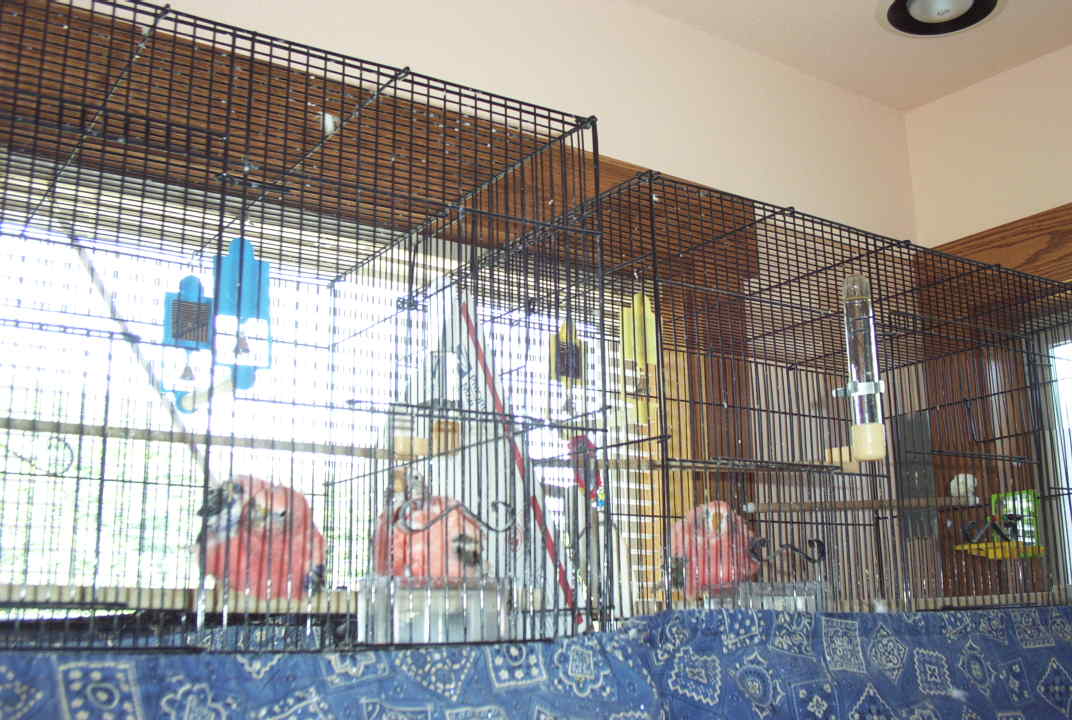
After downsizing, now only three cages in the living room.
Rosie is in the top cage. The two lower cages with nestboxes
belong to 2011 hens. They haven't done anything yet.

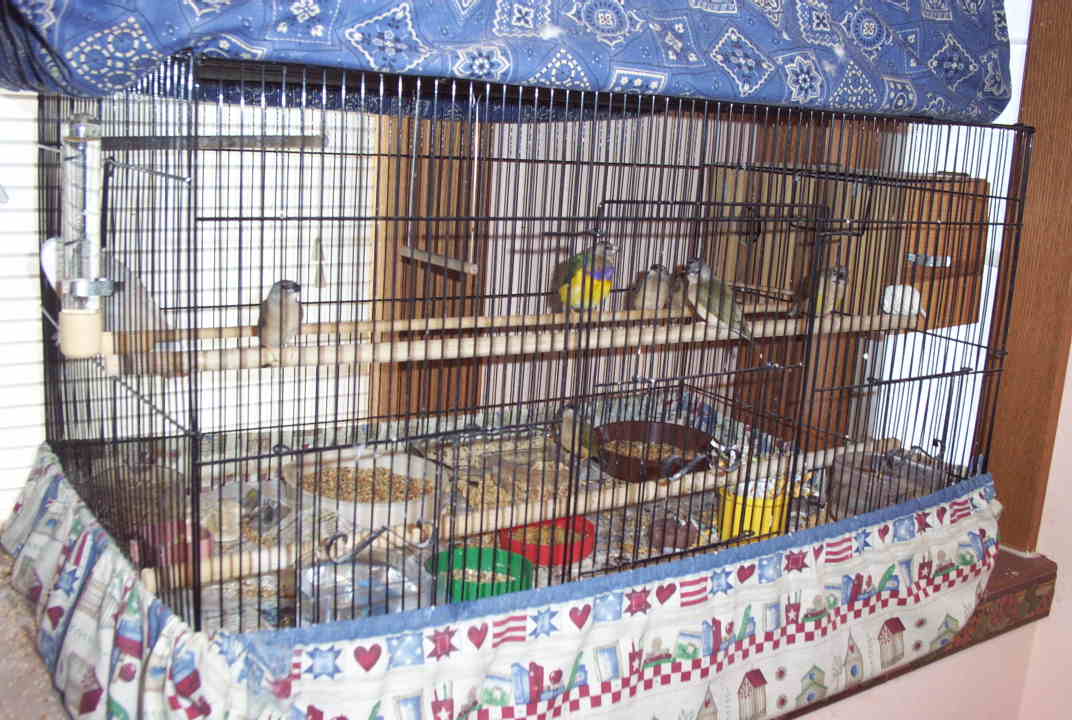
Four cages in the nook off the kitchen. Fuchsia and Flame on top left.
Rhett and Cherry below. Gouldians are in the cage at lower right.
Pink-eyed, white-faced Bachelor in upper right needs a
special mate. Hoping for a Lutino.
Our three oldest Rosy Bourke hens each have two eggs with more to come. It will be interesting to see when they hatch because Fuchsia and Cherry are not staying on their eggs yet. However, Rosie began staying fluffed up and in the nest box as soon as she laid her first egg.

Setting on the eggs does affect their hatch date...18 to 21 days is typical. I'm betting Rosie's will begin hatching at 18 days and every other day thereafter. Fuchsia and Cherry's will be slightly delayed depending upon when they begin to keep them warm.


Duke Daddy-bird on his Lady Gouldian eggs. He gives
Duchess a break periodically throughout the day.
She is always the only one in the nest at night, however.

Our Lady Gouldian finches don't provide us with many opportunities to see their eggs. He goes into the box before she comes out and vice versa. However, I decided to move Rosie's cage, which had been above the Gouldians, into the living room. In doing that, Rosie remained on her eggs, but the Lady Gouldian fled the box to see what was going on. It gave me a chance to look inside. She has seven (7) eggs. She didn't set on them until all were laid and they should all hatch the same day. I expect that to happen next week, June 6-8.


Fuchsia on two eggs with more expected. She's hand fed,
very tame, and  her first year 2011 she and Flame produced
more young in a year than any of our other Bourkes ever have.

Rosie, who looks just like Fuchsia, is also on two eggs.
Although hand fed because her own mother was dreadful,
she is a great little mother. She is our sweetest bird,
very friendly and affectionate. Mated to dark pink Pretty Boy.

Cherry is a grandmother and great grandmother many times over.
She takes this whole business in stride. Although not hand fed
like Rosie and Fuchsia, she is not afraid of anything.  It's all
"old stuff" to her. She and Rhett are wonderful parents.

Peace & Blessings Everyone!