Friday, November 29, 2013

Young Bourke Parakeets & Lady Gouldian Finches for Sale


Placed the following three ads at eBay Classifieds, Pets, Birds today. Thought I'd share them here too.

I primarily raise Rosy Bourke parakeets and this one is a rarity. He's a very pale pink, although over time he will darken some. His face is white and should remain that way. He also has a touch of yellow, but isn't a Lutino. He is an Opaline Fallow Rosy Bourke and has red eyes. Very unusual. Has not been DNA tested to confirm his sex.


Hatched this year (2013) he is parent raised and very sweet. With more attention he should become a tame bird, but is not hand fed. He's a lovely songster. If you raise Bourkes, his line should introduce some beautiful offspring. Recently his great grandfather died, so he is currently keeping his elderly great grandmother company. She is the Rosy shown with him.


Read more: http://oregoncoast.ebayclassifieds.com/birds/north-bend/rare-rosy-bourke-parakeet-in-opaline-fallow-pink-with-red-eyes/?ad=30737181#ixzz2m5oSolQn

Have very young Rosy Bourke Parakeets now eating on their own. They are from three different clutches and are too young to be certain about their sex, male or female. However, I'm good at guessing if you want to try for a pair.


Have very young Rosy Bourke Parakeets now eating on their own. They are from three different clutches and are too young to be certain about their sex, male or female. However, I'm good at guessing if you want to try for a pair.

These youngsters were parent fed by very tame parents. They should tame down quickly with kind handling. Bourkes are quiet, sweet-natured birds. When it's important to have a quiet pet, they are perfect. Most active at day break and sunset, and have natural, lovely songs. They also wolf whistle.


Read more: http://oregoncoast.ebayclassifieds.com/birds/north-bend/rosy-bourke-pink-parakeets/?ad=30736071#ixzz2m5ouEvpH


I raise many birds, but keep only one pair of Lady Gouldian finches. They are a sweet, tame and prolific couple. Hence, the inexpensive price for their offspring.


Baby Lady Gouldian finches. Photo taken 11/29/2013.
They will eventually be very colorful.
After first molt.


Not fully molted yet, but getting color.

Currently, we have six baby Gouldians out of the nest and beginning to eat on their own. They don't yet have their adult colors, so they are mostly brown. After their first molt they will have the brilliant colors of their parents.

I've included photos of an earlier clutch that I kept until they molted, but will let these go sooner. If I don't keep them as long, I can sell them for less...an advantage for you!


Read more: http://oregoncoast.ebayclassifieds.com/birds/north-bend/lady-gouldian-finch-babies-will-have-black-faces/?ad=30737366#ixzz2m5pIFlrd

 PEACE & BLESSINGS!


Thursday, November 21, 2013

Pink Bourke Parakeets & Lady Gouldian Finches, Young Birds Today

Below are photos I took this morning. These will be the last baby birds for 2013 and no more until late next Spring.
 
The Opaline, Fallow Pink Bourke Parakeet below has red eyes. Notice the bit of yellow on his wings. It's also on his rump. He is currently sharing a cage with our elderly Cherry whose mate, Rhett, passed away recently. Rhett was my very first Rosy Bourke and I miss him. Chose this bird to house with her because I might decide to keep him and didn't want her to be alone. He's also the oldest of the Bourke babies we still have from this year. 
This baby is out of Rosie and Pretty Boy.
He was raised alone and would be easy to hand tame.

Four young Rosy Bourkes ready for new homes.

The Rosy Bourke babies above are all for sale. Remember, I don't ship. They are only recently weaned. One is out of Rhett and Cherry and one out of Fuchsia and Flame. Two others are from Rosie and Pretty Boy.


Fuchsia laid four eggs and two have hatched. The other two probably won't. She's very tame. These babies will be ready to band in another couple of days.

Our Lady Gouldian finches are on their second clutch of the year. There are three babies outside the nest box and three still inside. Mother Gouldian finch is in the foreground with her pretty black face.
 
If I don't get the nest box off soon, she's going to lay another clutch. Not sure if I want that to happen. She's a sweet bird, and overly prolific.
 
These babies are also available, although our local pet shop wants them.
 
We live on the south coast of Oregon, near Coos Bay. Contact us at:  rosie.birds@gmail.com
 
May God bless you and all your beautiful birds with peace, joy and good health.
 

Saturday, November 16, 2013

Small Exotic Birds by Gail Husband Lewis is Coming

Don't miss the video at the bottom of this post.

My novel is back with the Cape Arago Press editor, so I'm free of that responsibility for a while. The novel, Cast Me Not Away, is being published with a pseudonym, Zara Heritage.
 
It's time to return to work on my bird book. This non-fiction, informational book will be published under my own name and available at Amazon.com and other retailerssoon.
 
Here is the tentative Chapter list, or Table of Contents. Have I left any subject out that you think should go into the book? Your input is appreciated. Thanks!
 
Introduction
Keeping Small Exotic Birds
Choosing a Bird, Behaviors and Personalities
Cages and Aviaries
Diet and Nutrition
Breeding, Mating and Sexing
Nest Boxes, Brooding and Incubation
Successful Parent Birds
Banding Baby Birds
Hand Feeding Baby Birds
Health, Safety and Medications
Hand Taming, Talking and More
Beak and Nail Trimming
Egg Binding Help & Rescue
Genetics and Maintaining Records
Birds with Other Pets
Questions and Answers
Birds Bring Joy

Meanwhile, here is a video of my favorite Rosy Bourke. I started calling him "Sweetheart" and it stuck. He is a very sweet Opaline, Fallow Rosy Bourke with red eyes.


Peace & Blessings!


Saturday, October 26, 2013

Crocheted Birds, What Fun


A Splendid parakeet, Ring necked parakeet, Galah (or
Rose breasted cockatoo), and a Bourke in the wild color.

Came across a fun site on Facebook. This person crochets birds and sells them. To see more crocheted artistic talent, here is a link:

https://www.facebook.com/thecrochetbirdhouse?hc_location=stream

Assorted Budgies

Peace & Blessings

Tuesday, October 8, 2013

Bird Beak Trimming Example ... on a Rosy Bourke Parakeet

It seems that every few months, this elderly Rosy Bourke Parakeet needs another beak trim. And, yes, he does have cuttlebone and mineral blocks available.

Our oldest Bourke Parakeet, Rhett.
By holding a small bird's head between your fingers (slightly higher than shown here...not covering the eyes, but over the sides of the head), you can keep the bird's head straight and not allow him to turn and bite you.

Rhett has become used to this procedure. I think he appreciates it.

He doesn't struggle, making it easy to snip the extra length.
However, I still hold his head steady between two fingers.

If you snip too much and the beak begins to bleed,
quickly add corn starch to the wound to stop the bleeding.
This also works for the nails of the feet if you snip too close.

 
If you are unsure how high to snip, examine a young parakeet for how long their beak appears. If you don't have another bird, check out parakeet photos (or photos of birds like yours) on the internet.

Peace & Blessings.

Monday, September 30, 2013

Bourke Parakeet Video of Newly Hatched Baby

Rhett and Cherry had fertile eggs, much to my surprise. They are quite elderly by Bourke standards, both over ten years. This first hatchling appeared to be dead in the nest, so I took its cold body out and noticed movement of its beak. My hands were cold, so I held it against my warm midriff and soon felt it begin to wiggle. I quickly prepared Exact Hand Feeding formula and fed him. He gulped down the food.


I returned him to Cherry, tucking him under her. I was hopeful she'd accept him back and had only accidentally let him slip away from her. She's been a good mother in the past.
 
I checked her before going to bed and didn't see him, so believed he was still under her, warm and safe. Next morning, however, he was in a far corner and this time he had died. Why did she reject him? I don't know. Would he have survived if I hand fed him? Well, he did have a partial black area on his stomach. Babies with black stomachs typically don't survive because there is some internal problem. This is true for finches, as well as Bourkes, and possibly for all birds. His was not ALL black, but did have that one area... Could that be why she rejected him? As an experienced mother, did she believe he couldn't survive?
 
Because of this chick's death, when Cherry left the nest momentarily, I checked her eggs. Three were not going to hatch, but one was piping (tapping and peeping). It would soon hatch. Would she reject that chick also? Was she tired and unwilling to keep raising her young...only willing to brood the eggs?
 
My sudden decision was to remove the viable egg and give it to Fuchsia who has a very good partner and has successfully raised nearly all her young.


The same day, Fuchsia hatched the egg and has been feeding the baby for several days now. It has dark eyes. Maybe Cherry would have done okay with it, and I felt sorry for her, but knew  Fuchsia would care for it and she has.
 
After a few days, Cherry gave up on the other three eggs in her nest, realizing they were not going to hatch.
 
Meanwhile, Fuchsia still has eggs due to hatch soon and so does Rosie.

Peace & Blessings.


Tuesday, September 17, 2013

Bourke Parakeets & Others - End of Season Update

I've tried to keep up with questions to rosie.birds@gmail.com, but lately I haven't been posting as often to this blog because my husband had back surgery. He is recovering nicely, but between him and the new puppy, my time is limited. One day I'll gather the newest questions and post them with their answers. However, for now, I want to update everyone on the current state of affairs with my birds this season.

Rosy Bourke parakeet on eggs. This is our sweetest hen,
 called Rosie. Photo taken 9-17-2013.
We've always recommended no more than three clutches a year per pair of birds. And, only two clutches per year for birds that might be stressed in any other way, such as being older, the weather suddenly turning cold, predators nearby causing a panic that could happen again -- anything that might make raising a third clutch difficult for the mated pair.

In spite of that recommendation, one year a young Flame and Fuchsia raised a fourth clutch because I didn't get their nest box removed in a timely manner. Often, I will hand feed a third clutch just to take some of the stress off the parent birds, and in the case of Flame and Fuchsia that year, I did hand feed their last clutch. Hand feeding the last clutch also allows me to remove the nest box before a pair begin mating again and the hen can go back and start laying more eggs.

Bourkes often begin to mate again right away, and a hen may lay eggs for a new clutch before their last clutch of young ones are all eating on their own. This year, in Fuchsia's case, while the last baby of her third clutch was still in the nest box, she laid another clutch of four eggs.

I couldn't hand feed the third clutches of any of our pairs this time because I knew we'd be traveling to a larger city for my husband's surgery. The birds were left alone with plenty of water and extra food for three days and two nights. They did fine, but hand feeding their young was out of the question.

Our oldest hen, Cherry. Her last clutch didn't hatch, so her
nest box has remained clean for this one. It seems unlikely
 these eggs will hatch either as her mate, Rhett, is quite
elderly too. In 1st clutch this year, they raised two.
My hubby usually attaches and removes nest boxes for me. This year, he's unable to remove them, and the nest boxes are still up. That problem can be dealt with by blocking off the entry opening. But, busy me, did not do so.

I also try to clean boxes between clutches and add new pine shavings. Since my birds are all very tame, if needed I can remove eggs for a short time and return them to a clean box. The hens always accept this from me. I'm not recommending it for everyone, however. I simply know my TAME birds will allow this, and I think they appreciate a clean box. The eggs are never away for more than a few minutes and handled carefully.

This post is to let you know how adaptable Bourkes (and probably all birds) can be. The picture below illustrates how they can accept their circumstances. Fuchsia's third clutch of four left the box pretty dirty and I've not been able to remove and clean it. She is using her "dirty" box for a fourth clutch. Cleaning it now will be a challenge since the dried food around her eggs is so hard. I need to decide when to do it...possibly after the babies hatch and I take them out to hand feed. Meanwhile, the box has a slight odor, but the weather is cool and that helps...

I'd never recommend allowing Bourkes to have fourth clutches in the same year, however, sometimes things happen that are beyond our control. These eggs are already laid and I'm not going to throw them away.

Fuchsia's box after raising four babies and starting
another clutch before the nest box was cleaned.
Instead of pine shavings, bottom has dry droppings.
The Lady Gouldian finches have babies again. All their clutches from late last year sold, and when she started laying eggs on the floor, I decided to give them their nest box back. I hear tiny peeps coming from within, Duchess won't move to let me see what's under her, smile. This photo is of a clutch from last year. They are about a week old here.
 
Lady Gouldian finch babies at about one week of age.


Turquoise Lineolated Parakeet.
The pair of Linnies (new to me), are in the nest box. The hen wasn't coming out, so I finally peeked in. She looked like she was brooding and I assumed she had eggs. However, I finally saw her out of the box and rushed over to have a look. No eggs. Disappointed, but still hopeful.

Cobalt blue Lineolated Parakeet. He loves his toys.


Light pink, white faced and red-eyed, opaline fallow Bourke.
This baby is from Rosie and Pretty Boy's third clutch this year.
She should be eating on her own soon. For now, Pretty Boy is
still feeding this daughter and his mate, Rosie, who is on eggs.
We have no breeding Splendids right now. It's all about the Bourke parakeets...my favorites.

Peace and Blessings,
Gail


Monday, September 16, 2013

Handfeeding Formula Substitute, A Question To Readers

Anyone have a solution to the question below? It was sent to rosie.birds@gmail.com.  BE SURE TO CLICK ON "COMMENTS" BELOW TO SEE ANSWERS... SMILE.
 
"Hi, I have a problem. I always keep some hand feeding formula around just in case one of my parents stops feeding a baby. Well I ran out and wouldn't you know I have a baby that is fully feathered but not eating and parents won't feed. I ordered the formula online because I live in the middle of nowhere and can't buy locally. Is there something I can feed the baby until the formula gets here? He's so thin I'm not sure he will make it."
 

As a child and teen, I was told that rescued baby birds could survive on egg yolk (from hard boiled chicken eggs), mixed with a little warm milk. However, none of my baby sparrows ever survived on it. But, maybe I didn't know to feed them enough and as often as necessary. I was only a child. - Gail

PEACE AND BLESSINGS.


Sunday, August 25, 2013

Finch Film and a Cobalt Blue Linnie

Ten-year-old granddaughter
with Mr. Blue, a cobalt blue
Linneolated parakeet.
It has been a busy summer, so I've blogged less often. Also, still trying to finish my novel, "Cast Me Not Away," for publication. The edits go slowly...

Another photo of her with Mr. Blue.

Our "Sheik" Skoshi, a Peke and Shih-Tzu mix at 5 months.
Skoshi has plenty of toys, but loves this cast-off slipper.

Our two oldest granddaughters spent a week with us last week. Enjoyed sharing the baby Bourkes with them.

Their visit went by too quickly.

Ages 15 and ten with Skoshi, on their way home.
He came back with us and misses their attention.

Below is a link to a Video of our finches via You Tube. All their youngsters from last year completed their molts and are beautiful. I had to separate this pair to prevent them from continuing to mate and lay eggs. During that time the hen molted, and the cock partially did so, but stopped. He has more color than he did last year, but still isn't fully colored out...notice the splotches on his face that still remain.
 
They were separated for eight months and I took pity on them and let them be together again even though he still hasn't finished a complete molt. Maybe in another year. Smile.


Peace and Blessings.


Monday, July 29, 2013

Bourke Parakeet Breeding Update, Including Visiting Horses

Below are the six Rosy Bourke babies produced in second clutches from Flame and Fuchsia and from Rosie and Pretty Boy. Elderly Rhett and Cherry hatched only one egg in their second clutch and that red-eyed baby only lived ten days.
 
Second clutch of 2013 Rosy Bourke parakeets.
These are parent fed, four from Flame and Fuchsia
and two from Rosie and Pretty Boy. Both sets of
 parents had a baby with red eyes this time.


Recently sold hand fed, tame Rosy Bourke parakeets.
Male on right is Songster. Female is Peaches.
Both went to new California homes last week.

Peaches on left is a hen. Songster on right is male.

 
Neighbor's horses escaped and paid us a visit yesterday. Took these photos of them grazing in front of our home. We have plenty of room for them to roam and they enjoyed running circles around the house.


They're very friendly and asked for treats, but I didn't give them any. Breaking out of their own fenced area is not to be encouraged. However, I enjoy having them visit once in a while...just don't enjoy the packages they leave.
 
 Blessings to you and all your pets,
and blessings to those that belong to your neighbors too!
 
Peace.


Thursday, July 25, 2013

Bourke Parakeets to New Homes

This lovely little lady is the excited new owner of a hand fed female Bourke. She's taking her home, and her mother shared this photo with us.

Bye Peaches. We know you will be loved.

Named "Peaches," this bird is the youngest from a clutch of three out of Rosie and Pretty Boy last November. Although it's unusual for us to do this, we clipped Peaches' wings to help her new owner keep track of her. A bird on a curtain rod is a problem for a child and Peaches is a strong flier.
 
 
Hopefully, by the time her flight feathers grow back Peaches will be bonded to her new owner and easier to retrieve. Her mother, Rosie, will come to me when I call her.


Bird at left is my red-eyed "Sweetheart." Bird on my hand is
Songster. He went to San Francisco on Sunday. Will miss him.

Another view of Peaches before leaving us. She is a
sweet little Rosy Bourke hen.

Saturday, July 13, 2013

Cobalt Blue Linnie, Hand Fed and Rowdy

Update on 12/11/2013 ... Have decided to keep "Blue." Our other pair is on babies, so hopefully we will get a mate for this bird and make it happy. Smile. Besides, he's growing on me. Very tame and fun.

------------------------------------------------------------

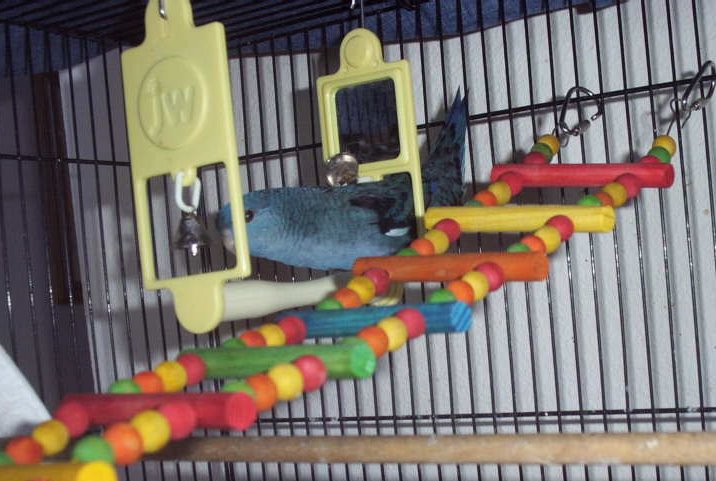
Beautiful hand fed cobalt blue Lineolated parakeet. He loves attention and loves his toys. He is the first Lineolated parakeet I've owned, although we've since added a mated turquoise pair. I hoped to get a youngster from them to mate with him, but am reconsidering raising Linnies as I have too many birds and want to continue specializing in Bourke and Splendid parakeets.

"Mr. Blue" was hatched in November, 2012.
Linnies come from South America. Although small, they act more like a large parrot than like the smaller parakeets. They pick things up with their feet, and do a lot of climbing, even upside down.

He loves to walk through the openings on this swing.

 
I call him a male, but he hasn't been DNA tested to verify sex. His breeder believes he's male, but another breeder commented on the lack of black at the tip of his tail, so possibly a hen. However, a third breeder says that's not a conclusive means of identifying sex. Have a DNA test kit, but haven't sent it in. Cost is just under $30 to DNA a bird using pulled (not shed) feathers.


His wings were clipped when we bought him.
First through one way.

Then back again. He loves the ladder too and it's funny to
watch him move quickly from one bar to the next.
 
Why sell such a gorgeous bird? Well... Blue wants attention and we've so many other birds that he isn't getting all that he desires. Hence, unlike most Linnies, he can get noisy. He was raised with Love Birds and Parrotlets that are louder than Bourke parakeets. Lineolated parakeets are great mimics and he sounds like a Love Bird or a Parrotlet. Since we added another pair of Linnies, he is beginning to mimic them, but I've decided to continue specializing in Bourkes and Splendids. And, I simply have too many birds right now.

Might consider letting the other Linnie pair go too. They are a 7-year-old proven pair. Wings are not clipped. Not hand fed, but calm birds. If interested, contact me at rosie.birds@gmail.com. Thanks.


Pair of turquoise Lineolated Parakeets.

Peace and Blessings.


Friday, July 12, 2013

Lady Gouldian Finches For Sale (Update, these are sold)

UPDATE: THESE ARE SOLD

If you are in Southern Oregon, have I got a deal for you. Five young Lady Gouldian finches have almost completed their molts. These three males are lovely singers. The two hens were hand fed and more tame than the others. All are related. Contact rosie.birds@gmail.com for prices and information.

 
Three young Lady Gouldian males. All hatched early this year.


Bird at far right isn't for sale. He's healthy, just unwilling to molt.

Bird on far right in photo above is their father who refuses to complete a molt. He and his hen have been separated for several months and she completed her molt and is lovely. Perhaps when his sons are gone, he will finally complete his own molt. He may need to be in a cage by himself for a while.
 
The young pair of Lady Gouldians I acquired over a year ago went to nest as soon as I got them, even though neither had completed their molts. They've raised some lovely offspring. By separating them, she finished her molt, but he hasn't. Yet, birds from their last two clutches are now brightly colored and gorgeous.
 
If you want to see beautiful birds, I recommend waiting to put young male and female Lady Gouldians together until they've completed their first molt. Obviously, it hasn't hurt mine to breed early, but it is nice to see their eventual wonderful colors.
 
Once this guy has completed a molt, I'll return him to his hen and a joy-filled life again.

Peace and Blessings.