Friday, June 13, 2014

Past Questions For Rosie Bird


Questions to Rosie Bird And The Emailed Answers. Some From Last Year, But Topics Are Relevant.
Fuchsia inspecting new nest box as Flame looks on.

QUESTION: What to Feed
Hi. My name is Luis and I just bought my first pair of Bourke parakeets. Can you tell me more about them? What you feed yours.  What type of fruit you feed yours. I read an article and it said no fruit because it not good for them. Is that true?  Honestly I never knew they existed until I found an article on the splendid parakeet. I plan on getting a pair of those eventually but I liked the pink. If you could help me out. Thanks.
Male Splendid Parakeet outside nest box.


ANSWER: I've never read that fruit in general is harmful and have offered apples and oranges to mine, but they ignore them. Avocados are a fruit that is poisonous to them. Avoid avocado!
In addition to parakeet seed and spray millet, they love many vegetables: kale, peas, green beans, corn, lettuce, shredded carrots. They will also chew on breads. Egg food can be made with boiled chicken eggs, blend shell and all, and add some dry bread crumbs, everything blended together. Always have calcium available, usually with cuddle bone, mineral block, oyster shell grit, and as I've mentioned in past posts on my blog, rabbit salt blocks contain iodine which the birds will chew too. It's good for them.

Below is a link to one of my posts about what they can eat. You can also use the search feature and type in "nutrition." Bourkes are wonderful birds.
http://thesplendidbourkebirdblog.blogspot.com/2010/03/healthy-additions-for-your-birds-diet.html

-------------------------------------------
QUESTION: When to Toss Out Old Eggs    
My hen’s been sitting on eggs for three weeks already. Will she toss them out of the nest box?? I believe I have a pair. One is all pink and the other one gray with blue and a little pink. I named him pinky.

Fuchsia with five offspring. Never throw out eggs.
Let the mother bird decide when to abandon them.

ANSWER:  Typically, I leave the eggs until the hen abandons them herself. I think that is best for her. Also, there is the possibility that a last laid egg might still be fertile. This year, one of my hens laid five eggs and the last three were fertile, but not the first two. I left those in the nest for quite a while before removing them. And, when I did, I candled them (held a bright light next to them to be sure they were clear).
If you remove the eggs before she abandons them, the hen may not trust you with her next clutch and be more afraid when you look into her box. Also, if the eggs don't hatch and she knows they weren't "stolen" maybe she will realize herself why they didn't hatch and make sure the next clutch is fertile.  You have a better chance of having good eggs the second time if you don’t remove the first “bad” clutch.
Are you sure she has a male for a mate? Two hens will lay eggs without a male. Sometimes both lay eggs so there are too many in the nest and that's an indication.  However, with Normal Bourkes you can identify males easily. They have a tiny line of blue feathers about the cere (nose). The one you described sounds like a Normal.
Did your male display? Throw his shoulders back, stand tall and flare his wings out for the hen? If not, you might have two hens. Or, perhaps one or both birds are too young and that's why the eggs aren't fertile. If that's the case, future clutches should turn out better. 

Best of luck next time around. Bourke hens go right back and lay a 2nd clutch...another reason to let her decide when to abandon this one.
 -------------------------------------------


A pair of Normal (wild colored) Bourke Parakeets.
QUESTION: Male Bourke Aggression & About Harvesting Weeds
My male Bourke got really upset when the hen got out of the box one time and started picking her feathers until she went back in. And he stands guard.  I’m pretty sure her eggs aren’t any good.

Also, do you know what weeds we can give them???

ANSWER:  Some bird breeders talk about harvesting weeds for the birds...newly sprouted are best. But, I've never done that. No one has ever pointed out to me what is safe and what isn't, so I don't do it. I give Kale and broccoli, cooked corn, carrots, peas ... I know there are wild things available, but I don't harvest them. For one thing, my indoor birds are protected from any illnesses that might be carried by wild birds.

Bourke hens don't usually toss their old or infertile eggs. They just quit going in the box. If he's harassing her, that doesn't sound good. Usually the hens are dominant. Does he have a tiny strip of blue over his nostrils (cere)? Normals have this, but Rosies do not. As I said, it sounds odd that he "makes" her stay in the box. That's not typical male Bourke behavior. They are usually hen-pecked by their mates.

If removing the eggs will make him quit it, then I'd remove them. But, check for that blue line of feathers ... it's tiny. If it's not there, maybe the reason the bird is aggressive is that it's actually another hen. If you have two hens, they can pair up when a male isn't available. Although, I'd expect both to go in and lay eggs in the same box.  Better luck next time.

Two Opaline Fallow Rosy Bourkes with red eyes.

 --------------------------------

QUESTION: How to Follow Blog
Hi, I’m becoming interested in the Bourkes!  I have 4 pair (3 rosies and 1 rainbow?).  I have one lone normal female, for whom I am seeking a male.  I like them because they are so quiet and gentle (seemingly?).  Don't know how to "join" your blog or if you are continuing with it, etc.

Thanks for the information that I read earlier.

 ANSWER:  Hello Jimmy, My blog has three columns; hopefully you can see all three. I moved the sign-ups toward the top of the first column. Enter your email address and push "Submit." Then you should get an email notice every time I post. The blog is still active. I don't post as often as I used to (or want to) because I've written a novel and am trying to get through the edits so that it can reach publication.

Believe me, blogging is a lot more fun and I feel guilty not spending more time editing the novel. The publisher, Cape Arago Press, is after me to hurry it up.

Good luck finding a mate for your normal Bourke hen. Too bad you don't live in Oregon. Smile.

One more thought. If you push the HOME button on the upper left, it will return you to the last post that went up. It sounds like your search took you somewhere else. Or, click here:
 http://thesplendidbourkebirdblog.blogspot.com/

 ----------------------------------------------------------

QUESTION: Unexplained Sudden Death of a Parent Bird
Hi I have two Bourke parakeets that have four young hatchlings. Yesterday I got home to find my male, only 1.5 years old, dead on the bottom of the cage. He was very healthy, eating good, singing, flying around. I have no idea what could have caused this and am now concerned about the babies. Do you think my female will be able to feed them enough by herself? Or do you have any suggestions as to what could have caused this and what I should do?  Thanks, Laura


Hand feeding Rosy Bourkes at approx. 3 weeks of age.

ANSWER:  Hello Laura, First, get some hand feeding formula immediately and watch the babies closely to see if their crops are full. You may have to hand feed to keep them alive. I had one hen whose mate didn't help her feed (he was younger than she). She refused to feed two of the four babies. One died before I realized it and I had to hand feed the fourth, youngest baby.
That was Spicy, the first bird I ever hand fed. She accepted him back into the nest and he stayed warm with his remaining two siblings, but she would not feed him.

I use Exact Hand Feeding formula, but get some immediately and have it ready. The directions are on the package. You can put the babies back in the nest and hopefully she will keep them warm and feed them. They will also help keep one another warm. If she appears to have abandoned them, you may need to provide warmth and food.
Sorry about your male.

ANOTHER QUESTION FROM LAURA:
I actually have some on hand [hand feeding formula] just in case, although I have never hand fed a baby. Right now the babies are 1-1.5 weeks. How often do you think I should supplement feed?

ANSWER: How Often to Hand Feed and Loss of a Parent
I hope you got the earlier email about being ready to hand feed. In fact, if it were me, I might pull the babies anyway...yet, they might be a comfort to your hen. Or, she may be so depressed she will abandon them. In any case, it's very sad.

If they’re only a week old, I’d recommend five feedings during the day and one in the middle of the night. At two weeks, continue with five feedings and stop the one at night. By three weeks, you can go to four feedings, and then three, etc. When they have feathers, offer nestling food and parakeet (budgie) seed. Chopped fresh broccoli is good for them too, as well as spray millet. You want to have foods ready for them to “try” to eat. Even once they’ve begun to eat a bit on their own, you still need to supplementally hand feed until they quit asking to be fed.  However, they may continue “begging” longer than necessary. The birds all like hand feeding formula. 

Hand feeding Rosy Bourkes at about 2 weeks of age.
Tame parents are keeping a close watch on the event.
Feeding babies is physically stressful for parent birds. If your male wasn't strong for whatever reason, then the added stress of feeding his mate and starving himself may have had something to do with it. I hope you are giving them egg food. It's easy to make and extremely good for feeding parents (see recent post). I also give nestling food that is higher in energy than just seed (they also always have budgie seed). They get cut up fresh kale and/or broccoli. They get cooked mixed veggies too...corn, peas, carrots, green beans. They can survive on just seed, but not as well. Especially if there is anything else going on.
I keep an excess of food in their cages all the time. If they run out, the male is likely to be the first to feel the loss as he feeds as much as he can to his mate. They also consume a lot of water when feeding babies. I give them fresh, cold water at least twice a day when they're raising young. They need water present all the time, so I have two cups and a bottle of water on the side of the cage as well.
About your male...It's impossible to know what he died of if there are no outward signs of injury. An avian vet can do an autopsy if you want them to. I took a 3-year-old hen to a vet who shipped her body to an avian vet about a four-hour drive away. She only took birds from other vets...wouldn't do it any other way.
The result was that this 3-year-old hen was obese. She'd never mated or laid an egg. I'd fed her and the other birds lots of corn, which they love, and safflower seeds, which they also loved. After that diagnosis that the fat on her organs had killed her, I quit giving safflower to my birds and cut way down on the corn...they are both high in fat. A parenting bird uses more fat, but she'd never been a parent or even laid an egg.

 
I'm very sorry for your loss. It couldn't have come at a worse time with babies in the nest. However, do everything you can to supplement the food for your hen. She's going to be more physically stressed then ever if she attempts to continue to keep her babies going. Also, in the past she's had food that he already ate, so it was thinner than what she's going to have to process herself.

I highly recommend helping her with lots of extra good food. Is she tame? If so, that's a plus because it will make it easier. If she's not, then I'd be tempted to pull the babies and begin hand feeding. Of course their age is a factor too. If they are small they will accept the hand feeding easier than if they are already feathering. And, if they are bigger, she has to feed them more food, so that's harder on her. I tend to hope they are still small... If so, consider pulling them to hand feed. They will be very tame and sweet afterwards, and their survival is more likely.
Best of luck. Don't hesitate to write with any further questions.

ADDITIONAL ANSWER:  So your babies are tiny. That's probably a good thing. Have you checked their crops? The widowed mother bird might gradually begin to feed them less and less (or not). I'd keep a close watch on them. If she's doing great right now and for the next few days, it doesn't necessarily mean she always will.

So, I'd let her feed them for another few days (if she does, keep checking). Then at 2 weeks, I'd pull them out and begin feeding with an eyedropper. Follow your directions and make sure the food isn't too hot. I test it like a baby's bottle on my wrist to be sure it's not too hot.

Parent fed baby Bourke.
 Look how they stuff them soooo full!
Manufacturers recommend a thermometer, but I'm lazy and my wrist is easier. Keeping the food warm is an issue. You need a tiny bowl, it cools fast, so when it does I sit it in another larger bowl with boiling water to help keep it warm...first you let it cool to very warm, then you try to warm it up...a problem, but do-able.
As the babies mature, they can take cooler formula...say when their feathers are almost full.  I always have extra left over...don't reuse it. Mix it fresh every time.

I think I'd allow them to remain in the nest box and see if she goes in with them. She may continue to feed them, but your helping will be a great boost. Or, if you prefer, you can remove them to a box, but you have to keep them warm. If she totally abandons them (I doubt she will, Bourkes are sweet, good birds)...but, if she does, move them to a box or something where you can add extra heat to keep them warm. I put them near a small space heater; they're in a cardboard box with pine shavings in the bottom...the top closes tightly.
At their age, I think you can avoid feeding in the middle of the night. But for the first few times I'd look at their crops. If they are empty, feed them! If they are almost empty, feed them. The books say let them get totally empty...I don't do that. I think it's more risky. If you watch the parents they gorge their babies until they look like they'll pop. So, I feed them all that I can.

When I was new to hand feeding I let myself get stressed over any air in a baby bird’s crop. Be sure you have no air bubbles in your feeding tube or eye dropper. But, if you see a little air in the crop, I've never lost one because of it and have seen it with parent fed babies too.  Some books say this is deadly, but it doesn't appear to be...at least not for Bourkes. 

-----------------------------------------

Splendid hen above, male below.
QUESTION: On Sexing Splendid Parakeets
I just read one of your posts on sexing Splendid parakeets and it mentioned a white bar on the underside of the wing for females. Is that something that comes in later or should it be there on a 4-month old female? The one I just purchased does not have a white band under either wing. Just curious.

ANSWER:  They usually get this banding very early. I had one baby that had broken white bars. I thought it would be female, but the white bars eventually faded into black and it was male. Solid bars indicate a female... Broken bars can be either one. All black under the wing is male.

Or, sometimes Turquoisines are mistaken for Splendids. You either have a male Splendid parakeet or a female Turquoisine parakeet.

 -----------------------------------------
QUESTION:  Best Age to Hand Feed

Hello I’m trying this time around to hand raise my baby rosa Bourke parrot. When is the right time to start doing this?

ANSWER:  I'd start feeding at two to three weeks, but no later. Two and a half weeks might be optimum. You can start even earlier if you’re comfortable doing so. Once they've started to feather they are harder to get to accept hand feeding instead of their parents’ food. Be sure to keep the baby warm and away from drafts.
 -----------------------------------------

QUESTION: On Splayed Legs

Baby Splendid with splayed legs.
They're splinted together here.
Thanks so much for the information. I have another problem. One of the babies in the nest has legs that stick out the front near its beak. Is there any way I can fix its legs or will it need to go to heaven, or is that normal?
I have only had the birds a short time and when they came to me they were very skinny and I didn’t expect them to lay.  I wormed them and kept them on a vitamin liquid. Could the cause of it be that they were very skinny?

ANSWER: Birds with splay legs usually develop it from sitting in the nest incorrectly. Do you have pine shavings or something similar in the bottom of the nest box? If you notice a baby while young enough you can attempt to move the legs to their proper location. I'd like to see a photo of the defect if that's possible.
 I have some posts about splay legs. Here is one:

 http://thesplendidbourkebirdblog.blogspot.com/2012/07/parakeet-leg-defect.html

The baby in that post only had one leg extended incorrectly and my attempts to fix it were probably started too late, or I didn't leave the splints on long enough. At any rate, I gave her away to a teenage girl who has had her for a year. I recently got an email from her saying how much she loves the bird. It flies just fine and can roost on one leg. Birds are amazingly adaptive.


Another reader had a young Splendid whose legs splayed out from side to side. She tied the baby's legs together early on and hand fed the bird. Its legs went back to normal by the time it was weaned. In that case, both legs were splayed. My Bourke only had one leg splayed and when I tied it to the other leg, it pulled the good leg off to the side and I was afraid I might cause an injury to it. Better one bad leg, then two. That's when I added a match stick between them, but the bad leg still pulled the other out of alignment. Wasn't sure what I should do and removed the splint. The bird still has its splayed leg. But, the Splendid with two legs held slightly apart, but prevented from splaying, recovered normally.

My attempt to correct a splayed leg. They're splinted.

Before you decide to put your bird down, or as you said, send it to heaven, wait and see how well it survives. It could be that it will move around in spite of the deformity. It might make someone a nice single pet even if it requires more consideration than most birds.

-----------------------------------------


QUESTION: Making a Nest Box For Mealy Amazons
I was browsing and looking for how to make a nesting box for my mealy amazon pair and ended up on your blog site. I was wondering if you could help me how to make nesting box for them?  Emil from Iceland

Mealy Amazon Parrot from Google
Images. Attributed to rightpet.com


ANSWER:  Hello Emil, I didn't answer right away because I wasn't sure about mealy amazons, and have since done some research. Since mealy amazons lay in hollow trees, a wooden nest box should work well, just as it does for my parakeets. However, it has to be larger, of course. Because they like to chew and will probably knaw on the nest box opening, a thicker wood is probably called for.
I found a recommended nest box size at the following website:
 http://animalworld.com/encyclo/birds/amazons/mealyamazon.php#Breeding/Reproduction

Here is their recommendation: Mealy Amazons require a nest box "that is 31"-39" (80-100 cm) high with an inside diameter of 12"-14" (30-35 cm) and an opening of 4"-5" (10-12 cm). Provide some soft bedding material inside on the bottom of the box."

Have you looked at the tab at the top of my blog that gives directions for making a parakeet nest box? You could use the same instructions, but make the dimensions bigger as indicated above. I put pine shavings in the bottom of our boxes. They're available for hamster cages and other small rodent cages, but work perfectly for lining Bourke parakeet boxes. I put in about an inch, but with the amazons it would need to be deeper...possibly three inches or more.
Best of Luck Everyone … With All Your Breeding Endeavors!
 

Young Rosy Bourkes, recently fledged and weaned.


Monday, June 9, 2014

Bourke Parakeets For Sale: Babies, Hand fed, Very Tame; Rosies, Opalines and Opaline Fallows

Life is so busy lately that I've not posted recently. I want to, and have lots of questions sent to rosie.bird@gmail.com that were answered and I hope to share with Readers.

I've been hand feeding five baby Rosy Bourke parakeets. Prices range from $150 to $225, depending on color. All are very, very tame and sweet. Sorry, but I don't ship. Can meet buyers from Coquille to Reedsport. We are in North Bend, near Coos Bay, on the southern Oregon Coast. (Not Bend, which is in Eastern Oregon).  Three are $150 each and the Opaline Fallows with red eyes are $225. Contact us at rosie.birds@gmail.com


These darlings are $150 each. Hand fed and very sweet.

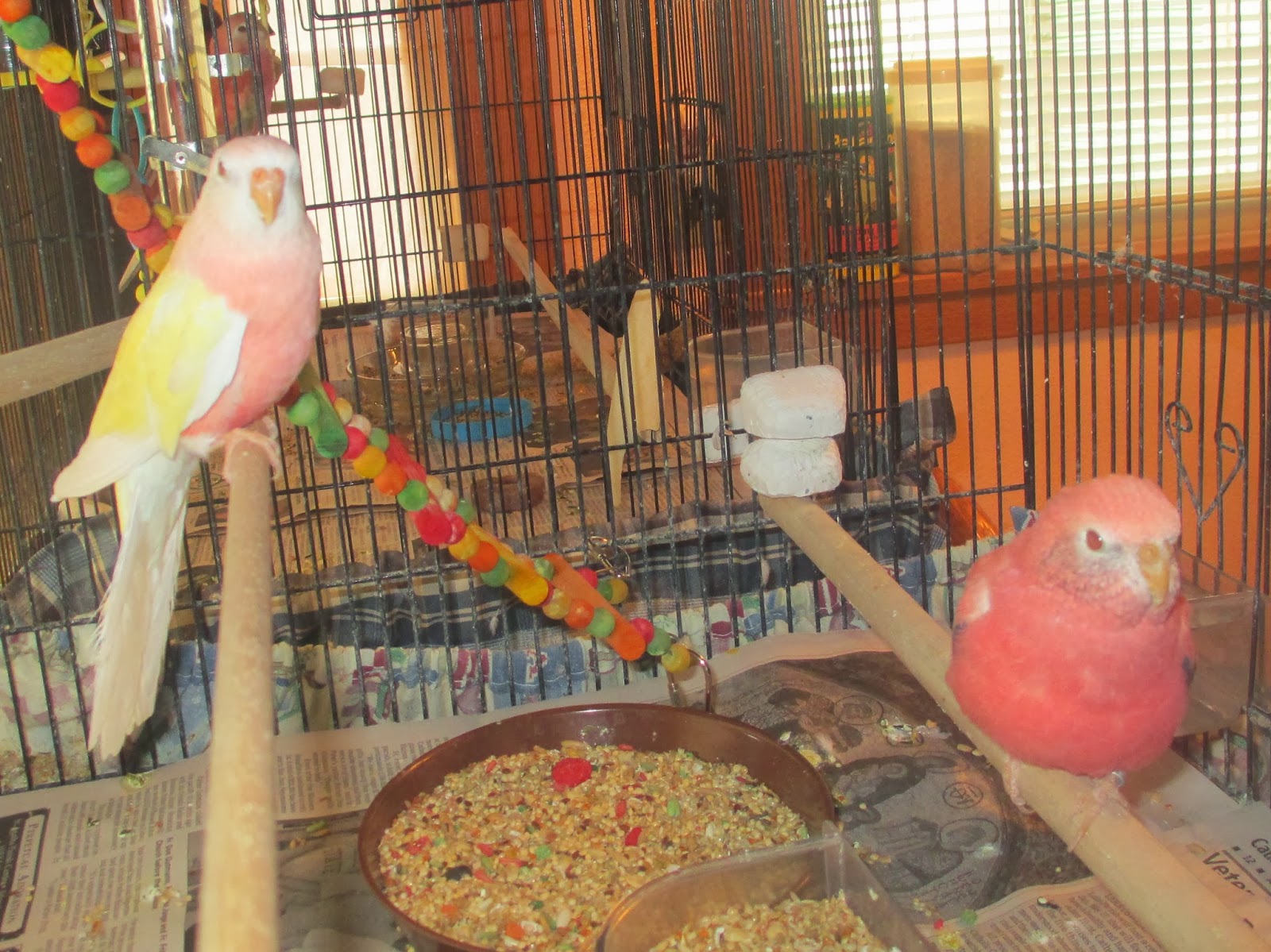
Pale pink, Opaline Fallow Rosy Bourke with red eyes.
This one is $225.

Hiding in a tissue box. These sweethearts are $150 each.

Just had a bath. Feathers are wet.


Contact us via email at: rosie.birds@gmail.com

PEACE & BLESSINGS!

Friday, April 25, 2014

Splendid and Turquoisine Parakeet Cross - A Question for Readers

A question for Readers: I know that if a canary is crossed with a green singing finch, their offspring will not be able to reproduce. They're essentially mules.
 
Is that also true of a cross between a Splendid Parakeet (or Scarlet-chested) and a Turquoisine Parakeet? Can their offspring reproduce? I'd guess not, but haven't found confirmation anywhere.
 

These photos are of a young bird parented by a male Splendid Parakeet and a female Turquoisine Parakeet. Photos were contributed by Miriana Loricchio, a bird breeder in Canada.
 

Anyone know the answer to our question?
 
Everything I've read confirms that Bourke Parakeets will not reproduce with any other variety of parakeet. It's interesting that Splendids and Turqs will accept one another as mates. I'm confident Bourkes and Splendids will pair off with one another too if another suitable mate isn't present. I've seen them do so, and even attempt to mate. But, fertile eggs do not result.
 
What about other interbreeding bird varieties? Anyone know of others that successfully reproduce? If so, can those younger birds choose mates of their own and reproduce with either of their parents' kind? I'd like to satisfy my curiosity.
 
Did you see my post about the Cockatiel and the Rose Breasted Cockatoo (or Galah) who presumably raised an offspring between them? If not, here is a link to it:
 
 
Peace & Blessings


Thursday, April 17, 2014

Parakeet Questions for Rosie Bird

Below are recent questions from Readers and the answers provided to them. They're worth sharing.

Female & Male Splendid Parakeets


Question:
1. I was ... given a flock of splendid s and Rosy's , I would like to have them all checked out by a vet. Do you know what type of tests should I have done to make sure they are all healthy, ... for parasites and Jardia, mites, etc.?  I would like to get the whole flock off to a good start. 
  
2. At which point do you take a nest box away from a pair ? I had two hens that laid and raised 2 clutches and then on the 3rd clutch both hens died in the nest box. Should I limit the hens to just 2 clutches a year? I was just worried that these hens would lay on the floor if they didn't keep the nest box for the 3rd clutch they wanted. I was afraid to take the hen out of the nest box thinking she was still feeding the big chicks inside the box and she was already producing the next batch of eggs. What should I have done ?


Opaline fallow Bourke Parakeet


3. What should you do if a chick will not come out of the nest box even though it is feathered and the next clutch is already laid in the same nest box? Do I remove it and put it by itself ? I am sure it is being fed by its parents but has just not left the box and the second brood is about to hatch. I do not want to starve it if it does not know how to eat on its own.
Thanks.  Randy


Answer:
Hi Randy, I'm sorry about your hens. Don't remove the baby from the box. Bourke parents and also Splendids feed their young another couple of weeks or more after they leave the nest box. It's not unusual for a hen to lay eggs while she still has young in there.

Rosy Bourke hen with her brood.

1. An avian vet recommended to me that I not medicate birds for unknown or suspected illnesses. You can quarantine them from other birds and watch for any sign of illness. If you have an avian vet near you and want to ask them to examine the birds, you can. However, we don't have an avian vet near us and the veterinarians in our area are unfamiliar with Bourkes or Splendids. When I took a dead Rosy Bourke into a local vet who had to be used to transfer it to an avian vet for an autopsy, the local vet said, "I've never seen a bird like this. It's beautiful, what is it?" That didn't instill any confidence. BTW, my dead Bourke died of obesity, so I quit feeding safflower seed and gave them less corn and less frequent spray millet, but added more leafy greens and vegetables.

2. My young birds do okay with three clutches a year, but older hens I restrict to two, or even one clutch a year. Egg laying and raising young is physically stressful. Not knowing the age of the two hens you lost, it's difficult to ascertain why they died. Were they getting enough calcium to prevent egg binding, for instance? An egg stuck in the vent would leave an obvious bulge there. Were your hens older birds who couldn't maintain the high level of physical toil required to lay and raise three clutches? Removing a nest box as soon as the babies leave it will usually prevent a hen from continuing to lay. If she lays eggs before her last clutch has left the nest, you can foster the eggs under a younger hen if you wish. Or, I've resorted to removing the new eggs and putting them in an incubator. It puts the eggs at risk of not hatching and means hand feeding babies who do hatch. However, it protects your hen safe. That's sometimes the best choice.

3. Most birds will eventually leave the nest box on their own. As I said, it isn't unusual for a hen to lay eggs while one or more of her previous clutch are still there. However, I can't imagine they'd still be there over two weeks after she laid the new clutch. If they are, there's something wrong with them.


Young male Splendid Parakeet.


Over the years, I've had three young Bourkes that could not feed themselves. I've no idea why and they didn't come from the same pair of parents. The first two (years apart) were very tame and I gave them away to people who agreed to hand feed them. I had spent over two years hand feeding the second one until I found someone who'd take her over. With the third bird, her father kept feeding her and I could see him getting thinner and thinner. She wouldn't allow me to hand feed her and would bite viciously. Sorry to say, she was mercifully destroyed rather than lose him. Birds that cannot feed themselves would die in the wild. If yours is one of those, you do need to remove it and not let the parents risk their new brood, or their health, trying to maintain that bird.

Best of luck with your choices.

--------------------------------

Question:
Yesterday, I made a trade of some birds I was raising for a pair of Bourkes. My female is a Rubino and my male is a Rosie. I have had them for almost a day now and I am very concerned about them. They do not move. They are not eating and I don't think they are drinking either. The breeder had them in their own cage in an enclosure around other birds he raises.


I have a large aviary outdoors and it's filled with Bourkes (a normal pair and 2 Rosie females) and finches. I have never had any issues bringing home a new Bourke nor any other bird for that matter. This behavior is so new to me.

I decided to keep this pair indoors for the time being so that I can monitor their behavior. I have put a seed mix and some spray millet on the bottom of the cage as well as offered 2 bowls of water (which I was told by the breeder that they are used to open water containers) ..but they do not move. Last night, when I turned out the lights, they became more active. I heard them chirp and fly around the cage. I left a soft light on so they can find their way around the cage but when I woke this am, I can clearly see they have not touched any of the food.

Today, I left them in peace and went run some errands only to return and they are in the same spot, and I can't say about the water for sure but I can see they have not touched the seed and I am guessing neither the water. Should I place them outside next to the aviary? Should I put them in the aviary for now to see if they feel more comfortable? I am at a loss of what I should do. Please help! - Brandy


Answer:
Hello Brandy, Bourkes are typically quiet during the day and active at daybreak and late in the evening when the sun is going down. Hence, their flying when you turned off the lights. Maybe they are very tired from all the changes they've gone through. I hope they're eating when you're not around to see them. I'd recommend keeping them indoors to be certain they're healthy before introducing them to the aviary.

Try standing near their cage and talking sweetly to them and see if you get some reaction ... Hopefully, they'll perk up at your voice and attention. Every bird is different though.

You might try enticing them with chopped fresh Kale or Broccoli. Mine also love cooked corn. See if they aren't willing to eat that. It might encourage their appetite enough that they will eat in front of you and reassure you that they're okay, and only frightened by the move. Let's hope that's all it is.

Blessings,
Gail
 --------------------------------

Question:
Hi Gail, My rosy Bourke's parakeet is a little over one year and she is showing signs of sickness. Unfortunately, I am not able to call the vet until tomorrow and  I'm having trouble diagnosing it, so I'll list the symptoms.


Two weeks ago she lost energy and slept a lot, and when she wasn't sleeping she was on an eating frenzy. She jumped from dish to dish eating only seeds (mostly the oats that come in the seed mix). She won't touch her vegetables except for sometimes the peas. Her droppings were normal and her vent and nostrils clean. I added vitamins to the food and offered fruit pate. I also made boiled eggs thinking it might be a hormonal issue. She started to perk up and go back to normal again....until today. Today she has slept most of the day and now her droppings come out watery and light green. She still eats a lot and when she's not eating, she sleeps. Any ideas what illness this could be? I was thinking fatty liver, but I read the symptoms and it said birds stop eating with fatty liver.

Thanks for your help. - Melissa


Answer:
Hi Melissa,
What worries me most is the watery, light green droppings. I'm no vet, so I can't begin to guess what's causing them. I can note that most Bourkes sleep a lot during the day. Is she active in the early morning and/or early evening? It's normal for Bourkes to fly and be active at dawn and at dusk. Sleeping during the day is pretty typical. If she fluffs up and sits on the floor, then you know something is very wrong. That is, providing she's not covering an egg or eggs down there...

My Bourkes won't eat fruit ... so fruit pate? Mine like cooked corn best. The fact that yours ate peas...could that have caused the watery, green droppings? I hope that's all it was...

I lost a hen at 3 years of age once. She had a stroke right in front of me and I was shocked, so we sent her body to an avian vet for an autopsy. I was afraid there might be something that could infect the rest of the flock. Turned out she had died of obesity that damaged her interior organs. She'd never had a mate and had never laid an egg, so all her food intake went to fat and not to producing eggs. I'd given her (and my other birds) safflower seed and lots of cooked corn and spray millet in addition to a budgie seed mix. They got some greens, but not regularly.

Now, I do better. I quit giving safflower seed all together. They get cooked corn only when breeding or raising young. Spray millet is sporadic in the winter and only given more frequently if they are feeding young, or laying eggs. They get chopped fresh kale, chopped fresh broccoli or cooked mixed vegetables often.

Always present is a budgie seed mix, cuttlebone, mineral block and a few years ago I added rabbit salt blocks for the iodine in them. That was recommended by several experienced breeders. The only bird I've lost in many, many years was my very first and oldest Bourke from geriatric causes.

I pray your little hen is okay and recovers from any problem she may have.

Peace & Blessings,
Gail


Follow-up message:
Hi Gail, This morning her droppings are normal again, so you could be right that is was the peas. She seems more perky too. I give my Bourke's peas and cucumber every morning because they seem to love them for breakfast. Only once per day though. This bird is over weight and I think that is really the issue. She used to be more active in the morning and evening, like typical Bourke's, but now her only activity has been eating. Even out of the cage she will just sit. I let my Bourke's out of the cage quite often. I really think a diet is in order for her.

The fruit pate is the conditioning food from the shop, it's made by Orlux Versele-laga. Should I not give this to them? Everyday I offer vegetables. Sometimes it's broccoli, spinach, parsley, carrots. I can't offer Kale until the summer when I grow it and it's in the shops. I bought some hemp seeds, what do you think about giving that to Bourke's? Always present also is budgie seeds, cuttle bone and mineral block. And occaisionally oyster grit and millet spray.

I'm sorry about your bird having a stroke. It must have been so upsetting to watch and not be able to do anything! Which makes me now realise I must put Emma on a diet. I don't quite know how because she shares a cage with her brother, who is thin (maybe too thin because she eats all the foods). So I plan to read from your webpage today about a proper diet. I thank you again for all your expertise. And the prayers really work!

Thank you. - Melissa

Second Answer:
Hi Melissa, I'd make sure budgie seed mix is always available. But, cut back on everything else. Maybe give vegies two or three times a week and spray millet twice a month. You might encourage her to fly more. One of my tame hens doesn't leave my shoulder very often, so I put her on my finger and drop my hand quickly so she'll fly. She goes to her cage when I do that and it's across the room and around a corner. Keeps her a bit more active. ;-)

I wonder if the Orlux Versele-laga could be fattening? I've never seen it here. I know nothing about hemp seed, and because I don't, I wouldn't offer it to my birds. My Bourkes sometimes get some finch seed mix because I keep finches and they seem to like it. The Splendids actually prefer it to Budgie seed.

I'm guessing that the cucumber is more likely to have caused wet stool than the peas. About spinach...I used to give it once in a blue moon, but have since read that it's not healthy for birds. So, I give kale, but never spinach any longer. I'd rather be safe than sorry.

Glad your girl is better...hope she loses weight and lives a long life. Meanwhile, her cage companion should do fine as long as there is a budgie mix for him to eat any time he wishes.

Blessings,
Gail
 --------------------------------
Question:
Hi again! It has been a while since I've bothered you for info and again am soooo thankful for your blog! I have a pair of rosie's that I am guessing are near 2 yrs old. They have been mating here and there since last August. I got them last late April. I have never provided anything remotely close to a nesting box or area hoping that this would discourage egg laying.  Well, she has decided to anyway! YIKES! Well the first egg arrived late Friday night on 3-28-14. I removed the egg and cleaned up the bottom of the cage a bit to hopefully discourage her from feeling it a safe place.
I should explain that they are in a good sized cage - 30" wide, 18" deep and about 36" tall. I did not put in the bottom grate that separates them from the very bottom. Their substrate is a mix of recycled crinkly paper and some timothy hay to try to provide them w/a more natural floor. I guess she felt that would do ok for a nest???  
So on the 29th I happened to go to a pet store to get some oyster shell, as for the first time ever she is mowing on the cuttlebone. There happened to be some good folks from a local bird rescue there and I spoke with a couple of them. They suggested I leave the eggs so she doesn't wear herself out continuing to lay. I get that now. Also they suggested switching out the eggs w/fake ones. I could only find fake ones that have little speckles on them and they are a tiny bit smaller than hers. I am wondering if I really need to swap them out as I highly doubt these eggs will likely hatch. They are on the bottom of the cage floor and when she broods she's not always covering all of them. I am not providing any extra heat or humidity. She has 5 eggs now as of Monday evening the 7th of April. 
So, I had no intention of breeding or adding to the unwanted pet population. What would you suggest I do next? I don't want to stress her or let her wear herself out. I do not have a second cage to remove the male to. I hope that's not the only answer as it would make me feel really bad for them aside from spending the $ and finding room. My other thought is putting the grate back in so it's a bit less natural feeling?? Please guide me and know that I appreciate you more than you can know. I read a lot on your blog but there isn't a lot of info that aims at UNWANTED babies : (   I will thank you in advance for any help and guidance you can offer. - Christy
Answer:
Hello Christy, I have a pair of Lady Gouldians that I have to separate to keep her from laying eggs constantly. My Bourkes, however, quit when I remove their nest box. But, I do allow them to raise two or three clutches every year and that seems to satisfy them.


The people who recommended you allow your hen to stay on eggs gave you valuable information. Laying eggs depletes calcium and is a physical drain on birds. She will probably keep laying if you only remove the eggs and that wouldn't be healthy. She might accept the smaller artificial eggs, but only trying it will let you know for sure.

As for "adding to the unwanted pet population," I don't know where you live, but my experience has been that there is never an over abundance of Rosy Bourkes. They make wonderful pets and hurry out of pet stores. It's more difficult for an individual to market them, but if your hen does hatch her eggs, you would be in for quite a treat. It's fun to watch the parents feed the babies and see them grow. If you don't want to keep the young birds, I'd guess that any pet store will be thrilled to get them. Even though a pet store might not be willing to pay much, they might let you trade the birds for pet products. For instance, I traded young zebra finches for a dog bed once.

My advice would be to let your hen stay on her eggs. After 30 days or so, if they don't hatch, she will abandon them. Then put the grate back in. The floor covering you describe sounds like a perfect medium for her to lay eggs. She would prefer to have a dark box around her, but since it's not available, I'm not surprised she's using that medium on the floor of the cage.


I don't like bird droppings on the grate at the bottom of my cages, so I lay newspaper down. Most Bourkes are good about not chewing. Even if they do, it's minimal compared to other birds. I throw out the newspaper when it's soiled and replace it. That works for me and keeps the floor and grate clean. The pan underneath stays clean, but still catches loose seed.

I recommend letting her abandon her eggs on her own instead of removing them (or let her raise the baby birds if the eggs are fertile). I hope you can experience baby Bourkes at least once. Best of luck preventing further clutches by putting the grate back after this clutch. You might want to check out some local pet stores and see if they have any interest in "Pink Parakeets"... Most will. Smile.

I had a terrible experience with a tame Budgie hen when I was a teenager. We'd moved her from indoors to an outdoor aviary and she set up housekeeping immediately. Raised one clutch, then I kept removing her eggs so she wouldn't raise more. I was inexperienced, and didn't recognize how upset she was. She ended up pulling out all the feathers she could reach and died from the cold outside. Now, I recommend allowing hens to abandon their own eggs and/or removing nest boxes (and nesting material in your case); rather than traumatizing them by stealing their "babies" (i.e., eggs). Animals have strong feelings just as we do, especially those that are maternal.

Peace & Blessings,
Gail

Follow-up message:
Thank you so much for your quick and detailed response! I am quite sure I would have no problem homing any babies...I think we all see too many people that think they want to own a bird and change their mind. I live in Wisconsin and have never seen a rosie at a pet shop. Only at bird fairs. As for the big IF...if she should actually hatch them - I would be amazed and delighted in the beauty and nature of it all. I just worry about the pair being able to tend to them all, as I have no time for hand rearing of babies in my life. Another reason I don't want babies. 

Is it normal for her to not always be covering all the eggs when she broods? I am so grateful for your involved info and I will allow her 30 days w/the eggs. Thanks again so much and God Bless You and your beautiful blog!!! - Christy

2nd Response:
Hi Christy, Hand feeding is seldom necessary. Most people who hand feed do it because they want very tame birds.

It's not unusual to lose one in a clutch, so if that happens, that's nature. The same goes for eggs...sometimes fertile eggs don't hatch and it may not be the hen's fault. As for sitting on the eggs, they can remain viable for a few days after they are laid without being brooded.

Some birds don't sit on the eggs until all are laid. That allows them to hatch closer together. My Gouldian finch never broods until all hers are laid and then they all hatch the same day. Bourkes don't usually do that, but it would be possible if they chose to.


How often, or how much, she sits on the eggs can be affected by the temperature. Also, she needs water to bathe in... a cup will do. Hens carry moisture to their eggs as needed. Since this is her first clutch, she might fail to keep them warm, especially since she's at the bottom of the cage and has nothing around her. She could be easily distracted, or frightened, off of them. When in a dark nest box, she'd be more likely to simply go to sleep and stay on them. I've never had a hen who wasn't in a quiet, dark nest box. However, my tame hens would probably do okay anyway. Is your hen tame? That would make a difference in how successful she is...whether she allows outside activity to cause her to leave the eggs more often.

My Lady Gouldian hen is not tame, yet when a dog toy was lobbed and accidentally hit her nest box two days ago, she did not leave her eggs. The first egg hatched today. Good Mama finch!

I hope your girl succeeds, but if she doesn't, don't grieve. You can give her a nest box for next time, and she will do better; or put the grate back in. Your choice. Nature can be harsh sometimes.

Blessings,
Gail

3rd message:
Thanks again for all the great info! She and the male are not tame. I do not handle them. They are getting used to me, but would still fly away if I reached near them. I sometimes wish I had held out for hand tamed birds, but I like that they don't need a lot of my attention and yet welcome interaction. We have routines such as certain treats and "Fly time". I have water available in a small cup on the side and a large crock near their door. I STILL have yet to see these two take a bath. I am hoping w/my outside birdbath in their view now this spring/summer they may be inspired. I had e-mailed you in the past re: baths. I understand about nature as I work as a vet tech assistant and am also very into wildlife. Truly I was hoping they would not hatch but I guess if by some miracle they do...I'll make the best of it with them! So just to be sure...I should wait around 30 days from the last egg arrival but wait to see if she stops brooding altogether before removing any eggs? Thanks again so much, Christy

Baby Rosy Bourke Parakeets


3rd Answer:
Fertile eggs begin to look slightly darker when nearing hatch. But, I've had people write to me that they are certain their eggs are no good and suddenly got a surprise hatch... That's why I recommend waiting 30 days from when the last egg was laid. They should all hatch in 18 to 21 days from being laid. But, as you may know, temperatures affect that. Also, delayed brooding can put off hatching.

If you wrote to me in the past, Christy, I apologize for not remembering. I probably get people confused with others from time to time. I get a lot of emails, for which I'm grateful, but my recent memory leaves a lot to be desired. ;-) 

Blessings,
Gail


Lady Gouldian hen with 3 young,
others left the nest already.


 --------------------------------

How are you and your birdies doing? ... So I have another question for you, I hope you don't mind me coming to you for advice and wisdom =).

I just recently got a baby Turquoisine parakeet that the mother was neglecting from a breeder. I'm thinking it's probably around 2wks old or so and it definitely seemed underweight. Breeder told me it would have not have lived past 2-4 days so I hope that I can give it a chance to survive. I have raised (hand-fed) two other babies before years ago but they were wild birds so it feels a bit different, I guess the wild birds to me seem hardier.

So far we have made it a few days now and the baby bird seems to be eating better and seems to be doing better. However, when I first started feeding it I noticed that the bird had tiny microscopic bugs (size of a piece of sand) crawling off of it and on my hand and arm, Eeeeck. I was in shock at how many of those critters were just crawling on it and that the breeder either was unaware of it or did not tell me, poor thing.

Maybe I should have expected it I suppose since it was in an aviary but I'm not sure what kind of bugs these are...mites or lice or something else??? I'm not sure if it is critical to have it out of my home or not now. I'm wondering if these critters do any harm to people. Since it's a baby I have it indoors in a good sized Critter Carrier that I have made into a brooder home inside another box in hopes that it will prevent those critters getting out and crawling around in my home where I have placed it. I had to get rid of the bedding it came in and change/clean it's home since the breeder dropped it off in a very filthy carrier that looked like it had been sitting around with old poop on it.

Even though I notice less crawling around on surface, me and on the bird, while feeding him/her I have noticed them in his bed area now especially around his feces which I change constantly. So I just don't know where to go to see pictures to compare to online and if there's anything to give the poor thing/put on it in a store versus having to order it online, do you have any suggestions? Have you encountered any bugs with your birds?

Thank You,
Rebecca


Answer:
Hi Rebecca, Sorry about your baby. Sounds like mites. They can transfer to other birds easily. I assume that like cat lice, they can't survive on people or other animals.

I had this occur once to my flock years ago. I bought a mite spray at our Grange that didn't work well (it was 8in1). Also, it was necessary to avoid the head and eyes. It said nothing about what to do for babies in the nest, and I had many of them at the time. 

What DID work was "Avian Insect Liquidator" by VETAFARM. It's a concentrate, and when mixed according to directions, it's approved for spraying into a nest box ,even on newly hatched chicks. It costs more for a bottle, but is a concentrate and makes a lot. I mixed the concentrate into a tiny spray bottle because it only takes a small amount. I reused a spray bottle that previously had eyeglass cleaner in it. It is small and emits a fine spray.  


That mixture worked wonders right away. I did have to order it online, but it came quickly. It was ordered through All Bird Products, Inc. The 100mL bottle makes two liters and I still have the concentrate these many years later. However, I've never had a reoccurrence of the problem.

I recommend you share this information with the breeder of your baby. He/she needs to take care of this problem ASAP. Mites sap a bird's energy and are harmful, especially to baby birds.

What are you hand feeding? I use Kaytee Exact Hand Feeding Formula. I know there are others, but I've never used anything else.

Peace & Blessings,
Gail

Tame Lady Gouldian finch hen.

Peace & Blessings,
Especially At This Easter Season.

Thursday, April 10, 2014

ROSIE BIRD DOES VIDEOS ON YOU TUBE


You won't want to miss the video's we produced and uploaded to You Tube.

A few were posted on this Blog in the past, but not all. We will continue to add more and more as we go along. We recently created a beginning and end unique for us that is added to several.

Have a look and let us know what you think! Click below:

 
Peace & Blessings to Everyone.
May your birds remain healthy, happy and live long lives.


Tuesday, April 8, 2014

Bald Eagle video of a mother with her young


For my bird loving friends, I want to share this charming video of Bald Eagles in the nest.

I notice that Bald Eagles don't regurgitate food for their young. She's feeding them scraps from her mate's kill.

If you watch closely you'll see a third chick struggling to release himself from the egg shell. Wish the video had gone a little longer, but he does successfully exit the shell as the video ends.


If we love any birds at all, we tend to love them all. Enjoy.


 Peace & Blessings.
 

Sunday, April 6, 2014

Bird Breeding Tip for Small Exotics, Especially Bourke Parakeets

I've raised a variety of small exotic birds over the decades of my life. As a child my grandfather gave me budgies from his flock. Later, my father added a variety of finches, doves and quail. Except for a parade of tame budgies, all others lived in outdoor aviaries.
 
Flame and Pretty Boy, male Rosy Bourkes in adjacent cages.
They spend too much time displaying at each other.
Today —although I have several other birds— my favorites are the grass parakeets, especially Bourkes. They're gentle, quiet birds, and less messy or destructive than other varieties.
 
Putting up a visual barrier between the cages. Any old
piece of cardboard works well.
We recently gave nest boxes back to our Rosy Bourke parakeets. As usual, the two males began displaying at one another and ignoring their hens' attempts to entice them to breed. These photos show what steps we take each breeding season to help our males focus on their mates and not what they consider to be the competition next door.
 
Flame at left. Pretty Boy on right. Visual barrier in place.


Flame & Fuchsia on left. No longer does Flame stay on
the side of the cage next to his neighbor, ignoring his mate.
Pretty Boy also now focuses on his mate, Rosie.
Fuchsia at the opening to her nest box with Flame nearby.


Rosie in the doorway of her nest box. A swing is in foreground.
Top of Fuchsia's nest box is open. She's only
just begun to set up housekeeping.


A composite of two photos ... Rosie is half out of her
nest box opening. Pine shavings line the bottom of box.
 
If you have a large aviary, you can put Bourkes together when they're ready to breed. But, they do best one pair to a cage when indoors. I've found that mine get along better with other varieties of birds than they do with other Bourkes of the same sex. They can be competitive for mates and/or nest boxes. The same holds true for Splendids (Scarlet-breasted) Parakeets and possibly most grass parakeets.
 
Peace & Blessings.


Monday, March 24, 2014

Can Parakeets Be Mean Or Cruel? Kill Their Young or Their Mates? Questions.

 
I've been answering questions to rosie.birds@gmail.com, but haven't blogged lately. I have many questions and answers to post and eventually will; however, this one arrived today and touches me. Here it is with my answer. Please don't hesitate to comment if you've experienced anything like it, or have suggestions. Thanks!  
 
QUESTION:
Hi.  I wonder if you can give me some advice please. I had a pair of Bourkes parakeets. The little pink one was the male, the normal the female. They have lived together for three and a half years.  The female has laid eggs four times. Time before last two hatched but she killed the babies.

Yesterday we went out for the afternoon and evening and when we got home the floor surrounding the cage, which is huge, was covered in pink feathers. The Rosie was at the bottom of the cage with hardly any feathers and blood on his back. He was obviously in shock. We put the separated in the cage to keep the female away from him, gave him some water and millet and left him for the night.
This morning when we got up he was dead in the corner of the cage.

I am heartbroken as he was such a gentle lovable little character.  I can't understand why the female killed him. Do you know if this is normal behaviour.  We don't know what to do with the female now as she will be on her own.  It would appear that she does want babies as she keeps laying eggs and sitting on them. I would be so glad of any advice you could give.  Thank you.


ANSWER: 
Wow, how terrible. Are you certain she did it? Sounds like you are. Parakeets of any variety can have birds that are mean. Bourkes are usually very sweet, but exceptions happen. I am surprised, however, that the male Bourke didn't fight back and protect himself even though Bourke females usually do boss (hen peck) their mates. I wonder if he was already weak or sick. All birds hide their health problems very well.

I had one hen that I think was mentally ill. I'd sold a Rosy hen with a Normal male. The person who bought them had them for a while, then gave them to her grandmother. While there, they laid a clutch of eggs and hatched one. One day she called to ask me to take them back. She said the baby had died in the nest and they didn't want to go through that again. She didn't tell me if the baby was bloody, but I've wondered since. Had no reason to speculate about it at the time. I don't know what the pair lived like for about two years away from me.
 
When I got them back, I put the Rosy hen with a Rosy male and sold the Normal male. She hatched two eggs and when I checked, one baby was dead with its neck torn open. I took out the other and found a wound on it too. I hand fed that baby. With the next clutch, I checked daily and after four eggs hatched, the littlest had a wound on him. So, I removed and hand fed all four.

At that point, I removed the hen and gave the male a different hen. I believed he was the culprit and thought that would tell me. However, he and the new hen began raising healthy offspring and had many clutches without a problem.

Months later, the guilty hen began to hang her head oddly. Day by day it got worse and within a few days of that odd behavior, she died. Have to admit, I wasn't sorry to see her go. I've wondered if she had a brain tumor or something wrong with her. I still have two of her offspring, a brother and sister. They are both sweet birds and have raised many lovely Rosy Bourkes with their Rosy mates. I don't think the problem was genetic and wonder if that hen was driven crazy somehow in her former environment. Or, was there a health issue? No way to know.

Is there any chance that a rodent could get into the cage? The male would protect his mate, or try to. My cages have such narrow bars that nothing could get through, even if a mouse or something did get into the house. As much as I wanted to believe that a hen would not do that to her young, it was my hen...sounds like it's probably yours too. If your hen were mine, I'd be afraid to let her have another bird in a cage with her. Yet, she lived for 3 1/2 years with her mate ... really odd that she'd do that to him.

I've had other strange things happen with birds over the decades I've raised them. Below is a link to a blog I did about some of the "mean" birds I've encountered.
 
After you read the post below, especially about the feather pulling male Splendid, I should tell you that one of my Rosy Bourke males fed a sick Normal female all winter when she had something wrong with her. She must have had a stroke because all she could do was pull herself along the floor with her beak. He kept her fed and alive and she gradually recovered! Amazing. Only two toes remained paralyzed. That was my sweet Rhett bird. He'd lost Scarlett and I gave him Willow. After she recovered, I gave him a Rosy Bourke named Cherry. Cherry and Bing had not gotten along well, but Bing did fine with our Normal, Stella.
 
Sweet-natured, Normal Willow got Bing Jr. as a mate, a Normal split to Rosy, so they produced Rosy hens and Normal males.  Rhett and Willow never reproduced together, but each were good parents with their last mates. Loving Rhett had three hens in his lifetime and was kind to all of them. Cherry, on the other hand, was always bitchy ... poor Rhett. Scarlett and Willow were both nicer.
 
 
Peace & Blessings.
 

Saturday, February 22, 2014

Lutino Bourke Hen and Potential Rubino Mate

Life has been pretty hectic for us lately, so I've not posted as often as I'd like to. The photo below is of our lovely new Lutino Bourke hen. She's destined (I hope) to become a mate for our tame Rubino, called Sweetheart. He is a sweetheart too, shown in lower right. He has a bit of pale yellow on wings and tail. Both have red eyes.


It will be fun to see what they produce. Although Sweetheart was hatched in 2011, this hen only hatched last July. So, it will be another year before we provide them with a nest box. We don't want to encourage breeding while she's too young and risk egg binding.

Aren't they a pretty couple?

Peace & Blessings.