Sunday, October 19, 2014

Lovely Linnie Aviary

Our beautiful, sweet Cremino Lineolated Parakeet came from  Lovely Linnie Aviary. Susan Kruger is a bird breeder located in Springfield, Oregon. Her charming aviary and flight are, indeed, very lovely.

The entrance to her delightfully cozy aviary.
Surrounded by forest. Notice the skylight in the roof.
Susan invites you to look inside.


Aviary at one end with workspace and viewing area
at opposite end where we're standing.
Birds are through this door.
Opposite end of room with workspace, some smaller cages
and a comfy chair for peacefully enjoying the birds.
Lineolated Parakeets enjoying millet.

Sliding windows let in a cool breeze on warm days.

Tools for maintaining a clean aviary.


View of the skylight from inside flight.
A side window could be a hazard for flying birds,
but a skylight requires them to fly upward, so less dangerous.

Yummy greens grow in hanging pot.

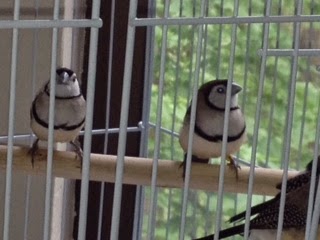
They can't all be Linnies. She has cute owl finches too,
and also a pair of Rosy Bourkes, not pictured.

A few of her Lovely Linnies.

Lots of things to climb and play on.

Friendly Linnies enjoy visits.

More come to look at us as we look at them.

Looking upward at the flight from inside the work area.

A useful work space.

This pretty pair live in the house with Susan and her family.

Linnie poster provides color descriptions.
It is on the wall in the aviary

A view of the left side of the flight.

Pretty handy, attractive storage.

If interested in buying a Linnie, contact Susan Krueger at:
 
 
***** 
Peace & Blessings.
 

Sunday, October 12, 2014

Rosy Bourke Parakeet Video and Recent Update


Rosie Bird has many videos downloaded on You Tube. The most recent is attached below this post.
 
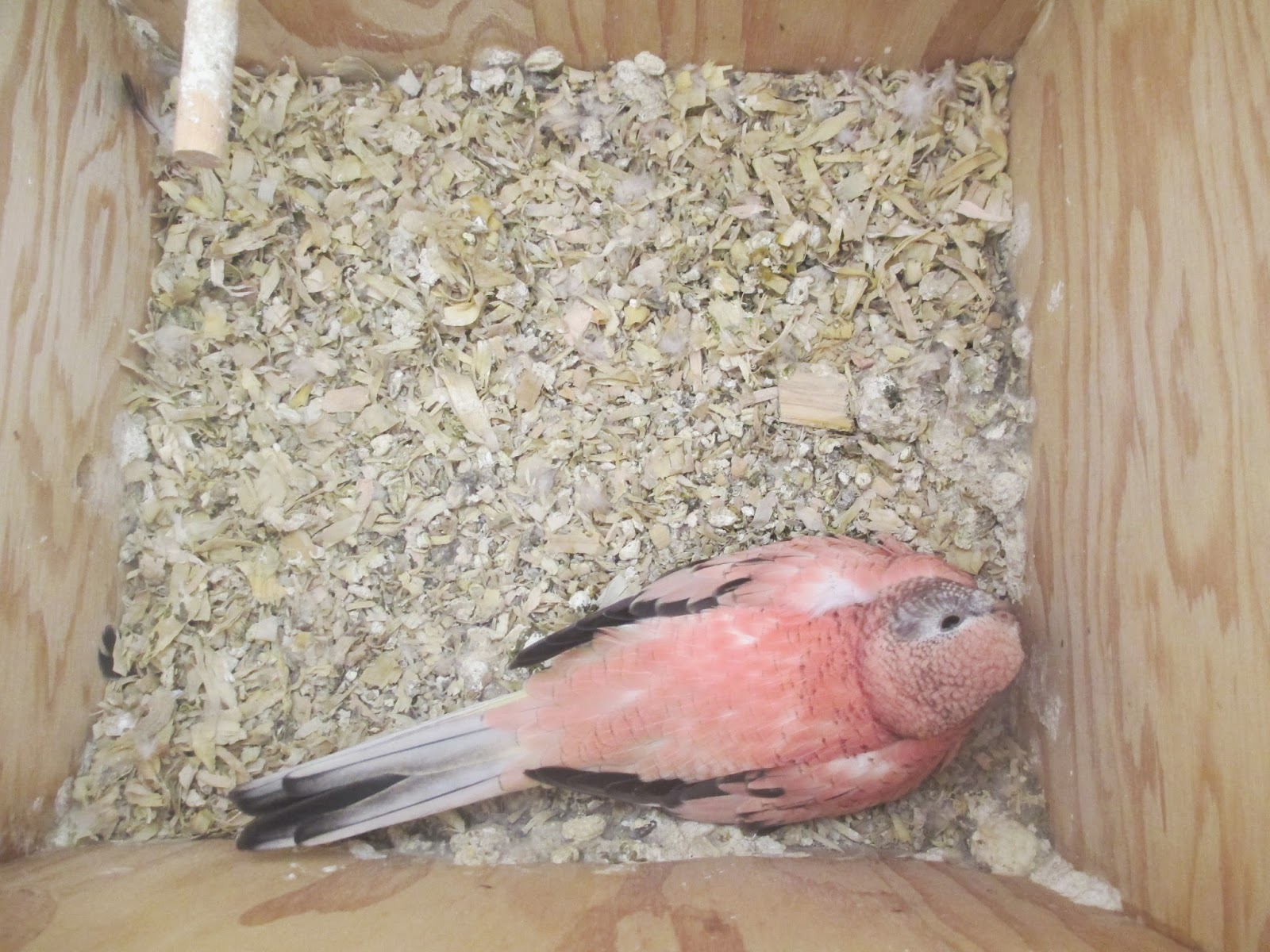
We allowed Rosie and Pretty Boy three clutches this year. Rosie laid four eggs each time, hatched and raised all four every time. Twelve baby Rosy Bourkes from my sweetest hen, Rosie. Not all birds are as consistently successful as she is.
 
This year in her first clutch she had two Opaline Fallow Bourkes, so I decided to hand feed them rather than her third clutch, as typically done in the past. I kept those two very sweet, tame Opaline Fallow Rosy Bourkes as future breeders. There is one of both sexes and their new names are Songster and Peaches. As you may guess, he sings and wolf whistles beautifully.
 
Rosie's second clutch of four were all lovely Rosy or Opaline Rosy Bourkes, but no Fallows with red eyes. In her third clutch there was one Opaline Fallow.
 
The video below shows four of Rosie's sweet babies. Two are from her first clutch and the two I'm hand feeding are from her third clutch. All ten of her sweet offspring have been sold and have gone to new homes. The last two, very sweet hand feds shown in the video left today. We met both buyers in Reedsport. One of our babies will live in Florence, Oregon and the other in Forest Grove, Oregon.


Bourkes are among the cleanest and quietest of birds. I highly recommend them. Although I love Linnies, cockatiels and finches of all varieties, Bourkes remain my favorite Small Exotic Bird.
 

Peace & Blessings!

Saturday, September 27, 2014

Amazing Praying Parrot

A bird brain? Don't think so ... he's brilliant.
Catholics should especially appreciate this.
Love it!
Enjoy.


Peace & Blessings to All.

Sunday, September 21, 2014

Lineolated Parakeets, Two Youngsters Added to the Flock


On Sept. 2, 2014, I brought home two very young Lineolated Parakeets from two breeders in Eugene and Springfield, Oregon, USA.

Cobalt blue on left is male. Creamino on right is a hen.

Trying to name them has been fun. For a little while I called them Angel and Sparkle. Later thought about Sunshine and Stormy, but I once had a pair of cockatiels by that name and it did not feel right. Wanted them to have their own unique names. Of all the combinations tried, I decided on Summer and Winter.
 
Aren't they a pretty pair?


Within two days Summer and Winter were inseparable.

Below are photos of their parents. I want to be certain to remember each bird's color history.

These are Winter's parents, a mauve (gray) and a cobalt blue.
Summer's parents are a lutino and a cobalt blue.
Look how bright yellow! Brighter than Summer.

Summer's parents again. One peeking out of nest box at right.


I have many videos on YouTube under "Rosie Birds." Rosie Bird is my alter ego, just like rosie.birds@gmail.com.  Below is a video recently uploaded starring these two Linnies. There are many more videos there, especially about Rosy Bourke Parakeets. Our Bourkes, by the way, are very interested in these young Linnies, especially the hens with babies of their own.


PEACE AND BLESSINGS
TO YOU AND ALL YOUR BIRDS


Thursday, September 11, 2014

Rosy Bourke Fosters Another's Baby At 18 Days of Age

So many things to post about and so little time. 

There really are five baby Bourkes in this photo.
Red-eyed baby is laying in front of the two in back.

Our Rosy Bourke, called Rosie, is the sweetest of birds. She and Fuchsia were both on their 3rd clutch of the year and I didn't want them to begin laying more eggs even before their current clutch had fledged ... just knew they would. To prevent that, I removed their youngsters to hand feed and took the nest boxes off their cages.
 
I'd been hand feeding their babies for a day and a half when the unexpected happened. It looked like my husband was having a stroke and I called 911 for an ambulance. Fortunately, it wasn't a stroke, it's Bel's Palsy, which most people recover from in a few weeks ... thank you, Lord.
 
However, Wednesday morning proved very chaotic. I had to follow to the hospital. What to do with the hand fed babies!? It seemed highly possible that they might fly my husband to a larger city than our rural community. Even if they didn't, under no circumstances would I get home in time to keep feeding the baby Bourkes. We live a half hour drive one-way to the hospital as it is. I wouldn't leave him and commute back and forth while he was in danger.
 
As they loaded him into the ambulance he asked if I'd be following. "As soon as I can," I said. Then raced around the house making sure the dog and cat had plenty of extra food and water. Fortunately, I'd already freshened all the birds' waters, but I added extra water bottles to all the cages and gave them all two sprays of millet (that was fastest).
 
Still, what about the babies?

Hand feeding baby birds, I change their box each time
they're fed. Throw out the paper towel liner, and allow
pine shavings under them to dry from droppings that
soak through the towels. A clean box at each feeding.

Fuchsia's nest box uses plastic cables to attach it to her cage and my husband puts it up while I hold the box ... not a quick fix.
 
I decided to trust my sweetest bird, Rosie. Her box has two hooks that allow it to quickly hang from the side, easy to install. I sliced through half the duct tape covering the hole where her nest box had hung and folded it back like a door. Then put the box back on. It hadn't been cleaned yet, but that wasn't much of an issue.
 
The real issue was, will they re-accept their young after almost two days absence? And, more worrisome, Will Rosie and Pretty Boy accept a foster baby that is already 18 days old? Not even a newly hatched chick?  Not only do they need to feed it, they need to not "savage" it as an intruder in their nest ... a potential risk.
 
Yet, it appeared to be my best option and I put all five babies into Rosie's nest box.
 
No one was home at our house from early Wednesday morning until late Wednesday evening after my husband was released from the hospital. I immediately checked the babies. All five were stuffed full and contented. 
 
What a wonderful bird is Rosie, our Rosy Bourke hen!  And, what a grateful diagnosis for my husband. He may be very uncomfortable for several weeks, but it isn't life threatening. God is good.
 
I still want to post photos of the two pretty baby Linnies we've had for two weeks now ... that post is coming up next, I hope. If things will only slow down a bit, smile. 

Peace & Blessings.
 

Friday, August 8, 2014

Today's Bourke Question & Answer on Lone Bourke Hen Laying Eggs

Today's photo of Rosie on four eggs.

There are still many questions and answers to post, but little time. This one came today, so all it takes is a quick copy and paste.

Question: LONE BOURKE HEN WON'T QUIT LAYING EGGS

Photo of Fuchsia on eggs.


Hi Gail,
 
First, thanks for creating this blog! I love reading your posts :)
 
I'm hoping you might be able to offer some suggestions on how to discourage my beautiful female normal bourke from constantly laying eggs?  My husband and I have had her for a year and a half now and she has never had a mate. We don't intend on getting another bird.
 
She is such a sweet little character and I honestly don't mind that she lays eggs, but I am concerned for her health. We have taken her to our avian vet and consulted local bird shops, but none of the suggestions seem to deter her.  The vet suggested we remove the eggs as soon as possible (but she continues to lay eggs until she reaches about 4 or 5. The bird shops suggested hard boiling them and putting them back, changing the location of her cage often, and misting her environment with water occasionally to simulate the rainy season?  Nothing seems to work and she is already on her third round this year. 
 
For the most part she is still behaving normally and will come out to interact a few times a day. She's still eating and drinking normally and does not sit on her eggs at night. We only use newspaper on the bottom of the cage and change it regularly (especially if we've noticed nesting behavior). Unfortunately, she will tear up any new paper we put in and create another nest.
 
Any suggestions you have would be much appreciated!

Thanks,
C ---
------------------

My 7 young Rosy Bourkes in a travel cage and about to go to their buyer.
 
Answer:
 
Hello C ---,

I'm curious where she's laying her eggs. I assume she doesn't have a nest box? That would stimulate egg laying, and isn't necessary for birds unless they are intended to lay. Is she using a seed cup or bowl? If so, remove it and feed her in something very shallow. If she's laying on the floor, that's another matter.

Egg laying is stimulated by sunlight ... longer days in the summer and shorter in the winter. She needs to get less light, whether sunlight or artificial light. Do you have a dark room where she can spend the late afternoon, evenings, etc. Allow her only 8 hours of daylight each day and she should quit laying. That might seem mean ... taking her away from the family; however, producing eggs is physically stressful and continuous egg laying puts her at risk. Have plenty of calcium available for her ... cuttlebone, mineral block, oyster shell. She needs to replenish her reserves.

When hens lay eggs and are allowed to sit on them, that's better for them then taking the eggs away. To do so can cause them to quickly lay another clutch. If she sits are her existing eggs for over 20 days and realizes they won't hatch, that might dissuade her from continuing to lay. She needs to know they are not any good. So, by leaving the eggs with her, she will lay fewer eggs and perhaps educate herself that laying is futile.

Even hens with mates sometimes have to abandon eggs that are infertile. They will typically sit for about 24 or 25 days before giving up (this can vary). I always recommend letting hens abandon their eggs themselves, rather than removing eggs before a hen gives up on them. Hens aren't producing more eggs while they're brooding. Also, they won't see you as the "bad" person who stole their eggs.

If she has eggs now, leave them with her. Let her keep brooding. Eventually, she will quit. Then, do the "dark" days treatment before she can start laying again. If she is in a room where you have the lights on late, that could be stimulating her to lay eggs at any time of the year. She's reacting to a longer day length and needs more hours of darkness.
 
Best of luck. Hope this helps.
-------------
 
Additional Thoughts:

Two of my Bourke hens are on their third clutch of eggs this year. Typically, I have allowed them to raise two clutches and hatch a third. When the babies in the third clutch are two weeks old, I remove and hand feed them so that I can take the nest boxes down. If I don't do that, the hens will begin laying more eggs before their previous young have all fledged.
 
This year, I hand fed the first clutches because there were two babies I wanted to keep and wanted to ensure they were very, very tame. Now, I need to decide if I'm going to hand feed their third clutches too. I probably will need to in order to prevent them from laying more eggs...

Young, hand fed Opaline Fallow with Red Eyes.
He was DNA tested and is a male.

Sister of the bird above. She was also DNA tested.
She is an Opaline Fallow Bourke from Rosy parents.

Two hand fed birds in front are promised and will leave us
next week. The Lutino hen in the background is staying.

 
Peace and Blessings


Tuesday, July 22, 2014

FREE FLIGHT, Bird Rescue in Bandon, Oregon, USA

This morning we visited Free Flight, operated by Mary Jane Dueul in Bandon, Oregon. Along with volunteers, she is available to rescue wild birds that are injured or ill.
 
This non-profit organization has operated since 1976 and was incorporated in 1978. Currently, there are eight birds being cared for at Free Flight. Whenever possible, the birds are released back into the wild; however, a few are either unable to fly or imprinted on humans and unable to survive in the wild.


Feeding, housing and medical care for the birds gets expensive. If you love all birds and want to help, donations can be sent to: Free Flight, 1185 Portland Ave., Bandon, Oregon 97411
 
To schedule a visit, call them at: 541-347-3882. Free Flight is very near the ocean with beautiful views, but bring jackets, it can be windy and cool.

Peace & Blessings.
 

Friday, July 4, 2014

Flame & Fuchsia's Babies on Video

Flame and Fuchsia are parents of three baby Rosy Bourke Parakeets. They're less than two weeks old in this video taken July 3, 2014.

Peace & Blessings to all.
Have a SAFE, Celebratory Fourth of July.


Tuesday, July 1, 2014

Visited Colleen's One-Stop Bird Shop in Eugene, Oregon

We said good-bye to our Lady Gouldian finches recently. They will be reproducing youngsters for Colleen at her One-Stop Bird Shop. We enjoyed our visit there. If you are in the Eugene, Oregon area, Colleen's One-Stop Bird Shop is worth a visit.

Entrance


I especially enjoyed seeing her pretty Rosy Bourkes.

This very light colored, young Bourke is almost Lutino.


Below is a link to her website with address and phone number.
 

Saturday, June 21, 2014

BIRD ACCIDENTS − A TRAGIC TALE SHARED


This is a bit long, but worth sharing. "R" sent this email recently. I've not edited anything out.
MESSAGE FROM “R” IN DELAWARE 
I have some sad news I wanted share so others don't make the same mistake.  I recently lost my 2 Scarlet Chested Parakeets.  One of my dogs killed both birds, even though she had been around them flying loose in my house for 3 years.  Before them, I had another dog for 17 years that never harmed any of my birds.  So while I am upset and depressed about this, I understand that my dog was just doing what came natural.  But I am disappointed and angry with myself for not being more careful.  I thought things were OK but my dog must have "snapped".  Now I don't think I'll ever trust a dog around loose birds again.

To go into detail, the first bird attacked was a new baby female Scarlet I got for my male.  She was partly hand-raised but never fully tamed.  I had her out one day (just a few days after I got her) and she would not go back on my finger.  I could not get her back in the cage.  My dogs needed to be walked so I left her out while we walked.  When I got in, she was not where I left her.  Before I knew it, one of my dogs took off into another room.  Immediately, I heard a bird scream, and my dog had killed her, all in 5 seconds.  She was apparently walking on the floor.  At the time, I had never seen my dogs go after my birds.  I assumed naively that the dog just didn't "know" this bird and maybe didn't see me with it − but I was wrong − the attack was just predatory.
 
A few weeks later, my dog got my other adult male Scarlet Chested.  I'd had this bird for 3 years. He was hand-raised but never really became finger tame. I never wing-clipped him but I got used to letting him fly around my house. A problem I had with him was, once he was out, he would not go back in his cage until dark. So there were evenings where I had to go out and I had to leave him out of the cage. He was a good flyer and seemed to be "street smart".  I'd come home and he'd be back in his cage.  This went on for 3 years without problems.  But, a few weeks after the first incident, he must have pushed his luck one evening by walking on the floor where my dog could get him.

Now in retrospect, I KNOW I should not have let these birds fly freely in my house if they were not 100% tame.  And I know I should not have trusted the 2nd bird, after what happened to the first.  I stupidly though they left the 2nd bird alone because they "knew" it.  But my point is, my dogs never showed predatory behavior toward them − so I pushed my luck − trying to accommodate both pets, giving my birds free flight time and not forcing my dogs outside for long periods.  But, even after 3 years of no problems, this happened.  My conclusion is, you cannot trust dogs 100% around birds − and not for 5 seconds, when your back is turned.
I still have my 2 tame Bourkes but they "cooperate".  I can let them out for a while and they will go right back in their cages.  So now, the rule is the dogs are outside the house when my Bourkes are out of their cages.  Period.

I feel so bad about the whole thing and wish I had known better.

ANSWER:  Dear R--,

You have my condolences. When I was a kid, I had very tame banty chickens and three dogs. Everyone lived happily together. Then one day the family was away all day. When we got home, the yard was a mayhem of blood & feathers. One of the hens had hidden a nest and when the eggs hatched, the dogs got into it. She tried to defend her chicks and they injured her. From then on, the dogs tried to get to the chickens and we had to give them all away. Once they'd killed a chicken, they were ready to try again and again if they could.

I think once your dog killed a bird, it was more likely to do it again.
If it helps, I'll plan to do a blog on bird safety and use your experience in it. Very bad things happen. I have always had cats, but I've never allowed them (intentionally) to stay in the house with the birds unless I was right there too. Accidentally, I've left and thought the cats were all outside, came home and found one sleeping in the window seat or elsewhere. I'm very lucky...none have gone after the birds, who were all in their cages.
 

I never leave my birds flying free unless I'm there with them. I've had them fall behind pieces of furniture and all sorts of things. Even so, we've lost birds to accidents too. My sweetest, favorite young hen was on the floor a lot and I'd warned my husband to always look any time he entered the room while the birds were out. Did he step on her? No ... it was me. A baby fell behind the cages, made a lot of noise and I turned suddenly to go rescue it and didn't realize she'd walked across the floor to me ... That was my most horrible experience with birds ever. I still feel awful about it and it was several years ago. She'd paired off with another young bird and he still refuses any other hen. I feel like I owe him my loyalty and affection because of what happened to the hen he chose.
We also had a Splendid get away from my husband who was transferring them to another cage for me. He flew into a window and injured a wing. He could never fly after that. Another young Bourke flew into a window because I'd forgotten to close the drapes. He broke his neck and died.
 

Looking back, we have many more successes than failures, but it's the failures that are sadly memorable.

Our big dog, Chinook, lived with birds for 14 years and never threatened them either, but he did step on a baby chicken and break its neck. I don't think he intended to hurt it, but he was so big and it was so little. The smaller dog we have now is not to be trusted. I've been working with him, but he is a definite risk. More so than any of the cats we've had.

We only have one cat now and I've had baby Bourkes get away from me when I was hand feeding them and land on the couch in front of her. She freezes ... she knows she'd better not hurt them since I'm screaming at her to leave the bird alone. I think the little dog would obey if I was screaming at him too, but I try not to give either of them an opportunity to prove me wrong. However, if I wasn't there at the time ... it's very likely that either the dog or cat would take that opportunity to grab the bird and "play" with it, killing it.
At night all the birds are in their cages, and the cat is locked in the bedroom with us. I've never intentionally left any cat or dog alone with the birds. But, it has happened and I've been very lucky that nothing bad transpired.

I'm sorry for your loss. Try not to blame yourself too much ... we all make mistakes. It's part of being human and not divine. As you can see, I've made my share of them too. We do the best we can.
2ND MESSAGE:

Dear Gail, Thanks for the kind note and sharing your experiences.  I still feel awful about it − sort of in shock − but I have no illusions any more − I simply cannot trust my dogs − and they are very loving to me and good dogs, otherwise − both were rescues.  I think the point you should make in your new blog is you can never completely trust dogs and cats with birds − and they can "change" after 15 years and suddenly kill − and it can take only 5 seconds.

My brother's children had aquatic frogs in a fish tank for many years.  Their cats seemed amused by them but never showed real aggression or even interest.  And then one time, after the cats had lived "peacefully" with these frogs for over 10 years, my brother's family came home one time and the frogs were out of the tank and ripped to pieces.  These were the aquatic type of frogs that never leave the water.  So apparently, one of the cats finally decided to go for them and fished them out of the tank and killed them.  It was a total shock to my brother's family. 
And another incident I know:  I am friends with an elderly Chinese American couple who had 2 pet chickens for many years.  I think these chickens were like 10 years old.  They were total pets − they came when you called them and even liked to be petted − during the day, when they were home, they let the chickens have the run of the back yard.  They also had an older ChowChow dog that was completely OK with these chickens and never attacked them. 

Well, finally, the old dog died and they got a new puppy of the same breed.  He seemed OK with the chickens − but they still didn't trust him.  However, one day there was an accident − somebody let the dog out without checking to see if the chickens were in their pen.  The new puppy killed both chickens all in about 30 seconds.  The couple were both devastated.  I worked with the woman and she always talked about her pet chickens − after this happened, she could barely talk about them.  They have chickens again but they stay in their pen now and the new dog is kept away from them.
Oh well − more sad stories − but maybe your future blog can help stop future accidents.

Thanks again for the kind words.