Monday, May 29, 2017


Sunday, May 21, 2017
Rosy Bourke & Normal Bourke Parakeet Youngsters
Our latest video. Four Beauties Still Available.
Write to rosie.birds@gmail.com
Tuesday, May 16, 2017
Thursday, April 27, 2017
Baby Bourke Parakeet April, 2017 Update
 |
| 2017 Baby Bourkes for sale, hand fed and very tame. |
 |
| Normal 2017 Baby Bourke, hand fed and for sale. |
 |
| One of two Normal Bourke Babies Hand fed and very tame. |
 |
| Young Opaline Rosy Bourke, a tame swinger. |
Our newest hen, Bella, a normal, laid four infertile eggs. Then, in her second clutch she had two fertile eggs out of four. They both hatched. However, the first baby died and it appears to me that it was not fed. Sometimes young, inexperienced hens do that... Sad, but true.
So, when the 2nd egg hatched two days later, I removed the baby and gave it to Fuchsia who is sitting on her usual five eggs. Some might be fertile in this, her 2nd clutch, but they haven't hatched yet. I candled them and removed one that was definitely fertile and replaced it with Bella's baby. I'm confident that Fuchsia will raise this little fuzzy creature and will probably have saved its life.
 |
| 2017 Opaline Rosy Bourke, tame and for sale. |
I've been hand feeding those eight babies from the two clutches so they will be very tame. Each one is beginning to eat on its own and will be ready to go to a new home very soon. We're located on the south coast of Oregon near Coos Bay. Sorry, but we are not currently shipping birds.
Below is Rosy Bird's Latest Video:
PEACE & BLESSINGS EVERYONE!
Monday, March 6, 2017
March Hello about Bourkes
Hi All, Sorry I've been away for a month ... so much going on. Too many trips out of town.
We gave in to birdie demands and put nest boxes up a bit earlier than usual. Three hens have fertile eggs: Fuchsia, Rosie and Peaches.
Bella is on four infertile eggs, but she's new at this.
Blossom and her mate have not ventured into the nest box yet. They're a new couple too, so we are hopeful they will soon take advantage of the nest box.
We have two lovely Lutino hens that need mates. Sunny is a mature girl from outside our flock, but none of our guys will have anything to do with her. All found mates elsewhere. Can't imagine why. She's very pretty and sweet.
Starfire is a tame daughter from Peaches and Stormy. She's too young to mate, but doesn't have a fella waiting in the wings yet either. Tee-hee.
With this many hens, we should limit how many clutches the gals have this year. Every year I'm fearful we won't be able to sell all the babies, that we will have more offspring than people interested in them. Fortunately, that hasn't happened yet.
Eventually two or three of these pairs will find new homes. We still hope to have only four tame pairs, but it's difficult to part with any of them. Sometime down the road, we need to have a large indoor aviary in a room where the lights can go out early so they won't be stimulated to want to breed, giving them all an early retirement. But, I do love seeing the miracle of new life each Spring. So wonderful.
Even though we should downsize, I still hope to find a mate for Starfire and keep those two! For now, she's my favorite. All the older, original birds, will always remain with us too. Love them all. Smile.
 |
| Rosy Bourke Parakeet, Fuchsia, on five eggs |
 |
| Rosie, on four eggs. She is a Rosy Bourke Parakeet hen. |
 |
| Peaches on six eggs. She's an Opaline Fallow Rosy Bourke. |
Bella is on four infertile eggs, but she's new at this.
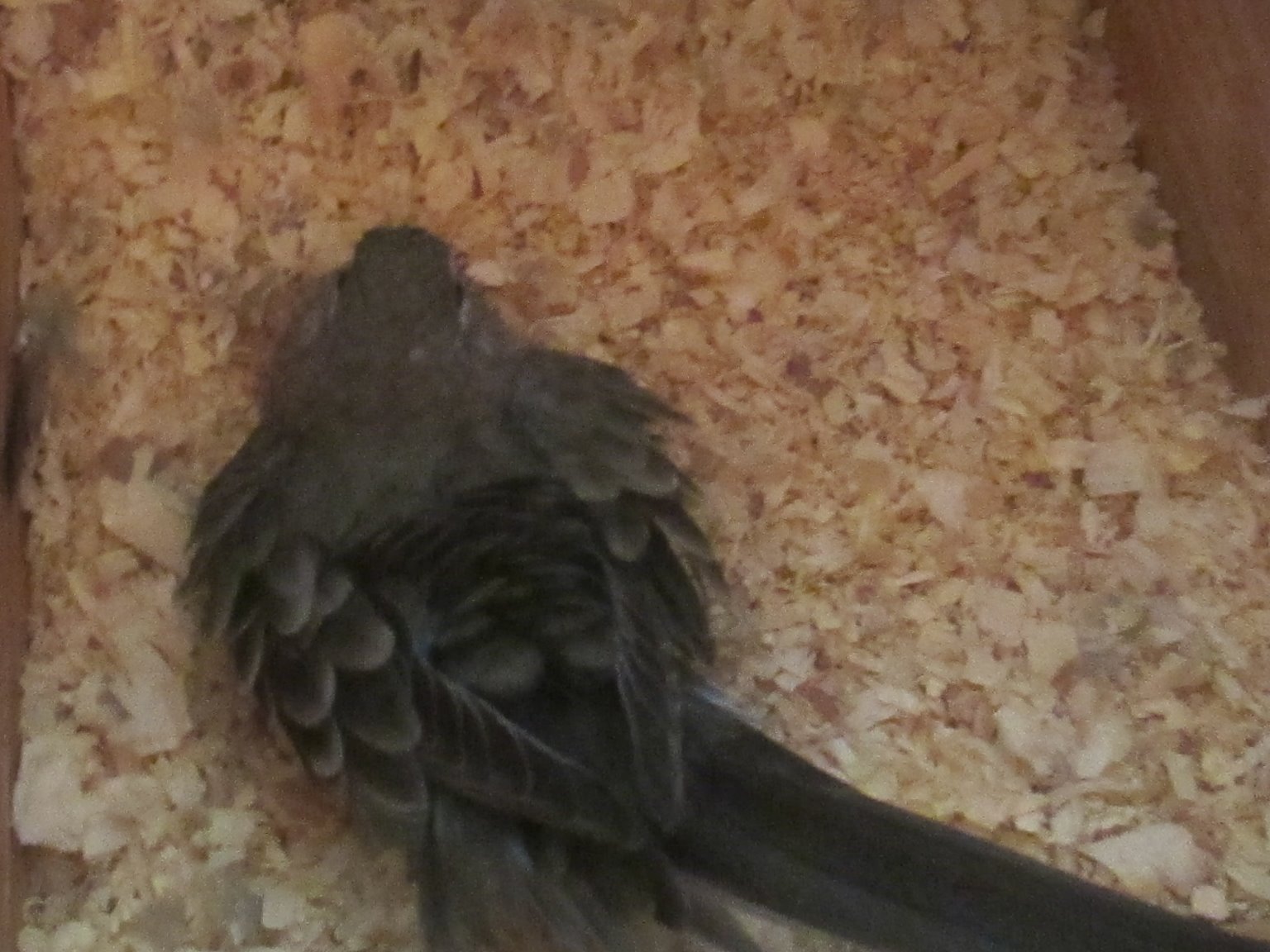 |
| Bella on four eggs that can't hatch because they're infertile. |
Blossom and her mate have not ventured into the nest box yet. They're a new couple too, so we are hopeful they will soon take advantage of the nest box.
 |
| Songster in front and his hen, Blossom, behind him. Songster is an Opaline Fallow and Blossom is a Lutino. |
We have two lovely Lutino hens that need mates. Sunny is a mature girl from outside our flock, but none of our guys will have anything to do with her. All found mates elsewhere. Can't imagine why. She's very pretty and sweet.
 |
| Sunny, a mature Lutino Bourke Parakeet hen. |
Starfire is a tame daughter from Peaches and Stormy. She's too young to mate, but doesn't have a fella waiting in the wings yet either. Tee-hee.
 |
| Sweet Starfire is a Lutino hen from Peaches & Stormy. She is young, only hatched last year. |
With this many hens, we should limit how many clutches the gals have this year. Every year I'm fearful we won't be able to sell all the babies, that we will have more offspring than people interested in them. Fortunately, that hasn't happened yet.
Eventually two or three of these pairs will find new homes. We still hope to have only four tame pairs, but it's difficult to part with any of them. Sometime down the road, we need to have a large indoor aviary in a room where the lights can go out early so they won't be stimulated to want to breed, giving them all an early retirement. But, I do love seeing the miracle of new life each Spring. So wonderful.
Even though we should downsize, I still hope to find a mate for Starfire and keep those two! For now, she's my favorite. All the older, original birds, will always remain with us too. Love them all. Smile.
Peace & Blessings!
May all your eggs hatch and your birds stay healthy and happy.
You stay healthy and happy too!
*****
***
*
Friday, February 3, 2017
Rosy Bourke Lutino hens Blossom & Starfire on Video
Sister Rosy Bourke Lutino hens: Blossom, hand-tamed, was hatched in 2015 and parent-raised by Stormy and Peaches. Starfire, hatched in 2016, was hand-fed from two weeks of age until weaned. She is also out of our Normal Bourke, Stormy, who also appears in the video below. Their mother is an Opaline Fallow Rosy Bourke, named Peaches. Both Stormy and Peaches were hand fed and very tame.
Although Blossom is not hand-fed, she became tame very easily. It probably helped that her parents are tame and she was handled in the nest as she grew up.
Although Blossom is not hand-fed, she became tame very easily. It probably helped that her parents are tame and she was handled in the nest as she grew up.
Be sure to enjoy our other Rosie Bird videos on You Tube.
Peace & Blessings!
Wednesday, January 18, 2017
Now on Pinterest as "Pink Birds" and "Bourke Parakeets"
We are PINK BIRDS. Why, you must ask? We think you will guess. Smile. https://www.pinterest.com/rosie9200/pink-birds/
Second account is as BOURKE PARAKEETS: https://www.pinterest.com/rosie9200/bourke-parakeets/

Peace & Blessings.
Second account is as BOURKE PARAKEETS: https://www.pinterest.com/rosie9200/bourke-parakeets/
It amazes me how many of my photos appear on other people's sites. Some give an attribution to The Splendid Bourke Bird Blog, but many do not ...

Peace & Blessings.
Wednesday, November 30, 2016
Wednesday, November 23, 2016
A Reader Contribution. Rosie Loves Wild Birds Too!
From Scotland, Margaret Cook writes:
"Am sending you a picture of a coal tit feeding on my hand... I've been in Speyside many times and never seen this before. Taken by Dave Slater. Sometimes the blue tits get brave, and even a crested tit, but mostly it's coal tits. Magic!"
"Am sending you a picture of a coal tit feeding on my hand... I've been in Speyside many times and never seen this before. Taken by Dave Slater. Sometimes the blue tits get brave, and even a crested tit, but mostly it's coal tits. Magic!"
 |
| Coal Tit in Speyside, Scotland. Photo by Dave Slater. |
Very sweet photo, thanks! We have similar birds come to our outdoor feeders in Southern Oregon, USA. Ours are Chickadees, and related to Coal Tits. Your photo urged me to check for others on the internet. Hence the one below.
 |
| Black-Capped Chickadee by Nadine Cox. This photo is from Smithsonian Migratory Bird Center. |
Like Coal Tits, our local Chickadees are easier to invite onto our hands than most other wild birds. I've not fed one on my hand yet, but can stand next to our feeder and talk to them as they eat. They're not easily frightened.
I read that Willow Tits are the most closely related to Black-Capped Chickadees. Although called Chickadees in America and Tits in Europe, all varieties of Chickadee and Tits have a relationship to one another, as do those in other parts of the world.
You Tube has videos of Chickadee, Coal Tit and Willow Tit songs. Interesting that there are similarities in how they sound, as well as looking much alike, even though often continents apart.
Aren't all birds amazingly unique and beautiful?
Peace & Blessings!
Monday, November 21, 2016
Bird Cages and a Recommendation for Bourkes
Naturally the bigger the bird, the larger the cage. However, take into consideration how your bird lives. Some fly, some climb. Some chew, some do not. Finches can live in lovely wooden cages, but hook bills can't. They'll chew through the posts, both damaging them and escaping.
 |
| Toys like these are necessary for a happy bird. |
Too often I've seen Bourkes housed in pretty cages that were too narrow for them to fly in circles. The result is that the strength of their wings weakens and they don't remain adequate fliers. While out of their cage they may lose control in flight and crash exhausted to the floor, or only take short flights from here to there because they know they cannot do more. A once-a-day flight out of their cage is healthy for them, but not enough. They need to be able to fly when caged.
The minimum-sized cage for a pair of Bourke Parakeets is 18 inches wide, 30 inches long and 18 inches wide. We recently decided to take advantage of a discount on several of these cages so that they can be offered to buyers of our birds. It saddens me to say that the local pet shops and marts we've visited do not carry bird cages that are sufficient in size ... only "pretty." Very sad. Fortunately, they are available on the internet.
 |
| This cage has a large door and a smaller one in the middle of it. |
We also purchased duplicates of the toys and swings our birds have, along with everything else that is necessary. We don't plan to profit from the cages. We simply want the birds we sell to go to healthy homes, so the complete set-up is $65. This same cage is available online in different colors, and usually for a higher cost. All of ours are black.
This is one of our set-ups, ready to go. Different sized perches, toys, swings, cuttlebone and mineral block are essentials. In addition to water cups, it's wise to add a water bottle on the side of the cage. The one in the photo is plastic because recently we've not found them in glass. However, glass water bottles are preferable to plastic ... the water stays fresher longer.
 |
| Although not shown here, we like to line the bottom of the cage with newspaper, not in the tray, but on the floor. |
 |
| The new cages came with an additional side door. Very low to use for a nest box, but might work, depending on the pair. |
Birds love spray millet. However, much of what is pre-packaged in grocery stores and even pet shops, is often old. Small isn't a problem, but graying millet indicates it's not fresh. California Golden spray millet is shown below next to some that was given to us with a rescue Bourke. She was being fed this. I put it outdoors at our bird feeder and the wild birds ignored it. What does that tell you?
The package had two left of four sprigs that were gray and dry ... actually looked worse than they do in this photo.
 |
| Make sure the millet you buy is golden in color. Old millet will appear grayish. |
Peace & Blessings!
Sunday, November 20, 2016
BOURKE PARAKEETS STAR IN VIDEOS and a HAPPY THANKSGIVING
Most of my posts these days are of the videos Rosie Bird puts up on You Tube. Only so much time in a day, and I apologize for not posting more specific topics recently. Search the Label List for anything you might want to know about Bourkes, or if you don't find what you want, write to rosie.birds@gmail.com with a question.

We hand fed 15 baby Bourke Parakeets this year and parent raised 15 others. It was thrilling to get several Lutinos and two Rubinos as well as very sweet, friendly Normals, Rosies and Pinks.


Normally, I allow the parents to raise one or two clutches and then remove that year's last clutch, sometimes their second, but most often their third clutch. We can then remove the nestboxes and discourage any further clutches. Bourkes would go right on raising offspring if allowed to do so.
In the house, where interior lighting simulates day length, they don't recognize that it's fall or winter and time to stop breeding. Our one-year-old hens are asking to mate now too, but won't be given a nest box until 18 months to two years of age. Until their mate checks out a suitable box for nesting, a male won't mate (at least typically they won't -- have yet to see an exception, but never say never).
About hand feeding Bourke Parakeets, the more you hand feed at once, the more difficult it is. I fed nine the first time, then let the parents raise some before taking out third clutches to hand feed seven more. It becomes difficult to keep the food warm and so I fed half, then made a second batch for the rest of them.
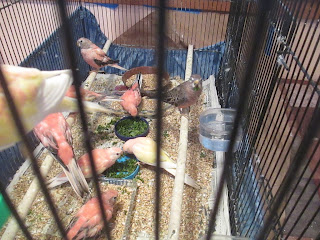 Got smarter with the second set of seven. We bought a small cup warmer by Mr. Coffee. It gets too hot, so I kept one small bowl of formula on it and one that wasn't. When one got cold, I could dip into the hot formula and mix some in with the other to warm it. Always test the formula so you don't feed hot formula to the babies. Better too cold than too hot. In fact, once the birds feather, it's less important that it stay warm. The younger the chick, the more important that the temperature is right...very warm, but not hot.

We also learned this year that our Bourkes love rice chex cereal. It's such a treat for them that I was able to hand tame some babies simply by offering it to them by hand. Of course, it helped that some of the hand fed babies were already eating it from the hand. We typically use spray millet in this way, but our birds are even crazier about rice chex cereal. Who knew!


Normally, I allow the parents to raise one or two clutches and then remove that year's last clutch, sometimes their second, but most often their third clutch. We can then remove the nestboxes and discourage any further clutches. Bourkes would go right on raising offspring if allowed to do so.
In the house, where interior lighting simulates day length, they don't recognize that it's fall or winter and time to stop breeding. Our one-year-old hens are asking to mate now too, but won't be given a nest box until 18 months to two years of age. Until their mate checks out a suitable box for nesting, a male won't mate (at least typically they won't -- have yet to see an exception, but never say never).
About hand feeding Bourke Parakeets, the more you hand feed at once, the more difficult it is. I fed nine the first time, then let the parents raise some before taking out third clutches to hand feed seven more. It becomes difficult to keep the food warm and so I fed half, then made a second batch for the rest of them.
 Got smarter with the second set of seven. We bought a small cup warmer by Mr. Coffee. It gets too hot, so I kept one small bowl of formula on it and one that wasn't. When one got cold, I could dip into the hot formula and mix some in with the other to warm it. Always test the formula so you don't feed hot formula to the babies. Better too cold than too hot. In fact, once the birds feather, it's less important that it stay warm. The younger the chick, the more important that the temperature is right...very warm, but not hot.
We also learned this year that our Bourkes love rice chex cereal. It's such a treat for them that I was able to hand tame some babies simply by offering it to them by hand. Of course, it helped that some of the hand fed babies were already eating it from the hand. We typically use spray millet in this way, but our birds are even crazier about rice chex cereal. Who knew!

May your Thanksgiving be blessed
and that you will give if your able, or receive if you're in need.
God bless you and your feathered companions with good health and happiness.
Tuesday, November 15, 2016
Sunday, September 18, 2016
Tame Bourke Parakeet Babies, Nearly Weaned
Have several buyers, but still some tame youngsters available! Write to me at rosie.birds@gmail.com for information or with questions. Love these little ones, so sweet and affectionate. Peace & Blessings.
Sunday, August 28, 2016
Birds of a Feather, An Observation About Bourke Parakeets
ROSIE BIRD'S latest video on You Tube. Peace & Blessings!
Tuesday, August 23, 2016
Saturday, August 6, 2016
Monday, August 1, 2016
Monday, June 27, 2016
ENTER TO WIN ... Giving Away Ten Copies of Suspenseful, Prolife Novel.
Begins at midnight tonight. June 28 to August 8. Goodreads does the random selections.
Good Luck!

Monday, May 23, 2016
Hummingbirds in Spring, 2016 -- Rosie Bird Loves Wild Birds Too
The Hummingbird Wars ... "hand" feeding various varieties on our back porch. Love these little guys, migrating through our area right now and very hungry!
Thursday, May 19, 2016
Tuesday, May 10, 2016
Baby Bourkes Are Now Feathered, Hand Feeding Nine!
Video taken today of our clutches ... nine babies are being hand fed!
Friday, May 6, 2016
Wednesday, April 27, 2016
Update On My Two Books
This is to let you know that my Small Exotic Bird Book will be available soon. The Publisher says the text is finalized and photos are currently being situated within each chapter. I expect it to be approximately 8 inches by 11 inches ... not small. Smile. It covers a wide variety of small bird species. Below are the chapter headings to offer enticement.

About my other book, the novel CAST ME NOT AWAY, written under the pseudonym Zara Heritage: In order to advertise and let people know about it, a Go Fund Me page was created solely to enable me (the author) to send out complimentary copies to ProLife organizations encouraging them to share this novel with others. I can buy the books wholesale, but they still cost money, as does the postage to send them. That's the purpose of the Go Fund Me request page.
Donations of $25 or more get a signed copy and a bookmark. Click below to see what else is offered.
If you support LIFE, and are willing to encourage it, here's a link.


SMALL EXOTIC BIRDS
By Gail A. Lewis
(aka Rosie Bird)
CHAPTERS- Introduction
- Keeping Small Exotic Birds
- Selecting a Bird, Behaviors and Personalities
- Cages and Aviaries
- Diet and Nutrition
- Breeding, Mating and Sexing
- Brooding and Incubation
- Successful Parent Birds
- Banding Baby Birds
- Hand Feeding Baby Birds
- Hand Taming, Talking and More
- Health, Safety and Medications
- Beak and Nail or Wing Trimming
- Egg Binding - Help and Rescue
- Maintaining Records, Genetics and Choosing Names
- Birds with Other Pets
- Aggression in Birds
- Building Projects, Nest Boxes and Incubators
- Questions and Answers
- All About Bourke Parakeets, Author’s Specialty
- Birds Bring Joy – A Final Note
If You're ProLife
Like Most of Us Are Who Love Birds
About my other book, the novel CAST ME NOT AWAY, written under the pseudonym Zara Heritage: In order to advertise and let people know about it, a Go Fund Me page was created solely to enable me (the author) to send out complimentary copies to ProLife organizations encouraging them to share this novel with others. I can buy the books wholesale, but they still cost money, as does the postage to send them. That's the purpose of the Go Fund Me request page.
Donations of $25 or more get a signed copy and a bookmark. Click below to see what else is offered.
If you support LIFE, and are willing to encourage it, here's a link.
Peace, Blessings and Thank You!

Thursday, April 21, 2016
Baby Bourke Future Color Identification and Banding by Foot Sizes.
Our current two clutches in video. It was taken today. Rosie & Pretty Boy have four babies. Peaches and Stormy have five. Fuchsia's five eggs were infertile, so maybe next time. Our beautiful Lutino, Sunny, hasn't been accepted by any of the three males she's had access to. Still hopeful for her.
Love these wonderful little miracle birds. Peace & Blessings!
Monday, April 11, 2016
Protecting Your Birds When Going Away: Bourke Parakeet Example
Our Latest Video on You Tube ... Smiles.
Subscribe to:
Posts (Atom)