Monday, May 31, 2010

Breakfast for Babies


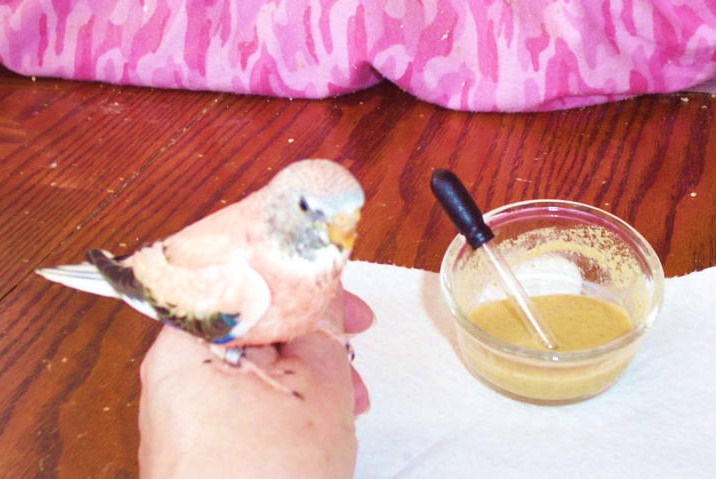
Time for breakfast.

These youngsters are eating on their own, but the youngest still begs to be fed. To keep him healthy, he gets two feedings of Exact Handfeeding Formula a day now, but also has nestling food and other seed available.

As long as the youngest is being fed, the other two like some special attention too. I make enough so that they can share. Mostly they sample some, then fly to my shoulder or arm. Then walk around the table and finally come back for another taste or two.

If I put my finger under their breast, they step up. I move them to my face to talk to them, and they will nibble the tip of my nose. I believe that's a sign of affection...very sweet.  I love birds.


Friday, May 28, 2010

Baby Birds with Problem Parents

Neversink7 asked, "...have you ever had problems with splendid or bourke parents pulling the feathers off of their babies?"  His Splendid parents are misbehaving and he wonders if a nutritional deficiency could be a possible culprit.

I don't think nutrition of any kind would cause this. There are plenty of feathers available that fall off the birds naturally and I often see my birds "playing" with fallen feathers, as well as routinely preening themselves. They can chew on all the feathers they want to, so why take them from their babies?

I've never had Bourkes pull feathers, except for the incident with one pair savaging a baby. With that pair, I always rescue and handfeed the young almost as soon as they hatch. I believe the male wants to breed again and dispatching the babies will allow that. I recently put the hen on "rest" and moved the male to another hen whose eggs have always been infertile. She's now on fertile eggs and I'm interested to see what happens. I may end up handfeeding her young too, if this male is actually the "bad" parent.

[UPDATE: After the cock was successful with another hen and a good dad, it turned out that the mother of the brood was to blame. Although she could hatch her eggs, she would not raise the babies and would begin savaging them as soon as all the eggs hatched. I still have two of her offspring (a brother and sister) that were hand fed and are wonderful parents with their mates. Both are very sweet natured. Their mother eventually developed an odd "droop" and died a few days later. I've wondered if she had a brain tumor that made her crazy or something. Also, she was sold and came back to me after her first clutch with a different mate also died. I don't know what her history was for the two years she was away from me.]
 
My experience with Splendids is different.  Many years ago I bought my 1st pair and the hen's back was bare. I was unfamiliar with Splendids, but didn't like the fact that the male pulled the feathers from her back. She was sweet and tame, but he was wild...drew blood the first time I caught him.

Their first brood died. They didn't seem to know to feed them. Their second clutch of three did fine and I still have a male from that clutch. He has NEVER pulled feathers from his mate(s) and neither has his son (the grandson of the 1st bird). None of my Splendids have ever pulled feathers from their young. I was happy to let that original bird go as a lone caged bird to someone else who enjoyed watching and listening to him.

To Neversink7:  How many clutches have your problem birds had? I'd limit them to two or three, with a few months in between. Maybe they're tired of feeding and caring for their young...? Sounds like you are doing the right thing by pulling and handfeeding them. 

Another thought ... if the young birds are fledged and able to eat on their own before the parents begin pulling the feathers, in the wild they would try to chase them off to live elsewhere. In a small cage or aviary, they can't leave. Is only one parent feeding and the other pulling feathers? That seems likely. I remove my own young birds as soon as the father begins to "chase" them from their perches. By then, they're eating okay and he wants them gone.

Past experience with Finches:  I once had a beautiful pair of Zebra finches. The hen was all white and the male was pied. They produced gorgeous babies with a "saddle" of color over the backs of white birds. Very pretty. However, about the 3rd year the male began to throw newly-hatched babies out of the nest. I'd put them back, and he'd throw them out again. He continuously did this and wouldn't raise them any longer. They'd produce another clutch and he'd do the same thing. My belief is that he felt he'd produced enough progeny and only wanted to continuously mate, not work to raise young. I gave him away to a bird store.

Past experience with button quail:  As a kid, I had a pair of cute button quail that hatched a large clutch. I
was shocked one day to go out to the aviary and find half the clutch bloodied and dead. Apparently, a male button quail will kill his sons after a certain age ... Sad. I don't know if every one of them does this, but enough do, that babies shouldn't be left with their dad for very long. Perhaps removing male button quail as soon as their eggs hatch is wise.

This sounds like it's the males of the species that savage their young. That might be typical, but I did have a female budgerigar parakeet who visited the nestboxes of other hens and killed their young. After she'd done this more than once, I finally caught her in a box that wasn't hers and realized who was doing it. She was "dispatched" and I never had another problem in that aviary.

There must be good birds and bad birds, just as there are good dogs and bad dogs, good people and bad people.

Thursday, May 27, 2010

Fun with House Finches, wild birds

A friend on Oahu, Hawaii sent these pictures.

House finches made a nest in their hanging spider plant. All four eggs hatched. Cute! The adult bird is the dad. Hens don't have the red coloring.

These finches are also called Linnet finches in other parts of the country. Or, Papayabirds ... but probably only in Hawaii!

Tuesday, May 25, 2010

More on Sexing Bourke Parakeets & a little on Splendids

Just noticed one of my young Bourkes doing a bounce and flair on his perch. He's definitely a male. Not only do male Bourke parakeets put their shoulders back and slightly flair their wings at the shoulders, but if they add a bounce too, that's a clear indication of a male Bourke.  In this photo, the male is at the far left, shoulders back, head up.

Females tend to have darker faces than males, but that's not totally reliable. I have a lovely male with a blue-gray face that's actually darker than some of his daughters. But, the girls will darken up as they mature, or so is the case with my hens. Once they are laying eggs, their facial feathers seem to come in darker than when they were youngsters. 

Other sources say the hens have a flatter head than the males do. Possibly the males flair their head feathers slightly when courting. As youngsters though, this isn't obvious to me, and that's when you want to learn their sex. Once they are mature, their actions will project their sex pretty clearly... That is, unless you have two males and one is dominant... then, you may have trouble telling that the subservient one is male and not female. However, in a mixed aviary where at least one hen is present, the males will "strut" their stuff and show off so that you should be able to identify them pretty easily if you pay attention to their behavior.

Females who are harrassed by too many males are likely to "scold" loudly. They also do this if they don't like the mate you gave them. Then it's time to switch them.

By the way, remember I moved my female Splendids to different males because for two years neither has had fertile eggs? Well, my 5-year-old patriarch was attempting to mate with his new lady. Wish them luck! They've been in the nest box together, but that's no guarantee. His attempts with her were better than with the previous hen ... just hope he's successful. All may depend on how stable she stands through the process. But, at least they're trying ... that's more than was done before with their earlier mates. This hen has never produced before, but the male, Rainbow, is the father of her previous, unsuccessful mate. Rainbow's first mate passed away. He's no youngster, but seems healthy.

Currently, have two Bourke hens on eggs and another asking to breed with her new mate. Should have three raising young soon (I hope!). Have several others who have each raised three clutches recently and are "resting" for a few months. Their boxes are closed or removed.

Have six babies almost ready to sell, only one is still being handfed occasionally. The others are eating on their own. They are so sweet. It's always difficult to part with them.

This photo is of the last six I sold. They are in a travel cage. It's not a cage where any babies live. It's too small. However, a divided cage like this works fine for temporary transportation. The links to Amazon below are for books I've discussed in the past.

Peace & Blessings!


Bourke's Parakeets

Tuesday, May 18, 2010

Good Morning Young Bourkes!

Actually, only the three in back are youngsters. The one or two in front are tame adults from earlier clutches. They still like to beg a bite or two once in a while. Something about the Exact's taste, or maybe they just like the extra attention they get when being fed.

I missed a good picture this morning, but by the time I got the digital camera on, the scene had ended. One of our young birds landed on a chair arm and Chinook, our big old malamute mix...mala-mutt...sauntered over and put a nose up to him. The baby nibbled his nose a bit, but by the time I had the digital camera on, their introduction was over.

Never leave other pets, or young children, unattended with your birds. Even the most reliable can have an "accident" or forget to be careful. Chinook is more curious than anything, but I watch him around the birds. He knows he's not to hurt them, and I doubt he ever would, but pets can do the unexpected.

As I mentioned in an earlier post, one morning we made a shopping trip to Eugene about a three-hour drive away. We were gone nearly 12 hours and when we arrived home, our oldest cat had been asleep in a window seat and left there all day. He never bothered the birds, but I would not intentionally let a cat stay alone in the same room with them all day.

We live in the country and usually put the cats outside when we leave...where the other two were. Although, one night one of our adult children was visiting and let another cat inside with the birds. About 1 a.m. she meowed outside our bedroom door wanting to come in with us. Who knows how long she was in the same rooms with the birds. She never bothered them either, and she's a stray we took in two years previous to that incident. She isn't a cat we raised ourselves, yet she's probably grateful to be rescued. She quickly accepted our big dog, and responded by looking away any time she glanced at a cage and was told sharply, "No Birds!"
As another aside. We love the wild birds around our place too, and when I'm outside and there are birds at feeders, I tell the cats, "No Birds!" and they seem to leave them alone too. They catch mice, moles and voles and I had to rescue a chipmunk from one of the cats a few months ago. But, I've never seen them go after wild birds ... a benefit of their indoor training, I'm sure. 

My tame birds like to fly around and visit their relatives in their breeding cages. The birds in the cages have gotten used to it, but they don't particularly like having someone walking around over their heads.

May God Bless You and our Beloved Pets. 

Sunday, May 16, 2010

Another Bourke Gender Identification

I'm sitting here listening to a young Bourke sing and realized there's one method of identifying sex that I've not mentioned before.

Three Rosies are sitting along a perch and one Rosy is singing away, interspersed with wolf whistles. He is a MALE for sure. Male Bourkes like to sing, especially in the Spring. I'm not sure how early this characteristic begins, but it happens while they are still very young ... too young to breed. He's just chittering away happily while the other two are quiet. They are likely hens, although I'm less sure of their gender than I am of his. Hens will sing too, but they tend to chirp more quietly and less often.

It's early morning and that's when Bourkes are most active ... at dawn and dusk ... early morning and late evening. If sunrise is at 5 a.m., as it is here now, they will start singing slightly before the sun is up no matter how early.

Something else was mentioned in a comment about a pair of birds that turned out to be male, and that triggered a memory. If there are no females available, the more dominant male will try to feed the less dominant one. This is common in both Bourke and Splendid parakeets. The males instinct is to feed a mate, and if no hen is around, they'll try to coerce another male to accept being fed.

In a cage of mixed birds, several times I've seen a male Splendid single out a female Bourke and attempt to feed her. That's only because I have two extra male Splendids that I've been unable to find mates for. The Splendids prefer a female Bourke to another male Splendid if both are present. However, they leave male Bourkes alone! Bourkes are slightly larger and can intimidate Splendids when bothered. By the way, you won't get a hybrid Bourke/Splendid, although Splendids may try... Splendids have, however, successfully bred with Turquoisine grass parakeets.

May all your birds have Good Breeding! Smile.

Friday, May 14, 2010

Bourke Behaviors

Thanks to “Sags” for his comment on the last post. I thought I’d address some of the ideas he raised. He said he’s been told another way to sex Bourkes is by looking at two birds sitting “together; a hen will generally sit flat to the perch, whilst the male will be more upright.” I believe this goes along with my observation that males “strut” their stuff during breeding season. They may sit higher to stay alert and protect their mate. However, at other times during the year, I see no difference in how they sit on a perch.

My bird pairs are mostly in cages of their own, 30 inches long by 18 inches wide and 18 inches high. The length allows Bourkes to fly in circles, something they do well.

Sags also says he thinks “hens will bite with a vengeance, much more than males when held.” I haven’t noticed any difference. However, I’ve learned how to catch or hold them so that I won’t be bitten. When reaching into a cage, I may use a washrag to capture birds I feel are likely to bite with “a vengeance.” Then they can bite the rag all they want to. I also keep a bird net handy in case one escapes, but I seldom need it. Of course, tame birds don’t bite!

When I was a kid my grandfather taught me how to hold wild budgerigar parakeets to avoid nips. You pin their head between the second knuckles of your first and second fingers so that they can't turn their head to bite. This hold works fine on Bourkes and Splendids too. See photo example at left.

Note that in the UK Bourkes are called Rosa Bourkes and in the U.S. we call them Rosy Bourkes – same birds. Sags added, “As you say Rosa is sex-linked, but a rosa hen paired to normal male will only produce normal looking coloured birds, the young males being split for rosa...unless the father is split for rosa (only males can be split) then you get both rosa and normals in the young males and hens.”

I didn’t know that only males could be splits. I have Normal males who produce Rosy hens, and realize they are splits (heterozygous), their father was a Rosy. All my Normal hens have only produced Normal males and Rosy hens. Their mates have all been Rosies. I expected that a Rosy hen with a Normal male would produce Rosy males and Normal hens. That’s what I had interpreted from what I’d read, but have not put it into practice before.

Recently, for the first time, I have a Rosy hen with a Normal male. Their first clutch was fertile, but the eggs didn’t hatch. If Sags is right, then all their young will be Normals. It will be interesting to watch this happen, if they manage to hatch their eggs. That hen is starting a new clutch now.

Sags said, “… I just wish I was as successful in breeding my birds. Things are not going too well so far (only last night I removed a dead chick, a lutino splendid)....I blame the British weather!”

When I have hens on eggs that are about to hatch, I make sure that the room they are in is at least 70 degrees or warmer. I think my success is because my birds live indoors where it’s always warm. They also get lots of light from large windows. Along with seeds, they get fresh greens and veggies too … maybe that helps.

Sags said, “Incidently, it’s my pictures in the link for sexing splendids. The wing bar is not 100% reliable, but helps when used with the differences in colour.”

Thanks again for your comments, Sags! I like your photos at: http://www.grassparakeets.talktalk.net/   It's a great site with wonderful web cam shots of babies in the nest!

P.S. I get my birds’ bands and bought the bird net from: L & M Bird Bands in San Bernardino, California. http://www.lmbirdlegbands.com/
May your birds bring you peace & joy. Here are two of my latest, almost adult babies.


Tuesday, May 11, 2010

A Baby Bourke’s Future Color

If you keep mixed couples, i.e., one Normal Bourke and one Rosy Bourke, you may wonder what their newly hatched babies are going to look like.

The Bourke book I own, published in the UK, says that Normals will have gray fuzz and Rosies will have white fuzz, and that’s how you can tell what they are going to be. Balderdash! All my fuzzy little baby Bourkes look the same even though some grow up to be Normals and some grow up to be Rosies. They all appear to have fuzz that’s more white than gray, sort of an off-white.

Maybe early Rosy babies were fuzzy white and Normals with no heterozygous genes were fuzzy gray? Mine always look alike, even when both colors are in the same clutch.

That said, there is another way to guess their future color. From their feet! Most Normals have dark feet and those destined to grow mostly pink feathers will have pink feet. That said, one of my current Rosy babies has feet with both brown and pink skin. It has no other Normal features, so I think you can safely assume that a baby bird with “striped” feet will be Rosy. The striping is unusual though.

Once their feathers begin to bud out, you will soon recognize pink dots of color on the backs of the Rosies.

As a reminder, Bourke color is sex-linked and babies will be the color of the parent of the opposite sex. This means a Rosy dad and a Normal mom will produce males that are Normal Bourkes and all their hens will be Rosy Bourkes and vice versa; a Rosy hen will produce Rosy sons and her Normal mate will produce Normal hens.


I have one pair, however, who produce 50/50 of each color and both are Normals. The male had a Rosy father and a Normal mother, so he is the Normal color. Apparently he’s heterozygous. All his progeny who are pink have been hens. All the Normals have been male. If you want more explanation of homozygous and heterozygous, query the internet. There’s more info. out there than I can provide. Suffice it to say that he carries the gene for Rosies, as apparently did many other Normals, or we wouldn’t have our beautiful Rosies. Smile.

May you have Rose-colored Blessings Galore.


Monday, May 10, 2010

Splendid Sex Identification

Thanks to reader, neversink7, for providing the site address below which has photos of Splendids, including the wing bands mentioned in the previous post.

http://www.grassparakeets.talktalk.net/sexing.htm

Sunday, May 9, 2010

Sexing Splendids

Although there are many hybrid colors of Splendids, I think the normal variety is the prettiest. Why fool around with a good thing? Adult male Splendids in their normal wild color are easy to recognize. The males have a scarlet chest and the females don't.

All young Splendids look like hens. It could be many weeks before bits of red begin to show on their chests, indicating that they're male, gradually filling in to cover most of their chest.

As with Bourkes, I'm not going to go peering inside a bird ... it might injure them and I wouldn't know what to look for anyway. I'm not a vet. Leave this to the professionals!

However, there is another way that may help determine the sex of your young birds. Splendid males tend to have black beneath their wings, whereas, females have white bands within the black. If the white bands are broken, you may have to wait and see whether the white bands fill in or disappear. In my case, I've seen partial white, broken bands fade out to become all black (males). If the underside of the wings are already black, then you know you have a male. If there are strong, unbroken white bands (lines) on the underside of the wings, then you have a female.

I posted this description once before and a reader said he appreciated it. He used this and said it's always proven true for him since. Handling the babies to check the feathers on the underside of their wings should also help tame them.

Good luck sexing your youngsters!

Sexing Bourkes

You may already know how to sex normal Bourkes (those with brown backs). Adult males grow a narrow row of blue feathers above their cere (nose/nostrils). Females don't have that line of blue, and typically neither do Rosies.

Sexing Rosies or young birds is more difficult. I'm not a vet and can't peer inside the birds, or do a DNA sample. But, watching the birds will often give a clue as to their sex. Males tend to strut their stuff by throwing their shoulders back and slightly flairing their wings at the shoulder. This is an obvious clue that they are male. Sometimes youngsters will start to do this almost as soon as they are weaned (eating on their own).

Another clue is if they attempt to "feed" a sibling. When this occurs, the one doing the feeding is likely male. Very young birds can be seen "practicing" this behavior. Don't, however, mistake this for when they are trying to steal food from each other's mouths!

Male Bourkes feed their hen during courtship and when she's on eggs. As soon as young leave the nest, father Bourkes take over most of their feeding. So, male feeding comes naturally to them, even at a young age.

As for identifying very young hens, that's not as easy. All you can do is say, "well, I don't see any male behavior, so this is probably a hen."  You have a 50/50 chance of being right!  

Peace & Bird Blessings.

Thursday, May 6, 2010

Feed me, Feed me ... & More on Breeding

In this first photo, all the birds want out to be fed at once. Sometimes I let them all out together, but it's easier to feed them one at a time (and less messy).

The three babies I'm feeding right now are almost weaned. They're scratching around and appear to be trying to eat seed. Hopefully, they are. Spray millet is the easiest, and I've given them nestling formula, as well as typical adult parakeet seed mix.

Once they are eating on their own, they will still want to be fed occasionally. Maybe it's only comfort food, or maybe it's needed to augment what they are eating on their own. No matter. I don't want them to go without, so I'll feed them until I'm certain they no longer need it or want it.

The three photos above are of three different babies. Although similar, I can easily tell them apart.

The picture in the lower right is of Rosie crowding into the box with the babies. See her long tail sticking out? The babies' tails are shorter. Rosie has been asking her brother, Flame, to breed so maybe she thinks she's ready for a nest box. She's not! Only three months old, she won't be ready until a minimum of 10-12 months of age ... best at two years old.  In a week or less, the tissue box will be history and the babies will be ready to sell.

As beautiful as Flame is (that's why I kept him), I may go ahead and sell him. Rosie needs a mate, and it shouldn't be him. I already have enough pairs, so keeping Flame and getting a mate for him simply adds more birds. I had considered keeping him because of his color and selling Rosie, but have decided I like Rosie too much, even if she's not as dark pink as Flame. 

Although distantly related, one of these babies may stay instead. However, at this point it's a guess which one is male. I hope to choose correctly. One looks just like Rhett, his father, and I think that might be the one to keep. He flies to my finger like Rosie does ... a good quality. The fact that I can call Rosie, hold up my finger and have her fly to it from anywhere in the room, is the main reason she's my favorite. Smile.

More on Breeding:

Three of my hens have had their three clutches in the last few months and deserve a rest to maintain good health. In the past, I've only allowed my hens to breed once a year. I put up nest boxes in Feb. or March and took them down after two or three clutches per hen. All came down in the Fall irregardless. Last year, however - because of noisy disruptions - we didn't have successful clutches in Spring or Summer. When things quieted down, the hens decided to go back to their nests in the Fall before the boxes came off, so I let them. Indoors with lights on in the evening, the day length didn't affect them much. Now, they want to continue to breed since the weather's sunny & warm.  

In discussing this with bird expert, Bob Nelson, he said that a two or three month rest period should be adequate. His recommendation? Close off the boxes until the Fourth of July and reopen them then. Sounds like a plan!

For us, this year has already proven to be a bountiful one for baby Bourkes, and may get better. Two other young hens have laid fertile eggs that didn't hatch. Maybe they will succeed next time, so their boxes will stay up. We have seven pairs of Bourkes altogether (not counting babies or Rosie or Flame).

Splendids, as mentioned in another post, haven't done well for the past two years. All eggs have been infertile. I moved males around recently, and am hopeful a change will create success ... even if only with one of the pairs! I have two extra males and it would be nice to have hens for them.

Peace & Blessings.

Sunday, May 2, 2010

Getting Iodine into their Diet

Took the advice of neversink7 (see his comments on April 29 blog) and bought some granulated kelp from our local health food store in order to provide more iodine into our birds' diets. It was 44 cents an ounce (no minimum and no shipping charge). 

So far, the birds haven't investigated it like they would fresh vegies. Next step will be to try mixing it in with Petamine, a treat they like. He also pointed out that ladygouldian.com carries liquid iodine that can be added to their water. If our birds continue to ignore the granulated kelp, we might order some. We'll see.

Although most of my hens are successful, this year two have had fertile eggs that didn't hatch. Adding iodine may or may not solve the problem. It can't hurt to try.

This came from Canada. I won't buy anything that I know comes from China.

Friday, April 30, 2010

New Temporary Home

Our three baby Bourkes being hand fed are now able to fly...not well maybe, but they can leave the table and end up who knows where. 

They still need to be fed and still want to hide away during the day. But, their previous shelter/box was no longer safe. It was time to move them into a cage, but still give them a place to hide. The small cage I had available has small doors and the box they were in wouldn't fit.

The answer? You see it here. A Puffs tissue box turned on its side. Paper towels in the bottom are changed each time the babies are fed.  They can go in and out as they please, so they are free to roam and practice their flying as they please. They can also try to eat on their own as there are several easy-to-eat choices available.

I put tame Rosie and Flame in with them to see how they'd do. Rosie has already taught the smallest one to eat spray millet, or at least try to. When I reached into the cage this afternoon, the oldest flew onto my arm next to Rosie who always gets there first. Granted it was time to feed the babies so he was motivated, but it was a first for him and pleased me.

The two tame older birds are setting examples for the babies. Interactions between the young adults and the youngsters are cute to watch.

Be careful if you decide to do this, however. Adult breeding Bourkes might try to chase the babies away and could harm them. These two tame birds are very gentle and still very young themselves. Still, I watched them closely until I was certain they wouldn't "bully" the younger birds.

Thursday, April 29, 2010

Incubation Observation & Other Thoughts…

(Watch for Comments at the bottom of each Blog; there may be one or two. The one added to yesterday’s blog, "Splendids," is particularly interesting. There is a Comments button at the end of each blog and it tells you how many, if any, comments there are).

If you’ve followed this blog for a while, you’ll recall our attempt to incubate two Bourke eggs. We were successful right up to the point where the eggs were even piping. It was very disappointing to lose the little chicks after getting them so close to hatching.

The cause, we had decided, might be that we didn’t have enough humidity present toward the end of incubation. More humidity is needed just before hatching. A dish of water was present, but we heard a recommendation to hang a wet washcloth near them in the last few days and keep checking it since it would dry out from the heat lamp.

Maybe that would have made a difference, or maybe not. Sugar, the hen who abandoned those eggs after becoming egg-bound with the 3rd egg, recently laid three eggs. It took her a while to recover from the ordeal we put her through to help her release the over-sized egg. At least she survived.

Sugar kept the three eggs from this clutch warm right up to the point of hatching, but these did not hatch either. After 21 days I was concerned, but left them under her for over 30 days. I wanted her to abandon them herself, but she was more persistent than any other hen I’ve ever had and remained on them – she was very determined, but in the end it did her no good.

Once the eggs were removed from her nestbox, I opened them. One was infertile, but the other two held dead chicks, fully developed and ready to hatch, but apparently they could not. Was it genetics, or something else? Unless she succeeds with another clutch someday, I may never know.

After talking to Bob Nelson, Bird Specialist extraordinaire, he said that the problem of “dead in shell” can sometimes be caused by low iodine in the parents’ diets. His solution has been to provide rabbit salt blocks which contain iodine. I was concerned about the salt intake, but Bob says they won’t consume more than they need. He warned about attaching the salt block to the side of a metal cage or the salt will damage the metal.

Eleven of my cages now have a small salt block available. We attached them each to a perch with small plastic ties (cable ties used by electricians). Getting them tight enough required pulling with a pair of pliers. So far, the birds are ignoring them.
***

As I sit here typing, I see Sugar and Spice mating again. Spicy’s picture is in the column at the left. He’s the very tiny, newly hatched baby being hand fed. At the time, his mother was mated to a much younger male (the only one available), and he wasn’t very good at helping feed the young. To compensate she was only willing to feed the first two eggs that hatched. When we lost the third baby, I paid close attention. Realizing she wasn’t feeding the fourth baby, I removed the newly hatched Spicy and hand fed him. He was my first experience at hand feeding. By the way, his father grew up the following year and the pair successfully raised three or four babies in most clutches thereafter.

Just Because It's Cute

Wanted to share some cute photos. Rosie is the sweetest bird I own. She's not the darkest pink or the prettiest, but her personality is fabulous. She's playful and affectionate and always flies to my finger when I call her. If I reach into her cage, she is on my hand or arm every single time. Rosie loves to be fed treats and usually shares a muffin or bagel with me each morning. I admit to spoiling her, but she's worth it. Others are sweet, but she's the best!  Smile.

The babies are temporarily in a plastic container while I clean their box. These three are being hand fed. Although I think Rosie might like to help!

Flame is also free flying here (for a little while), but his interest in babies isn't as intense as Rosie's.

Wednesday, April 28, 2010

Splendids

Since my Splendids haven't hatched any eggs in many months, I've not been blogging about them very often. To make up for that, here's a photo of our last clutch of youngsters taken quite a while ago. All look like hens, but all developed the typical scarlet chest ... all were males.

As with my Bourke book, I don't often find books about Splendid parakeets. However, I found this one on Amazon. I don't own it yet, but I'm tempted to order it. If you are too, here is the location: 

Splendid Reflections: 40 Years of Grass Parrakeet Husbandry

Tomorrow:  Recent insights on egg incubation

PEACE & BLESSINGS

Thursday, April 22, 2010

Baby Bourke Personalities

The three babies currently being hand fed are from two different clutches. The two largest with the most down and fewest feathers are siblings. They shared their nest with the pink-eyed albino baby previously discussed. They're very healthy.

One is outgoing and likes to wander. The larger of the two is very timid. He's no longer afraid of us, but likes to hide under a hand in preference to exploring.

The photos with me in them were taken early this morning. My tame birds like to investigate and mooch some of the Exact baby formula.

The third bird has a sibling too, but that one is being parent fed. This bird was much smaller and slower to develop than his sibling. I began to worry whether he was being pushed away and not fed enough. So, I pulled him to hand feed. He's at least a week older than the other two, but not any bigger than they are. He is very affectionate and nibbles on fingers. As I've gotten to work closely with him I realize he simply won't eat as much as the other baby birds do. When his crop is about half as full as the others, he's finished. Consequently, he needs to eat more often ... that's a nuisance! However, he's growing fast and seems to be catching up.

The photos of the two birds in the cage are a mother and her youngster. Notice that the adult's tail is longer. This is the sibling of the baby I'm hand feeding. It has been out of the box for about a week, so it's very far ahead of its brother. The hen laid four eggs and hatched two. Since Bourkes lay and hatch every other day, the second baby can only be 6 days younger than the other, at most.  It has developed much slower and I'm convinced it's because its crops is smaller. It will make a fine pet bird, but probably would not want to make a breeder out of him since he would have to store food to regurgitate for his/her offspring.