Friday, November 26, 2010

Casual Friday with Bourkes and Hummingbirds ...

Snow on the South Coast of Oregon is unusual.  It snows in Eastern Oregon a lot, and in Eugene or Portland a few days every year, but seldom down here. The coastal climate is moderate in winter and summer.  That said, we got three inches of snow on our hilltop this week! Rare, amazing and beautiful. Must be the so-called global warming. Right. In the 1970's they were warning that another ice age was coming. Truth is, no one has a clue.

Anna's Hummingbirds don't migrate like the others we see in Spring and Summer. So, they are grateful for the several feeders we put out around the house. They're agressive, however, and one usually claims a feeder as his own and tries to chase everyone else away. Hence, a good reason for multiple feeders. These are some of ours. 

They always have a bird on or near them, guarding his treasure. But, if he flies after a trespasser, another bird will slip in for a sip before he gets back. They're fun to watch.


----------------------------------------------------------------
Can I ride along?
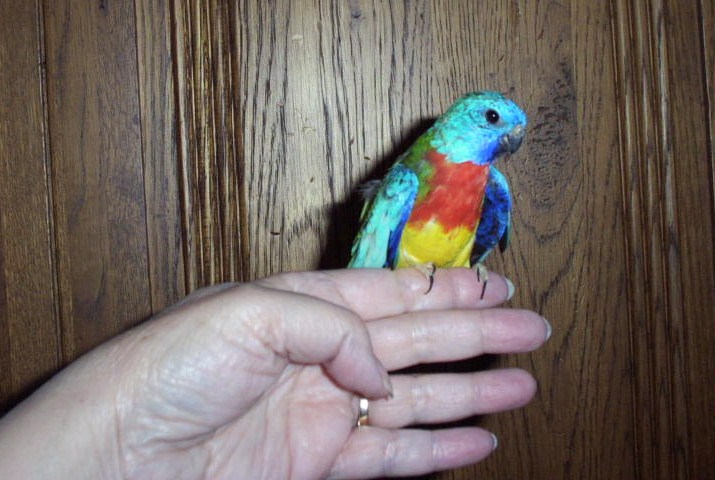
On a different note, Rosie is my favorite Bourke. She's a handfed hen hatched late last year. When she and the other tame birds are out of their cages, the others come and go on and off my shoulder. However, she typically stays with me wherever I go. Probably why she's my favorite...


What's this? I like the clicking it makes.


My hands don't look like they did when I was 20 to 40 years old and proud of them, but time marches on for all of us...  I'm grateful to still be here and able to enjoy being a wife, a mother, and a grandmother with a dog, two cats and over a dozen beautiful, sweet birds.
Let me make it turn!

Whooo...what's under there?

I haven't blogged as often lately because I'm trying to make time to finish a novel. Here she is trying to help! She likes the quiet clicking of the mouse wheel when it's rolled and can't figure out why she can't make it do it herself. 

Birds are all curious, playful creatures.

Hope everyone in the U.S.A. had a wonderful Thanksgiving Holiday.
Worldwide: God Bless all of you, your loved ones and all of your wonderful pets.
***

Friday, November 19, 2010

Birds and Their Feathers: Selecting a Healthy Bird

Healthy Splendid Parakeets, Rainbow & Jewel.
When selecting a bird to add to your flock or as a pet…There is much to be learned by examining a bird’s feathers since feathers are a good indication of a bird’s health and well-being. Molting is a normal process where feathers are periodically lost and replaced with new plumage. I’ll attempt to identify the difference between a molt and when something might be wrong with the bird, such as disease or malnutrition.

One-week Rosie Bourke babies, pink tipped feathers
just starting to show.
Budgerigar parakeets (budgies) appear bald when they hatch. Bourkes and Splendids both have “natal down” covering them. Like any chick, it’s wet at first hatch, but quickly dries to become fluffy. These are actually downy feathers, those that provide added warmth by underlying the larger outside feathers in mature birds. A baby bird’s feathers begin to form in the follicles as the bird grows. These appear as darkened areas under the skin that are easier to see in larger birds than in small parakeets such as Budgies, Bourkes, Splendids and other small members of the avian family.

Feathers gradually protrude through the skin, encased in a sheath. The fuzzy tips of feathers soon begin to show through the end of the sheath. If you are raising Bourkes and have a mixed pair (one Rosie and one Normal), you can begin to recognize their future color at this stage. Rosies will show their pink at the ends of feather sheaths on their backs one to two weeks after hatching. You’ll also know their sex since color is sex-linked in Bourkes. Hens from mixed parents will be the color of their father. Males will be the color of their mother.

Rosie Bourke babies with some down still present.
No stress bars on them. Lines are color and fade as they mature.
Until their first molt, most young birds have the same color plumage as the hens of their species. This is especially true of Splendids. Males develop their scarlet chest after their first molt. However, even the rose color in Bourke males’ deepens and seems to become richer as they mature.

Sexing Baby Splendids: Although young Splendid parakeets look like mom at first, you can lift their wings and look for white bars on the bottom of their wings to help determine males from females. The undersides of the wings of adult Splendid males are all black. Youngsters with white bars (or stripes) under their wings are female. However, some have broken white bars and that makes identification trickier since they could be either sex. In my clutches, however, the hens have had solid white bars and the broken white-barred babies grew up to be males that later filled in with black after their first molt.

Close up of healthy feathers on a Rosie Bourke.
Healthy feather development requires adequate nutrition. If there is a disruption in the absorption of nutrients when the feathers are developing, stress bars may appear on the feathers. In this case, feathers may be a normal length, but with a line across them where areas on each of the shafts are empty of the colorful pieces that poke out and lock together. This can be caused by digestive disturbances, pro-longed periods of chilling, or the bird not being fed enough as the feathers were developing. They can appear as dark lines or white lines, depending on the color of the feathers.

If only one or two feathers have these bare areas, they are probably not stress bars. This can happen when a feather sheath isn’t preened off soon enough. What you need to watch for are continuous lines of stress bars.

Yet, a bird with stress bars may since have recovered and be healthy. If it's healthy, replacement feathers won't have the stress bars. If it is a bird you’re considering purchasing, you might want to wait and watch, skip that bird and look for another, or have the bird evaluated by an avian veterinarian before purchasing it.

Molting is caused when feathers are pushed out by new feathers coming in below them. A bird should never have bald spots because of a molt, and most birds molt the same feathers on both sides. The easiest way to recognize a molting bird is the feather sheaths you will see at the wings, tail or head. Lone birds will have more trouble preening these off than if you have a friendly pair. They will help preen areas for each other that they cannot reach, for instance, the top of their heads.

Damaged feathers also occur if birds fly into things, or from over handling. See my articles on safety.

As always, looks at the bird's eyes. They should be shiny and alert. Not half closed or watery. Also, inspect the bird’s vent. If feces have gathered there, the feathers around the vent are wet and/or soiled, that’s a bird to avoid as it may be ill. You don’t want to introduce that bird to your other birds. New birds, even apparently very healthy birds, should be quarantined for ten or more days before introduction to your others. If at any time, one of your birds appears ill, address the problem promptly and keep it separated from your others to avoid spreading the problem.

Friday, November 12, 2010

Splendid Parakeet Portraits, Scarlet-chested Neophema's

Rainbow, son of Merlin & Millet. Now our old Patriarch.

The flash reflects off their faces making them look turquoise
like their shoulders, however, their faces are actually a dark cobalt blue.
I love my birds and tend to cover much more about Bourkes than my Splendids. That’s probably because I have 22 Bourkes right now, 19 Rosies and 3 normal’s. No doubt that’s why I successfully raise more Rosies than Splendids, hmmm?

Yet, my clownish, very fun Splendids deserve attention too! I only have two hens, but have four male Splendids, all in their normal wild color.

Rainbow is the father of two of our other males, Flip and Rainbow Junior. Handsome Rudy came to us in a trade for one of Rainbow’s other sons in order to introduce genetic diversity.

Although Splendids don’t sing as lyrically as a Bourke parakeet, they do call back and forth to each other, especially the two bachelors who want mates of their own. Not an easy feat to find them though.

If you keep birds, you’ll find the colorful Splendids lots of fun. They love to tear up paper, play with toys and are crazy about swings! They like taking baths, and water cups are just another plaything for them.


You can see some of the shiny, dark cobalt blue of his
face under his beak. The wing color is correct, but their
faces are actually very dark blue, almost black.

Photos at right and below are of Rudy. Hole in nest box doesn't have to be so big. They adapt to various sizes.

They do like to put things in their water! Change their water dish at least once a day or more, and provide them with another source too. A tube of water on the side of a cage works well. It isn’t as likely to be splashed out. Keep an eye on it too, however, because it is likely they’ll make soup in the basin of it as well.
Here is a better depiction of a Splendid's true face color.
As an afterthought, here are other relevant photos, even though they've been posted in earlier articles.
These are young Splendids. Hen is below.
Males above do not have all their scarlet color yet.

Young Male Splendid with a young male Normal Bourke (in wild color).

Very young Splendids. Actually there are four males and
one hen in this cage, but their color hasn't come in yet.
At the time the photo was taken, I didn't know their sexes.
As they matured, the hen had to be removed as she was so outnumbered.


Young Splendid hen with her first egg.

May your Birds Bring You
Peace & Blessings
and Keep You Smiling!

Tuesday, November 9, 2010

PET BIRDS IN THE FIRST CENTURY: African Greys, Alexandrine Parrots & Lovebirds

I admit that I didn't write this post. Because it's about birds, I borrowed it from my husband's first century historical site:  http://seedsofchristianity.com/wordpress/

PET BIRDS IN HISTORY
An African Grey Parrot in the wild.
Birds have been popular pets from earliest times. Hieroglyphic records indicate the Egyptians kept them 4,000 or more years ago. The Romans also kept many varieties of birds as pets. Parrots were most popular because of their color, but they also kept crows, magpies and starlings because they, too, could learn to repeat words. Pet birds were so highly prized, that in wealthy Roman households sometimes a slave’s only assignment was to care for the birds and teach them to talk. The common man, without the connections and affluence required to obtain the more exotic specimens, would have made do with native species such as finches, doves, etc.

The ancient Jews clearly kept pet birds. Duet 22:6 warns, “If you come across a bird’s nest beside the road…and the mother is sitting on the young…do not take the mother with the young.” Robbing a nest would have been a common way to acquire birds for pets or resale. Job 41:15 asks, “Can you make a pet of him like a bird?” And Jeremiah 5:27 says, “Like cages full of birds…”

WHERE THE BIRDS CAME FROM
A large portion of Europe was under Roman control, but the northern latitudes don’t have the colorful birds most favored as pets. And two modern sources of exotic birds, Australia and South America were both unknown. However, Rome’s influence extended into Africa which is home to a variety of colorful parrot species.

Currently, one of the most popular parrots is the African Grey. They are generally acknowledged to be among the smartest of all birds and are known to have vocabularies of up to 500 words. They surely would have been popular in Roman times as well.

An Abysinnian Parrot
Africa is also home to nine species of Poicephalus, or short tailed, parrots. Widely dispersed, several of these species exist in slightly different forms so that they represent a total of 24 varieties when the subspecies are included. One example in this group is the Abyssinian Parrot. It lives wild in northwest Somalia, across northern Ethiopia and into the Sudan. They generally live in areas that are lightly forested and, though this species generally travels in small groups, they sometimes gather in flocks of over a thousand birds. Abyssinian parrots belong to the ring- necked subspecies and are commonly kept as pets.

A wild Lovebird looking out from
hole in tree with nest.
Lovebirds, Psittaccidae Agapornis, are also native to Africa. There are nine subspecies of lovebirds, meaning that these beautiful and popular birds can be found in a wide variety of colors and colorations. They are intelligent, affectionate, and playful little birds who form strong bonds with their owners. 

THE PARTHIAN CONNECTION
The eastern boundary of the Roman Empire butted up against the realm of the Parthians. This area was once part of Alexander the Great’s Empire. Following the death of Alexander, Parthia became a Seleucid governorate under Nicanor. Their sphere of influence extended from the boundaries of Roman Syria to the Indus River.

The Alexandrine Parakeet or Alexandrian Parrot is named after Alexander the Great, who is credited with exporting the birds from Punjab into various European & Mediterranean countries. Given their relationship with Alexander, they became prized possessions of nobles and royalty. The species name eupatria translates to noble ancestry.


The Ultimate Gift an Alexandrine Parrot

The Alexandrine Parrot is a larger version of both the Indian and African Ringneck. They look so much like their smaller cousins that they are sometimes accidentally classified as one of their more popular cousins. All Alexandrine Parrots exhibit the classic ringneck look: dark green bodies, long tails, red beaks, and yellow eyes. The only difference between them and their smaller relatives are their maroon patched wings and larger bills.

One of the Alexandrine’s smaller cousins, the Indian Ringneck Parakeet, can speak so clearly that once monks considered them sacred after hearing one repeat their daily prayers. This big talking, medium-sized bird is capable of reciting long and complicated excerpts from books, poetry, and scripture.

Indian Ringnecks Can Recite
Long Passages of Scripture
By the First Century, Rome had several hundred merchants ships traveling across the Red Sea to India to import pepper. It’s not hard to imagine a bird trader wandering the docks with a cage of birds that he’d trapped and tamed. Who better to sell them to than foreign merchants docked at the harbor?

The merchants would transport the birds back to the Egyptian port of Bernike and resell them to someone heading for Rome or any of the other capitols of the Empire. After all, if Herod the Great were in Rome and happened to see the talking bird Caesar had, wouldn’t he want one too? And if it were the current fashion, wouldn’t Pontius Pilate’s wife, Claudia Procula, want some lovebirds dangling from her ceiling in a gilded cage? Just because they were living out in the sticks didn’t mean she had to live like a peasant. Besides, who did she have to talk to all day? Pontius was always tied up with paperwork, centurions and that high priest, Caiphas…

So were the early Christians familiar with exotic pet birds? The answer is clearly, Yes they were. Did they own them? Maybe, maybe not. Some Christians came from elite families and could have easily afforded to purchase such a pet. Others were poor and would have had to make do with sparrows, wrens, finches, and doves.

Traditional tells us Saint John kept homing pigeons as a hobby. What about the boy Jesus? Did Joseph perhaps construct a cage out of willow branches and wood scraps to house the little desert finch Jesus brought home? It’s certainly not beyond the realm of possibility.

Tuesday, November 2, 2010

Parakeets Are Desirable Prey For Hawks and Falcons

If the Internet sources can be trusted, there are 16 varieties of hawk and 37 different species of falcon. This could make it difficult to identify the small raptor that tried to get into my kitchen this morning.

If only the flash hadn't automatically
discharged! Reflection hides hawk.
Our bump-out with birds inside.
We have a bump-out nook off the kitchen with a plant shelf. Instead of plants, I have four large cages sitting on the shelf with a pair of Bourkes in each, plus one baby recently out of the nest. There are windows on three sides of the shelf. Early this morning, all nine birds went crazy.

A small hawk was flying very close to each of the windows and peering inside at the birds. A nice snack for him! When he couldn’t reach them, he lit on a deck post right outside their window and continued to watch the birds. They did not like it!

Juvenile Sharp-shinned Hawk.
Photo by Kevin T. Karlson

I grabbed a camera, and headed for a window, fixed the bird in the center of the viewfinder and clicked. The flash went off automatically. Drat! He flew away, and the flash’s reflection in the window destroyed any hope of getting a picture of him.

Several hours later, he flew past again, but didn’t land or stay long enough for me to retrieve the camera. However, it was another opportunity to study him and that’s when I decided he most resembled a Cooper’s Hawk or a Sharp-shinned Hawk. Wish I had a picture specifically of him, but he looked just like many of their photos on the internet, some provided here. Since he was small, I believe he was a juvenile Sharp-shinned Hawk. He was very mottled brown, not grey.

There are about 50 species of falcons and hawks in the genus Accipiter. Females are naturally larger and weigh more than males. The smallest falcon is only 9-11 inches long and weighs about 4 ounces. The largest weighs about 2 or 3 lbs. and is 19-24 inches long. A falcon’s lifespan can be as long as 17 years. Large hawks live longer as size is relative to lifespan. Red-tailed hawks have lived 29 years in captivity, although in the wild their average lifespan is only 12 years.

 provided the following information:

Juvenile Birds of Prey
Cooper's Hawk


Sharp-shinned Hawk
Juvenile Sharp-shinned and Cooper's hawks have yellow eyes, dark vertical stripes on their breasts, and variable brown backs and heads with some white spots.

Heavy, bold, reddish streaks on chest and belly.

Usually has a pale stripe above the eye. Finer streaks mostly on upper breast; lower belly mostly white. Often reddish color on side of head and nape.
Photos by David Smith, Grand Junction, Colorado

Saturday, October 23, 2010

Bathing Bourke Parakeets. David and Bathsheba?

Morning bath time ...  My husband arrived in the kitchen this morning at an opportune time to snap these photos.  Rosie and Pastel are two handfed youngsters we decided to keep. They enjoy bathing in the sink. There were three birds bathing, but Flame finished before my husband arrived, and decided to stay on my shoulder to watch the other two.

Thinking about it.
We have a Splendid who used to do this, but I've learned from experience that you need to continue to give your tame birds lots of attention. If you ignore them for too long, they become less tame. He no longer trusts me enough to bath in the sink on my hand. So, these birds usually come outside their cages about once a day, most often in the morning - our favorite time together.
If you do, I will.

How does it feel?


How's this pose? Happy now!


Ahh...just the way I like it. Nice of them to install
this sink in the island bar just for us!


The others don't know what they're missing!


Friday, October 22, 2010

Pink Birds! Red Birds! All Kinds of Birds, Birds, Birds!

Hello All,
Male Rosy Bourke Parakeet.
When I was growing up, my grandfather raised budgerigar parakeets and gave me my first pairs. My dad built an aviary and my parents encouraged my love affair with birds. We spent a lot of time visiting zoo’s and assorted bird farms.

However, there was one bird in particular that made a lasting impression on me.

Rose-breasted Cockatoo.


In 1966 I fell in love with a sweet, young Rose-breasted cockatoo. She had been handfed and was for sale at Magnolia Bird Farm in Anaheim, California for $250. I visited her many times and lamented the fact that I didn’t have $250 to buy her. Although my parents were happy to help me support parakeets, finches and doves, the cockatoo was beyond their realm of possibility.


Rose-breasted Cockatoo.

Pair of Rose-breasted's.
If I’d been old enough to buy her myself, she could still be with me today. Their lifespan is typically 60 years. Probably because of that Rose-breasted cockatoo, I was later led to explore the world of smaller – yet just as beautiful – Rosy Bourkes.

I love my pink birds and wondered just how many more of them there are in the world. This photo assortment is by no means all of them, but an impressive group none-the-less. Most are photos borrowed from Google Images. (If any are your photos and you want credit, or want them removed, let me know and I will oblige. None indicated a license).
Enjoy. 

American Robin.


Male Cardinal, from American Midwest.


Crested Bird of Paradise

Crowned Cockatoo.


Pink Flamingo.

Frigate Birds.

Wild Gouldian Finches.


House Finch.


Audubon's King Bird of Paradise.

Baby Major Mitchell's or Leadbeater's Cockatoos.

Major Mitchell Cockatoo.


Major Mitchell Cockatoos in front, Rose-breasted in back.

A striking Leadbeater's or Maj. Mitchell.

Mount Goliath Lorikeet.


Purple Finch.

Rainbow Lorikeets.


African Grey Parrots. Rare red-factor in center.


Young Red Factor African Grey Parrot, rare.

Red Faced Parrot Finch


Red Factor Canary.


Red Factor Canary Babies.


Red Factor Sun Conures.


Roseate Spoonbill in flight.

Roseate Spoonbill.

Roseate Spoonbill.


Roseate Spoonbill with young.


Wild Rose-breasted Cockatoo.


And one of my own...Bonnie's mate, Clyde, a Rosy Bourke Parakeet.

Scarlet Finch.


Wild Scarlet Macaw in flight.


More lovely pink Roseate Spoonbills.


Wilson's Bird of Paradise.


Zebra Finches in their wild color. Male at left with cheek patches. Hen on right.


Four newly hatched Rosy Bourke Parakeets.


Young Rosy Bourke Parakeets almost ready to leave nestbox.

Rosy Bourke hen in front, male Scarlet-chested Parakeet
in back.

Click "Home" in upper left above to see Recent Posts.