Showing posts sorted by relevance for query nest box. Sort by date Show all posts

Wednesday, March 25, 2020

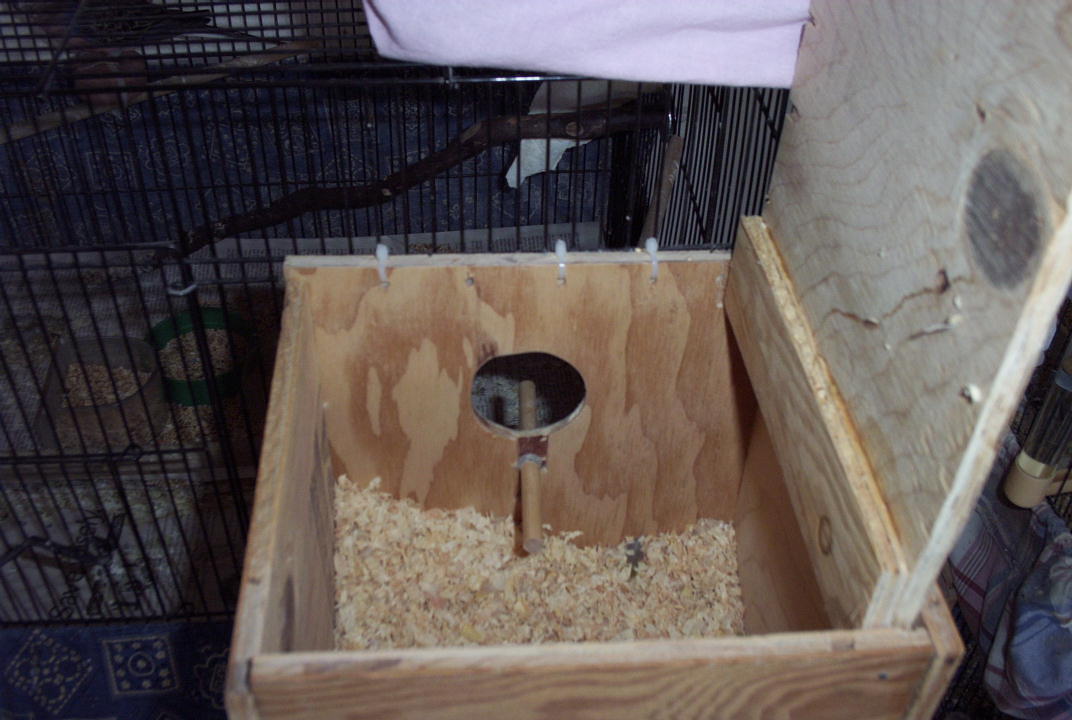
Nest Box Construction


This post is taken from Chapter 17 of my book,
 "Rosie Bird's Guide to Small Exotic Birds" by Gail A. Lewis
Home to multiple clutches of baby birds, the humble nest box duplicates
the hollows where many varieties of birds nest and reproduce in the wild.
Making a nest box for your birds need not be an overwhelming project. Anyone with basic carpentry skills and a few tools can produce an inexpensive and functional box. The sizes given in this chapter will yield a box suitable for the various Grasskeets discussed in this book. It also works for Linnies and Finches. If you plan to raise larger birds, proportionally increase the dimensions.
Tools You Will Need
A saw capable of cutting plywood.
A 12 inch ruler or tape measure.
Drill with a 3/8 inch bit, 1/8 inch bit, and a 1¾ inch hole cutter.
Piece of 3/8 inch dowel – about six inches.
Rasp to round off corners.
Sandpaper to smooth edges.
Carpenter’s glue, such as Elmer’s Wood Glue.
Clamp(s) to hold pieces together as they dry.
A generous handful of small finish nails.
A hammer to drive those nails.
Pliers and small wire cutters to install nest box.
Each nest box is constructed of a bottom piece made from ¾” exterior plywood. The sides and lid are made of 3/8” plywood.
We asked our friendly local lumberyard to rip a sheet of plywood into nine inch strips lengthwise. Since a sheet of plywood is 48 inches wide, this yields five 9” x 8’ strips and one thin remainder. Save that remainder to use later. If you’re only making a couple of nest boxes, check with your lumber yard to see if they sell half-sheets of plywood.


Here’s a cutting list of pieces needed for a Grasskeet-sized box:
Floor – 9” x 8 1/4” piece cut from ¾” exterior plywood.
Front – 9” wide x 11” high plywood piece with the entrance hole, and a row of four or five small holes, 1/2” down from the top.
Back – 9” wide” x 10” high cut from plywood.
Side A – 9” wide x 9 ¾” high cut from plywood. This ¼” is the lip that the lid will rest on.
Side B – 9” wide x 10” high plywood piece. This will become the hinge side.
Top or Lid – 8” wide x 10” long plywood.

Schematic of the Nest Box
Viewed from above Lid not shown
All corner joints are glued and nailed
for strength and stability.

Preparing for Assembly:
1. Cut your plywood floor to size.
2. Cut out the plywood pieces from a 9 inch strip of plywood.
3. The front will be mounted against the cage. Determine where you want to place the entry hole. [This will be determined by the location where you intend to remove several bars of the cage so the birds can access it from inside the cage.] It can be centered, or off to either side. Draw a horizontal line across the back (the 9” x 11” piece) about 3 ½ inches down from the top. Draw a vertical line where you want the middle of the entry to be. Where these two lines cross marks the center of the entry hole. Drill a 1¾ inch diameter hole there.
4. Carefully sand and smooth the edges of the entry hole to protect your birds.
5. About ¾ inches below the entry hole, drill a 3/8 inch hole on your vertical line for a perch.
6. Take your six inch dowel and carefully drive it through the hole under the entry. Enlarge the hole slightly if necessary, but not so much that the dowel doesn’t fit tightly. Center the dowel so there’s as much inside as there is outside. This allows a mother bird in the nest to stand on it while the father bird in the cage feeds her from outside the box. You can make this easier by placing one of the cage’s perches adjacent to it.
7. Drill a series of four or five 1/8 inch holes in an evenly-spaced line about ½ inch below the top of the board. They will be used to attach the nest box to the cage.


Creating the hinge:
1. Take the thin leftover strip of plywood and cut a piece equal to the width of the lid. This will be used to form a hinge. The lid is hinged from side-to-side and is attached between the front and back of the cage.
2. Apply glue, clamp the strip tightly, and let it dry.
3. After the glue has dried, use the rasp and sandpaper to round the bottom and top edge of the hinge end. This will allow it to open and close without binding. You’ll also want to round the exterior corners and edge, sanding them smooth. You’ll be lifting the lid often to check the eggs and baby birds...so smooth is nice.
Assembling the Nest Box, Step 1:
1. Lay your floor board floor flat on your work table. It helps to lay the four sides of the Nest Box on the work table around the floor so you can visualize how it comes together.
2. Attach the sides. Apply glue to one side of the base. Put Side A in place and drive several nails along the bottom to reinforce the connection. Remember, the lid will close onto Side A; its placement determines the direction the lid faces. Repeat the process, putting Side B on the opposite side.
Assembling the Nest Box, Step 2:
Attach the front and back. Spread glue along the floor edge and the edges of the piece. Carefully slip it in between the sides you’ve already put on. Nail along the floor and temporarily clamp. Repeat the process with the final piece. Once it’s in place and clamped, drive some nails along the joint where the two sides meet.
Assembling the Nest Box, Step 3:
Install the lid. Put the lid on the box the way it will be installed. The hinge portion should slip in between the front and back sides. Hold in place by pressing down the lip onto Side A, the shorter side, so the lid is level. Mark this position on Side B with a pencil line.
Now turn the box on its side and align the lid with the pencil line. Move it away from Side B creating a tiny gap so it doesn’t rub when opened. Once the lid is properly positioned, drive a 2d (1”) finish nail through each side and into the thin scrap glued to the lid. The nails will act as a hinge allowing you to open and close the box lid.
How to attach the Nest Box to a cage:
Align the nest with the hole you’ve created by removing several sections of the cage’s bars. Feed an 8” plastic cable tie through one of the holes previously drilled across the top of the Nest Box. Loop it around the upper horizontal bar of the cage and tighten. Four or five ties securely hold the box in place.

You can view our nest boxes at the Link Below: 


***
PEACE AND BLESSINGS! 


Tuesday, February 7, 2012

Bourke Questions and Answers

Flame feeding Fuchia through opening into her nest box.
When this was taken their five eggs had all recently hatched.
Quite a brood for them to keep fed.
Shawn wrote to say he raises budgies and cockatiels, and is unfamiliar with Bourkes. He sent the list of questions below. Although most have been answered in earlier posts, I'll address them here all together.

01. What are the foods for Bourkes?
  • Bourkes will eat anything that a Budgie eats. Parakeet seed is their primary diet. However, mine also love fresh greens like spinach, kale, lettuce, broccoli, etc. They also like most vegetables, such as cooked corn, peas, carrots and green beans. Always have sources of calcium available, such as cuttlebone and mineral block.
Four cages with nest boxes attached outside.
These rectangular cages are 18"x30"x18".
Skirts help control scattered seeds.

02. What about the cage size for Bourkes?
  • Bourkes need to fly and can't do so in a tall narrow cage. Their cage should be oblong or rectangular.  My smallest cages are 30 inches long, 18 inches high and 18 inches deep 18"x30"x18". One pair per cage except when their young are present with them. Aviaries or flights of any larger size are beneficial too and can accommodate more then two birds.

A larger cage that is three feet high, 30 inches wide and 18 inches deep.
Some of this year's young Bourkes share it while waiting to be sold.
03. Did the parents feed the babies like as Budgerigars?
  • Male Bourkes typically check out a new nest box to ensure it's safe before a hen ventures inside for the first time. After she settles in, my male birds seldom go back into it (although other people's have). Male Bourkes will feed the female while she's on her eggs. She in turn feeds the young when they hatch. She seldom leaves the nest except to deficate. Males often sit outside the door as if keeping watch, and feed her through the entrance. Once the babies are two to three weeks old, experienced hens begin to spend more time outside the box, allowing the young to keep each other warm.
  • Fathers begin to also feed their young once the babies are feathered and able to reach the entrance to the nest box. They will often be fed through the entrance until they leave the nest. Parents continue to feed their young after they are outside the nest box. This lasts at least two weeks or longer.
Flame & Fuchsia's five babies in a nest box
that is barely big enough as the babies grow bigger.

04. Is it possible to rare up the babies without Hand Feeding?
  • I think you're asking abour rearing or raising babies by their parents. Most parent Bourke parakeets successfully raise all their young. However, there are occasional exceptions. When my Normal Bourke, Willow, and her mate were very young, she would hatch four eggs but reject the two youngest. In her case, I learned to watch carefully and if a newly hatched bird wasn't being fed, I pulled him to hand feed. Only one of her babies ever starved, and it happened before I knew what she was capable of. Later, as a mature hen, she did raise four babies many times.
  • I don't know why this would make a difference, but my hand fed, tame hens have never abandoned any of their offspring even while very young themselves and with large clutches.
A nest box with a slide-up side opening.
This one was used by parents, Bonnie and Clyde.

05. Size of the Nest Box for Bourkes?
  • For instructions and size of nest boxes, see the "Pages" tabs above and click on "Building Nest Boxes."
  • Size is subjective. I've had several pairs raise their young in former cockatiel nest boxes. They did well and probably enjoyed the extra space. Another hen had a much smaller parakeet-sized nest box and reared five babies in it successfully. However, I cleaned it twice before they were weaned. It was very crowded with six birds in the box, so the pine shavings had to be replaced to avoid unpleasant odors and keep the babies from getting their feet stuck together from an excess of feces. For this reason, a box that is too big is better than one that is too small.
  • There is one major difference between raising Bourkes and/or Splendids versus raising budgerigars and/or cockatiels. Bourkes and Splendids like pine shavings, or something similar, in the bottom of their nest box. Budgies and cockatiels don't need them. I give my birds about an inch of pine shavings in the bottom of the box (never use cedar - it is too aromatic). They will scratch around and make an indentation for themselves.
Two breeding successes.
White faces with pink eyes: Opaline, fallow Bourkes.
I hope this is useful to many of you. If you have other suggestions, don't hesitate to comment below.

Peace & Blessings to you and your Birds.

    Thursday, October 27, 2011

    NEST BOX CLEANING BETWEEN CLUTCHES

    Pretty Boy at left with his pink-eyed youngster on right.
    I’ve written about cleaning and replacing nest boxes before breeding season. However, I haven’t written about keeping them clean between clutches.

    Most of my hens are meticulously clean while on eggs. They leave the box to defecate. However, after babies hatch and begin to grow, nest boxes start to become soiled. Two babies in a nest aren’t bad, but four can make the boxes pretty dirty.

    When that happens, I temporarily remove the half-grown baby Bourkes, and place them in a safe, confined place. A large butter tub lined with a paper towel works perfectly for this. Old pine shavings are removed and fresh ones added. I press them down before returning the babies to their box.

    Notice how dirty and crusty the pine shavings have gotten.
    Three babies beginning to feather, but not ready to leave box.
    My Bourkes live indoors and are very familiar with all of us, so cleaning out boxes with babies still in them is not a problem. If you have birds in an aviary, and they aren’t used to you coming and going, consider whether removing the youngsters is wise or not. I doubt a Bourke would ever abandon their nest because of a short-term cleaning, but there is a slight risk with birds that aren’t used to people.

    Although I don’t always clean out boxes that have babies in them … unless they’re very dirty … between clutches, I always do. New babies are better off in a clean box. The photos with this post are of Rosie’s box. Currently, her second clutch of three is still in the cage with her and her mate. They’re being parent fed and learning to eat on their own, but not ready to leave home yet.

    A photo of old shavings completely turned over by hen.
    Loose and no longer crusty, but gray after previous use.
    Rosie, on the other hand, is more than ready to start a new clutch. I had planned to remove her nest box, but changed my mind. These pictures illustrate how dirty a box can get, and how she decided to make it useful again. She turned over all the shavings to make the box ready for another clutch. She worked hard to make the formerly crusty, dirty box shavings soft and pliable, albeit old and gray.

    Nevertheless, I felt that clean pine shavings are preferable. I set an empty 40 lb. dog food bag on a chair where it was easy to reach and, using a metal ladle, scooped shavings into it. With a sharp knife, I scraped hardened droppings and food off the sides of the box. Then, I vacuumed the interior.

    An empty pill bottle blocks entry to nest box.

    It might be advisable to remove the boxes to vacuum them. However, my birds are used to hearing the vacuum cleaner. It’s not very noisy as it’s an in-home vac with the motor in the basement. What they hear is loud air flow.

    While I cleaned the box Rosie stayed away. She seemed to know what was going on. I did this between clutch one and two. However, before vacuuming, I decided to block the entry hole to be safe. I used an empty pill bottle that fit. Easy to put in and take back out.

    Investigating her box after it has been cleaned out.
    Windex was used on the sides after scraping off dry food & dirt.
    Then the box was aired out. It will be throughlyscrubbed
     before it goes back up for use next year.
    Later, satisfied with her box, she's fluffed
    (wings out) and ready to lay an egg.
    With about an inch of clean pine shavings in the bottom, I packed them down for her. As soon as the pill bottle went away, it didn’t take her long to investigate. She has already formed a “bowl” in the center. She is fluffed and ready to lay an egg, which I expect any day now.

    Meanwhile, she and her mate, Pretty Boy, are still doing the deed. I expect all her eggs to be fertile. Smile.  


    Pretty Boy on bowl. His three youngsters in background.
    Rosie is out of sight in the nest box.

    Peace & Blessings.

    Friday, May 13, 2011

    REPLACING NEST BOXES FOR BREEDING SEASON

    Hello All,
    Eight home made parakeet nest boxes after a good cleaning.

    Dry and ready to bring inside. Installation was the next day.
    I retrieved all our nest boxes from the basement where they’d been stored since last year, shook out a few mouse turds (frown) then brought them up to the laundry room and thoroughly cleaned them with warm sudsy liquid dish detergent. 

    After a good rinse, they spent the afternoon on the deck drying in the sun, as the photo illustrates. The sun is beginning to drop on the horizon and the nest boxes, now dry, are about to come indoors. The next day we installed them on cages. An inch or two of pine shavings covers the bottom of our boxes. Bourkes and Splendids like pine shavings (don't use cedar).

    Budgies need an indented circle in the bottom of an empty box for their eggs. We're not currently raising Budgies, so all these nest boxes are for Bourkes or Scarlet-chested parakeets.

    It’s important to keep an eye on your hens when they’re laying. We’d planned a trip to Chicago during the month of May and I didn’t want our hens laying eggs when I wasn’t at home. This resulted in putting the nest boxes up late this year.
    
    Jewel's new box. It sometimes takes a few days
    for birds to investigate a recently installed nest box.
    Usually the male checks it out first to be sure it's safe.
     Even though I had someone who would come in each day to provide them with fresh water and food, I wanted to be present during breeding season. If anything unusual were to happen, such as egg-binding, I could recognize and respond to the problem and, hopefully, save a hen’s life. It’s also a good idea to check your nestlings daily. If for some reason a chick isn’t being fed, you can pull the chick and save it with hand feeding.

    As you know, having a nest box stimulates the bird’s desire to breed and rear young. Without a nest box, they usually won’t attempt to reproduce. However, like every rule, there are exceptions. One year, I had one female lay her eggs in a food cup in early February.  She has since learned to wait for me to put up a box. I think she realizes that if she waits, one will eventually materialize.
    This box slides open on the side, rather than from the top.

    Last year Cherry, an older Rosy hen who didn’t lay eggs in 2009, surprised us by raising a total of six youngsters in 2010.  And here I thought she was finished. Apparently not. There was no change of cage or mate  … everything was the same as always. I’m curious to see what she does this year.

    Another of my older hens — a Normal named Willow — also appeared to have gone into retirement. Although she raised numerous clutches over the years, in 2009 and 2010 she never glanced at the nest box and turned away her younger mate when he tried to feed her. My husband asked why it was necessary to put a box on their cage.

    “You never know,” I said. “Look at Cherry who raised young last year after skipping a year. We’ve nothing to lose. We have the box and it only takes minutes to install it.” Of course, those “lost” minutes were his sacrifice, not mine … Smile.
    Clyde outside Bonnie's nest box. 

    Peeking inside a newly installed box.
    This morning, I looked up from my desk, and Willow was in her nest box!  Will she lay eggs? That is yet to be seen. She was an adult bird when I purchased her a number of years ago, and she isn’t banded. So her age is unknown. If hens live a healthy long life, they eventually quit laying.

    Some breeders sell off their older, non-productive birds. I don’t do that. If they’ve done well for me, they deserve a pleasant retirement in the home where they’ve become familiar and comfortable.


    Peace & Blessings.
    May your birds bring you joy. 

    Tuesday, September 17, 2013

    Bourke Parakeets & Others - End of Season Update

    I've tried to keep up with questions to rosie.birds@gmail.com, but lately I haven't been posting as often to this blog because my husband had back surgery. He is recovering nicely, but between him and the new puppy, my time is limited. One day I'll gather the newest questions and post them with their answers. However, for now, I want to update everyone on the current state of affairs with my birds this season.

    Rosy Bourke parakeet on eggs. This is our sweetest hen,
     called Rosie. Photo taken 9-17-2013.
    We've always recommended no more than three clutches a year per pair of birds. And, only two clutches per year for birds that might be stressed in any other way, such as being older, the weather suddenly turning cold, predators nearby causing a panic that could happen again -- anything that might make raising a third clutch difficult for the mated pair.

    In spite of that recommendation, one year a young Flame and Fuchsia raised a fourth clutch because I didn't get their nest box removed in a timely manner. Often, I will hand feed a third clutch just to take some of the stress off the parent birds, and in the case of Flame and Fuchsia that year, I did hand feed their last clutch. Hand feeding the last clutch also allows me to remove the nest box before a pair begin mating again and the hen can go back and start laying more eggs.

    Bourkes often begin to mate again right away, and a hen may lay eggs for a new clutch before their last clutch of young ones are all eating on their own. This year, in Fuchsia's case, while the last baby of her third clutch was still in the nest box, she laid another clutch of four eggs.

    I couldn't hand feed the third clutches of any of our pairs this time because I knew we'd be traveling to a larger city for my husband's surgery. The birds were left alone with plenty of water and extra food for three days and two nights. They did fine, but hand feeding their young was out of the question.

    Our oldest hen, Cherry. Her last clutch didn't hatch, so her
    nest box has remained clean for this one. It seems unlikely
     these eggs will hatch either as her mate, Rhett, is quite
    elderly too. In 1st clutch this year, they raised two.
    My hubby usually attaches and removes nest boxes for me. This year, he's unable to remove them, and the nest boxes are still up. That problem can be dealt with by blocking off the entry opening. But, busy me, did not do so.

    I also try to clean boxes between clutches and add new pine shavings. Since my birds are all very tame, if needed I can remove eggs for a short time and return them to a clean box. The hens always accept this from me. I'm not recommending it for everyone, however. I simply know my TAME birds will allow this, and I think they appreciate a clean box. The eggs are never away for more than a few minutes and handled carefully.

    This post is to let you know how adaptable Bourkes (and probably all birds) can be. The picture below illustrates how they can accept their circumstances. Fuchsia's third clutch of four left the box pretty dirty and I've not been able to remove and clean it. She is using her "dirty" box for a fourth clutch. Cleaning it now will be a challenge since the dried food around her eggs is so hard. I need to decide when to do it...possibly after the babies hatch and I take them out to hand feed. Meanwhile, the box has a slight odor, but the weather is cool and that helps...

    I'd never recommend allowing Bourkes to have fourth clutches in the same year, however, sometimes things happen that are beyond our control. These eggs are already laid and I'm not going to throw them away.

    Fuchsia's box after raising four babies and starting
    another clutch before the nest box was cleaned.
    Instead of pine shavings, bottom has dry droppings.
    The Lady Gouldian finches have babies again. All their clutches from late last year sold, and when she started laying eggs on the floor, I decided to give them their nest box back. I hear tiny peeps coming from within, Duchess won't move to let me see what's under her, smile. This photo is of a clutch from last year. They are about a week old here.
     
    Lady Gouldian finch babies at about one week of age.


    Turquoise Lineolated Parakeet.
    The pair of Linnies (new to me), are in the nest box. The hen wasn't coming out, so I finally peeked in. She looked like she was brooding and I assumed she had eggs. However, I finally saw her out of the box and rushed over to have a look. No eggs. Disappointed, but still hopeful.
    
    Cobalt blue Lineolated Parakeet. He loves his toys.


    Light pink, white faced and red-eyed, opaline fallow Bourke.
    This baby is from Rosie and Pretty Boy's third clutch this year.
    She should be eating on her own soon. For now, Pretty Boy is
    still feeding this daughter and his mate, Rosie, who is on eggs.
    We have no breeding Splendids right now. It's all about the Bourke parakeets...my favorites.
    
    Peace and Blessings,
    Gail


    Thursday, April 19, 2012

    Raising Lady Gouldian Finches - Exploits


    Five baby Lady Gouldian finches. Most hatched five days ago.

    Five baby Gouldian finches left. Mother Nature may determine that only the fittest survive, but it's still sad to lose any.

    The smallest Gouldian lived about
    five days. His parents tossed the
    dead chick out of the box.
    Woke this morning to find a dead baby on the floor of the cage. As you can see from the photo of him in my hand, it appears his crop is empty. That caused me concern for the other babies. I hope his loss wasn't due to neglect by his parents.

    For several days I've been looking into the nest box without incident. Whichever parent (or both) are in the box, they haven't left the nest even once, until today. This time, I wanted to check the other babies to see if their crops were full. I had the "bright" idea of putting a dish towel over the top of the box so that I might reach inside and "chase" the hen off the nest. I thought with a towel covering the top she'd exit through the nest box entrance and not try to fly upward and maybe escape. The box hangs outside the cage.

    Well, the lid of the box was barely open when the white dish towel frightened her more than I do. The "white" thing hovering outside the edge of the box lid might have been an owl, or something even worse. Me she knows, but this was something new and scary. Before I knew it, she flew off her babies and toward me. I put my hand up to prevent her flying out, so she flew upward and out the crack next to the cage. She landed against the cage bars outside the cage as my hand flew after her. I grabbed her before she flew any farther, and quickly returned her to her cage.

    Well, at least she was off the babies and not flying all over the house!

    Upon inspection of the remaining five baby birds, only three appeared to have anything in their crops. The two largest had empty crops. It seemed wise to take those two out and raise them myself by hand feeding them. I retrieved my "baby bird" box where baby Bourkes are raised. Then gave these two a feeding with Exact Handfeeding Formula. They ate with enthusiasm. Next, I went down to the basement to retrieve an oil heater to place near the box to be certain they would be warm.

    Male Gouldian finch in bottom cage. Nest box at right.
    Hen is inside. She spends the night covering her young.

    All of that done, I realized that the hen still had not returned to her nest and her other three babies. So, I took them out and handfed them too. Then decided to put all five back in the nest box and see what she did. She gradually began looking in the box, but it was probably 45 minutes to an hour before she and her mate finally returned to the nest. Since then, the babies have cheaped loudly several times and I assume they're being fed.

    I am not eager to hand feed them at this small size, mostly because of how frequent the feedings would need to be. However, I must monitor them closely to be certain they are being fed enough. This is problematic for me since Bourkes stuff their offspring so very, very full that they look like they could pop. Do Gouldians do the same? I suspect they are very different, or else these parents are not feeding their offspring often or thoroughly enough.  

    Any Lady Gouldian breeders want to weigh in on this subject? Thanks!

    Peace and Blessing Everyone.

    Sunday, December 16, 2012

    BOURKE PARAKEET QUESTIONS ANSWERED


    Moved these three hand fed babies into a cage today.
    They were four weeks old yesterday, Dec. 15, 2012.
    There is parakeet seed and spray millet available,
    but they're not eating on their own yet.
    Received two Bourke questions in email this morning. Thought I'd share them with you.
     
    Question on Temperature:
    My male randomly died today, not sure why? They had food and water. Are they sensitive to cold? It did get really cold last night.
    Thank you.
     
    Answer:
    Bourkes are Australian birds. It's very warm there. Mine are indoors and the temp never goes below 68 degrees Fahrenheit...usually 70-72. If they are protected from drafts they can withstand lower temps if they've gradually become accustomed to them. But, drafts are deadly for any variety of parakeet or Australian finch. Extreme cold is going to stress them and the weakest will die first.
     
    I'm sorry you lost your male Bourke. I'd watch the hen closely. Was she in a more sheltered place, a nest box perhaps? If not, she could also come down with a cold or something else from being stressed by the low temperature. If mine appear to have a health problem that involves their breathing, I put them in a small cage, cover it with a towel or something like that, and then (outside the cage, but under the towel) I put a mug of boiling water that has a teaspoon of Vicks VapoRub in it. The vapors help clear the bird's breathing and help them recover. Be sure they have good food and clean water in the cage.
     
    I've known people who lost a bird because they forgot to replace their water source. Usually the hen is the first to go because they require lots of water since they produce eggs. But, water...clean water is essential too. I hope it wasn't so cold that their water froze. If temps are that low, they shouldn't be in an outside aviary. Although you said they had food and water.
     
    I met a couple who raised Budgerigar parakeets in an outside aviary on the Oregon coast where I live. They wintered them outdoors in an aviary. I would not do that. However, Budgies aren't as valuable as Bourkes, so they felt if the weakest didn't make it, they weren't concerned. I would be!
     
    When I lived in Calif., I had a sheltered outdoor aviary, and the Oregon coast is warmer than the rest of the state of Oregon, but it still can get very chilly in the winter. So here, north of California, all my birds are indoors in individual cages. The tame birds get to come out and visit almost daily, but some of our breeders are always in their cages 18"x30"x 18".
     
    I hope you can find a replacement for your male Bourke and that you have another alternative for them if they are in a cold or drafty spot.
     
    Peace and Blessings,
    Gail
     
    Our birds are all indoors. These 3 cages are in the living room.
    We have 4 cages in a nook off the kitchen, and used to have
    more in the living area before I began downsizing our flock.
     
    --------------------------------------
    A Reader in Finland sent several questions.
     
    Question on Behavior When Breeding:
    Hi Gail,
    Thank you for your [earlier] response to my question. I live in Finland! It's very cold here at this time, but we keep our apartment warm at 70F degrees. The days are very short, but I keep artificial light on. I don't have a special sunlight or UV bulb.
     
     
    Eight days ago I hung a nest box high to mid height on the outside of the cage. [A previous question asked about nest box height. I told her to hang it high. Nest boxes should not be on the floor of cages].
     
     
    Both the male and female are interested in the box but have not entered it. The male will stick his head in and sing a pretty, quiet song. He also shakes his feathers a lot while examining the box. The box size is 8 x 7 x 5 1/2 inches- a parakeet size. I put a few pine shavings inside like the ones for the hamsters but not too many as I don't know if they like a lot of fluff. The top is white plastic and slides open. But because it's white plastic, there is much light inside the box. So my two questions are, do bourke's prefer it to be dark inside the box? And when should I take the box away if the they decide not to go inside and use it? Thanks a bunch!
     

    An Answer:
    In Finland, that's great. Glad to hear you found my blog. Smile.
     
    It sounds like your birds are very interested in the box and considering it. All my boxes are wood and dark inside. Assuming wild Bourkes would use a hollow tree in Australia, it would be dark inside. Bourkes have very good eyesight in dim light. As you know, they are most active early in the morning and late in the evening when the sun is first coming up or going down. So, the light box "might" turn them off, but I can't be certain of that.
     
    I'd bet that if you replaced it with a wooden, darker box, they'd be quicker to go inside. But, that's my guess. I've never known anyone who used anything that was translucent like your box seems to be. I hope it has a way for you to open the top or side and see the eggs and babies as they grow.
     
    As for removing it, unless you plan to replace it with a wooden box (or maybe cover the outside of the one you have?), it's not necessary to remove it. They might eventually use it. However, the mother bird probably sleeps a lot inside while on the eggs...the light might make that more difficult for her...? I put about an inch of pine shavings in the box. Bourkes aren't budgies and want the shavings. Some toss a few out if they think they're too many, some push them aside, but they all want and need them. They cushion the eggs and help absorb the babies' droppings.
     
    I notice a lot of excess food in nests that it almost seems some mother's build a "shelter" around their babies that looks like a round nest. It's the regurgitated food...either from them or maybe it comes from the excess that overfed babies regurgitate themselves. I notice if I overfeed the hand fed babies, they sometime spit some up.
     
    You will want to limit your Bourkes to two or three clutches a year. Clean the nest box after each clutch and put fresh pine shavings back inside.
     
    You mentioned artificial light. It doesn't have to be any special kind. Any lamp or overhead lighting with any kind of bulb is fine. Light of any kind is fine to stimulate breeding. Twelve to sixteen hours of light is appropriate.
     
    Best of luck. These birds are so lovely and fun to raise.
     
    A Normal Bourke male outside nest box with mate inside.
     
    An Update and Other Concerns:
    Hi Gail,
    Thank you for your help. Since that time the female has entered the box and after 3 days of spending a lot of time in there she laid an egg. This was yesterday evening. But then she came out of the nest and has not been sitting on the egg and is not interested. She was also a bit aggressive to the male. I had the lights off through the night and they slept outside of the box.
     
    This morning she ate breakfast and then went back in the box. Does this mean there is a problem with her or the egg? Will the egg die since it's been abandoned for so many hours? Right now she is going in and out of the nest box and for some reason the male is flying around the cage crazy like. I usually let them out to fly around but should I let him out while she is in the box? Thanks again for your help. You are such a successful breeder.
     
    Answer: 
    Hi,
    Hens don't usually sit on their eggs until all of them are laid and Bourkes typically lay an egg every other day. So, you probably have no reason to worry about her. Also, it's not uncommon for them to be "grouchy" when laying and take it out on their poor mate. You've heard the expression "hen-pecked?" Bourke hens can be bossy. Not all, but some.
     
    As for the male flying "crazy like," he's excited he's going to be a dad! ;-) He will settle down and then probably act that way again when the first egg hatches in 18-21 days. New dads are always excited. After several clutches it may not be as exciting to him any longer. Smile.
     
    It sounds like they are doing exactly what they should be. If you have plenty of calcium present and she uses it ... chews on cuttlebone, for example ... she should be fine. A hen that experiences egg binding will usually sit on the floor of the cage all fluffed up and obviously miserable. I have posts on what to do if that happens, but it's less likely to occur then the likelihood that all will go as it's supposed to.
     
    You asked about letting them fly around outside their cage. Do they go back in when you want them to? If so, then a short fly around isn't going to hurt. If they typically give you problems about going back into their cage right away, just to be safe you might want to wait to let them out until after the eggs are hatched and the babies are several days old. Since this is their first clutch, they might be better off devoting their time to it.
     
    Best of luck. I hope the pair managed to successfully breed and that the eggs will be fertile. If they are not fertile, let her decide when to abandon them ... usually about 28 or more days after the last one was laid. I always recommend that we not remove them until she leaves the nest. Also, if three out of four or five eggs hatch and one or two don't, leave them there. Sometimes they are very late, but even if they're not good, they help keep the babies warm. I remove them after the babies are fully feathered or not at all. Sometimes they slip into the pine shavings, get lost, and are removed when the box is cleaned between clutches.
     
    May all your eggs hatch!
     
    Rosy Bourke hen with her young. Leave egg shells alone.
    They can provide calcium for hens. Leave unhatched
    eggs alone too. Even if infertile, they help warm babies.
    A Later Update:
    Thank you Gail and God bless you! You have eased my mind. It's all those little things that worry me. I'm keeping a diary of these things too.

    This afternoon she went to the nest and has been sitting on that one egg all day. She comes out to eat and then back in. :) Thanks again!

     
    My Reply:
    She is probably getting ready to lay a second egg.
     
    My blog has lots of information. If you enter a topic in the search window, it will bring up previous posts on that subject. Or, look at the drop down "Blog Archive" in the left column. It lists post topics by month.
     
    Always happy to help, and thank you for the blessing. ;-)
    Gail
     
     PEACE AND BLESSINGS TO ALL!