Tuesday, September 17, 2013

Bourke Parakeets & Others - End of Season Update

I've tried to keep up with questions to rosie.birds@gmail.com, but lately I haven't been posting as often to this blog because my husband had back surgery. He is recovering nicely, but between him and the new puppy, my time is limited. One day I'll gather the newest questions and post them with their answers. However, for now, I want to update everyone on the current state of affairs with my birds this season.

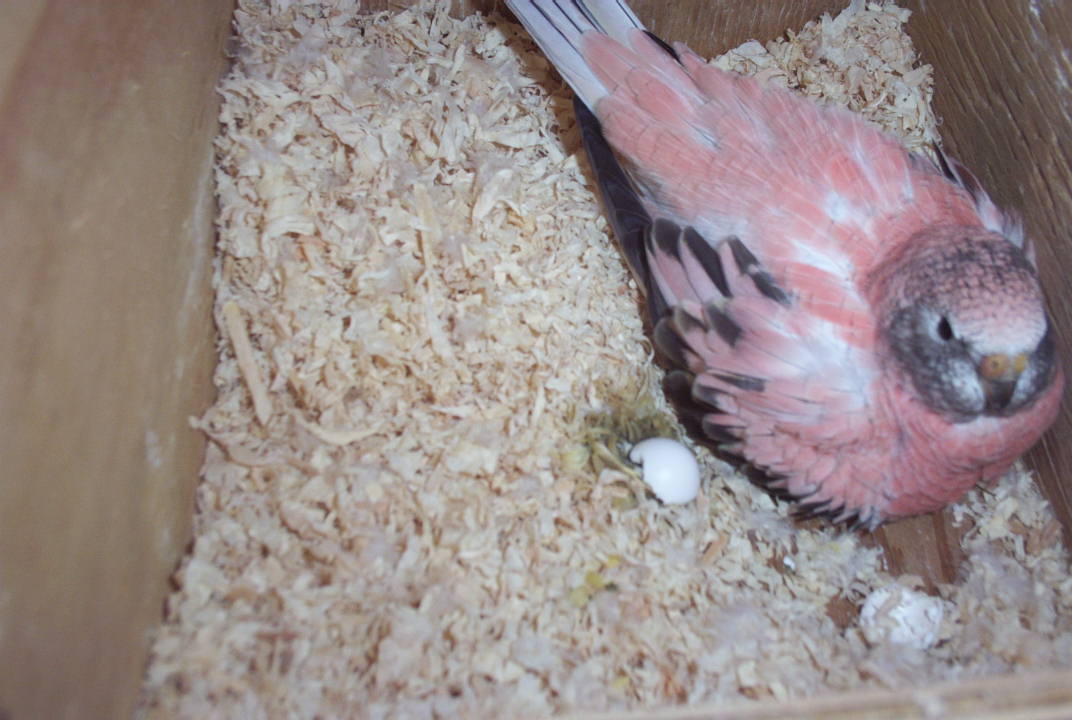
Rosy Bourke parakeet on eggs. This is our sweetest hen,
 called Rosie. Photo taken 9-17-2013.
We've always recommended no more than three clutches a year per pair of birds. And, only two clutches per year for birds that might be stressed in any other way, such as being older, the weather suddenly turning cold, predators nearby causing a panic that could happen again -- anything that might make raising a third clutch difficult for the mated pair.

In spite of that recommendation, one year a young Flame and Fuchsia raised a fourth clutch because I didn't get their nest box removed in a timely manner. Often, I will hand feed a third clutch just to take some of the stress off the parent birds, and in the case of Flame and Fuchsia that year, I did hand feed their last clutch. Hand feeding the last clutch also allows me to remove the nest box before a pair begin mating again and the hen can go back and start laying more eggs.

Bourkes often begin to mate again right away, and a hen may lay eggs for a new clutch before their last clutch of young ones are all eating on their own. This year, in Fuchsia's case, while the last baby of her third clutch was still in the nest box, she laid another clutch of four eggs.

I couldn't hand feed the third clutches of any of our pairs this time because I knew we'd be traveling to a larger city for my husband's surgery. The birds were left alone with plenty of water and extra food for three days and two nights. They did fine, but hand feeding their young was out of the question.

Our oldest hen, Cherry. Her last clutch didn't hatch, so her
nest box has remained clean for this one. It seems unlikely
 these eggs will hatch either as her mate, Rhett, is quite
elderly too. In 1st clutch this year, they raised two.
My hubby usually attaches and removes nest boxes for me. This year, he's unable to remove them, and the nest boxes are still up. That problem can be dealt with by blocking off the entry opening. But, busy me, did not do so.

I also try to clean boxes between clutches and add new pine shavings. Since my birds are all very tame, if needed I can remove eggs for a short time and return them to a clean box. The hens always accept this from me. I'm not recommending it for everyone, however. I simply know my TAME birds will allow this, and I think they appreciate a clean box. The eggs are never away for more than a few minutes and handled carefully.

This post is to let you know how adaptable Bourkes (and probably all birds) can be. The picture below illustrates how they can accept their circumstances. Fuchsia's third clutch of four left the box pretty dirty and I've not been able to remove and clean it. She is using her "dirty" box for a fourth clutch. Cleaning it now will be a challenge since the dried food around her eggs is so hard. I need to decide when to do it...possibly after the babies hatch and I take them out to hand feed. Meanwhile, the box has a slight odor, but the weather is cool and that helps...

I'd never recommend allowing Bourkes to have fourth clutches in the same year, however, sometimes things happen that are beyond our control. These eggs are already laid and I'm not going to throw them away.

Fuchsia's box after raising four babies and starting
another clutch before the nest box was cleaned.
Instead of pine shavings, bottom has dry droppings.
The Lady Gouldian finches have babies again. All their clutches from late last year sold, and when she started laying eggs on the floor, I decided to give them their nest box back. I hear tiny peeps coming from within, Duchess won't move to let me see what's under her, smile. This photo is of a clutch from last year. They are about a week old here.
 
Lady Gouldian finch babies at about one week of age.


Turquoise Lineolated Parakeet.
The pair of Linnies (new to me), are in the nest box. The hen wasn't coming out, so I finally peeked in. She looked like she was brooding and I assumed she had eggs. However, I finally saw her out of the box and rushed over to have a look. No eggs. Disappointed, but still hopeful.

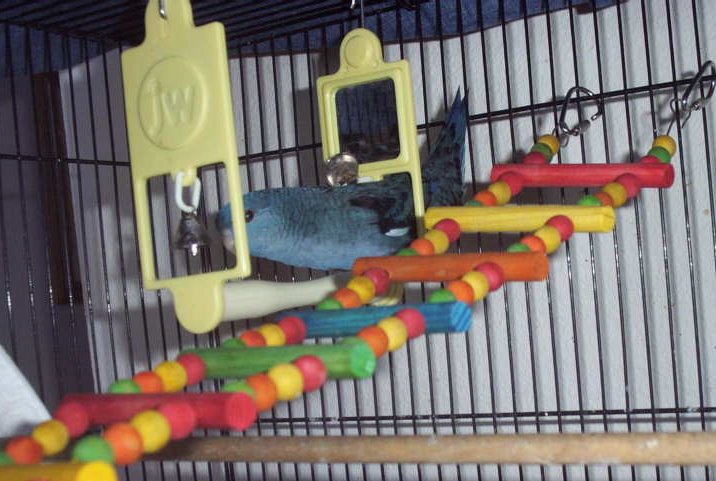
Cobalt blue Lineolated Parakeet. He loves his toys.


Light pink, white faced and red-eyed, opaline fallow Bourke.
This baby is from Rosie and Pretty Boy's third clutch this year.
She should be eating on her own soon. For now, Pretty Boy is
still feeding this daughter and his mate, Rosie, who is on eggs.
We have no breeding Splendids right now. It's all about the Bourke parakeets...my favorites.

Peace and Blessings,
Gail


Monday, September 16, 2013

Handfeeding Formula Substitute, A Question To Readers

Anyone have a solution to the question below? It was sent to rosie.birds@gmail.com.  BE SURE TO CLICK ON "COMMENTS" BELOW TO SEE ANSWERS... SMILE.
 
"Hi, I have a problem. I always keep some hand feeding formula around just in case one of my parents stops feeding a baby. Well I ran out and wouldn't you know I have a baby that is fully feathered but not eating and parents won't feed. I ordered the formula online because I live in the middle of nowhere and can't buy locally. Is there something I can feed the baby until the formula gets here? He's so thin I'm not sure he will make it."
 

As a child and teen, I was told that rescued baby birds could survive on egg yolk (from hard boiled chicken eggs), mixed with a little warm milk. However, none of my baby sparrows ever survived on it. But, maybe I didn't know to feed them enough and as often as necessary. I was only a child. - Gail

PEACE AND BLESSINGS.


Sunday, August 25, 2013

Finch Film and a Cobalt Blue Linnie

Ten-year-old granddaughter
with Mr. Blue, a cobalt blue
Linneolated parakeet.
It has been a busy summer, so I've blogged less often. Also, still trying to finish my novel, "Cast Me Not Away," for publication. The edits go slowly...

Another photo of her with Mr. Blue.

Our "Sheik" Skoshi, a Peke and Shih-Tzu mix at 5 months.
Skoshi has plenty of toys, but loves this cast-off slipper.

Our two oldest granddaughters spent a week with us last week. Enjoyed sharing the baby Bourkes with them.

Their visit went by too quickly.

Ages 15 and ten with Skoshi, on their way home.
He came back with us and misses their attention.

Below is a link to a Video of our finches via You Tube. All their youngsters from last year completed their molts and are beautiful. I had to separate this pair to prevent them from continuing to mate and lay eggs. During that time the hen molted, and the cock partially did so, but stopped. He has more color than he did last year, but still isn't fully colored out...notice the splotches on his face that still remain.
 
They were separated for eight months and I took pity on them and let them be together again even though he still hasn't finished a complete molt. Maybe in another year. Smile.


Peace and Blessings.


Monday, July 29, 2013

Bourke Parakeet Breeding Update, Including Visiting Horses

Below are the six Rosy Bourke babies produced in second clutches from Flame and Fuchsia and from Rosie and Pretty Boy. Elderly Rhett and Cherry hatched only one egg in their second clutch and that red-eyed baby only lived ten days.
 
Second clutch of 2013 Rosy Bourke parakeets.
These are parent fed, four from Flame and Fuchsia
and two from Rosie and Pretty Boy. Both sets of
 parents had a baby with red eyes this time.


Recently sold hand fed, tame Rosy Bourke parakeets.
Male on right is Songster. Female is Peaches.
Both went to new California homes last week.

Peaches on left is a hen. Songster on right is male.

 
Neighbor's horses escaped and paid us a visit yesterday. Took these photos of them grazing in front of our home. We have plenty of room for them to roam and they enjoyed running circles around the house.


They're very friendly and asked for treats, but I didn't give them any. Breaking out of their own fenced area is not to be encouraged. However, I enjoy having them visit once in a while...just don't enjoy the packages they leave.
 
 Blessings to you and all your pets,
and blessings to those that belong to your neighbors too!
 
Peace.


Thursday, July 25, 2013

Bourke Parakeets to New Homes

This lovely little lady is the excited new owner of a hand fed female Bourke. She's taking her home, and her mother shared this photo with us.

Bye Peaches. We know you will be loved.

Named "Peaches," this bird is the youngest from a clutch of three out of Rosie and Pretty Boy last November. Although it's unusual for us to do this, we clipped Peaches' wings to help her new owner keep track of her. A bird on a curtain rod is a problem for a child and Peaches is a strong flier.
 
 
Hopefully, by the time her flight feathers grow back Peaches will be bonded to her new owner and easier to retrieve. Her mother, Rosie, will come to me when I call her.


Bird at left is my red-eyed "Sweetheart." Bird on my hand is
Songster. He went to San Francisco on Sunday. Will miss him.

Another view of Peaches before leaving us. She is a
sweet little Rosy Bourke hen.

Saturday, July 13, 2013

Cobalt Blue Linnie, Hand Fed and Rowdy

Update on 12/11/2013 ... Have decided to keep "Blue." Our other pair is on babies, so hopefully we will get a mate for this bird and make it happy. Smile. Besides, he's growing on me. Very tame and fun.

------------------------------------------------------------

Beautiful hand fed cobalt blue Lineolated parakeet. He loves attention and loves his toys. He is the first Lineolated parakeet I've owned, although we've since added a mated turquoise pair. I hoped to get a youngster from them to mate with him, but am reconsidering raising Linnies as I have too many birds and want to continue specializing in Bourke and Splendid parakeets.

"Mr. Blue" was hatched in November, 2012.
Linnies come from South America. Although small, they act more like a large parrot than like the smaller parakeets. They pick things up with their feet, and do a lot of climbing, even upside down.

He loves to walk through the openings on this swing.

 
I call him a male, but he hasn't been DNA tested to verify sex. His breeder believes he's male, but another breeder commented on the lack of black at the tip of his tail, so possibly a hen. However, a third breeder says that's not a conclusive means of identifying sex. Have a DNA test kit, but haven't sent it in. Cost is just under $30 to DNA a bird using pulled (not shed) feathers.


His wings were clipped when we bought him.
First through one way.

Then back again. He loves the ladder too and it's funny to
watch him move quickly from one bar to the next.
 
Why sell such a gorgeous bird? Well... Blue wants attention and we've so many other birds that he isn't getting all that he desires. Hence, unlike most Linnies, he can get noisy. He was raised with Love Birds and Parrotlets that are louder than Bourke parakeets. Lineolated parakeets are great mimics and he sounds like a Love Bird or a Parrotlet. Since we added another pair of Linnies, he is beginning to mimic them, but I've decided to continue specializing in Bourkes and Splendids. And, I simply have too many birds right now.

Might consider letting the other Linnie pair go too. They are a 7-year-old proven pair. Wings are not clipped. Not hand fed, but calm birds. If interested, contact me at rosie.birds@gmail.com. Thanks.


Pair of turquoise Lineolated Parakeets.

Peace and Blessings.


Friday, July 12, 2013

Lady Gouldian Finches For Sale (Update, these are sold)

UPDATE: THESE ARE SOLD

If you are in Southern Oregon, have I got a deal for you. Five young Lady Gouldian finches have almost completed their molts. These three males are lovely singers. The two hens were hand fed and more tame than the others. All are related. Contact rosie.birds@gmail.com for prices and information.

 
Three young Lady Gouldian males. All hatched early this year.


Bird at far right isn't for sale. He's healthy, just unwilling to molt.

Bird on far right in photo above is their father who refuses to complete a molt. He and his hen have been separated for several months and she completed her molt and is lovely. Perhaps when his sons are gone, he will finally complete his own molt. He may need to be in a cage by himself for a while.
 
The young pair of Lady Gouldians I acquired over a year ago went to nest as soon as I got them, even though neither had completed their molts. They've raised some lovely offspring. By separating them, she finished her molt, but he hasn't. Yet, birds from their last two clutches are now brightly colored and gorgeous.
 
If you want to see beautiful birds, I recommend waiting to put young male and female Lady Gouldians together until they've completed their first molt. Obviously, it hasn't hurt mine to breed early, but it is nice to see their eventual wonderful colors.
 
Once this guy has completed a molt, I'll return him to his hen and a joy-filled life again.

Peace and Blessings.


Monday, June 24, 2013

Rosy Bourke's Second Clutches From Three Hens

Hello All and Welcome,

The second clutches of the season are doing well. Flame and Fuchsia have four offspring, one with red eyes.

Flame & Fuchsia's 2nd clutch of four.
They raised three in their first clutch this year.


Rosie and Pretty Boy hatched two of four eggs. One offspring has red eyes.

Our tame Rosie with her two babies.
She raised three in her first clutch this year.


Rhett and Cherry have one new baby and three eggs yet to hatch (hopefully).

This is Cherry, our oldest hen and not tame.
She is covering one new baby and three eggs.
She and Rhett raised two babies in their 1st clutch this year.

Peace and Blessings.
May all your eggs hatch and all your baby birds grow strong, healthy and beautiful!

The newest member of our household, Skoshi-san.
He's a "Sheik" -- Peke and Shih-Tzu.

Wednesday, June 19, 2013

Number of Views To Date

Looked at the number of views to date -- 167,388 -- and decided to check out where they've come from.

The Splendid Bourke Bird Blog has received views from all 50 states in the USA, including Washington DC, and from 169 countries worldwide. Wow.

Go Bird Lovers!

God Bless All Babies.
Be PRO-LIFE.

Peace and Blessings.


Tuesday, June 18, 2013

LUTINO BOURKE PARAKEETS


These two baby Lutino Bourkes were raised by my friend, Deena, at Feathered Friends in Roseburg, Oregon. Although she plans to keep these two for further breeding, I hope to get a hen from this same pair's next clutch. That Lutino hen will be presented as a mate to the red-eyed, dark pink Rosy Bourke male I call Sweetheart. There is a bit of yellow on him too and their youngsters should be fantastic.


One of the babies above just prior to leaving the nest box.

Aren't they gorgeous? Below is a link to the Feathered Friends website:


Two previous post Links on Lutino Bourkes, with photos and videos, are provided below. Jill Warnick in Maine is the breeder of these lovely birds.
 
 
 Peace and Blessings.
May all your eggs hatch and all your
young birds grow healthy and strong.


Monday, June 17, 2013

Lineolated Parakeets, Now There Are Three

 
The photos below are of our first Lineolated Parakeet. We call him Mr. Blue. 


Mr. Blue is a cobalt blue Linnie that was hand fed. His wings were clipped before we got him, but they will grow back. Unfortunately, he lived around Lovebirds and can be loud like they are. We're working on that! Linnie's are supposed to be quiet, sweet birds. Lineolated parakeets are wonderful mimics and he copied what he heard.
 

The black stripes and spots on a Linnie's back, tail and wings are what led to their being named Lineolated, which means marked with fine lines.
 
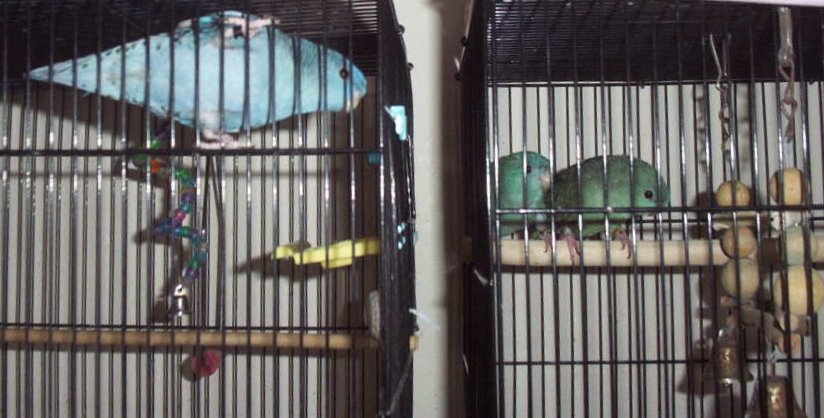
Our beautiful cobalt blue, hand fed Lineolated Parakeet, Mr. Blue, has new friends and now he's less noisy.They are quiet and hopefully he will copy them...not the other way around! This mated pair appear more green in the photo below than they actually are. They are a turquoise pair, one slightly bluer than the other. Acquired only last Saturday, the pair crowd as close to Mr. Blue as they can get. Their cages are side by side.
 

It's my hope to get a mate for Mr. Blue from this pair. I won't put up a nest box for them right away. Want them to become accustomed to us and their new home. So, a mate will probably be a year or so younger than our cobalt blue Linnie as he was hatched last November. Based on past results, I hope to get a lutino Linnie for Mr. Blue to pair up with.
 
Mr. Blue on Sweetheart's cage, my red-eyed bachelor
Rosy Bourke who is also waiting for a Lutino hen...
a Lutino Bourke, however.

 
Lineolated parakeets are so different from Bourkes. Guess that's not surprising since they come from South America and not Australia. They act very much like a miniature parrot and not much like a parakeet. They hang upside down, can hold food up to eat it from their feet, walk one foot over the other, and are simply shaped differently...longer bodies, shorter tails and more hunched forward. All in all I expect to really enjoy these Linnies. Mr. Blue is quite a clown and fun to watch play with toys and get down on the floor and walk to me. When his wing feathers grow back, I hope he will fly to me like my tame Bourkes do.

Peace and Blessings.


Monday, June 10, 2013

More Bird Questions With Answers

QUESTION: Baby Bourke’s splayed legs and preventing more clutches
I have a questions regarding a new baby bourke. They are about 2 weeks old, there are 4 beautiful babies and their parents are taking good care of them. However, one of the babies legs are splayed, he is struggling at all times to try and stand, the parents are feeding him regularly but he seems to be struggling. I’m so worried about him and I don’t know what to do.
This is one of our babies. There is a link to our earlier post
about this bird at the bottom of this Answer.

Since my Maggie refuses to be in a nest box these babies were at the bottom of the cage, I put them in a small box at about a week old.

Do you have any suggestions for this poor little guy? I can send a picture if you think it would help.

Also, this is Maggies 3rd clutch and we do not want any more babies, Maggie and Indie have been together in the bird store that we bought them from and here for 2 years. Would it be harmful to them to separate them.

Thank you in advance, Terry

 ANSWER
Instead of separating them, why not try restricting the light they get. Long daylight stimulates breeding, so covering their cage early in the evening to make it dark inside might keep them from breeding. Only allow about 8 hours of daylight and 16 of darkness as if it's a long winter's night. If that doesn't work, you could still separate them, but that's sad for them. Another option would be to remove the eggs and/or replace them with "false" plastic eggs via the internet. People have done this with canaries for ages.

 
Newly Hatched Baby Rosy Bourke at Windy Ridge Rosies.

As for the splayed legs, I have two posts on that topic at The Splendid Bourke Bird Blog. I wasn't very successful with a bird with ONE splayed leg. When it's two and they can be put together, it seems to work better. A reader with a Splendid with splayed legs was successful in correcting them. The earlier you start binding them together with a space in between the better. I can't tell you how long to leave them tethered. I didn't do it long enough and the bird still has a leg in the air, but gets along fine flying and landing on one leg. I think the other person's Splendid recuperated and has legs in a normal position, but she did bind them even before he had feathered. She was hand feeding that bird. Good luck.

Links to Earlier Posts on this Defect:  Splayed Leg Defect in a Bourke and A Young Splendid with Splayed Legs

 
**********
 
QUESTION: Lineolated Parakeets with Bourke Parakeets
I saw on your Blog that you now have a Linnie.  Do you think they are safe to interact with Bourkes, when outside of the cage?  (i.e. can they be flying around together safely?).  Also, did you let your Linnie become free-flying again and is he “manageable” like that? (will he go back in his cage easily, etc?).
I enjoy my 2 free flying Bourkes and 1 Scarlet Chested.  I can pretty much get them to go back in their cages without problems as long as I give them a reasonable amount of free-flight time.  So I was wondering if a Linnie would be cooperative like that?
ANSWER
Cobalt Blue Lineolated Parakeet with a Rosy Bourke.
Mr. Blue and Sweetheart getting acquainted. So far, so good.
Notice the Bourke is the "protected" one, although I
doubt they'd have a problem with each other.
Hello Ron, The Linnie I recently purchased had clipped flight feathers when I got him. I will let them grow back. I've only had him a few weeks and he was terrified a first. We put him in a lower cage so the Bourkes would not land on the top and risk getting their toes nipped...he could bite off a toe if he chose to.
 
However, I think he likes the Bourkes. They are parakeets too, yet he's bigger and stronger than they are.
 
Believe it or not, after weeks of talking sweetly to him, he finally got on my finger. I left his door open while the Bourkes were out flying and he came out of his cage and eventually ended up on the floor. Remember, he can't fly yet. I put my hand down and called to him and he walked over and got on it. (He was hand fed).
 
While he was on one hand, I put a Bourke on the other. There was no fear or aggression on the part of either bird.
The silver tape is covering a hole made for a nest box
entrance. Nest boxes are only put up during breeding
season and removed the rest of the year.
 
I believe that once his wing feathers grow back, that he will get along fine flying with the Bourkes. The one question I still need to answer is how he will act if/when he has a mate. Will he be protective? My male Bourkes tend to chase other males away when they have a mate on eggs or with babies. The hens likewise chase other hens away from their cage when they are about to brood (when setting, they stay in the nest box).
 
So, are Lineolateds aggressive when nesting? I've yet to find out, but hope to. Meanwhile, this fellow, who was hatched last November and hand fed, seems to get along fine with my Bourkes. I've considered letting him share a cage with one of my bachelor Bourkes, but not ready to risk that yet...although I think they'd be fine, and he seems to want company.
 
As an aside, this Linnie is much louder than I expected. Bourkes are so sweet and quiet and this guy can get loud in spite of everything I've read that says they are a quiet bird. Quiet next to a Conure or bigger parrot maybe. Possibly not as loud as a Lovebird, but still he can shriek, unlike my quiet Bourkes. I'm hopeful that getting him a mate will make him happy and he will quiet down. Thankfully, his being loud isn't constant, only occasional.
 
**********

QUESTION: Frightened Young Boukes
 
On April 28th I bought my first pair of rosie's. I forgot to ask the breeder their hatch date. If they are just old enough for sale how old would you guess them to be? He says he didn't handle them much so they are very scared of me. I am hoping with time they will adjust to me. Also, would you assume they are siblings? There were about six of them in the cage together. Would that be an issue if they decide to breed, which is not my intention. I feel very sure I have a male and a female. I love your blog and found so much useful info. Thank You for all the work you do on it! 
 
ANSWER
Opaline fallow Rosy Bourkes at Windy Ridge Rosies.
Hi Christy, If possible I'd call the breeder back and ask about the hatch date just because it's nice to know. And ask whether the birds were all siblings as they might be.  If they were banded, that would tell you something…consecutive numbers for instance.
 
When I bought my first pair they were 9 months old. Too old to tame, but they became very used to me and unafraid. Rhett and Scarlett never sat on my finger, but both would come up to the cage bars when I talked to them, and he still does. Our sweet Scarlett is long gone and Rhett’s newer mate, Cherry, is less tame, but I can clean their cage without any problem...they don't panic. They're both over ten years old now, and still reproducing.
 
Except for those two older birds, over time I've sold many pairs and gone to just hand fed birds because I like having them tame. But my early pairs weren't hand fed. In spite of that, all became very accustomed to the activity in the house and didn't panic. Young birds, however, are easily frightened. So, if yours are young, it's not surprising that they panic when you first approach their cage. Talk sweetly to them as often as you can, and they will mellow out in time and be less flighty.
 
Without knowing their age, it's difficult to know if you can hand tame them or not. With two, possibly not. If very young, and handled a lot, they can be hand tamed and Rosie's mate, Pretty Boy is hand tamed. Because of his dark color I wanted to keep him, so I worked with him.
 
It takes a lot of constant attention and I'd not have the time and patience any longer (that's why I like hand fed birds). However, as cage birds they can adapt to their environment, accept it, and be very happy interacting with you through their cage. They will sing, bathe and be a wealth of entertainment and joy. Just give them time to get used to you and to mature. They don't have to be finger tame to be fun.
 
As for whether they are siblings, the breeder hopefully knows. I can't tell all my new baby birds apart, so I band them with colored bands to identify which pair of parents they came from. I doubt that one bird had six babies...highly unusual for a Bourke.
 
To avoid breeding, don't leave them in a brightly lit room late into the evening. Light stimulates a desire to breed. It’s day length for birds in outdoor aviaries, or for wild birds, and  indoor artificial light has the same effect on indoor birds.
 
**********
  
QUESTION: Bourke Diet
Hi my name is Luis and I just bought my first pair of Bourke parakeets. Can you tell me more about them. What you feed yours. what type of fruit you feed yours I read an article and it said no fruit because it not good for them. Is that true?  Honestly I never knew they existed until I found an article of splendid parakeet. I plan on getting a pair of those eventually but I liked the pink. If you could help me out thanks.
ANSWER: 
Nestling food and spray millet for a young Rosy Bourke
bird learning to eat. Notice short tail which will lengthen.
I've never read that fruit in general is harmful and have offered apples and oranges to mine, but they ignored them. Avocados are a fruit that is poisonous to them. Avoid avocado!

In addition to parakeet seed and spray millet, they love many vegetables: kale, peas, green beans, corn, lettuce, shredded carrots. They will also chew on breads. Egg food can be made with boiled chicken eggs, blend shell and all, and add some dry bread crumbs, everything blended together. Always have calcium available, usually with cuddle bone, mineral block, oyster shell grit, and as I've mentioned in past posts on my blog, rabbit salt blocks contain iodine which the birds will chew too. It's good for them.
I recently read that spinach isn't good for birds. Don't remember why, but I no longer give mine spinach.

Below is a link to one of my posts about what they can eat. You can also use the search feature and type in "nutrition." Bourkes are wonderful birds.
 
**********

Have many more questions I could post and will try to in the future, but it takes time to format them, and I've a novel to finish editing.


Splendid Parakeets, Joy and Finnegan.
Photo contributed by Karen and Kenneth Shelton.

Peace and Blessings.