Monday, July 29, 2013

Bourke Parakeet Breeding Update, Including Visiting Horses

Below are the six Rosy Bourke babies produced in second clutches from Flame and Fuchsia and from Rosie and Pretty Boy. Elderly Rhett and Cherry hatched only one egg in their second clutch and that red-eyed baby only lived ten days.
 
Second clutch of 2013 Rosy Bourke parakeets.
These are parent fed, four from Flame and Fuchsia
and two from Rosie and Pretty Boy. Both sets of
 parents had a baby with red eyes this time.


Recently sold hand fed, tame Rosy Bourke parakeets.
Male on right is Songster. Female is Peaches.
Both went to new California homes last week.

Peaches on left is a hen. Songster on right is male.

 
Neighbor's horses escaped and paid us a visit yesterday. Took these photos of them grazing in front of our home. We have plenty of room for them to roam and they enjoyed running circles around the house.


They're very friendly and asked for treats, but I didn't give them any. Breaking out of their own fenced area is not to be encouraged. However, I enjoy having them visit once in a while...just don't enjoy the packages they leave.
 
 Blessings to you and all your pets,
and blessings to those that belong to your neighbors too!
 
Peace.


Thursday, July 25, 2013

Bourke Parakeets to New Homes

This lovely little lady is the excited new owner of a hand fed female Bourke. She's taking her home, and her mother shared this photo with us.

Bye Peaches. We know you will be loved.

Named "Peaches," this bird is the youngest from a clutch of three out of Rosie and Pretty Boy last November. Although it's unusual for us to do this, we clipped Peaches' wings to help her new owner keep track of her. A bird on a curtain rod is a problem for a child and Peaches is a strong flier.
 
 
Hopefully, by the time her flight feathers grow back Peaches will be bonded to her new owner and easier to retrieve. Her mother, Rosie, will come to me when I call her.


Bird at left is my red-eyed "Sweetheart." Bird on my hand is
Songster. He went to San Francisco on Sunday. Will miss him.

Another view of Peaches before leaving us. She is a
sweet little Rosy Bourke hen.

Saturday, July 13, 2013

Cobalt Blue Linnie, Hand Fed and Rowdy

Update on 12/11/2013 ... Have decided to keep "Blue." Our other pair is on babies, so hopefully we will get a mate for this bird and make it happy. Smile. Besides, he's growing on me. Very tame and fun.

------------------------------------------------------------

Beautiful hand fed cobalt blue Lineolated parakeet. He loves attention and loves his toys. He is the first Lineolated parakeet I've owned, although we've since added a mated turquoise pair. I hoped to get a youngster from them to mate with him, but am reconsidering raising Linnies as I have too many birds and want to continue specializing in Bourke and Splendid parakeets.

"Mr. Blue" was hatched in November, 2012.
Linnies come from South America. Although small, they act more like a large parrot than like the smaller parakeets. They pick things up with their feet, and do a lot of climbing, even upside down.

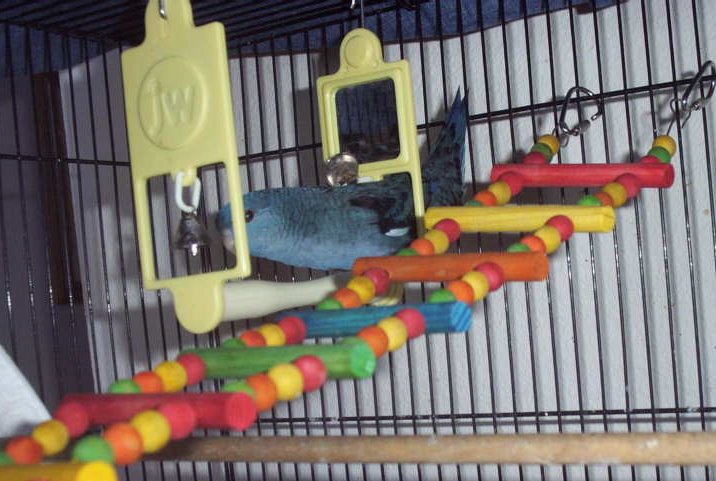
He loves to walk through the openings on this swing.

 
I call him a male, but he hasn't been DNA tested to verify sex. His breeder believes he's male, but another breeder commented on the lack of black at the tip of his tail, so possibly a hen. However, a third breeder says that's not a conclusive means of identifying sex. Have a DNA test kit, but haven't sent it in. Cost is just under $30 to DNA a bird using pulled (not shed) feathers.


His wings were clipped when we bought him.
First through one way.

Then back again. He loves the ladder too and it's funny to
watch him move quickly from one bar to the next.
 
Why sell such a gorgeous bird? Well... Blue wants attention and we've so many other birds that he isn't getting all that he desires. Hence, unlike most Linnies, he can get noisy. He was raised with Love Birds and Parrotlets that are louder than Bourke parakeets. Lineolated parakeets are great mimics and he sounds like a Love Bird or a Parrotlet. Since we added another pair of Linnies, he is beginning to mimic them, but I've decided to continue specializing in Bourkes and Splendids. And, I simply have too many birds right now.

Might consider letting the other Linnie pair go too. They are a 7-year-old proven pair. Wings are not clipped. Not hand fed, but calm birds. If interested, contact me at rosie.birds@gmail.com. Thanks.


Pair of turquoise Lineolated Parakeets.

Peace and Blessings.


Friday, July 12, 2013

Lady Gouldian Finches For Sale (Update, these are sold)

UPDATE: THESE ARE SOLD

If you are in Southern Oregon, have I got a deal for you. Five young Lady Gouldian finches have almost completed their molts. These three males are lovely singers. The two hens were hand fed and more tame than the others. All are related. Contact rosie.birds@gmail.com for prices and information.

 
Three young Lady Gouldian males. All hatched early this year.


Bird at far right isn't for sale. He's healthy, just unwilling to molt.

Bird on far right in photo above is their father who refuses to complete a molt. He and his hen have been separated for several months and she completed her molt and is lovely. Perhaps when his sons are gone, he will finally complete his own molt. He may need to be in a cage by himself for a while.
 
The young pair of Lady Gouldians I acquired over a year ago went to nest as soon as I got them, even though neither had completed their molts. They've raised some lovely offspring. By separating them, she finished her molt, but he hasn't. Yet, birds from their last two clutches are now brightly colored and gorgeous.
 
If you want to see beautiful birds, I recommend waiting to put young male and female Lady Gouldians together until they've completed their first molt. Obviously, it hasn't hurt mine to breed early, but it is nice to see their eventual wonderful colors.
 
Once this guy has completed a molt, I'll return him to his hen and a joy-filled life again.

Peace and Blessings.


Monday, June 24, 2013

Rosy Bourke's Second Clutches From Three Hens

Hello All and Welcome,

The second clutches of the season are doing well. Flame and Fuchsia have four offspring, one with red eyes.

Flame & Fuchsia's 2nd clutch of four.
They raised three in their first clutch this year.


Rosie and Pretty Boy hatched two of four eggs. One offspring has red eyes.

Our tame Rosie with her two babies.
She raised three in her first clutch this year.


Rhett and Cherry have one new baby and three eggs yet to hatch (hopefully).

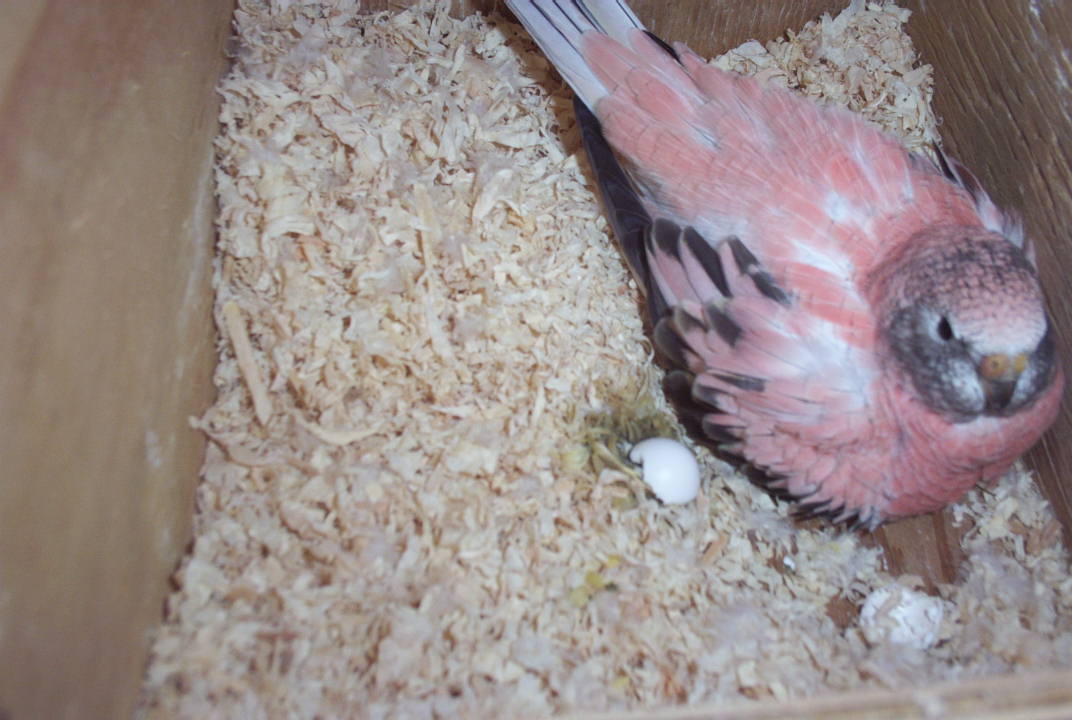
This is Cherry, our oldest hen and not tame.
She is covering one new baby and three eggs.
She and Rhett raised two babies in their 1st clutch this year.

Peace and Blessings.
May all your eggs hatch and all your baby birds grow strong, healthy and beautiful!

The newest member of our household, Skoshi-san.
He's a "Sheik" -- Peke and Shih-Tzu.

Wednesday, June 19, 2013

Number of Views To Date

Looked at the number of views to date -- 167,388 -- and decided to check out where they've come from.

The Splendid Bourke Bird Blog has received views from all 50 states in the USA, including Washington DC, and from 169 countries worldwide. Wow.

Go Bird Lovers!

God Bless All Babies.
Be PRO-LIFE.

Peace and Blessings.


Tuesday, June 18, 2013

LUTINO BOURKE PARAKEETS


These two baby Lutino Bourkes were raised by my friend, Deena, at Feathered Friends in Roseburg, Oregon. Although she plans to keep these two for further breeding, I hope to get a hen from this same pair's next clutch. That Lutino hen will be presented as a mate to the red-eyed, dark pink Rosy Bourke male I call Sweetheart. There is a bit of yellow on him too and their youngsters should be fantastic.


One of the babies above just prior to leaving the nest box.

Aren't they gorgeous? Below is a link to the Feathered Friends website:


Two previous post Links on Lutino Bourkes, with photos and videos, are provided below. Jill Warnick in Maine is the breeder of these lovely birds.
 
 
 Peace and Blessings.
May all your eggs hatch and all your
young birds grow healthy and strong.


Monday, June 17, 2013

Lineolated Parakeets, Now There Are Three

 
The photos below are of our first Lineolated Parakeet. We call him Mr. Blue. 


Mr. Blue is a cobalt blue Linnie that was hand fed. His wings were clipped before we got him, but they will grow back. Unfortunately, he lived around Lovebirds and can be loud like they are. We're working on that! Linnie's are supposed to be quiet, sweet birds. Lineolated parakeets are wonderful mimics and he copied what he heard.
 

The black stripes and spots on a Linnie's back, tail and wings are what led to their being named Lineolated, which means marked with fine lines.
 
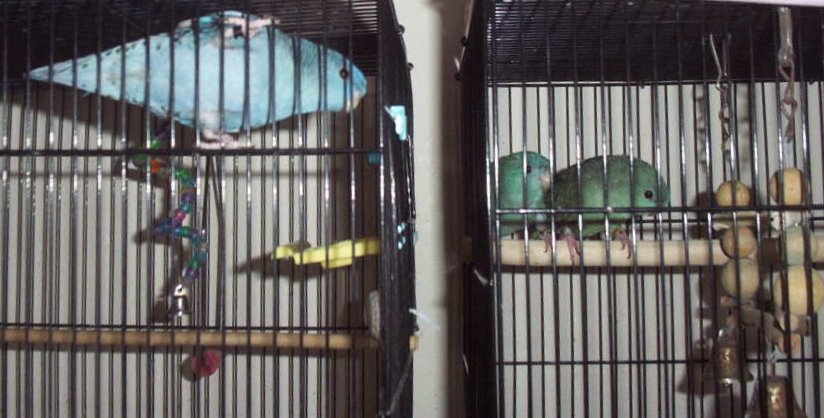
Our beautiful cobalt blue, hand fed Lineolated Parakeet, Mr. Blue, has new friends and now he's less noisy.They are quiet and hopefully he will copy them...not the other way around! This mated pair appear more green in the photo below than they actually are. They are a turquoise pair, one slightly bluer than the other. Acquired only last Saturday, the pair crowd as close to Mr. Blue as they can get. Their cages are side by side.
 

It's my hope to get a mate for Mr. Blue from this pair. I won't put up a nest box for them right away. Want them to become accustomed to us and their new home. So, a mate will probably be a year or so younger than our cobalt blue Linnie as he was hatched last November. Based on past results, I hope to get a lutino Linnie for Mr. Blue to pair up with.
 
Mr. Blue on Sweetheart's cage, my red-eyed bachelor
Rosy Bourke who is also waiting for a Lutino hen...
a Lutino Bourke, however.

 
Lineolated parakeets are so different from Bourkes. Guess that's not surprising since they come from South America and not Australia. They act very much like a miniature parrot and not much like a parakeet. They hang upside down, can hold food up to eat it from their feet, walk one foot over the other, and are simply shaped differently...longer bodies, shorter tails and more hunched forward. All in all I expect to really enjoy these Linnies. Mr. Blue is quite a clown and fun to watch play with toys and get down on the floor and walk to me. When his wing feathers grow back, I hope he will fly to me like my tame Bourkes do.

Peace and Blessings.


Monday, June 10, 2013

More Bird Questions With Answers

QUESTION: Baby Bourke’s splayed legs and preventing more clutches
I have a questions regarding a new baby bourke. They are about 2 weeks old, there are 4 beautiful babies and their parents are taking good care of them. However, one of the babies legs are splayed, he is struggling at all times to try and stand, the parents are feeding him regularly but he seems to be struggling. I’m so worried about him and I don’t know what to do.
This is one of our babies. There is a link to our earlier post
about this bird at the bottom of this Answer.

Since my Maggie refuses to be in a nest box these babies were at the bottom of the cage, I put them in a small box at about a week old.

Do you have any suggestions for this poor little guy? I can send a picture if you think it would help.

Also, this is Maggies 3rd clutch and we do not want any more babies, Maggie and Indie have been together in the bird store that we bought them from and here for 2 years. Would it be harmful to them to separate them.

Thank you in advance, Terry

 ANSWER
Instead of separating them, why not try restricting the light they get. Long daylight stimulates breeding, so covering their cage early in the evening to make it dark inside might keep them from breeding. Only allow about 8 hours of daylight and 16 of darkness as if it's a long winter's night. If that doesn't work, you could still separate them, but that's sad for them. Another option would be to remove the eggs and/or replace them with "false" plastic eggs via the internet. People have done this with canaries for ages.

 
Newly Hatched Baby Rosy Bourke at Windy Ridge Rosies.

As for the splayed legs, I have two posts on that topic at The Splendid Bourke Bird Blog. I wasn't very successful with a bird with ONE splayed leg. When it's two and they can be put together, it seems to work better. A reader with a Splendid with splayed legs was successful in correcting them. The earlier you start binding them together with a space in between the better. I can't tell you how long to leave them tethered. I didn't do it long enough and the bird still has a leg in the air, but gets along fine flying and landing on one leg. I think the other person's Splendid recuperated and has legs in a normal position, but she did bind them even before he had feathered. She was hand feeding that bird. Good luck.

Links to Earlier Posts on this Defect:  Splayed Leg Defect in a Bourke and A Young Splendid with Splayed Legs

 
**********
 
QUESTION: Lineolated Parakeets with Bourke Parakeets
I saw on your Blog that you now have a Linnie.  Do you think they are safe to interact with Bourkes, when outside of the cage?  (i.e. can they be flying around together safely?).  Also, did you let your Linnie become free-flying again and is he “manageable” like that? (will he go back in his cage easily, etc?).
I enjoy my 2 free flying Bourkes and 1 Scarlet Chested.  I can pretty much get them to go back in their cages without problems as long as I give them a reasonable amount of free-flight time.  So I was wondering if a Linnie would be cooperative like that?
ANSWER
Cobalt Blue Lineolated Parakeet with a Rosy Bourke.
Mr. Blue and Sweetheart getting acquainted. So far, so good.
Notice the Bourke is the "protected" one, although I
doubt they'd have a problem with each other.
Hello Ron, The Linnie I recently purchased had clipped flight feathers when I got him. I will let them grow back. I've only had him a few weeks and he was terrified a first. We put him in a lower cage so the Bourkes would not land on the top and risk getting their toes nipped...he could bite off a toe if he chose to.
 
However, I think he likes the Bourkes. They are parakeets too, yet he's bigger and stronger than they are.
 
Believe it or not, after weeks of talking sweetly to him, he finally got on my finger. I left his door open while the Bourkes were out flying and he came out of his cage and eventually ended up on the floor. Remember, he can't fly yet. I put my hand down and called to him and he walked over and got on it. (He was hand fed).
 
While he was on one hand, I put a Bourke on the other. There was no fear or aggression on the part of either bird.
The silver tape is covering a hole made for a nest box
entrance. Nest boxes are only put up during breeding
season and removed the rest of the year.
 
I believe that once his wing feathers grow back, that he will get along fine flying with the Bourkes. The one question I still need to answer is how he will act if/when he has a mate. Will he be protective? My male Bourkes tend to chase other males away when they have a mate on eggs or with babies. The hens likewise chase other hens away from their cage when they are about to brood (when setting, they stay in the nest box).
 
So, are Lineolateds aggressive when nesting? I've yet to find out, but hope to. Meanwhile, this fellow, who was hatched last November and hand fed, seems to get along fine with my Bourkes. I've considered letting him share a cage with one of my bachelor Bourkes, but not ready to risk that yet...although I think they'd be fine, and he seems to want company.
 
As an aside, this Linnie is much louder than I expected. Bourkes are so sweet and quiet and this guy can get loud in spite of everything I've read that says they are a quiet bird. Quiet next to a Conure or bigger parrot maybe. Possibly not as loud as a Lovebird, but still he can shriek, unlike my quiet Bourkes. I'm hopeful that getting him a mate will make him happy and he will quiet down. Thankfully, his being loud isn't constant, only occasional.
 
**********

QUESTION: Frightened Young Boukes
 
On April 28th I bought my first pair of rosie's. I forgot to ask the breeder their hatch date. If they are just old enough for sale how old would you guess them to be? He says he didn't handle them much so they are very scared of me. I am hoping with time they will adjust to me. Also, would you assume they are siblings? There were about six of them in the cage together. Would that be an issue if they decide to breed, which is not my intention. I feel very sure I have a male and a female. I love your blog and found so much useful info. Thank You for all the work you do on it! 
 
ANSWER
Opaline fallow Rosy Bourkes at Windy Ridge Rosies.
Hi Christy, If possible I'd call the breeder back and ask about the hatch date just because it's nice to know. And ask whether the birds were all siblings as they might be.  If they were banded, that would tell you something…consecutive numbers for instance.
 
When I bought my first pair they were 9 months old. Too old to tame, but they became very used to me and unafraid. Rhett and Scarlett never sat on my finger, but both would come up to the cage bars when I talked to them, and he still does. Our sweet Scarlett is long gone and Rhett’s newer mate, Cherry, is less tame, but I can clean their cage without any problem...they don't panic. They're both over ten years old now, and still reproducing.
 
Except for those two older birds, over time I've sold many pairs and gone to just hand fed birds because I like having them tame. But my early pairs weren't hand fed. In spite of that, all became very accustomed to the activity in the house and didn't panic. Young birds, however, are easily frightened. So, if yours are young, it's not surprising that they panic when you first approach their cage. Talk sweetly to them as often as you can, and they will mellow out in time and be less flighty.
 
Without knowing their age, it's difficult to know if you can hand tame them or not. With two, possibly not. If very young, and handled a lot, they can be hand tamed and Rosie's mate, Pretty Boy is hand tamed. Because of his dark color I wanted to keep him, so I worked with him.
 
It takes a lot of constant attention and I'd not have the time and patience any longer (that's why I like hand fed birds). However, as cage birds they can adapt to their environment, accept it, and be very happy interacting with you through their cage. They will sing, bathe and be a wealth of entertainment and joy. Just give them time to get used to you and to mature. They don't have to be finger tame to be fun.
 
As for whether they are siblings, the breeder hopefully knows. I can't tell all my new baby birds apart, so I band them with colored bands to identify which pair of parents they came from. I doubt that one bird had six babies...highly unusual for a Bourke.
 
To avoid breeding, don't leave them in a brightly lit room late into the evening. Light stimulates a desire to breed. It’s day length for birds in outdoor aviaries, or for wild birds, and  indoor artificial light has the same effect on indoor birds.
 
**********
  
QUESTION: Bourke Diet
Hi my name is Luis and I just bought my first pair of Bourke parakeets. Can you tell me more about them. What you feed yours. what type of fruit you feed yours I read an article and it said no fruit because it not good for them. Is that true?  Honestly I never knew they existed until I found an article of splendid parakeet. I plan on getting a pair of those eventually but I liked the pink. If you could help me out thanks.
ANSWER: 
Nestling food and spray millet for a young Rosy Bourke
bird learning to eat. Notice short tail which will lengthen.
I've never read that fruit in general is harmful and have offered apples and oranges to mine, but they ignored them. Avocados are a fruit that is poisonous to them. Avoid avocado!

In addition to parakeet seed and spray millet, they love many vegetables: kale, peas, green beans, corn, lettuce, shredded carrots. They will also chew on breads. Egg food can be made with boiled chicken eggs, blend shell and all, and add some dry bread crumbs, everything blended together. Always have calcium available, usually with cuddle bone, mineral block, oyster shell grit, and as I've mentioned in past posts on my blog, rabbit salt blocks contain iodine which the birds will chew too. It's good for them.
I recently read that spinach isn't good for birds. Don't remember why, but I no longer give mine spinach.

Below is a link to one of my posts about what they can eat. You can also use the search feature and type in "nutrition." Bourkes are wonderful birds.
 
**********

Have many more questions I could post and will try to in the future, but it takes time to format them, and I've a novel to finish editing.


Splendid Parakeets, Joy and Finnegan.
Photo contributed by Karen and Kenneth Shelton.

Peace and Blessings.


Friday, May 31, 2013

2013 Bird Questions and Answers


QUESTION: Aggressive Baby Bourke in Nest

Hi Gail, I have one baby bourke's that is a little over two weeks old (only one egg hatched from six)! The parents are doing a good job feeding him. The past few days my husband and I have been patting him and picking him up so that he can be used to our hands and also when I clean the nest box. But just yesterday he began to lunge and bite at our hand. Do you know why he is doing this? Did we do something wrong by picking him up out of the nest? Thank you!
ANSWER

Hi Melissa,

He does this because he's afraid. His instinct is to attack something he feels threatened by.

 I've found that Bourkes are more aggressive in the nest than budgies. If you have Exact and want to take him out to hand feed, it's probably not too late. Once he depends on you for food, he will begin to trust you.

However, if you leave him for his parents to feed and continue to handle and talk sweetly to him, perhaps over time he will quit being afraid. But, there are no guarantees. It depends on his personality and how often you handle him, etc. There are lots of factors involved.

I'm not surprised if he hisses and tries to lunge at you. It’s a baby Bourke’s normal reaction to fear while in the nest box. Look at it from his perception. He's snuggled down feeling comfortable and safe and something really huge suddenly lets in lots of bright light and then reaches for him. Whoa...what the heck? I was safe and happy, now what?

I have one male Bourke who was hand tamed (not hand fed), but his hen was hand fed and she helped convince him I'm not a threat. He will get on my finger when I want to put him back in his cage, but he doesn't fly to my shoulder like the hand fed birds will.

Good luck with him. Being a lone nestling is going to make him more easily frightened too. There's safety in numbers. Smile.

By the way, I usually only clean the nest boxes between clutches. It's not necessary to do it more often than that--especially with only one baby. The only time I've ever cleaned a nest box while it still held babies was on a hot summer day when a box with five older babies began to emit an odor. If it's not hot, and the birds are few, the pine shavings usually absorb and control odor. Disturbing a mother can be risky to her offspring if she's not tame.
 
**********
QUESTION: Time of Year to Breed Bourkes

I recently purchased some pairs of rosie bourkes. I have normals, rosies, pinks, rubinos, and lutinos. I am wanting to know what and when their breeding seasons are. I also raise English budgerigars and I usually breed them starting in November through May or June depending on the weather … Thanks in advance.

ANSWER
Hello Doug,

 You haven't said where you are. In Australia I've read that wild Bourkes begin breeding in November. In the wild nearly all birds begin their breeding activity in the spring, during warmer weather, and carry into summer. Depending whether you are in the northern or southern hemisphere, which month they begin is going to be different.

In the USA, many are raised indoors. Like all birds, their breeding is triggered by length of daylight. We can moderate this by using artificial light ... whether on purpose or by accident.

Bourkes indoors, where artificial lighting may stay on until late, can be encouraged to want to breed at any time during the year. If they are in an outside aviary, the day length will trigger their instinct to breed during longer or warmer days.

In my case, my birds start wanting to breed in February. That's also when the trees flower on the South Coast of Oregon. Inland the season is later, but the coast has an early spring. I have given them boxes in February in the past, but I've decided it's best for me to wait as late as possible...usually late March. However, if they start mating, I go ahead and put up nest boxes. After two or three clutches the nest boxes come back down. Nest boxes also stimulate breeding.

I have a lot of information on this blog about breeding and what has worked best for me. In the far right column is a "Label List." Click on "breeding" and it will bring up 52 earlier posts on breeding birds.  Scroll through them and read whatever sounds applicable to you.

**********
 
QUESTION: How Long Do Bourkes Live?

Thank you for your website. There was very little available information about Bourke's when I got mine nearly 10 years ago. Could you tell me what you find is an average lifespan for a Bourke's? Thanks.
ANSWER

Hello Ann,

I know a breeder with Bourkes that are over 14 years old. He retired them several years ago and doesn't raise Bourkes any longer. He lets them enjoy an outdoor aviary.

I have a pair that are over ten years old and are still raising young. Both have beaks that over grow and need to be trimmed periodically even though they have cuttlebone, mineral block and oyster shell. They're my oldest pair. I've not had to trim the beaks of any of the others. Just that pair, and the male more often than the female.

A book, "Bourke Parakeets" by Doreen Haggard, was published in the UK in 1997. She says this: "The lifespan of a Bourke's parakeet is 8-12 years, though some have been recorded as living for longer."

My husband found this book for me many years ago on Half.com. It was mailed to us from the UK. I've seen a few others occasionally on the internet, if you're interested. There are a few things the author and I don't agree on, but for the most part it is informative and she makes some worthwhile observations.

**********
 
QUESTION: A Bourke Male With Two Hens
 
Well, it has been a while since I have sent any news. I have 1 Bourke male and 2 Bourke females... This is my first season with them and I am pleased to tell you that the male is "man enough" to handle BOTH females!

I had placed 2 parakeet nest boxes on the cage and they both set out in each nest only to decide to use only 1 nest between the two females...wow! They hatched baby after baby from under each hen but only 1 chick was fed for a day or so while the rest died fast after hatching.

I came to the realization that I was the problem...really dumb new Bourke breeder...I was checking the box often and even though they were comfortable with each other they apparently did not like me peeking.

I replaced the 2 parakeet nest boxes with 1 cockatiel nest box. (thinking maybe they were just too crowded in the 1 smaller box.) This time I had better success. Two chicks being fed and healthy between the 2 moms. GREAT! Male is caring for both females in the box and out...but I can only assume I AGAIN looked too many times... and both hens left the box for 2 days and nights. Both chicks were fat and healthy but the nights were cold and the youngest did not make it. One died a fat healthy chick that got cold. MY FAULT!

I ended up with 1 nice male fledging the nest and now both hens are laying another clutch.

How many eggs in nest now you say? Heck if I know! I learned that even though this male breeds and cares for 2 hens, these hens set and feed chicks together with no problem, that it is I who is the problem with this wonderful trio and have pledged to keep the nest box shut and not to peek for a while. Then it will only be a one time peek to check the process they are making. How many eggs...any chicks..etc. I will leave them alone until something fledges to see what they have.

I was excited to read about the [Normal] pair you have that produced 2 rosies out of 4 chicks! Congrats!

HOPEFULLY I may someday get the same? Or should I purchase 1 rosie to breed with the normal?
One thing I know...I will not be so nosy again and will instead wait and see what they have at fledging. Have a wonderful blessed day.
 
ANSWER

Hello Mary,

It's wonderful that your male is so attentive. I've read that when Bourkes were still rare that they did put one male with two hens. But I've never tried it.
 
If your male is a Rosy and your hens are Normals then you can expect Normal males and Rosy hens. If you told me their colors, I don't remember. Color is sex-linked in Bourkes. With my Normal pair that threw two rosies and two normals, the rosies were hens and the normals were males. That was because my normal father was out of a Rosy dad and normal mother. He was split to Rosy.

It's sad that your babies didn't all survive. My birds are indoors, so cold nights never go lower than 68 and usually closer to 70...still a baby with no feathers needs its mother for warmth even in warmer temps.

Typically, I can look into any hen's box and she won't get off her eggs or babies. Even the hens that weren't tame would stay put. Maybe that’s because they lived in the house with us and were so used to our coming and going, unlike with an outdoor aviary situation.
 
Since they won’t get off their eggs, I have to check when they leave the box to defecate. You have to be quick because they go right back. That's easier to do when they're in the house and you can see them most of the time. With two hens in the same box, they probably don't leave at the same time.

I had two hens share a box once, but I didn't have a male with them so their eggs weren't fertile. I think they were sisters, which might have encouraged their companionship. They were some I purchased, I didn't raise them.

The hens I have now are hand fed and tame. If they come out of their separate cages at the same time, they bicker at each other...especially during breeding season. The males do the same with each other. They're all protective of their cages and their "space."

Fuchsia has three babies that are out of the nestbox, but not yet weaned. The male has taken over and she went back into the box and started laying a second clutch. The box needed cleaning, so I removed her three eggs and emptied out all the pine shavings and replaced them. She was slow to go back inside, so I wonder if I should have left well enough alone. Only time will tell. I noticed when I picked up the eggs that I could feel one of them "pecking" against the shell already. Amazing. She usually lays five eggs, so will probably lay two more. At least the box is clean and sweet smelling again.

Since they are in the house, I like to clean the boxes between clutches. However, I noticed she had turned the shavings over and done a fair job of making it nice herself. But, there was stuck food on the sides that had started to mold, so it is better to clean it out. Hopefully, the eggs didn't get cold. I cleaned very fast and they were warm when they went back, but her hesitation to return is bothersome. Being tame I expected her to recognize the cleaning routine from previous years and go right back. If all the eggs don't hatch, that will tell me I did the wrong thing. It's been okay in the past, but usually I was able to clean sooner...she was in a hurry to lay this year. ;-)

May all your babies survive this next time.

**********

QUESTION: What Could Cause ‘Dead in Shell?’

I have a pair of rosey bourkes that recently mated. The female sat on the eggs and protected them. After about three weeks, the eggs did not hatch and the female left the nest. I checked the nest this morning and there were five eggs. Three of the eggs did not develop. However, two of the eggs had fully formed chicks that did not hatch. One of the eggs showed signs of a crack all around the top which indicated the chick was in the process of hatching.

I really do not understand why the chicks died. There are two other pairs of bourkes in the aviary and I did not see any signs of them going into the nest box and causing any issues. Have you had this experience? One person told me it might be due to the lack of humidity causing the shells to be too hard.  The aviary is outside and I do not think this is the problem. Another person told me the hen might have been spooked off the nest in the middle of the night and the eggs got too cold. It would be nice to know what happened and try to prevent it from occurring again. Thank you.
 
ANSWER

Hi Vin,

Either of those scenarios is possible. Is this the hen's first clutch? Did you have a cold snap one night? Also, if she was only on them three weeks, I'd have left them longer. Even if an egg was laid 21 days before, it might not start to develop until a few days later if the weather is cold, or if the hen doesn't sit on her eggs right away. They won't usually abandon the eggs until much, much later than they were supposed to hatch.

It's always heartbreaking when eggs don't hatch, but it's happened to all of us. This year my oldest hen laid four eggs and hatched all four. The first two had red eyes, but both died...one the day after it hatched and the other a week later. She managed to raise the other two with dark eyes.

 There are so many possibilities. I had one pair that always laid fertile eggs and carried them to term, but they never hatched. I even took some of their eggs and incubated them, but had the same experience. They grew to full term, but didn't hatch. So, it wasn't the hen's fault. There was something wrong ... possibly with the combination between the two (a genetic defect, perhaps? They weren't related to each other). Or, were the eggshells too hard? Too much calcium, if that’s even possible? I'll never know. They were treated just like all the other birds that were successful.

I ended up putting them with new partners to hope for the best. Don't know how that will turn out.

Better luck next time. Bourkes typically go right back to have another clutch. Make sure you have plenty of fresh water available that she can bathe in. If needed they carry moisture into the nest on their feathers.

**********
QUESTION: Taming an Adult Bourke and How They Bathe

Hi! I just purchased a beautiful  more coral colored than pink) rosey bourke and would like to know if u can please tell me how to get a close bond with him and how to bathe him. Any insight would be wonderful. I need all the help I can get. What should I be doing with him to make him want to be with me and trust me?
 
ANSWER
 
Hello Kathy,

How tame he will be probably depends on his history and how old he is. Young birds tame down fairly easily. All will eventually be less afraid, but maybe not finger tame.

They bathe themselves. A shallow bowl of water, or a water cup and they'll splash water on themselves. Warm weather encourages bathing. Give them fresh cold water ... they don't like it warm or even at room temperature. I keep a water cup (or two) in my cage all the time and change them at least once a day if not more often when it's hot. I also have a water bottle hanging outside the cage with the tip inside. That way, if they splash most of the water out of the cup(s) they always have water available to drink from the bottle hanging on the side of the cage.

Make sure there's no perch over the water supply to keep the water from getting droppings in it. However, that can still happen, so I also clean my cups daily, or give them a new, clean cup and set the one from the day before aside to wash.

The best way to tame him is to talk to him many times daily in a "sweet" voice ... sort of like you'd talk to a newborn baby. Then, you can offer him treats ... spray millet, fresh Kale or broccoli. The website will tell you what things my Bourkes prefer. If he's young, you can try slowly raising your finger up under his breast so he will step up on your finger. But, if he goes crazy, back off until he's calm. Try again the next day. Keep talking softly and sweetly to him. They sense our frustration, impatience or anger...so none of that.  Best of luck.
 
**********

QUESTION: Is Air in the Crop Dangerous For Hand Fed Babies?

I pulled two of my young baby Bourkes on Tuesday this week to start hand feeding. Within a day they quickly adjusted to the new way of feeding and beg and guzzle their food quickly.  I've been feeding them 4 times a day and do so until it looks like their crops will burst. I've read through your posts on hand feeding and see that their crop can come over their shoulders when well fed. I've seen this too, so I'm guessing they are getting enough. My question is that there seems to be a little air in the top of the crop each time after feeding. Is this normal? If not, what might we be doing wrong and how can we correct it. By the time their next feeding comes the air seems to be gone. Thanks again for the help and congratulation on the new little addition to your family. [our puppy].

ANSWER

Hi Scott,

We try to avoid getting air in the crop. I've read sites that say it's deadly, but it isn’t. In fact, it’s difficult to totally avoid. Even parents sometimes get air in their offspring's crops.

When you feed make sure all the air in the eyedropper (if that's what you're using) is out of it. It means expressing some of the food until it's all at the tip. Also, I make more food then I'll use so that I can put the tip of the eyedropper down into the food and not pull any air into it. I refill before all the food is out of the eyedropper.

Avoid getting air in the tube and avoid feeding them with any air. A little air isn't deadly, but not desirable either. The less air they get in their crops the better.

Keep them warm. You'll also want to use warm water to clean off any excess food around their mouths. Be careful not to cover the openings in their cere (nostrils). The formula I use gets very hard when dry and then is very hard to remove. It’s best to get it off while it's still soft. It tends to hide under the feathers on their cheeks, so I always check there. Mine always get used to being “cleaned up” with warm water and don’t struggle or complain. I use a soft washrag. Don’t hold their face under running water.

Good luck. You'll have some very sweet birds!

**********

QUESTION: When, or if, to Clean Nest Boxes in Use

I have a quick question for you regarding my four hatchlings. Their nest box is really dirty, is that normal or should I clean it and put fresh shavings in it for them?

ANSWER
 
Hello Laura,

It depends...is the mother bird doing her business outside the box, so it's only baby droppings? I hope so. Most hens are clean that way, but once in a while one might not be. It's usually because she isn't healthy and it's more work to leave the box.

It won't hurt the babies if you leave the box alone and don't clean it. That's nature for them. However, I have cleaned boxes before the babies fledged. If the weather is warm and the box begins to smell, then I clean it. Not so much for the young as for us... Although they probably prefer a clean box. If the weather is cold then the droppings help keep them warm (and there is less odor).

If the babies are still in the nest, I don't remove a box to clean it. I do remove the babies to a safe, dry place...into another box deep enough that they can't escape. If they're feathered, put the box inside a cage or close the box's top because they can fly away.

Scoop out all that you can, or want to, and replace the pine shavings with fresh ones. Don't wash the box and get it damp. Just scoop away what you can. Scrape the sides if you want to, but do all of this quickly. Much of it may only be the food the mother has regurgitated that has attached itself to walls, etc. Return the babies as soon as possible. If you have a tame pair, this project is easier.

After the babies have fledged, any regurgitated food in the box can mold in warm weather. So,it's a good idea to clean the box thoroughly after the babies leave, and before the hen returns for another clutch. Unlike other birds, most Bourkes go right back for a second and third clutch with very little time in between. They can typically handle two clutches a year with no effort. While young and healthy a third clutch is okay too. A fourth is a stretch, so I'd remove the nest boxes after the second or third clutch and wait eight or nine months before putting them back up.

PEACE AND BLESSINGS.